
Volleyball
Volleyball Rotations, Explained From Zero
Rotation in volleyball is the clockwise, one-position move all six players make each time their team wins the serve back from the opponent. It decides who serves, who is allowed to attack at the net, and where everyone must stand when the ball is contacted. This page is the hub for our whole rotation library: the rules that apply to every team, then the system guides, and the tools that turn a roster into a legal rotation plan in seconds.
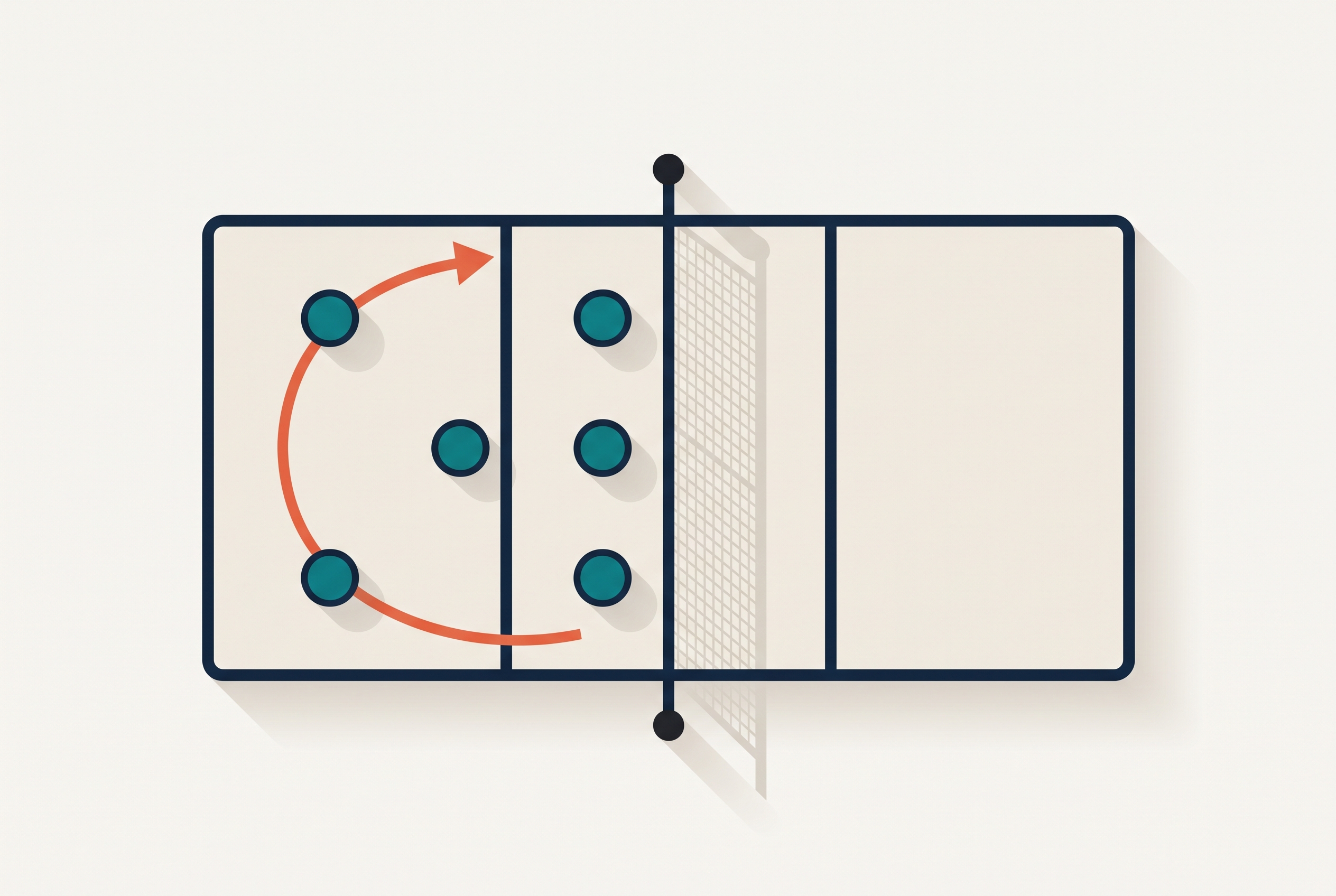
5-1 rotations — One setter sets in all six rotations; opposite hits right side.
Rotation 1
Rotation 2
Rotation 3
Rotation 4
Rotation 5
Rotation 6
Build this with your roster — free →
No login required
How Rotation Works: The One Rule Everything Hangs On
You rotate exactly once, one position clockwise, at exactly one moment: when your team wins the right to serve after the opponent served the previous rally. The player who moves from zone 2 to zone 1 becomes the new server. If your team is already serving and keeps winning rallies, nobody moves; the same server keeps serving. If you lose a rally while receiving, nobody moves either. That single trigger is the entire rule, and most youth-team confusion comes from players rotating on every point instead of only on the side-out win. The complete rulebook view, service order, positional faults, attack rights, and the libero, lives in our rotation rules guide.
The six zones are numbered counterclockwise from the server's corner: zone 1 is right back, 2 right front, 3 middle front, 4 left front, 5 left back, 6 middle back. Rotating "clockwise" means the player in 2 drops to 1, the player in 3 slides to 2, and so on, with the player in 1 walking across to 6. Front-row players (zones 2, 3, 4) may attack and block at the net; back-row players (1, 5, 6) may not complete an attack above net height in front of the attack line. That attack-rights difference is why every system on this page exists.
Position Is Not Zone: The Idea That Unlocks Everything
The rotation order fixes where players must stand at the moment of serve, not where they play the rally. The instant the ball is struck, everyone is free to move, and every organized team immediately switches: the setter releases to the target area, the outside hitter swings wide left, the middle crashes to the center of the net. A rotation "system" is nothing more than a plan for who stands where at contact so those switches are short and legal. (The roles themselves, who sets, who swings, who digs, are covered player by player in the volleyball positions guide.)
Legal is the operative word. Until the serve is contacted, each player must hold a lawful alignment relative to their neighbors: every front-row player needs part of a foot closer to the net than the teammate directly behind them, and every side player needs a foot closer to their sideline than the middle of their row. There are seven of these checks and none are diagonal. They are the source of nearly every alignment whistle in youth volleyball, and we cover all seven with diagrams in the overlap rule guide.
The Systems, Compared
Every named system answers one question: who sets, and from where? The name's first number is the count of attackers, the second the count of setters.
| System | Setters | Front-row hitters | Best for | Guide |
|---|---|---|---|---|
| 4-2 | 2, setting from the front row | 2 | Beginners, 10U to 12U; simplest legal alignments | 4-2 guide |
| 6-3 | 3, each setting two rotations | 2 to 3 | Rec and school teams that spread development | 6-3 guide |
| 6-2 | 2, setting from the back row | 3 in every rotation | Teams with two capable setters; 14U and JV | 6-2 guide |
| 5-1 | 1, setting all six rotations | 3 for half, 2 for half | One clearly best setter; 16U, varsity, college | 5-1 guide |
| 6-1 | 1, counted as a sixth attacker | 2 plus an attacking setter | A 5-1 whose setter genuinely scores | 6-1 guide |
| 5-2 | 2, one per half of the wheel | Varies | A niche bridge; usually a stepping stone | 5-2 guide |
The standard development ladder runs 4-2 (or 6-3) for beginners, 6-2 as setters learn to penetrate from the back row, then 5-1 once one setter separates from the pack. If you are choosing for a team right now: pick the 4-2 when your players are still learning zones, the 6-2 when two setters are close in ability, and the 5-1 when one setter is clearly better, because a consistent ball beats an extra hitter.
Serve receive deserves its own layer on top of whichever system you run. Where your passers stand, and how the setter hides inside a legal stack, changes rotation by rotation. The serve-receive formations guide charts the standard three-passer shapes, and the 5-1 and 6-2 walkthroughs diagram every rotation of the two systems that need it most.
From Understanding to Paper: Sheets and the Generator
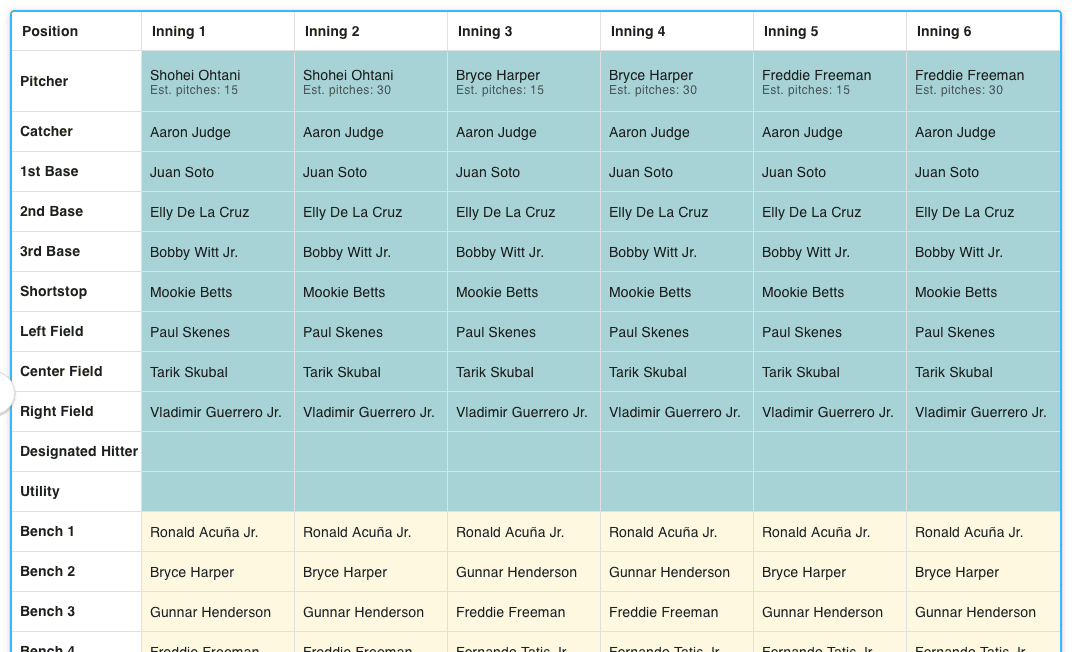
Knowing the wheel is half the job; game day wants documents. The rotation sheet is the six-diagram chart your bench reads, and the lineup sheet is the official service-order form the second referee collects before each set. They must agree with each other, and both derive mechanically from one row of six names.
The free rotation generator does that derivation for you: enter your six starters and a system, and it draws all six rotations, applies the libero pairing, flags any overlap violation in real time, and prints the sheet. It runs on the same rotation engine as the Rizzler coach app, with no login required. Coaches planning a full match inside Rizzler get the bigger version: the volleyball Game Manager builds the rotation plan alongside serve order, playing-time tracking, and a position-grouped depth chart, so the wheel you teach in practice is the wheel your assistant sees on the bench.
Teaching Rotations Without Losing a Week
Three field-tested shortcuts. First, teach service order before zones: have your six starters hold their lineup order in a circle and walk the wheel, because the order never changes and the zones follow from it. Second, give each player one landmark to check at serve, taken from the seven overlap constraints, rather than asking anyone to memorize the whole rule. Third, walk the full wheel twice at a practice session before your first match, once in base positions and once in serve-receive shapes, and keep rotation-teaching reps inside your warm-up block so they cost you five minutes, not a period. Rotation IQ is also a fair thing to score at tryouts: a player who knows where to stand saves you a season of whistles.
Frequently Asked Questions
When do you rotate in volleyball?
Only when your team wins a rally that the opponent served. All six players move one position clockwise and the player arriving in zone 1 serves. You never rotate while your own server keeps winning points, and you never rotate after losing a rally.
What are the 6 positions in volleyball rotation?
The zones run counterclockwise from the serving corner: 1 right back, 2 right front, 3 middle front, 4 left front, 5 left back, 6 middle back. Zones 2, 3, and 4 are the front row with full attack rights; zones 1, 5, and 6 are the back row.
Can players switch positions after the serve?
Yes. Alignment rules apply only at the moment of serve contact. After contact, players may go anywhere: setters release to target, hitters swing to their lanes, and back-row players cover. They must return to a legal alignment before the next serve.
What is an out-of-rotation violation?
A positional fault called when players are not in a lawful alignment at serve contact, either the wrong service order or an overlap between adjacent players. The rally is lost immediately and, if the fault was on the serving team, so is the serve. The seven alignment checks are diagrammed in our overlap rule guide.
Which rotation system should a youth team use?
Start with a 4-2, where the setter is always front row and never has to penetrate. Move to a 6-2 when two setters can run an offense from the back row, and to a 5-1 when one setter is clearly your best. The comparison table above links a full guide to each.
Does the libero rotate?
The libero replaces a back-row player, normally the middle, and follows that player's spot in the rotation order without ever rotating into the front row. When the replaced player's turn reaches the front row, the original player returns. The full mechanics are in our libero rotation guide; rules vary slightly by governing body, which the rotation generator handles automatically.
Is there a printable volleyball rotation chart?
Yes. The rotation sheet page has a printable chart for all six rotations, and the free rotation generator builds the chart from your actual lineup, checks it for overlap, and prints it.
Does volleyball rotate clockwise or diagonally?
Clockwise. When your team wins the serve back, every player moves one spot clockwise: the right-front player drops to right back to serve and the left-back player comes up to left front. Nothing moves diagonally in rotation; the diagonal idea comes from alignment, where players diagonal from each other in the order have no overlap relationship at all.
Talk to our team
Want to spend more time coaching and less time with paperwork? Let's talk.
Tell us about your team and we'll show you how to plan games, set lineups, run the schedule, and develop players in one place, so you spend the season coaching instead of chasing admin.
Less admin, more coaching
Plan games, set lineups, and track the season in one place
Keep every family in the loop automatically
Tell us about your program
4 fields · takes 30 seconds
Lands in the same inbox as the Help button · human response only
Read Next
How to Start a Travel Baseball Team
LearnVolleyball Setting Drills: Technique Work + Setter Training
VolleyballYouth Baseball Tournament Planning Checklist
BlogHow Do I Download the Rizzler iOS App?
FAQ12U Softball Practice Plan: A Complete 90-Minute Practice
LearnThe Coach's Guide to Quality At-Bats (QAB)
Stats