Rizzler Sports Logo
PricingFree Practice Planner
Basketball

Basketball Practice Plans You Can Run Tonight
A basketball practice plan is a timed sequence of blocks, each with one teaching point, that moves a team from individual skill work to live play inside the gym time you actually have. The three plans below are complete and runnable as written: a 60-minute youth practice for grades 3 through 6, a 90-minute middle school session, and a two-hour high school practice. Each one is built from the same curated drill modules that power the free basketball practice planner, so you can open any plan there, change the length, swap a block, and print a one-page coach sheet without retyping anything.
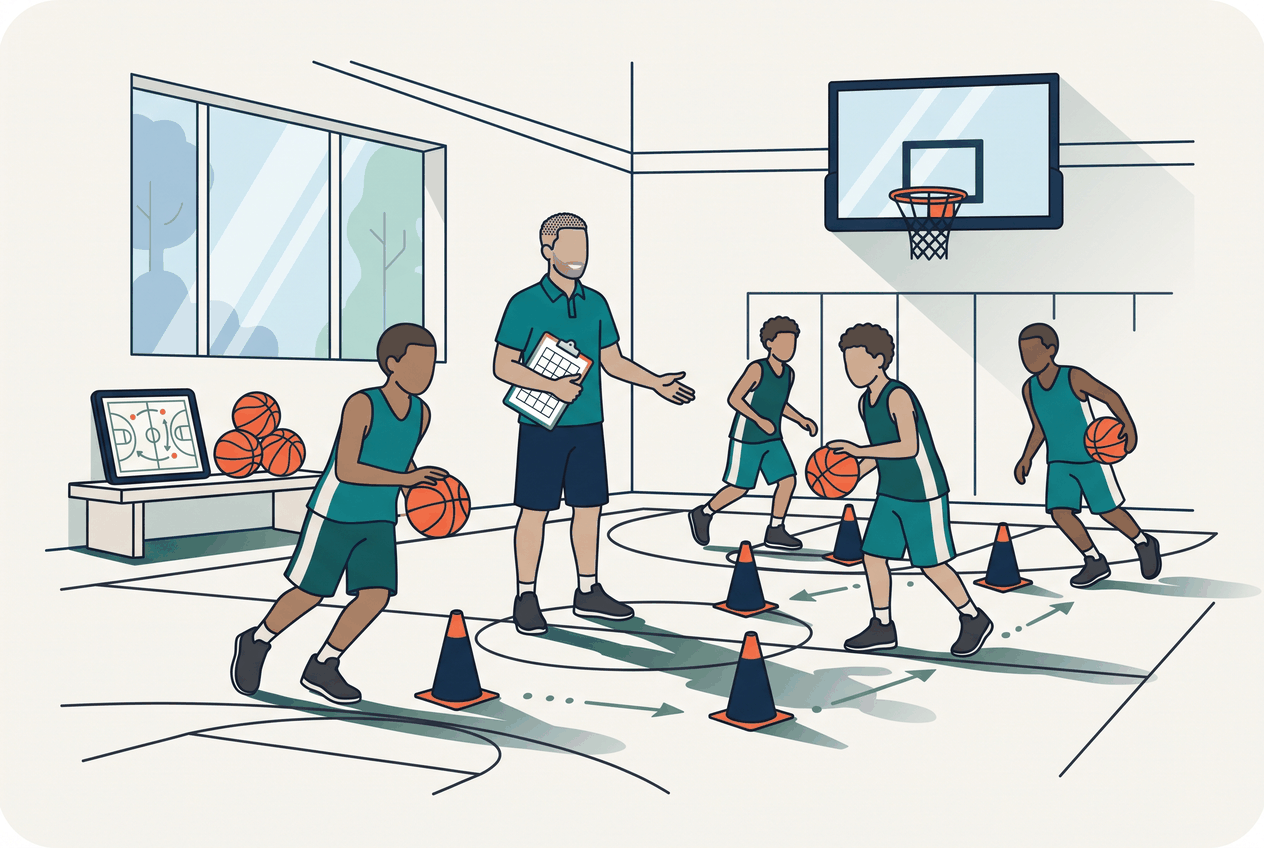
Youth basketball coach holding a clipboard with a timed practice plan while players run a ball handling circuit at three baskets

What Every Good Basketball Practice Plan Has in Common

Every effective basketball practice runs from touches to decisions: it starts with a ball in every hand, isolates one skill, puts that skill inside a team concept, and finishes with live play where the skill has to survive pressure. Conditioning is folded into the drills rather than tacked on at the end, because a team that runs the 3-man weave to layups at full speed for twelve minutes has already conditioned.
The structure that holds up across every age is five phases. An arrival block gets players touching the ball the moment they walk in, so the first ten minutes are not wasted on stragglers. A dynamic warm-up prepares hips, ankles, and shoulders for cutting and jumping. The core block, usually two or three segments, is where the night's focus lives: shooting, ball handling, defense, or transition. A conditioning segment, if you use one, comes late and short. A cooldown ends the practice at the free throw line, because free throws under fatigue are the only ones that matter in February.
Two rules govern the timing. First, one focus per night. A practice that tries to install an offense and fix defensive slides in the same session sharpens neither; the plans below each name their focus. Second, no line longer than four players. If eight kids are waiting to shoot at one basket, split the group and use the second basket, or run two drills at once. The station rotation format exists for exactly this problem.

Youth Basketball Practice Plan: 60 Minutes, Grades 3-6

The right youth practice is 60 minutes, every player has a ball for the first two thirds of it, and the scrimmage at the end is small-sided with a rule that rewards the skill you just taught. At this age the team concept is secondary; what matters is the number of quality dribbles, passes, and shots each player takes per practice, and how many of them happen with a defender nearby.
Basketball practice plan · 9-12 (3rd-6th grade, 8U-12U)

Youth Basketball Practice Plan (60 Minutes, Grades 3-6)

60 min · 6 segments

  1. 0:00

    8 min

    Dribble Tag Zone

    Everyone dribbles inside a zone and tries to tag others while protecting their own ball; scales to any headcount.

    Arrival
  2. 0:08

    8 min

    Dynamic Warm-Up Baseline Lines

    Baseline-to-baseline dynamic movement series that ends with defensive slides and closeouts, ball-free.

    Warm-Up
  3. 0:16

    12 min

    Ball Handling Circuit

    Four-station handle circuit: stationary two-ball, cone weave, change-of-direction moves and full-speed finishing.

    Core
  4. 0:28

    12 min

    Form Shooting Progression

    Close-range form shots that step out to game spots, every player shooting or rebounding, tracked by makes.

    Core
  5. 0:40

    14 min

    3v3 Scrimmage: Score Off a Pass

    Reduced-numbers scrimmage with a single constraint so every player gets maximum touches and decisions.

    Core
    Universal
  6. 0:54

    6 min

    Huddle: Wins & One Thing

    Two-minute huddle: each player names a win and one thing to fix, coach previews the next practice.

    Cooldown

Equipment: basketballs (1 per player), 4-8 cones, none (cones optional), basketballs (1-2 per player), 12-16 cones, chairs optional, basketballs (1 per 2 players), tape or cones, sport balls, cones or boundary markers, pinnies, none

Change the length, swap modules for your age group, print a one-page coach sheet, and share it by link. No login.

Customize this plan free →Save to my account
The plan opens with Dribble Tag, which is a warm-up disguised as a game and gets nine-year-olds dribbling with their heads up because they are looking for the tagger. The ball handling circuit and form shooting progression are the skill block. Form shooting at this age means one-hand shots from three feet, not three-pointers, and the coaching point is the wrist finish, not the result. The 3v3 scrimmage counts baskets only when the shot comes off a pass, which is how you make ten-year-olds pass without telling them to. Rotate the groups every three minutes so nobody sits longer than they play. The youth practice plan page has a second plan for grades K-2 and the specifics of what to skip below third grade.

Middle School Basketball Practice Plan: 90 Minutes

A 90-minute middle school practice is where team defense enters the plan for the first time, and the session below spends 20 of its minutes on the shell drill because help and recover is the single concept that separates a seventh-grade team that competes from one that watches the ball.
Basketball practice plan · 13-15 (middle school, 7th-9th)

Middle School Basketball Practice Plan (90 Minutes)

90 min · 7 segments

  1. 0:00

    10 min

    Arrival Form Shooting Spots

    Players shoot one-hand form shots from taped spots as they trickle in, partner rebounds, no coach needed.

    Arrival
  2. 0:10

    10 min

    Dynamic Warm-Up Baseline Lines

    Baseline-to-baseline dynamic movement series that ends with defensive slides and closeouts, ball-free.

    Warm-Up
  3. 0:20

    15 min

    Ball Handling Circuit

    Four-station handle circuit: stationary two-ball, cone weave, change-of-direction moves and full-speed finishing.

    Core
  4. 0:35

    12 min

    3-Man Weave to Layups

    Three-player full-court weave finishing with a layup, then a 2v1 back; classic passing-and-finishing block.

    Core
  5. 0:47

    20 min

    Shell Drill: Help & Recover

    The classic 4v4 shell: ball pressure, one pass away denial, help side positioning, then live on the whistle.

    Core
  6. 1:07

    15 min

    Transition 3v2 to 2v1

    Continuous 3v2 one way and 2v1 back; teaches numbers advantage, lane filling and getting back.

    Core
  7. 1:22

    8 min

    Free Throws & Stretch

    Tired-legs free throws in pairs with a team consequence, then a guided static stretch.

    Cooldown

Equipment: basketballs (1 per pair), tape or 5 cones per basket, ball rack, none (cones optional), basketballs (1-2 per player), 12-16 cones, chairs optional, basketballs (1 per 3 players), basketballs, cones optional for help line, basketballs (2)

Change the length, swap modules for your age group, print a one-page coach sheet, and share it by link. No login.

Customize this plan free →Save to my account
Arrival form shooting spots put players at five spots around the key the moment they walk in, which quietly adds 50 to 80 shots per player per week. The 3-man weave to layups is the transition from skill work to team work: it demands passing on the move, full-speed finishing, and communication, and it conditions without anyone calling it conditioning. The shell drill installs the four-player defensive positions (on ball, one pass away in denial, two passes away in help) and the recover rotation when the ball is reversed. Transition 3v2 to 2v1 teaches numbers-advantage decisions, which is where middle school games are actually won. Free throws and stretch close the practice with tired legs at the line, the way the fourth quarter will feel.

Ready to take your game to the next level?

High School Basketball Practice Plan: 120 Minutes

A two-hour high school practice needs three things the shorter plans do not: an offense install block with walkthrough reps, a 5v5 situations block that rehearses end-of-game scenarios with the clock, and a conditioning segment that is short, measured, and separate from the skill work so effort in the drills is never a question.
Basketball practice plan · 16-18 (high school, JV, varsity)

High School Basketball Practice Plan (120 Minutes)

120 min · 10 segments

  1. 0:00

    10 min

    Arrival Form Shooting Spots

    Players shoot one-hand form shots from taped spots as they trickle in, partner rebounds, no coach needed.

    Arrival
  2. 0:10

    10 min

    Dynamic Warm-Up Baseline Lines

    Baseline-to-baseline dynamic movement series that ends with defensive slides and closeouts, ball-free.

    Warm-Up
  3. 0:20

    6 min

    Partner Passing Series

    Chest, bounce, overhead and one-hand push passes in pairs, then on the move; gets hands ready with zero lines.

    Warm-Up
  4. 0:26

    10 min

    Form Shooting Progression

    Close-range form shots that step out to game spots, every player shooting or rebounding, tracked by makes.

    Core
  5. 0:36

    12 min

    Closeout 1v1

    Defender rolls the ball out, closes out under control and plays live 1v1 to a stop; two lines max.

    Core
  6. 0:48

    20 min

    Shell Drill: Help & Recover

    The classic 4v4 shell: ball pressure, one pass away denial, help side positioning, then live on the whistle.

    Core
  7. 1:08

    20 min

    Offense Walkthrough & Reps

    Install or refine a set or motion offense: 5v0 walk, 5v0 speed, then 5v5 with guided defense.

    Core
  8. 1:28

    20 min

    5v5 Situations

    Scripted game situations from the whistle: last shot, down 3 with 20 seconds, press break after a make.

    Core
  9. 1:48

    8 min

    17s & Line Touches

    Sideline-to-sideline 17s and baseline line touches with recovery, done with a ball in hand for older groups.

    Conditioning
  10. 1:56

    4 min

    Huddle: Wins & One Thing

    Two-minute huddle: each player names a win and one thing to fix, coach previews the next practice.

    Cooldown

Equipment: basketballs (1 per pair), tape or 5 cones per basket, ball rack, none (cones optional), basketballs (1 per 2 players), tape or cones, basketballs (1 per basket), basketballs, cones optional for help line, whiteboard, pinnies, scoreboard or whiteboard, stopwatch, basketballs for the dribbling variant, none

Change the length, swap modules for your age group, print a one-page coach sheet, and share it by link. No login.

Customize this plan free →Save to my account
The first 36 minutes are individual: arrival shooting, dynamic warm-up, partner passing, and form shooting progression, which for high school players means game-speed catch-and-shoot from the spots your offense creates. Closeout 1v1 is the defensive fundamental for the whole practice: sprint, chop the feet, high hand, contain. The shell drill follows so the closeout technique lives inside the team scheme. Twenty minutes of offense walkthrough and reps is enough to install one set or one action per practice; trying to install three is how teams end up running none of them cleanly. 5v5 Situations puts the night's work under the clock: down three with 40 seconds, up two with a foul to give, inbounding against pressure. The 17s finish is eight minutes of measured conditioning with a standard the players know, and the huddle names one thing each player will do better tomorrow.

Middle School and High School: Why the Plan Changes at 13

The plan changes at 13 because the players can now hold a team concept in their heads for more than one possession, so practice time shifts from individual touches toward defensive scheme, offensive structure, and situational play. Under 13, roughly 70 percent of practice is individual skill work and small-sided play; from 13 up, that share drops toward 40 percent, and the shell drill, offense install, and 5v5 situations take the rest.
The other change is intensity and accountability. Middle school and high school players can run a 20-minute defensive block at game speed and be held to a conditioning standard. What does not change is the free throw line at the end and the one-focus rule. A varsity practice that tries to fix everything still fixes nothing. The free planner filters the module library by grade level, so a 13-15 or 16-18 plan only shows the modules built for that age, including the two team-period modules (5v5 Situations and Offense Walkthrough) that do not appear for younger groups.

Build Your Own Basketball Practice Plan

Open the free basketball practice planner, pick 60, 90, or 120 minutes and a grade level, and drag curated basketball modules onto the timed timeline; the duration meter shows when the plan is over, and every module carries its own coaching points and equipment list. Print the one-page coach sheet or share the plan by link. No login is required. Any plan on this page opens in the planner with its blocks already loaded through the "Customize this plan" button beneath it.
When you want the plan attached to a real practice on your schedule, with RSVP counts on the summary bar, station assignments for your assistants, and the equipment list assembled from the drills, save it to a free Rizzler account and it lands in Practice Manager with every module unlocked. The practice planner overview covers what the full product does for a season.
The tryout guide covers the two weeks before the first practice, and Rizzler Reps gives players at-home ball handling and shooting reps between practices, so the ten minutes you spend on stationary dribbling can shrink as the season goes on.

Frequently Asked Questions

How long should a basketball practice be?

Sixty minutes for grades 3 through 6, 75 to 90 minutes for middle school, and 90 to 120 minutes for high school. Younger players lose focus after about an hour no matter how good the plan is, and a 60-minute practice with a ball in every hand produces more skill development than a 90-minute practice with lines. High school teams need the extra time for offense installation and situational play, not for more drills.

What should a youth basketball practice plan include?

A ball for every player, a warm-up that is a game, one skill focus taught in a circuit or station format, a small-sided scrimmage with a rule that rewards that skill, and a short huddle at the end. It should not include laps, full-court 5v5, plays, or any line longer than four players. The youth basketball practice plan has two complete sessions, for grades 3-6 and K-2.

How do you structure a 90-minute basketball practice?

Ten minutes of arrival shooting, ten minutes of dynamic warm-up, 15 minutes of ball handling, 12 minutes of a full-court passing and finishing drill, 20 minutes of team defense, 15 minutes of transition offense, and eight minutes of free throws and stretching. That is the middle school plan above, and it can be opened and edited in the free planner.

How many drills should be in a basketball practice?

Five to seven blocks, with two or three of them carrying the night's focus. More than seven blocks in 90 minutes means each one is too short to teach anything; fewer than five means players are standing in one drill too long. The right count depends on the plan length, which is why the free planner shows a duration meter as you add modules.

Can I print a basketball practice plan?

Yes. Every plan built in the free basketball practice planner prints as a one-page coach sheet with a time column, every segment, the coaching points, and the equipment list, without an account. The basketball practice plan template is a blank printable version with a filled example for coaches who plan by pencil.