
Basketball
Basketball Stat Sheet (Free Printable PDF + Excel)
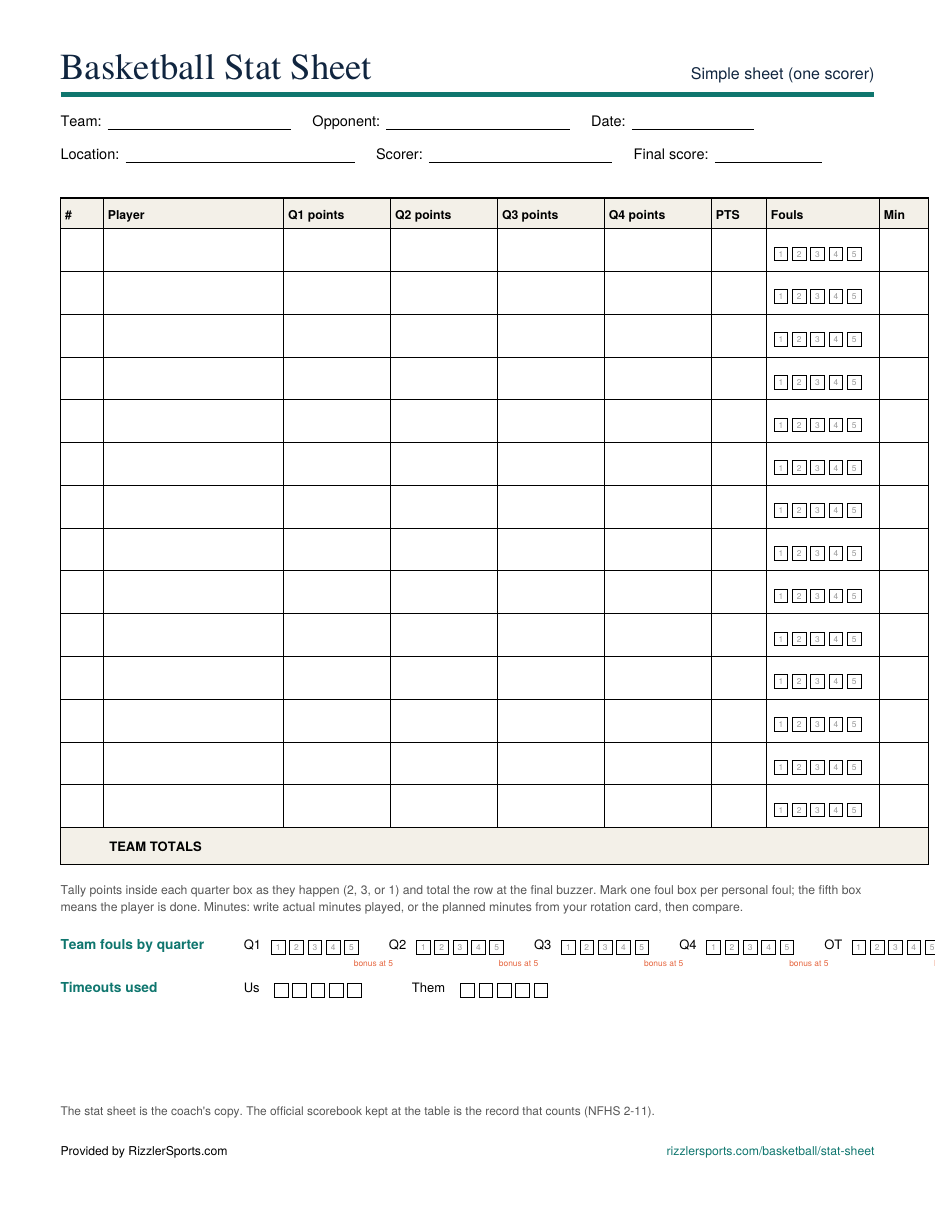
A basketball stat sheet is a one-page grid, one row per player, where a bench helper tallies the seven things that explain a youth game: points (split into twos, threes and free throws), rebounds, assists, steals, blocks, turnovers and fouls, plus the minutes each kid played. It is the coach's copy, not the official record; the official scorebook at the table is the only book that counts under NFHS rules, and the stat sheet exists so the coach can see on Sunday why Saturday went the way it did. The sheet on this page comes as a printable PDF (a simple one-scorer sheet, a full two-helper sheet, and a filled example from a 10U game) and an Excel template that totals points and rebounds automatically and rolls each game into a season tab.
Download the Basketball Stat Sheet
PDFDownload the printable PDF
Three pages: a simple sheet one parent can keep (points by quarter, fouls, minutes), a full landscape sheet with the complete stat line for two helpers, and the full sheet filled in from a real 10U game so you can see what a finished one looks like.
ExcelDownload for Excel
A Game tab where you enter made and attempted shots and the counting stats and the sheet calculates points, field goal percentage, total rebounds and team totals; a Season tab that collects up to 12 games per player with per-game averages; and an Abbreviations tab.
For Google Sheets, upload the Excel file to Drive and open it; the formulas carry over. Both files are free, no email or account.
What Is on the Sheet, Column by Column
The full sheet has fifteen columns and every one of them earns its space. Shooting is written as made-attempted (M-A) for twos, threes and free throws because the attempts are the stat that changes coaching; a player who is 1 for 9 and a player who is 1 for 2 both scored two points, and only one of them needs a conversation about shot selection. Points calculate from the makes. Rebounds are split into offensive and defensive because at the youth level offensive rebounds are effort and defensive rebounds are positioning, and you coach those two things differently.
| Abbreviation | What it counts | How to tally it |
|---|---|---|
| 2PT M-A | Two-point shots made and attempted | A tick per attempt, circle the makes, write the pair at the quarter break |
| 3PT M-A | Three-point shots made and attempted | Same; many youth leagues have no three-point line, so leave it blank |
| FT M-A | Free throws made and attempted | Same; every trip to the line is an attempt |
| PTS | Points | 2 x twos made + 3 x threes made + free throws made |
| OREB / DREB | Offensive and defensive rebounds | A tick when the player ends up with a missed shot |
| REB | Total rebounds | OREB + DREB |
| AST | Assists | The pass that led directly to a made basket; one per basket at most |
| STL | Steals | Took the ball from the other team, including a deflection the player recovered |
| BLK | Blocks | Deflected a shot attempt |
| TO | Turnovers | Lost the ball without a shot: bad pass, travel, double dribble, stolen, offensive foul |
| PF | Personal fouls | One box per foul; the fifth box means the player is done under NFHS rules |
| MIN | Minutes played | Actual minutes, or the planned minutes from the rotation card, then compare |
The simple sheet drops the shooting split and the counting stats and keeps only what a single parent can track without missing the game: points by quarter, a total, fouls and minutes. That is the sheet most rec benches should print. Nobody has ever regretted tracking fewer stats accurately.
Simple Sheet or Full Sheet
Print the simple sheet when one person is keeping it, which is most rec and 8U to 10U benches. Print the full sheet when you have two helpers and a reason to care about the line: a travel team, a middle school or high school program, or a rec team whose coach wants to know who is actually rebounding. One person cannot keep the full sheet. They will keep points for two quarters, give up on turnovers in the third, and hand you a sheet with holes in it, which is worse than the simple sheet kept all the way through.
With two helpers, split the sheet by family of stat, not by team. One helper owns shooting and points: every attempt gets a tick the moment the ball leaves the hand, makes get circled, and the running PTS column gets checked against the official book at every stoppage. The other helper owns rebounds, assists, steals, blocks, turnovers and fouls. The fouls column is the one that matters most live, because a player with four fouls needs to come out before the fifth, and a parent with the sheet will see it before the coach does.
How to Keep Stats During a Basketball Game
Before tip-off, write every player's name and number on the sheet in the order the coach calls them, starters first, and put the planned minutes in pencil next to each name if the coach built a rotation. During the game, tally only at dead balls; nothing on this sheet needs to be recorded while the ball is live, and a helper who watches the possession and then records it gets it right far more often than one writing while watching. At every timeout and quarter break, add the PTS column and compare it with the official scorebook. If they disagree, the official book wins (NFHS 2-11), and the fix is to find the basket you credited to the wrong player, not to argue with the scorer.
After the game, total every column, check the identity that catches most errors (team points should equal 2 x twos made + 3 x threes made + free throws made), and check that minutes add up to the game length times five. In a 4 x 8 minute game that is 160 player-minutes. If you are short, a substitution was missed; if you are over, someone was credited twice.
The tally convention that works for youth games: a short vertical tick for an attempt, circle it when it goes in, a diagonal slash for every counting stat, and a cross in the next empty foul box. Avoid shorthand that only the person holding the clipboard understands, because the sheet gets handed to a different parent next week.
Reading the Sheet After the Game
Three numbers on a youth stat sheet are worth the coach's time, and none of them is a player's point total. The first is shot attempts by player, because a 10-player team where two players took 25 of 40 shots has a ball-movement problem that the score hides when the team wins. The second is turnovers, which at 8U through 12U are the single biggest driver of the final score and the thing practice can fix fastest. The third is minutes, which is the fairness check, and the one a parent will ask about.
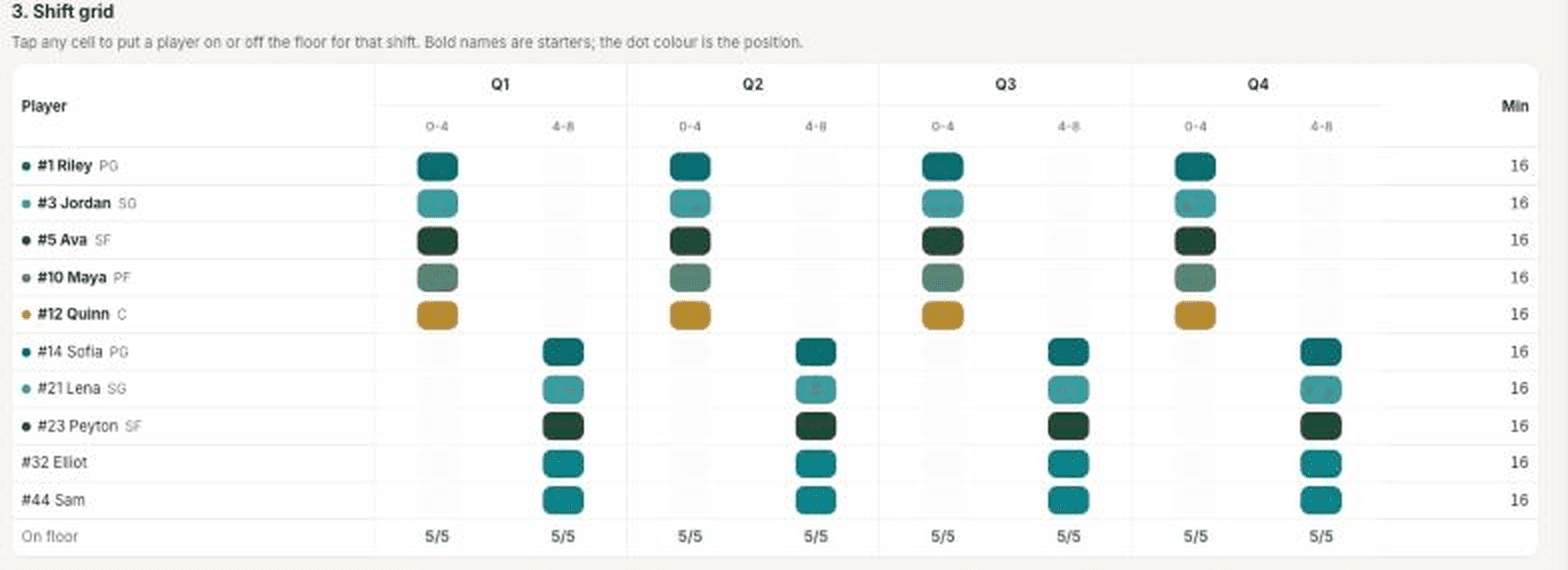
Here is the filled example from the PDF, a 10U rec game with a ten-player roster and 4 x 8 minute quarters. The team won 40-33, shot 17 for 41 from the field and 6 for 11 from the line, had 11 offensive rebounds and 18 turnovers, and every player logged 16 minutes because the coach planned the rotation before the game with equal playing time and ran it. The 18 turnovers are the Monday practice. The 16-minutes-each column is why no parent emailed on Sunday.
| Player | 2PT M-A | FT M-A | PTS | REB | AST | TO | PF | MIN |
|---|---|---|---|---|---|---|---|---|
| #1 Riley | 3-6 | 1-2 | 7 | 3 | 3 | 2 | 2 | 16 |
| #5 Ava | 4-7 | 2-4 | 10 | 6 | 0 | 1 | 3 | 16 |
| #12 Quinn | 2-3 | 1-2 | 5 | 5 | 0 | 1 | 4 | 16 |
| #32 Elliot | 0-2 | 0-0 | 0 | 2 | 1 | 3 | 1 | 16 |
| Team (10 players) | 17-41 | 6-11 | 40 | 32 | 10 | 18 | 18 | 160 |
Quinn's four fouls in 16 minutes is the other line to notice. The sheet shows it; the coach has to decide whether the fourth foul means fewer minutes next game or a conversation about reaching in.
Stat Sheet, Score Sheet, or Scorebook
The three documents get confused because they overlap on points. The basketball score sheet is the game record: running score, each player's points and fouls, team fouls by quarter, timeouts. It is what the official scorer keeps, and what a parent keeps as a shadow book. The scorebook is the bound version of the score sheet with the official symbols, and the how-to on that page covers the symbol set. The stat sheet is the player record: everything the score sheet does not track (attempts, rebounds, assists, steals, blocks, turnovers, minutes). A bench that keeps a score sheet and a stat sheet has the game and the players both covered; a bench that keeps only a stat sheet has no record the referee will accept.
Minutes: Plan Them Before, Confirm Them After
The MIN column is the one that connects the stat sheet to the rest of the week. Write the planned minutes in before the game and the actual minutes after, and the difference is your substitution discipline in one number. The free basketball rotation generator builds the plan: enter the roster, pick the game format and equal or starters-weighted playing time, and it produces a shift-by-shift chart with each player's planned minutes and a printable rotation card for the bench. The basketball playing time page has the minutes-per-player math by roster size and format, and the printable rotation chart page has ready-made charts for 7 to 12 players if you would rather not enter names.
Save a rotation to a free Rizzler account and it lands in Game Manager, where the planned minutes from every game collect in one playing-time view across the season. That is the view to open before a parent meeting. Rizzler does not score basketball games or track live stats yet; the stat sheet on this page is still the way to keep the stat line, and the rotation plan is the part Rizzler carries.
Frequently Asked Questions
Is the basketball stat sheet free?
Yes. The PDF and the Excel file both download directly from this page with no email or account. Print as many copies as the season needs.
What stats should a youth basketball coach track?
Points split into twos, threes and free throws (made and attempted), rebounds, assists, steals, blocks, turnovers, fouls and minutes. If one person is keeping the sheet, track points, fouls and minutes only; those three decide most youth coaching conversations, and a sheet kept accurately beats a longer sheet with gaps.
What is the difference between a stat sheet and a scorebook?
The scorebook (or score sheet) is the official game record: running score, each player's points and fouls, team fouls and timeouts, kept at the scorer's table. The stat sheet is the coach's player record: shot attempts, rebounds, assists, steals, blocks, turnovers and minutes. Only the scorebook counts in a dispute under NFHS rule 2-11.
How do you track minutes played in basketball?
Write the planned minutes next to each player before the game from your rotation card, then mark actual minutes as substitutions happen at dead balls. Check the total afterward: it should equal the game length in minutes times five (160 for 4 x 8 minute quarters). A rotation generator makes the planned column automatic.
Does the Excel stat sheet work in Google Sheets?
Yes. Upload the file to Google Drive and open it with Sheets; the points, rebound and season-average formulas carry over without changes.
What is a good stat line for a 10 year old?
There is no useful benchmark, because youth rosters, game lengths and leagues vary too much for per-game numbers to mean anything across teams. Compare a player with their own earlier games instead: more attempts with fewer turnovers over a month is development, and that is what the Season tab in the Excel file is for.
Read Next
How to Plan a Youth Baseball Tournament Weekend
LearnRoster Management: Organize Your Baseball Team
FeaturesVolleyball Stat Sheet: Printable Template a Parent Can Keep
VolleyballHow to Share a Team Schedule With Parents
LearnStrike Percentage: The Youth Pitching Development Stat
StatsEarned Run Average (ERA): Definition, Formula & Youth Context
Stats