
Basketball
How to Keep a Basketball Scorebook
A basketball scorebook tracks four things: the running score, each player's points and fouls, the team fouls in each period, and the timeouts each team has used. Under high school rules the official scorer keeps it at the table, and when the book and the scoreboard disagree, the book wins and the referees settle it (NFHS Rule 2-11). Keeping it well is not hard, but it is a job with a deadline, a symbol set, and three or four traps that catch every new table volunteer in the first quarter. This page walks through all of it, with a filled page and a one-page cheat sheet you can keep beside the book.
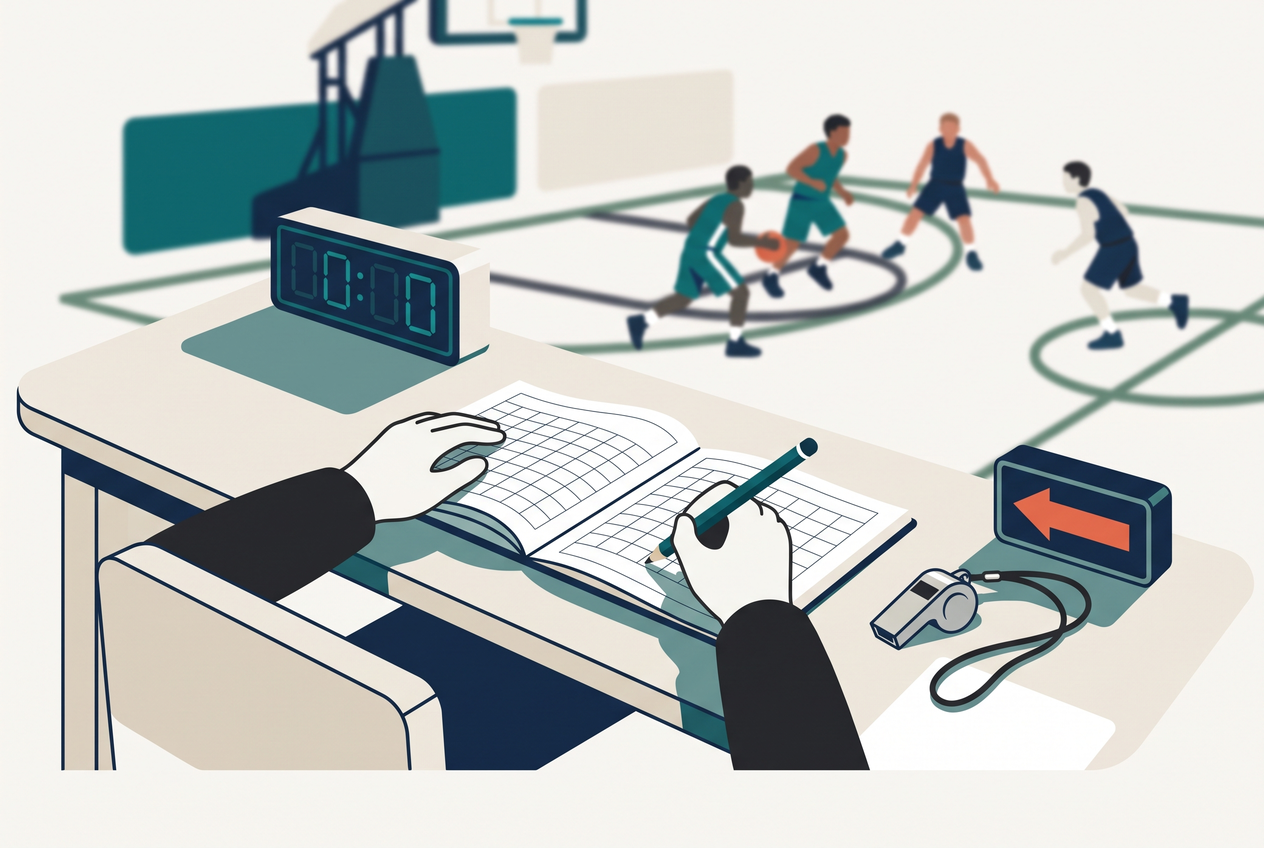
Before Tip-Off: The 10-Minute Rule
Both teams must have their roster and five starters in the official book at least 10 minutes before the scheduled start (NFHS 3-2-1 and 3-2-2). A late list, or a starter changed after that moment, is an administrative technical foul charged to the team, with a cap of one such foul per team no matter how many infractions follow (NFHS 10-1-1 and 10-1-2). The only free changes to a starter after the deadline are forced ones: an injury or illness, illegal equipment, or shooting a technical-foul free throw before the game (NFHS 3-2-2a).
As the scorer, the routine is short. Write the date, site, level, both team names, and the referees' names in the header. Enter the home team on the upper half of the page and the visitors on the lower half, in jersey-number order, with the starters marked (most books use an asterisk or a circled number). Confirm that every number in the book is a number you can see on a jersey: NFHS 3-4-3 allows only the digits 0 to 5, one or two digits, and a team may not list both 0 and 00. Then put your own name in the scorer box. The sheet coaches hand you to make this fast is the scorebook lineup sheet; it carries exactly the fields you need and nothing else.
The Symbols
Every book uses the same handful of marks. Write them the same way every time, because the person reading the book after the game may not be you.
| Mark | Where it goes | Meaning |
|---|---|---|
| 2 | Player's points column for the period | Two-point field goal |
| 3 | Player's points column | Three-point field goal |
| 1 | Player's points column | Free throw made |
| 0 | Player's points column | Free throw missed (the book records the attempt) |
| X in P1 to P5 | Player's foul boxes | One personal foul; the fifth disqualifies |
| T in the next P box | Player's foul boxes | Technical foul: counts as a personal and a team foul |
| X in the period row | Team fouls | One team foul in that period |
| Slash through the next number | Running score strip | One point scored |
| Vertical bar after a number | Running score strip | End of a period |
| Slash in the period box | Player's row | Player entered the game in that period |
| TO with the period number | Timeout boxes | Timeout used, and when |
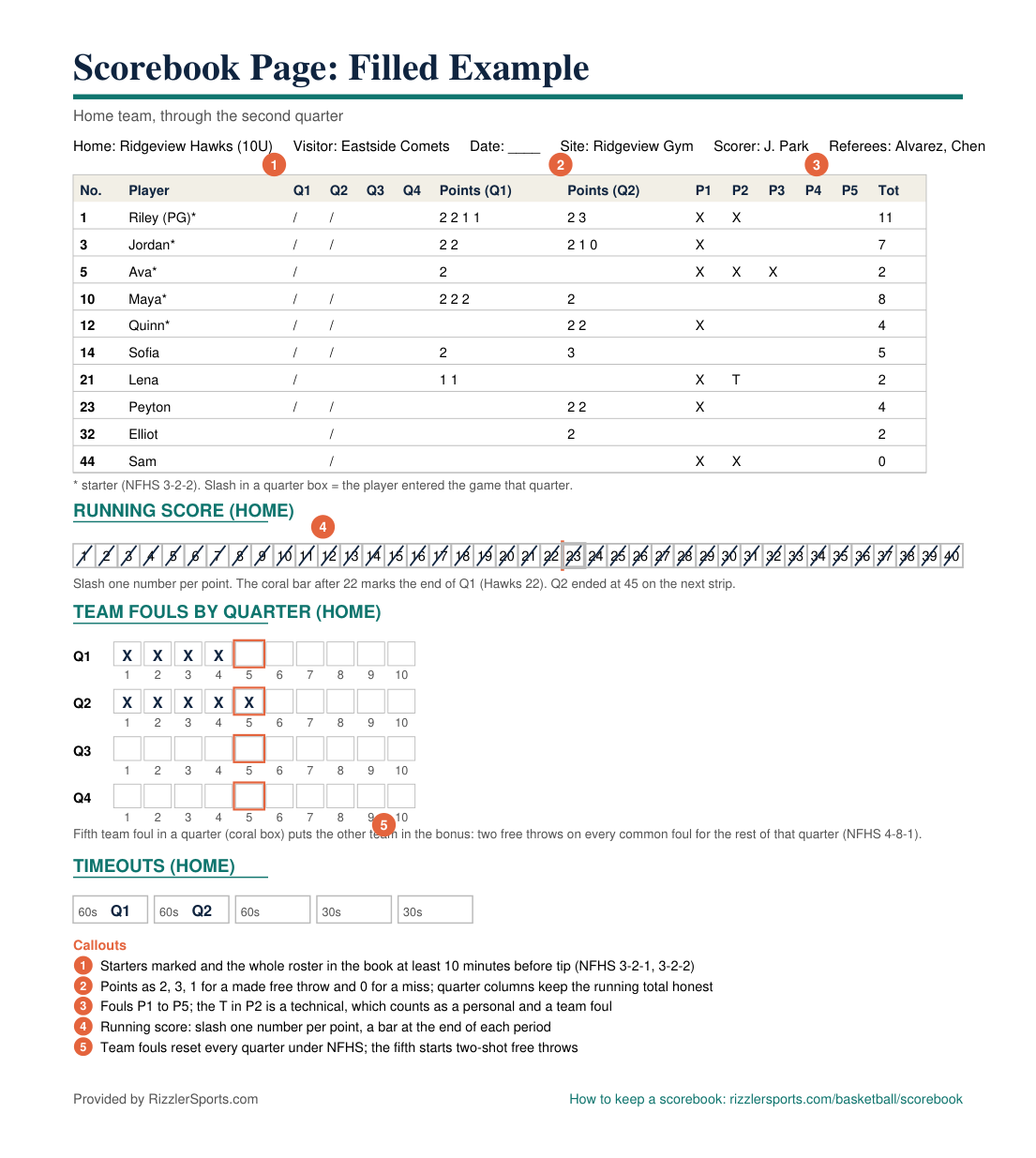
The example above is the home team through halftime. Read it the way a referee would: Riley has 11 points (2, 2, 1, 1 in the first quarter and 2, 3 in the second) and two fouls; Lena's second foul is a technical, so it sits in her P2 box as a T and also put an X in the team-foul row; the running score crosses 22 with a bar for the end of the first quarter; the team-foul row hit five in the second quarter, which means the Comets shot two free throws on every common foul for the rest of that period.
Keeping the Running Score
Every time a team scores, slash the next unslashed number on that team's strip: a two-point basket crosses two numbers, a three crosses three, a free throw crosses one. At the end of each period draw a bar after the last slashed number and copy the period total into the score-by-period box. Then, at every stoppage, read the last slashed number against the scoreboard. If the two disagree, raise it with the nearest official at the next dead ball rather than quietly "fixing" the book; the referee corrects the scoreboard to match the book, not the other way round.
The drift that bites most tables comes from doing the player column first and the running strip second. Do the strip first, because the strip is what the referee asks for; the player column can be caught up during the next free throw.
Fouls, Bonus, and the Period Reset
A personal foul gets an X in the player's next P box and an X in the team's period row. At the fourth personal, tell the coach and the nearest official; at the fifth, the player is disqualified and the official will want to know immediately. A technical foul on a player gets a T in the next P box and counts toward the team total; a technical charged to the coach or bench adds a team foul but no personal foul, so note it in the margin.
The bonus is where the rule sets diverge, and it is the one thing the scorer must announce without being asked.
| Rule set | Team fouls counted | Bonus free throws |
|---|---|---|
| NFHS (high school) | Per quarter, reset at the end of each quarter | Two free throws on every common foul from the fifth team foul of the quarter (4-8-1) |
| NCAA men | Per half | Traditionally one-and-one from the seventh team foul and two shots from the tenth; the NCAA has experimented with dropping the one-and-one, so check the current book |
| NCAA women | Per quarter | Two shots from the fifth team foul |
| FIBA | Per quarter | Two shots from the fifth team foul |
| Youth leagues | Varies; many adopt NFHS, some play no bonus | Check the league rule sheet before the first game |
High school dropped the one-and-one a few seasons ago and moved to the quarter reset, so if you learned the book under the old rules, the two things to relearn are that the count starts over every quarter and that the fifth foul sends the shooter to the line for two. Tell the official when a team reaches four, so nobody is surprised at five.
Timeouts and the Possession Arrow
High school teams get three 60-second and two 30-second timeouts per game, plus one extra 60-second timeout for each overtime period; unused timeouts carry into overtime (NFHS 5-11). Mark each one in the team's timeout box with the period it was used in, and tell the coach when a team is down to one. The possession arrow belongs to the scorer's table too: set it toward the team that did not control the opening tip, and flip it every time it is used for a held ball or a period start.
Substitutions and Playing Time in the Book
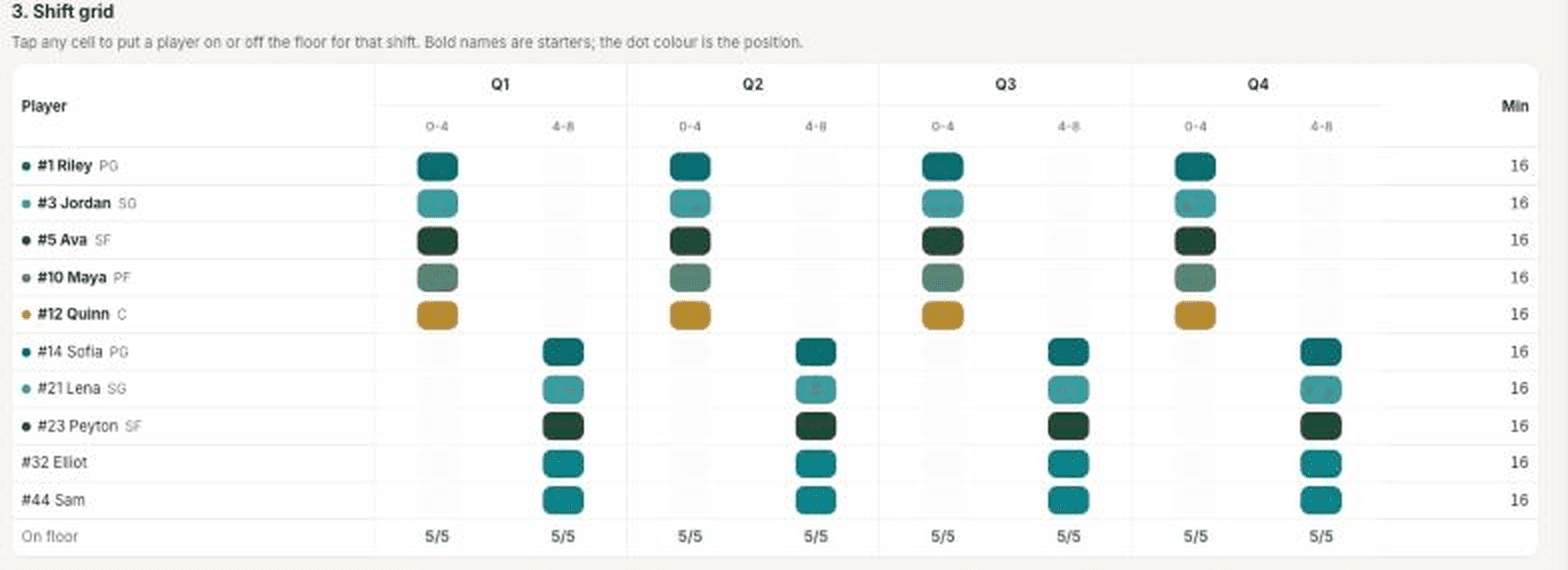
A substitute reports to the table, you note the number, and the official beckons the player in at a dead ball. Many books carry a small period box next to each player; slashing it when the player first enters that period is how youth leagues verify minimum-play rules after the fact, so do it even if nobody has asked you to. Coaches who want the book to match their plan hand the table a printed rotation card before the game: the free basketball rotation generator builds one with equal or starters-weighted minutes by period, and the playing time page explains how to read league minimum-play rules against it.
When the Book and the Scoreboard Disagree
The book is the official record; the scoreboard is a convenience. If the home book and the visiting book disagree with each other, the officials decide, and the home book is normally treated as official (NFHS 2-11-11 covers the scorer's duties and the correction process). The fix is procedural, not personal: stop at the next dead ball, show the official the strip, and let them rule. Most disputes trace to a free throw credited to the wrong player or a three recorded as a two, which is why the per-player points column has to add up to the running score at every period break.
Where the Rules Differ by Level
The symbols are the same at every level, but four things change: when team fouls reset (quarter or half), what the bonus awards, how many timeouts a team has, and how many personal fouls disqualify a player (five under NFHS, NCAA, and FIBA; six in the NBA). Youth leagues add their own layer, often a running clock, no bonus, segment play with mandatory substitutions, or a scorer who is also the clock operator. Ask the league for its rule sheet, write the differences on the inside cover of the book, and keep the printable cheat sheet at the table so the next volunteer does not have to learn it live.
Downloads
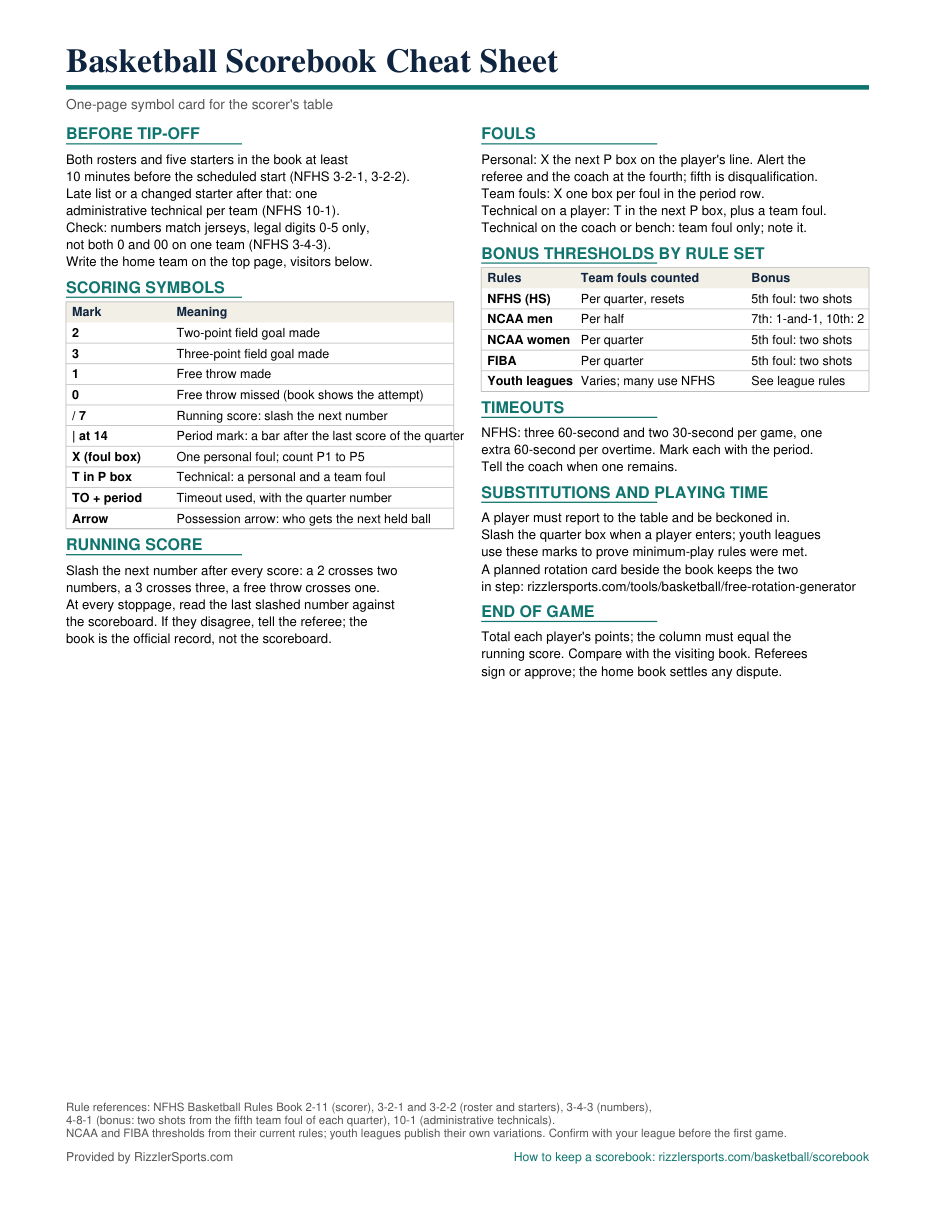
PDFDownload the scorebook cheat sheet (PDF)
One page for the scorer's table: the 10-minute roster rule, every symbol, running score, fouls and bonus thresholds for NFHS, NCAA, and FIBA, timeouts, substitutions, and the end-of-game check.
The blank sheets live on their own pages: the printable basketball score sheet in a simple youth layout and an official-format layout, and the scorebook lineup sheet coaches hand the table before the 10-minute deadline. If your bench wants rebounds, assists, and steals as well, that is a stat sheet, kept separately from the official book.
Running the Table at a Tryout or Scrimmage
The same book works for an intrasquad scrimmage at a tryout, where the point is to see who scores and who fouls when the drills end and the game starts. The basketball tryout guide covers how to staff the table and the stations around it, and scoring the scrimmage in a book gives evaluators something to check their station scores against.
Frequently Asked Questions
Who keeps the official basketball scorebook?
The home team's scorer is the official scorer under NFHS rules, and the visiting team usually keeps a second book. The official scorer records the roster, starters, field goals, free throws made and missed, the running score, personal and technical fouls, team fouls, and timeouts, and alerts the officials at the fourth and fifth personal foul, the fifth team foul in a quarter, and when a team's timeouts run out.
What happens if the two scorebooks disagree?
The officials decide, and the home book is normally the official record. Stop at the next dead ball, show the official both running-score strips, and let them rule. The per-player points column should equal the running score at every period break, which is the fastest way to find where a book went wrong.
How many team fouls before the bonus in high school basketball?
Five in a quarter under NFHS rules. From the fifth team foul of each quarter, every common foul sends the shooter to the line for two free throws, and the count resets at the end of each quarter. NCAA men count per half (traditionally a one-and-one from the seventh foul and two shots from the tenth, with recent experiments dropping the one-and-one); NCAA women and FIBA use the fifth foul of each quarter.
Do I record missed shots in the scorebook?
Only missed free throws, which go in as a 0 so the book shows the attempt. Missed field goals, rebounds, assists, and steals are not part of the official book; keep those on a separate stat sheet if the bench wants them.
Does a technical foul count as a personal foul?
A technical on a player counts as a personal foul toward disqualification and as a team foul toward the bonus, so it gets a T in the player's next foul box and an X in the team-foul row. A technical charged to the coach or bench adds a team foul but no personal foul.
Is there a basketball scorebook app from Rizzler?
Not today. Rizzler does not score basketball games or track live stats. What it does for basketball game day is the rotation and playing-time side: the free rotation generator builds an equal or starters-weighted substitution chart and prints the rotation card, and a saved plan carries into Game Manager, where planned minutes aggregate across games.
Read Next
Best Apps for Travel Baseball Coaches in 2026
Learn6-1 Volleyball Rotation: What It Means and How to Run It
VolleyballBest Baseball Tryout Management Tools in 2026
LearnHow to Run a Tennis Tryout: A Coach's Step-by-Step Guide
LearnSurveys: Player Goals & Parent Feedback for Coaches
FeaturesYouth Sports Seasons Calendar: Tryout Windows and Season Timing (US and Canada)
Learn