
Volleyball Practice Plans You Can Run Tomorrow Night
The Anatomy Every Plan Shares
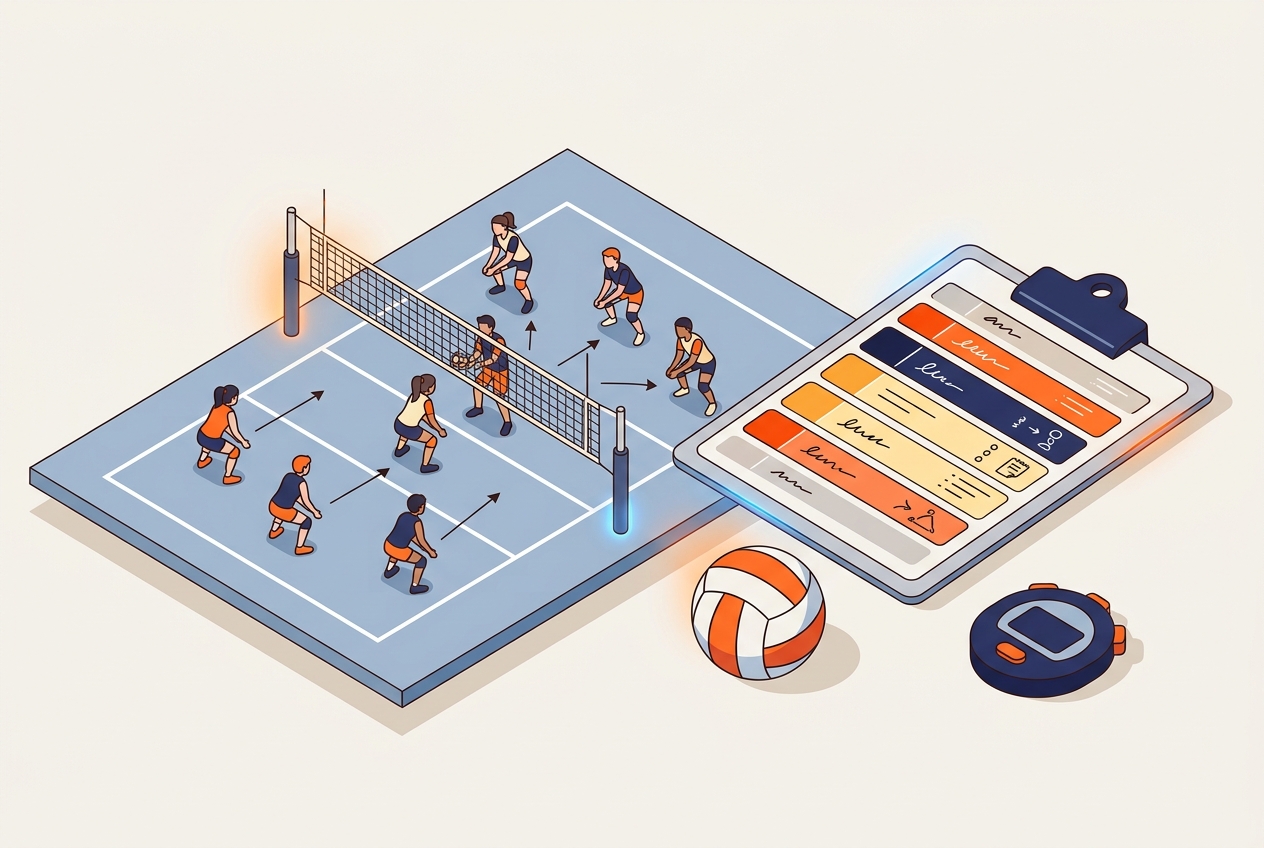
Plan 1: Serve-Receive Night (the record-changer)
| Time | Block | Detail |
|---|---|---|
| 0:00-0:12 | Warm-up: platform ladder in pairs | Rungs 1-3, from the passing drills |
| 0:12-0:30 | Serve grid passing | Charted 3-2-1 per player, servers rotate |
| 0:30-0:50 | Wave serve receive | Trios cycle vs. live serving; post averages |
| 0:50-1:10 | Serve receive in rotation | Your actual six rotations take turns receiving; fix seams per rotation |
| 1:10-1:28 | 6v6, serve-receive scoring | A 3-pass earns a bonus point; shanks give one away |
| 1:28-1:30 | Huddle | Tonight's team passing average vs. last week's |
Serve-Receive Night (90 Minutes)
90 min · 7 segments
0:00
8 minWarm-up: Platform Ladder in Pairs
Pairs three to five metres apart: toss, controlled platform pass back, then add a shuffle step.
Warm-Up0:08
6 minShuttle Passing Lines
Two lines of three face each other 8 m apart; each front player passes high, then sprints to the back of the...
Warm-Up0:14
16 minServe Grid Passing
Servers on the far endline call and hit numbered zones 1–6; three passers in receive play every ball to the target;...
Core0:30
17 minWave Serve Receive
Servers vs. passing waves of three with a target setter; groups rotate on scored passes so everyone serves and passes.
Core0:47
18 minServe Receive in Rotation
Full receive unit in a real rotation against live servers; scorer charts each pass 3-2-1 against the setter's...
Core1:05
20 min6v6, Serve-Receive Scoring
6-on-6 wash scoring: win the served rally and the free-ball rally to earn a point; losses wash and pressure stays high.
Core1:25
5 minHuddle: Tonight's Passing Average vs. Last Week
Coach-led closing circle: each athlete shares a win and a work-on, coach connects practice to the next competition.
Cooldown
Equipment: volleyballs, ball cart, towels, tape, whiteboard, net, chart, scoreboard or flip score
Change the length, swap modules for your age group, print a one-page coach sheet, and share it by link. No login.
Customize this plan free →Save to my accountPlan 2: Offense Night (setter-hitter connections)
| Time | Block | Detail |
|---|---|---|
| 0:00-0:12 | Warm-up: pepper with the standard enforced | Pass-set-hit in order, partners rotate |
| 0:12-0:30 | Split stations | Setters: footwork squares and target setting; hitters: approach lines, per the setting drills |
| 0:30-0:52 | Connection reps | Each hitter x each setter: pass-set-attack from a coach-fed ball, zones called |
| 0:52-1:10 | Rotation offense | Run your rotations in order; each must convert two in-system attacks to advance |
| 1:10-1:28 | 6v6 wash, offense scoring | In-system kills count double |
| 1:28-1:30 | Huddle | Which connection earned crunch-time trust tonight |
Offense Night (90 Minutes)
90 min · 6 segments
0:00
12 minWarm-up: Pepper With the Standard Enforced
Classic pepper built up in stages: pass-set, then controlled hit-dig-set, with movement variations to stay honest.
Warm-Up0:12
9 minSplit Stations: Setter Footwork Squares
Four cones in a 3 m square by the setter's spot; the setter runs to the tossed cone, squares to the left antenna,...
Core0:21
9 minSplit Stations: Target Setting (Hitters Run Approach Lines)
Setter at the target spot delivering to hoops at the outside antenna, the middle quick zone and the back-set lane...
Core0:30
22 minConnection Reps
Hitting lines done right: every hitter passes first, two lines alternate, shaggers feed so reps never stall.
Core0:52
18 minRotation Offense
Serve, pass, set, swing: the passer transitions off the court to the pin and attacks the set; the pin hitter resets...
Core1:10
20 min6v6 Wash, Offense Scoring
6-on-6 wash scoring: win the served rally and the free-ball rally to earn a point; losses wash and pressure stays high.
Core
Equipment: volleyballs, cones, ball cart, hoops, net, scoreboard or flip score
Change the length, swap modules for your age group, print a one-page coach sheet, and share it by link. No login.
Customize this plan free →Save to my accountPlan 3: Defense Night (the culture builder)
| Time | Block | Detail |
|---|---|---|
| 0:00-0:12 | Warm-up: base-and-adjust reads | No ball, then slow toss, from the defense drills |
| 0:12-0:32 | Coach-on-box digging | Trios, charted 3-2-1, mixed speeds |
| 0:32-0:50 | Block-and-dig pairs | Blockers channel, diggers cover, per the blocking drills close-and-seam work |
| 0:50-1:05 | Pursuit + tip coverage | Six-minute pursuit cap, then tip-responsibility reps |
| 1:05-1:26 | Team defense wash | Defense earns washes vs. a coach-run offense |
| 1:26-1:30 | Huddle | Best pursuit of the night gets named |
Defense Night (90 Minutes)
90 min · 9 segments
0:00
6 minWarm-up: Base-and-Adjust Reads
Six defenders in base (1) with routes to their adjusted spots (2) for an outside set; coach across the net plays the...
Warm-Up0:06
6 minMirror Blocking
Pairs across the net mirroring shuffle steps and block jumps.
Warm-Up0:12
15 minCoach-on-Box Digging
Coach on a box swings at left, middle and right back in turn; each dig goes to the target, balls return to the cart,...
Core0:27
10 minBlock-and-Dig Pairs: Close and Seam
Pin blocker plants at the antenna and sets the line; the middle crossovers from centre net and closes hip to hip...
Core0:37
8 minDig and Replace
Coach on a box swings every two seconds; the digger plays to the target, sprints off through the sideline, and the...
Core0:45
6 minPursuit
Coach tosses to the deep corner; left back chases it, middle back sprints under the dig, front left sends it over,...
Core0:51
10 minTip-Responsibility Reps
Coach on a box with a blocker in front; three defenders hold, then release to the tip zone behind the block or the...
Core1:01
24 minTeam Defense Wash
6-on-6 wash scoring: win the served rally and the free-ball rally to earn a point; losses wash and pressure stays high.
Core1:25
5 minHuddle: Best Pursuit of the Night Gets Named
Coach-led closing circle: each athlete shares a win and a work-on, coach connects practice to the next competition.
Cooldown
Equipment: net, volleyballs, ball cart, coaching box, hoop, scoreboard or flip score
Change the length, swap modules for your age group, print a one-page coach sheet, and share it by link. No login.
Customize this plan free →Save to my accountPlan 4: Pre-Tournament Sharpener (48 hours out)
Pre-Tournament Sharpener (90 Minutes, 48 Hours Out)
90 min · 6 segments
0:00
12 minMatch-Day Warm-Up
Dynamic movement lengths blended into partner ball touches so bodies and platforms warm up together.
Warm-Up0:12
12 minServing to Zones With Match Routines
Servers start at the attack line and earn steps back to the endline; from there they call deep-left, deep-right or...
Core0:24
20 minStarting-Lineup Rotation Walk-Through
Walk through the starting lineup in all six rotations with the libero swaps and sub entries exactly as planned. Nothing new; substitutions run off the actual plan.
0:44
30 min6v6 Sets vs. Your Own Bench, Starting at 20-20
6-on-6 wash scoring: win the served rally and the free-ball rally to earn a point; losses wash and pressure stays high.
Core1:14
10 minServing-Pressure Ladder
Servers on the endline serve to a called zone (1–6 marked on the far court), sprint to touch mid-court, and return...
Conditioning1:24
6 minHuddle: End Early and Confident
Coach-led closing circle: each athlete shares a win and a work-on, coach connects practice to the next competition.
Cooldown
Equipment: volleyballs, cones, resistance bands, ball cart, net, scoreboard or flip score, tape
Change the length, swap modules for your age group, print a one-page coach sheet, and share it by link. No login.
Customize this plan free →Save to my accountAge-Scaling the Plans

Beginner Volleyball Practice Plan (First Season)
Two-Hour Volleyball Practice Plan
First-Day Volleyball Practice Plan
Middle School and High School Volleyball Practice Plans
Build Your Own Volleyball Practice Plan
From Plan to Published Schedule
Frequently Asked Questions
What should a volleyball practice plan include?
How do you plan a 90-minute volleyball practice?
How often should you practice serve receive?
What is a good volleyball practice plan for middle school or younger teams?
What is a good beginner volleyball practice plan?
How do you plan a 2-hour volleyball practice?
Should practice plans change during tournament season?
Talk to our team
Want to spend more time coaching and less time with paperwork? Let's talk.
Tell us about your team and we'll show you how to plan games, set lineups, run the schedule, and develop players in one place, so you spend the season coaching instead of chasing admin.
Less admin, more coaching
Plan games, set lineups, and track the season in one place
Keep every family in the loop automatically
Tell us about your program
4 fields · takes 30 seconds
Lands in the same inbox as the Help button · human response only
Read Next
Rizzler vs SportsEngine: Team Coaching vs League Platform
ComparisonHow to Organize a Youth Sports Team
LearnLittle League Age Eligibility: League Age Determination
RulesPrintable Baseball Lineup Card (Free PDF + Excel)
ResourcesHow to Run a Basketball Tryout: A Coach's Step-by-Step Guide
LearnVolleyball Practice Plan Template: Printable Session Sheet and Weekly Grid
Volleyball