
Rizzler Sports Logo
PricingFree Rotation Generator
Learn

The Volleyball Tryout Evaluation Form, Category by Category

A volleyball tryout evaluation form scores every player on the same set of volleyball skills, usually six to eight categories covering serving, passing, setting, attacking, blocking, and defense, plus athleticism and volleyball IQ. Every evaluator uses one scale, scores are totaled per player, and the ranked list drives your roster decisions. This page gives you the full category list, a filled-out example you can copy, and scale definitions for each skill. If you just want a blank form to print, grab the printable tryout evaluation form template; if you're planning the whole event, start with how to run a volleyball tryout.
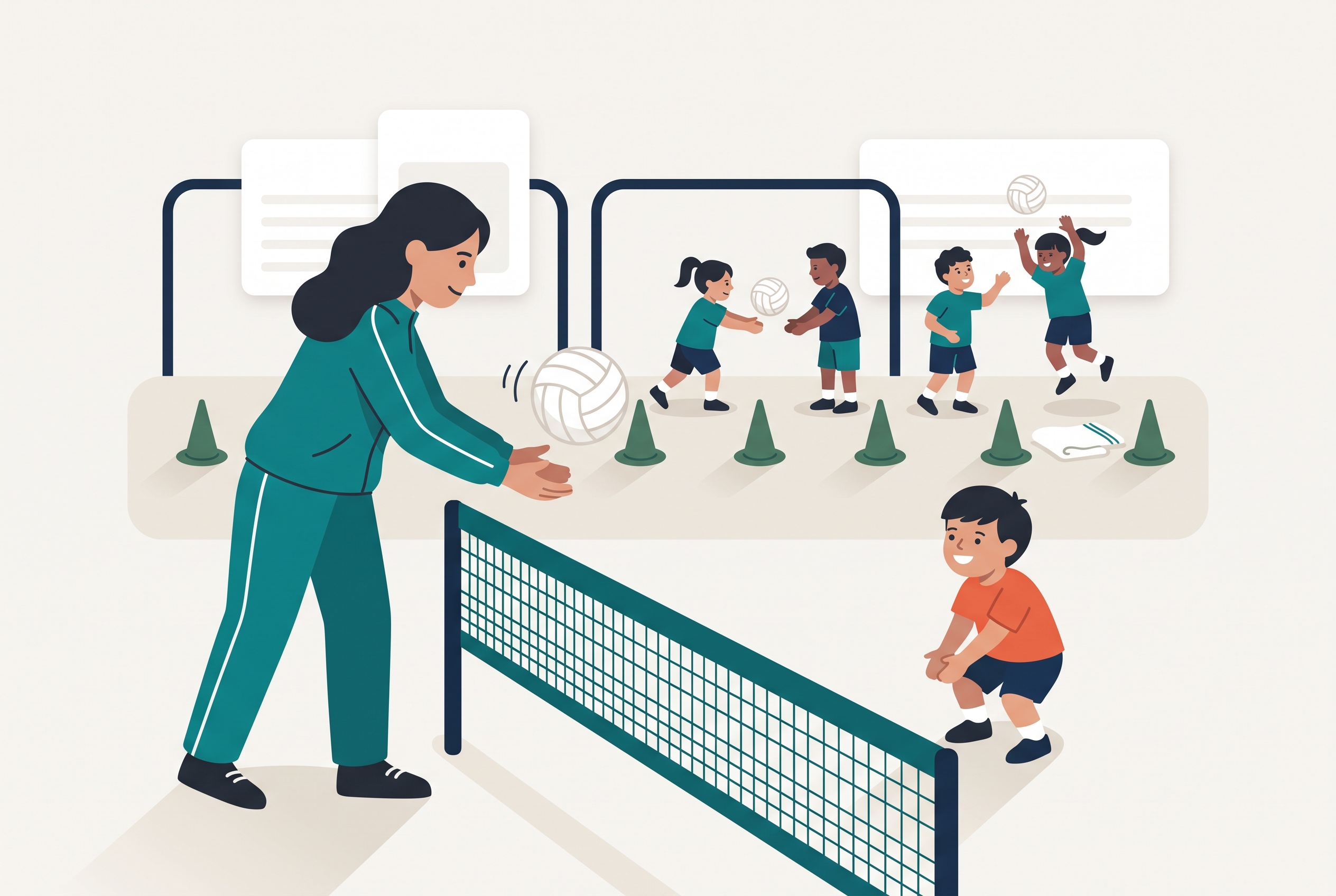
Volleyball coach scoring a player evaluation form on a tablet courtside during a tryout

The 8 categories that belong on a volleyball tryout form

Score eight categories: athleticism, volleyball IQ, serving, passing, setting, attacking, blocking, and floor defense. This is the same eight-category template Rizzler provisions automatically for every volleyball team, and it exists because each category answers a different roster question. Serving and passing decide whether you can run an offense at all. Setting, attacking, and blocking sort players into roles. Athleticism and IQ tell you who will grow.
CategorySkills to scoreWhat to watch for
AthleticismVertical jump, lateral quicknessTouch height on approach, first step in coach-toss digging
Volleyball IQRules and rotations, court awarenessDoes she know where to stand after a rotation without being told?
ServingConsistency, placement, power or float10-serve sets: how many in, how many to a called zone
Passing (serve receive)Platform control, footwork to ballAngle of the platform, feet beat the ball or reach for it
SettingClean hands, location, decision makingHittable ball to the pin under medium pressure
AttackingApproach and timing, power, shot selectionFull approach rhythm; does she tip or swing when blocked?
BlockingTiming, hand positionPress over, not into, the net; penetration on a live hitter
Floor defenseDigging, hustle and pursuitControlled digs to target, chases the dead ball anyway
Resist adding more rows. Eight categories with two or three skills each is already 18 to 20 marks per player. At a club tryout with 60 kids and four courts, anything longer stops getting filled in by the second hour.

A filled-out example: what a scored form actually looks like

Here is a completed form for one 14U outside hitter candidate, scored 1 to 10, the way it reads at the end of her second court session. A real filled-in row tells you more about how the form works than any blank template.
Player: #14, outside hitter candidate Group: 14U, Court 2 Session: 2 of 2
CategoryScore (1-10)Evaluator note
Athleticism7Best approach touch in her group, slow laterally
Volleyball IQ5Lost rotation twice in wash play
Serving68 of 10 in, all zone 6, no aggressive serve yet
Passing4Platform swings, shanked 3 of 8 in serve receive
Setting5Fine emergency hands, not a setter
Attacking8Clean full approach, hits high seam, scored on the block
Blocking6Good press, late on the slide
Floor defense6Digs hard-driven balls, pursuit is real
Total: 47 / 80 Projects: OH2 on 14-1s, swing to 14-2s if passing lags
Notice what the notes do. "Shanked 3 of 8 in serve receive" is evidence you can defend to a parent in October. A bare 4 is not. Train every evaluator to write one short note per category, scored immediately after the rep while it's fresh.

Define the scale before the first whistle

A 1-to-5 scale works best on paper, and 1-to-10 works best in an app. On paper, five points is fast to mark with a pen: 1 is well below age level, 3 is right at level, 5 is exceptional. Digital scoring earns the wider 1-to-10 scale because tapping 7 is as fast as tapping 4, and the extra spread separates a 60-player field far better, then converts straight to a percentage for ranking.
Whichever scale you pick, write one sentence per number for your two or three most contested categories. For passing: a 5 means the platform is quiet and the pass is settable from zones 1, 5, and 6; a 3 means settable from free balls only; a 1 means the ball rarely lands on your side playable. Then calibrate: have two coaches score the same three players in the first rotation, compare, and close any gap before the group spreads across courts. If your assistant's 7 is your 5, the ranked list is noise.

Adjust the form by position

Use one form for everyone, then weight it by the position a player is trying out for. Setters: double-weight setting and volleyball IQ, and watch decision making under a bad pass rather than clean-ball reps. Liberos and defensive specialists: passing and floor defense carry the evaluation, and attacking is irrelevant, so don't let a weak swing drag down a great passer's total. Middles: score blocking timing and the slide approach over dig quality, because a 14-year-old middle who moves her feet on the block will out-develop one who happens to be tall today.
For older club tryouts, add measurable rows: approach touch and block touch in inches, and serve velocity if you have a radar gun. Numbers like these travel across tryout days and years in a way that opinion scores never do. Rizzler's volleyball template catalog includes these as optional metric skills you can toggle on.

Ready to take your game to the next level?

Adjust the form by age

At 12U, cut the form to serving, passing, athleticism, and coachability, and score the serve as in-or-out rather than by zone. Most 12s are mid-transition from underhand to overhand, so placement scores mean little. By 14U the full eight categories apply. At 16s and 18s, add discrimination inside the categories you already have: shot selection under a set block, out-of-system attacking, and serve-receive from jump-float serves, because at that level everyone passes the easy ball.

Two formats: one sheet per player, or the whole court on one page

Run the form in one of two formats, or both. The per-player sheet is the format above: one page per player, the eight categories as rows, an evidence note beside every score. Use it at stations and for the players your callback decisions hinge on. The compact roster sheet flips the layout: one row per player, the categories abbreviated across the top, a whole court's group on a page or two. Use it when one coach is watching wash play across a full court and wants every OH candidate comparable at a glance.
Court / group: ______ Evaluator: ______ Date: ______ Score each cell 1 to 5.
#PlayerAthIQSrvPassSetAttBlkDefTotalRec
1
2
3
4
5
Rec: Y = yes, B = bubble, N = no. Columns: Athleticism, Volleyball IQ, Serving, Passing, Setting, Attacking, Blocking, Floor Defense.
The roster sheet gives up the notes column, and "shanked 3 of 8 in serve receive" is exactly the note that settles an October parent call, so keep per-player sheets for the bubble. The downloadable pack below includes both formats, plus a team sheet that totals each row automatically and a draft board that ranks the group from the scores.

From clipboard to tablet on tryout day

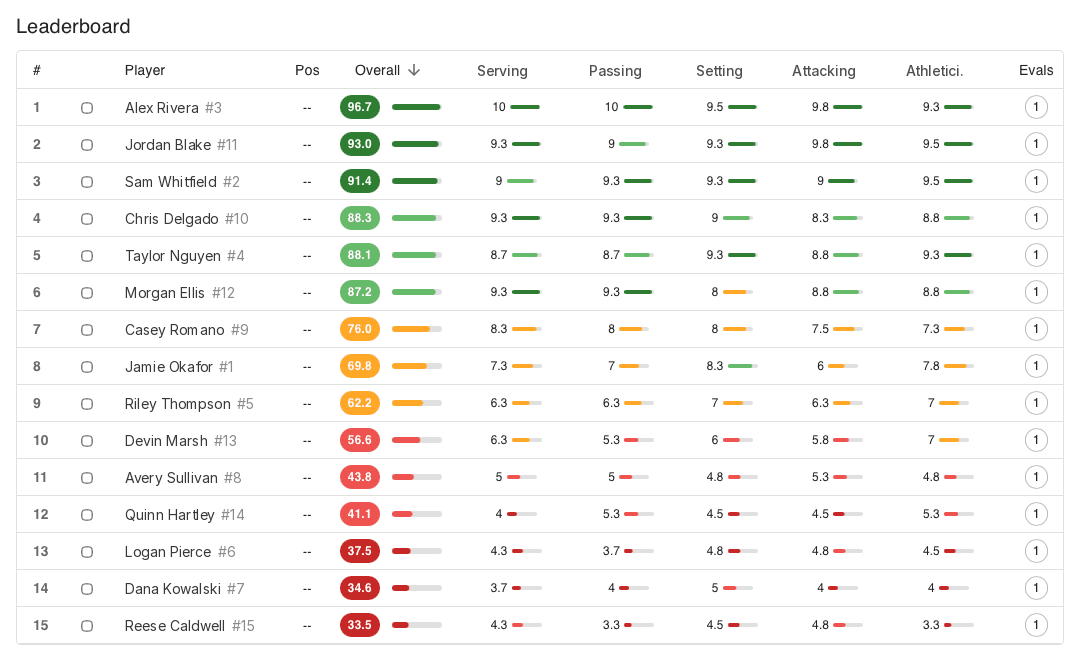
The form is half the system; collecting and tallying it is the other half. On paper, plan one runner per court collecting sheets each rotation, and budget a late evening adding totals in a spreadsheet before callbacks. Scored digitally in Rizzler, each coach enters scores at their station and the ranked list builds itself as the tryout runs, so the coaches' meeting starts from a sorted board instead of a stack of paper. The Team Tryouts workflow handles registration, check-in, station scoring, and offer tracking for up to 300 players on the Club plan, and the volleyball evaluation template ships pre-loaded, editable on Pro and Club to match your club's categories. That is hours saved between the last serve and the first offer email, which is exactly when club directors have the least time. Pair the form with the tryout drills that make each category visible, and see the volleyball tryouts page for the full workflow.

Frequently Asked Questions

How many categories should a volleyball tryout evaluation form have?

Six to eight. Fewer than six and you can't separate positions; more than eight and evaluators stop filling in rows by mid-tryout. The standard eight are athleticism, volleyball IQ, serving, passing, setting, attacking, blocking, and floor defense, with two or three observable skills inside each.

What scale should I use to score volleyball tryouts?

Use 1 to 5 on paper and 1 to 10 in an app. Five points is fast with a pen; ten points separates a large field better when tapping is as fast as writing. Either way, define what the middle number means per skill before the tryout and calibrate evaluators on the first few players.

Should liberos and setters use a different form?

Same form, different weighting. Score everyone on all eight categories so you can compare across the field, then weight setting and IQ for setter candidates and passing and floor defense for libero candidates when you rank by position. A separate form per position makes cross-position comparisons impossible.

Is a printable form or an app better for volleyball tryouts?

Paper works fine under about 25 players with two or three evaluators. Above that, totaling sheets becomes the bottleneck: a 60-player club tryout generates over 1,000 individual marks. Digital scoring totals continuously and lets you sort the field between sessions, which is when cut and callback decisions actually get made.

Get the full template pack: player sheets, team sheet, draft board

The forms above are free to copy straight from this page. The pack adds the print-ready and editable versions of all of it: individual player sheets, a full team sheet that scores your whole roster on one page with totals that add themselves, and a draft board that ranks players from the scores. Use the form below, mention volleyball tryout evaluation pack in the message box, and we will email the whole pack to you.

Talk to our team

Running volleyball tryouts at scale? Let's talk.

Tell us about your club, league, or school and we'll come back within one business day with a walkthrough of registration, check-in, evaluations, invites, and offers in one place.

  • Cut tryout admin from days to minutes

  • Online registration and check-in for hundreds of players

  • Evaluate, rank, invite, and track offers in one place

Tell us about your program

4 fields · takes 30 seconds

Lands in the same inbox as the Help button · human response only