
Rules
Little League Baseball Rules: The Complete Coach's Reference
Little League International governs youth baseball and softball for millions of players across divisions from Tee Ball through Seniors (ages 4-16). The rules that matter most on game day are all covered here with the specific numbers coaches need to know: pitch count limits, mandatory rest days, the catcher-to-pitcher restriction, minimum play requirements, and substitution rules.

Little League Rules at a Glance
| Rule Topic | Key Point | Full Details |
|---|---|---|
| Pitch Count Limits | 50-95 pitches per day depending on league age | Charts by age group |
| Rest Day Requirements | 0-4 calendar days based on pitches thrown | Rest day calculator tables |
| Catcher-to-Pitcher Rule | Catch 4+ innings: no pitching that calendar day. Throw 41+ pitches: no catching that day | Full rule with exceptions |
| Minimum Play Rules | Every player: 1 AB + 6 consecutive defensive outs | How to track and enforce |
| Batting Rules | Continuous batting order below Majors; local option in Majors | Division-by-division breakdown |
| Substitution Rules | Free substitution in most LL divisions | Re-entry rules and exceptions |
| Pitching Rules (Overview) | Covers warmup, balks, visits, and more beyond pitch counts | Complete pitching rule summary |
| Age Eligibility | Based on "league age," not school grade | Age determination date chart |
| Field Dimensions | 46 ft pitching distance, 60 ft basepaths (Majors) | All divisions |
The Rules Coaches Violate Most Often
Three rules cause the most forfeits, protests, and board complaints in Little League:
1. Pitch count rest days. A coach pitches a kid on Tuesday who threw 55 pitches on Saturday. Fifty-five pitches requires three rest days (Sunday, Monday, Tuesday), so he isn't eligible until Wednesday. Game gets protested. Forfeit. Rizzler's rule compliance engine prevents this by tracking every pitch and calculating eligibility automatically.
2. Minimum play. A kid sits on the bench for four innings and the coach forgets to put him in. At the LL level, every rostered player must get at least one at-bat and play six consecutive defensive outs per game. Rizzler's playing time tracking flags players who haven't met the minimum.
3. Catcher-to-pitcher violations. Your catcher catches innings one through four, then you bring him in to pitch in the fifth. That's a violation. Once a player catches four or more innings, they can't pitch that calendar day. Read the full catcher-to-pitcher rule.
How Rizzler Helps You Stay Compliant
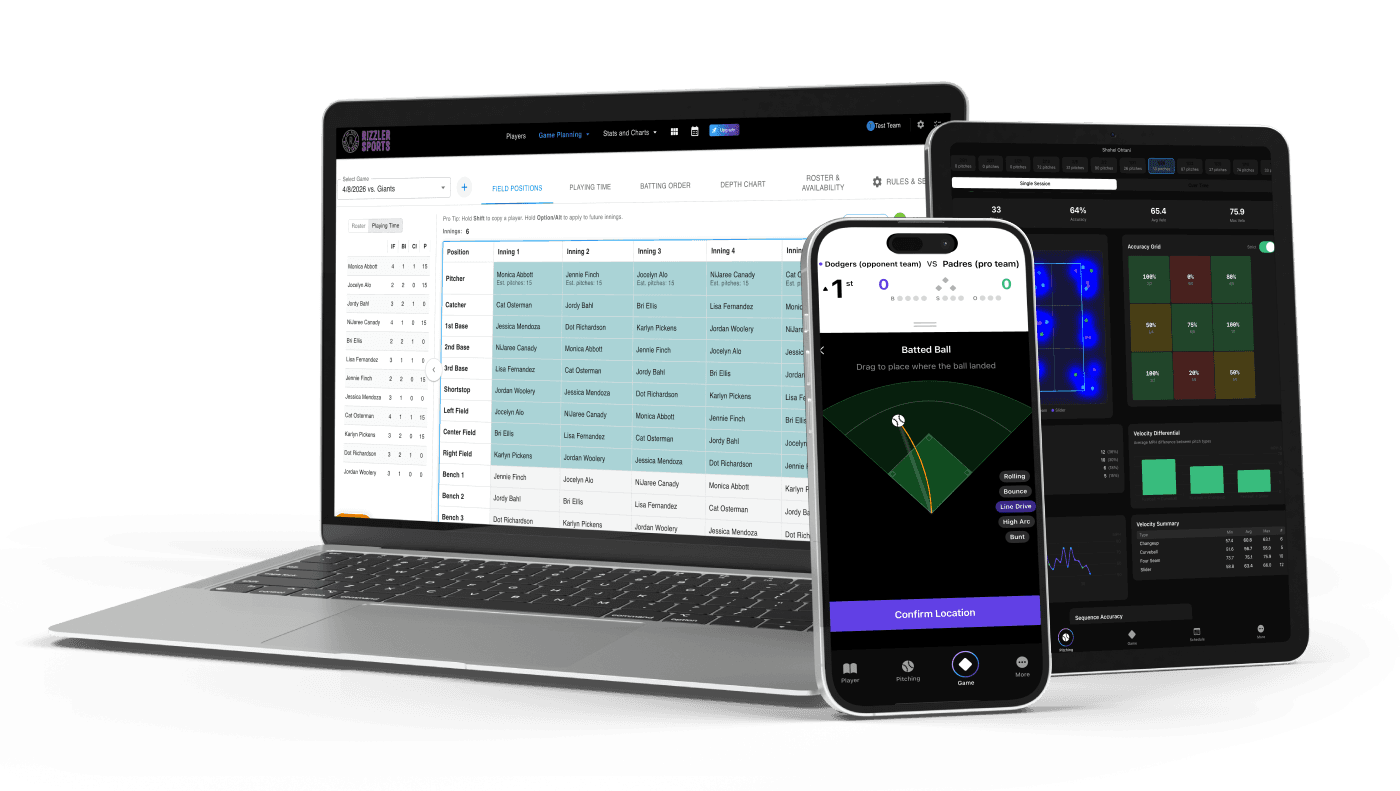
Rizzler is built with Little League rules baked in. When you plan a game, assign a pitcher, or make a substitution, Rizzler checks the rules before you make a mistake. Pitch count limits, rest day calculations, catcher-to-pitcher restrictions, and minimum play tracking all run automatically.
Coach-level rule checking is available on every plan. For league administrators, cross-team compliance visibility through the organization dashboard is an emerging capability; ask us about league-wide reporting.
Frequently Asked Questions
Where can I find the official Little League rulebook?
The official rulebook is published at littleleague.org. This reference is a coach-friendly summary based on the current rules; always defer to the official publication for disputes.
Do Little League rules apply to softball too?
Little League governs both baseball and softball, but some rules differ, particularly pitch count thresholds, field dimensions, and pitching distance. This reference covers baseball rules; softball variations are noted where applicable.
Does Rizzler automatically enforce Little League rules?
Rizzler's rule compliance feature monitors pitch counts, rest days, playing time, and catcher-to-pitcher restrictions in real time. It warns you before a violation happens.
What happens if my league uses modified rules?
Many local leagues modify certain Little League rules (longer games, different age groupings, etc.). Rizzler lets you set custom rules so compliance tracking matches your league's actual regulations.
How are Little League rules different from travel ball rules?
Significantly. Little League has stricter pitch count limits, mandatory rest days, minimum play requirements, and continuous batting orders. Travel ball (USSSA, Perfect Game, etc.) generally gives coaches more flexibility. See the pitch count rules comparison.
Want Little League compliance handled automatically while you focus on coaching?
Setting up rules across a whole league or organization? Our team can help.
Talk to our team
Want to spend more time coaching and less time with paperwork? Let's talk.
Tell us about your team and we'll show you how to plan games, set lineups, run the schedule, and develop players in one place, so you spend the season coaching instead of chasing admin.
Less admin, more coaching
Plan games, set lineups, and track the season in one place
Keep every family in the loop automatically
Tell us about your program
4 fields · takes 30 seconds
Lands in the same inbox as the Help button · human response only
Read Next
10U Baseball Practice Plan: A 75-Minute Kid-Pitch Practice
LearnAI Stats Analysis: Turn Game Data into Coaching Insights
FeaturesIn-Game Intel & Matchups: Competitive Advantage from the Dugout
FeaturesHow to Build a Batting Order for 11U-12U Baseball
LearnRizzler vs iScore: Coaching App Comparison
ComparisonVolleyball Practice Plan Template: Printable Session Sheet and Weekly Grid
Volleyball