
Rules
Little League Substitution Rules
Little League allows free defensive substitution in divisions using the continuous batting order (Majors and below), meaning any player can move to any defensive position between innings without restriction. The batting order remains fixed, but fielding positions can change every inning. In Intermediate (50/70) and above, standard substitution rules apply with limited re-entry.
Substitution Rules by Division
| Division | Defensive Substitution | Batting Order Impact | Re-Entry |
|---|---|---|---|
| Tee Ball through Majors | Free (change positions any inning) | None (continuous order stays fixed) | N/A (all players remain in batting order) |
| Intermediate / Juniors | Standard (must report to umpire) | Substitute enters at the replaced player's spot | One re-entry allowed for starters |
Re-entry deserves care at the Intermediate level and above: a starter who is removed may re-enter the game once, but a substitute who is removed generally may not return. The details (where the re-entering player bats, timing restrictions) are covered by Rule 3.03, so verify against the current Little League rulebook before game day.
How Free Substitution Works (Majors and Below)
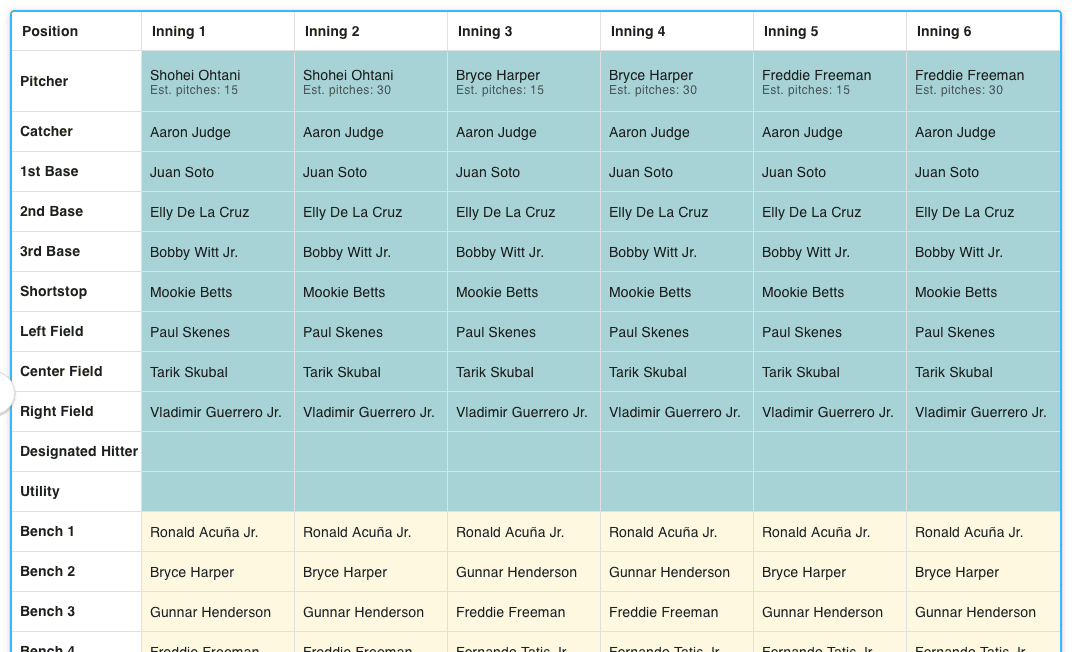
In a typical Little League Majors game with 12 players, all 12 bat in the continuous order. Only 9 play defense in any given inning. Between innings, you can shuffle all 9 fielding spots however you want: move your shortstop to right field, bring a bench player in to play third base, rotate your outfielders. The batting order never changes.
This is what makes Little League lineup planning both flexible and complex. You're essentially building a new defensive alignment every inning while keeping the batting order intact. Rizzler's AI fielding positions generates these rotations automatically, ensuring every player gets their minimum playing time.
Substitution and the Catcher-to-Pitcher Rule
Free substitution means you can move a catcher to pitcher mid-game, but the catcher-to-pitcher rule still applies. If the catcher has caught 4 or more innings, they cannot pitch that calendar day. Track catcher innings carefully when planning substitutions.
Frequently Asked Questions
Can I move my pitcher to another position and bring them back to pitch later?
Depends on the division. In Minors and Majors: no. Regulation VI(b) says a pitcher once removed from the mound cannot return as a pitcher, even if they stayed in the game at shortstop. In Intermediate (50/70), Junior, and Senior League: yes, once per game, provided the pitcher remained in the game at another defensive position. Their pitch count continues from where it left off, and rest day requirements are based on total pitches for the day.
Do I need to report substitutions to the umpire?
In Majors and below with continuous batting, you're technically not "substituting" but repositioning defenders. You should still communicate your defensive alignment to the umpire each inning. In Intermediate and above, all substitutions must be formally reported.
What happens if a player is injured during the game?
If a player is injured and cannot continue, they're removed from the game. In continuous batting order divisions, their spot in the lineup is skipped. No replacement batter is inserted.
Can I substitute a player for strategic reasons in the middle of an inning?
In Majors and below, you can change defensive positions between innings. Mid-inning defensive substitutions are allowed but less common and should be reported to the umpire.
Want fielding rotations planned out with rule conflicts flagged before they happen?
Standardizing substitution and re-entry practices across a league? Our team can help.
Talk to our team
Want to spend more time coaching and less time with paperwork? Let's talk.
Tell us about your team and we'll show you how to plan games, set lineups, run the schedule, and develop players in one place, so you spend the season coaching instead of chasing admin.
Less admin, more coaching
Plan games, set lineups, and track the season in one place
Keep every family in the loop automatically
Tell us about your program
4 fields · takes 30 seconds
Lands in the same inbox as the Help button · human response only
Read Next
Best Apps for Little League Administrators in 2026
LearnPitching Analytics: Track, Chart, and Develop Your Pitchers
Features12U Softball Practice Plan: A Complete 90-Minute Practice
LearnBest Apps for Travel Baseball Coaches in 2026
LearnRizzler Plans & Pricing: Free vs Coach vs Club
ComparisonSoftball Pitching Chart: Free Printable PDF + Excel Tracker
Resources