
Rules
Little League Catcher-to-Pitcher Rule
In Little League Baseball, any player who catches four or more innings is not eligible to pitch for the rest of that calendar day, not just that game. Conversely, any player who delivers 41 or more pitches may not move to catcher for the remainder of that day. This rule protects young arms from the combined stress of catching and pitching.
The Rule, Clearly Stated
| Situation | Rule |
|---|---|
| Catcher catches 4+ innings, wants to pitch | Not allowed that calendar day |
| Pitcher throws 41+ pitches, wants to catch | Not allowed for the remainder of that day |
| Caught 1-3 innings, then pitched 21+ pitches, wants to RETURN to catcher | Not allowed for the remainder of that day (31+ pitches for league age 15-16) |
| Catcher catches 3 or fewer innings, wants to pitch | Allowed (subject to pitch count limits) |
| Never caught today, pitched 40 or fewer, wants to catch | Allowed |
Notice there are two different pitch thresholds. Any pitcher who delivers 41 or more pitches is barred from catching that day. But a player who already caught earlier in the day (three innings or fewer) faces a stricter bar: once they deliver their 21st pitch (31st for league age 15-16), they cannot go BACK behind the plate. Coaches who only know the 41-pitch number get burned by the 21-pitch return rule.
Both thresholds carry a finish-the-batter exception. A pitcher who reaches exactly 20 pitches (or 40 for the general rule) while facing a batter may finish that batter and keep catcher eligibility, provided they are moved or removed before pitching to another batter.
An "inning caught" means the player was the catcher of record for any part of that half-inning. The official approved ruling is blunt: receiving one pitch to a batter in the fourth inning constitutes having caught four innings. Warmup pitches do not count, only live-ball pitches. And because the restriction runs to the calendar day, innings caught and pitches thrown carry into a second game played the same day.
This restriction sits alongside the rest of Little League's pitching and catching rules: mound visit limits and re-entry are covered in the general pitching rules, and daily maximums in the pitch count rules.
Why This Rule Exists
Catching and pitching are the two most physically demanding positions in baseball. Both put significant stress on the arm and shoulder. Asking a kid to catch four innings (squatting, throwing to bases, blocking pitches) and then pitch puts them at substantially higher injury risk. The rule forces coaches to plan ahead rather than defaulting to their best athlete for both positions.
The Scenarios That Trip Coaches Up
Scenario 1: The versatile kid. Your best player catches innings 1-4 and you want him to close the game on the mound in the 6th. He can't. Four innings caught means no pitching for the rest of that day.
Scenario 2: The partial inning. Your catcher catches the first three outs of the 4th inning, then you sub in a new catcher for the rest of the game. That's still 4 innings caught (innings 1, 2, 3, and part of 4). He can't pitch that day.
Scenario 3: The reverse, pitcher to catcher. Your starting pitcher throws 45 pitches through 3 innings. You want to move him behind the plate. He can't catch for the rest of that day; he's thrown more than 40 pitches.
Scenario 4: The swap that only works one way twice. Your catcher catches innings 1-3 (3 innings). Your pitcher throws 35 pitches through 3 innings. In the 4th, you can swap them: the catcher can pitch (3 innings caught, under the 4-inning threshold) and the pitcher can catch (35 pitches, under 41, and he had not caught earlier). But the swap is now locked in: once the new pitcher delivers his 21st pitch, he cannot return behind the plate, because he caught innings earlier that day.
Scenario 5: The doubleheader. Your catcher catches four innings in game one of a Saturday doubleheader. He cannot pitch in game two. The restriction applies to the whole calendar day, not just the game where he caught.
How Rizzler Tracks the Catcher-to-Pitcher Rule
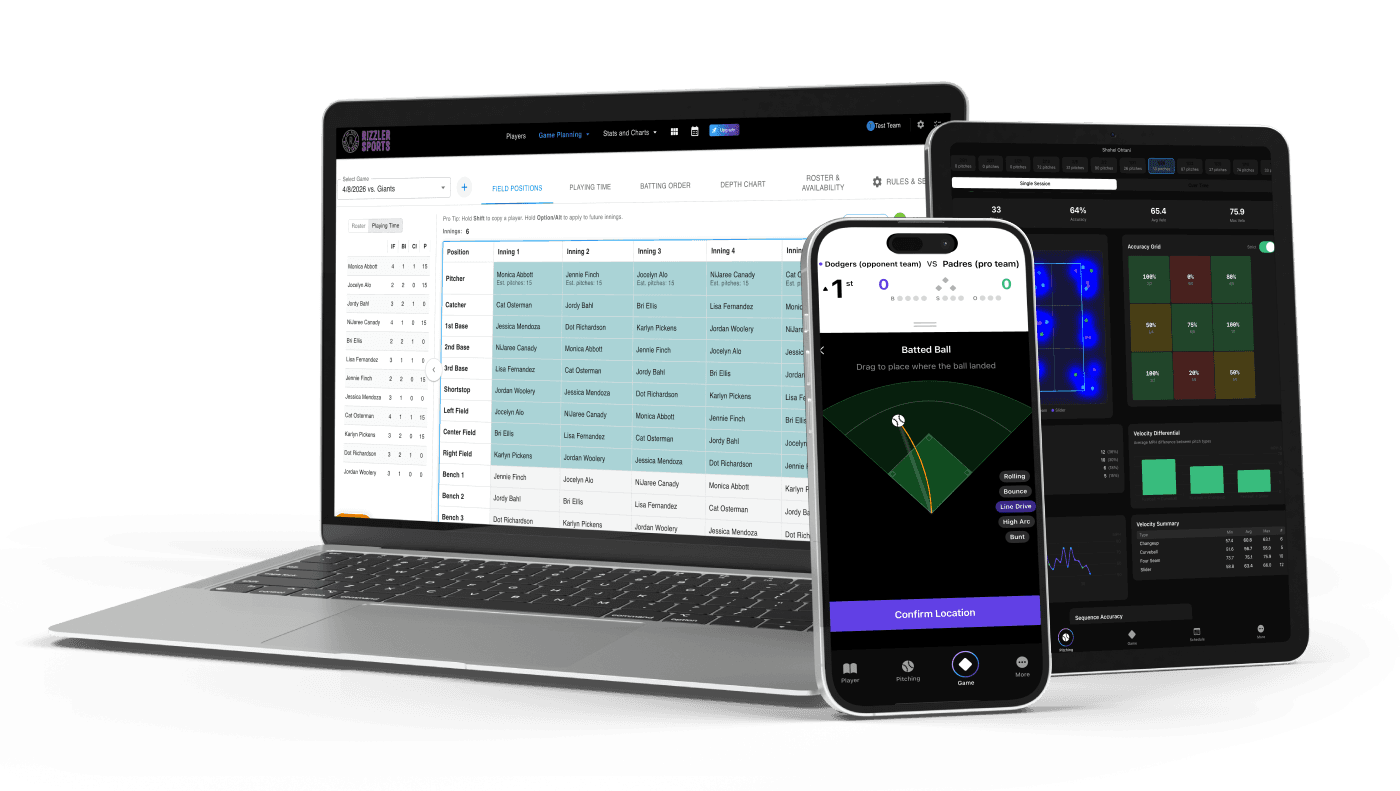
Rizzler's rule compliance engine tracks innings caught and pitches thrown for every player in real time. When you go to make a substitution that would violate the catcher-to-pitcher rule, Rizzler warns you before you send the lineup card to the umpire. No mental math, no checking the scorebook.
The game planning tool also flags potential conflicts when you build your lineup. If you've assigned a player to catch 4+ innings and also listed them as a potential reliever, Rizzler tells you that plan violates the rule.
Frequently Asked Questions
What is the Little League catcher to pitcher rule?
It is the pitching and catching crossover restriction: a player who catches 4 or more innings cannot pitch for the rest of that calendar day, a player who throws 41 or more pitches cannot catch for the rest of that day, and a player who caught 1-3 innings and then pitched 21 or more pitches (31 for ages 15-16) cannot return to catcher that day.
Does the catcher-to-pitcher rule apply to softball?
No. Little League Softball's Regulation VI limits pitching by innings (a 12-inning daily maximum in Minors and Majors) and contains no catcher-to-pitcher crossover restriction. Local leagues may adopt their own additional limits, so check your league's local rules.
Does this rule apply in tournament play?
Yes. The catcher-to-pitcher rule applies in all Little League games: regular season, playoffs, and tournament play including All-Stars.
What counts as an "inning caught"?
Any time the player is the catcher of record for any portion of a half-inning counts as one inning caught. Even if they catch only one pitch before being subbed out, that partial inning counts.
Can a player catch and pitch on different days?
Yes. The catcher-to-pitcher restriction applies to a single calendar day. A player who catches four innings on Monday can pitch on Tuesday, assuming they meet rest day requirements from any previous pitching. Within the same day, including doubleheaders, the restriction holds.
What's the penalty for violating this rule?
The game is subject to protest. If upheld, the result is typically a forfeit. In tournament play, it can lead to elimination.
Want innings caught and pitches thrown tracked for every player, every day?
Helping a whole league stay on the right side of Regulation VI? Our team can help.
Talk to our team
Want to spend more time coaching and less time with paperwork? Let's talk.
Tell us about your team and we'll show you how to plan games, set lineups, run the schedule, and develop players in one place, so you spend the season coaching instead of chasing admin.
Less admin, more coaching
Plan games, set lineups, and track the season in one place
Keep every family in the loop automatically
Tell us about your program
4 fields · takes 30 seconds
Lands in the same inbox as the Help button · human response only
Read Next
Youth Baseball & Softball Rules: Complete Reference
RulesPitch Count Tracking Sheet: Printable + Auto-Calculating Excel
ResourcesBasketball Tryout Drills: 12 Drills That Actually Evaluate Players
LearnHow to Plan a Youth Baseball Tournament Weekend
LearnHow to Coach Youth Soccer: A First-Season Guide
LearnIn-Game Intel & Matchups: Competitive Advantage from the Dugout
Features