Volleyball Drills for 10 to 12 Year Olds That Keep Every Kid Moving
Drills for 10 to 12 year olds live inside three hard constraints: attention spans of about eight minutes, wildly mixed skill levels on the same roster, and bodies that cannot yet serve a full court or sustain long rallies. The drills below are built for those constraints: catch-bridge progressions that guarantee early success, stations that keep groups of four moving, and small-sided games that produce ten times the touches of 6-on-6. This page is the age-band layer of the library; the pure skill-teaching progressions live in the beginner drills guide, and the 11-14 practice structure in the middle school guide.
Set Up the Gym for This Age First
Three equipment decisions matter more than any drill choice. Lower the net to around 7 feet (2.13 m), the standard for 12U, so attacking and blocking are real actions rather than theater. Use lighter or "volley-lite" balls for 10s and 11s, which transforms platform confidence overnight. And shorten the serving distance: a serving line at 20 feet, moving back as players earn it, produces rallies, while full-court serving at this age produces aces, tears, and no volleyball. The serving progression covers the earn-your-distance ladder in detail.
Drill 1: Toss-Pass-Freeze
Purpose. Platform shape with a built-in self-check, the first passing drill that works for every skill level at once.
Setup. Pairs, one ball, three meters apart.
Steps. Partner tosses; passer passes back and freezes her finish for two counts: flat platform, knees bent, facing the tosser. Ten reps, swap. Advance to five meters, then to passing off two shuffle steps. The freeze is the drill; it lets ten-year-olds coach themselves.
Coaching cues. "Freeze and check": elbows locked, thumbs together, ball off the forearms not the wrists. Say "angle, not swing" until it is boring, then twice more.
Age scaling. Stronger 12s skip to continuous pass-to-pass with no catch, the bridge to the full passing drills ladder.
Drill 2: Four-Square Stations
Purpose. Solve the mixed-skill problem: four small stations, four minutes each, every kid busy, nobody exposed.
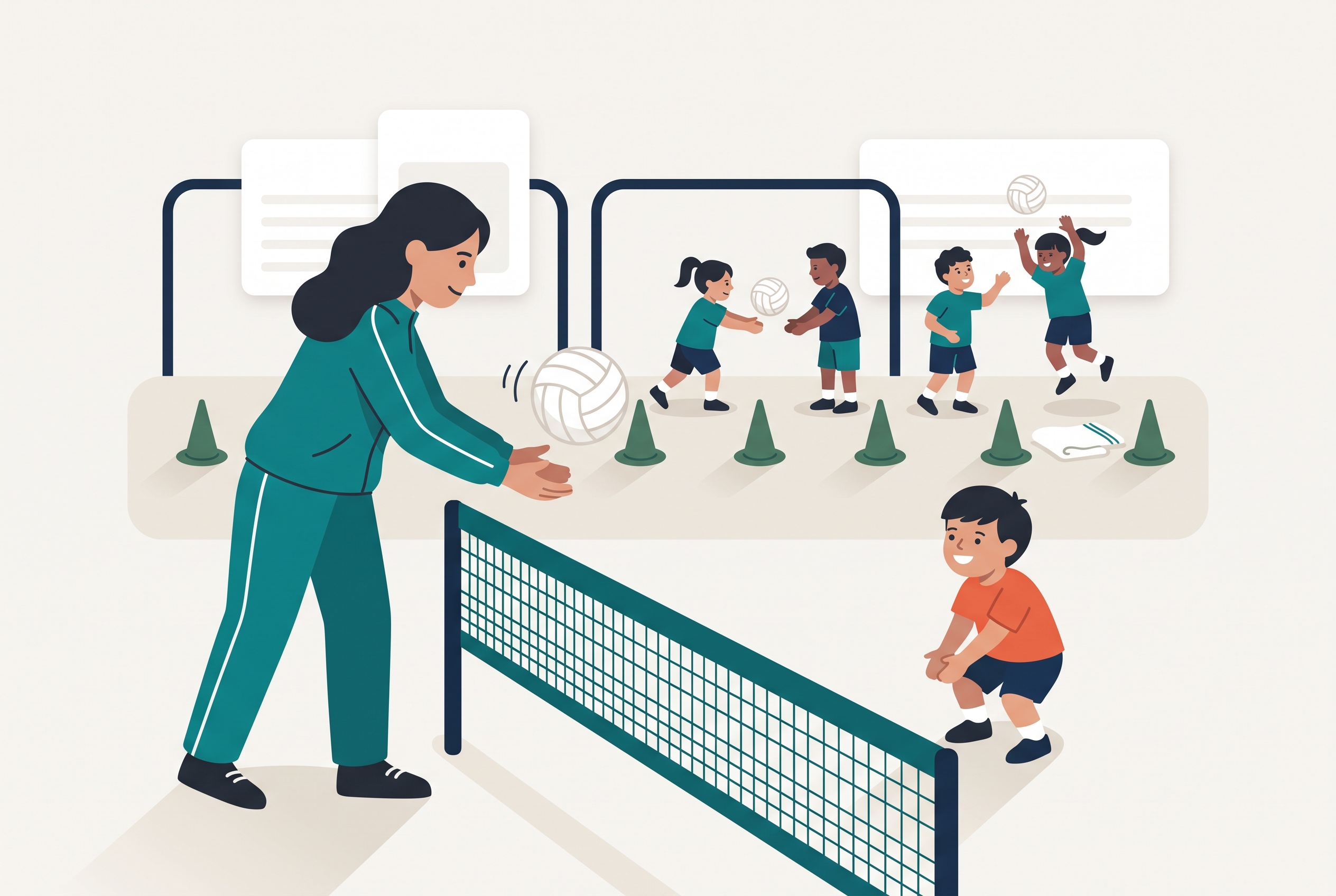
Setup. Split the court into quadrants with cones: (1) wall passing streaks, (2) partner setting to a hoop target, (3) serving to towels at the shortened line, (4) coach-toss digging to a bucket.
Volleyball · Youth
Four-Square Stations
Court split into four quadrants: wall passing, hoop-target setting, short-line serving to towels, coach-toss digging; groups rotate every 4 min.
0:00 / 16:00
Steps. Groups of three or four rotate on a whistle every four minutes; each station has a countable score (streaks, hoop hits, towels sunk, bucket digs). Post a team total for the day and chase yesterday's number.
Coaching cues. Coach floats to the station that needs teaching; the other three run on their scores. Counting is the assistant coach you did not have to recruit.
Age scaling. For 10s, replace digging with toss-pass-catch. For advanced groups, station two becomes setter footwork squares.
Drill 3: Serve to the Treasure Map
Purpose. Turn serving practice into an aiming game, at a distance where this age can actually aim.
Setup. Towels, hoops, and a folding mat scattered on the far court with point values (mat 1, towels 3, hoops 5). Serving line at 20 feet, a bonus line at 25.
Serve to the Treasure Map
Steps. Teams of four alternate serves for eight minutes, calling their target before contact, points doubled from the bonus line. First team to 25 points names the warm-up game next practice.
Coaching cues. Consistent toss above the hitting shoulder; contact with a firm, open hand; the same three-step routine every serve. Reward called-target hits over lucky bombs.
Age scaling. 12s who hit 25-foot serves reliably move to the endline and the six-zone chart from the serving drills guide.
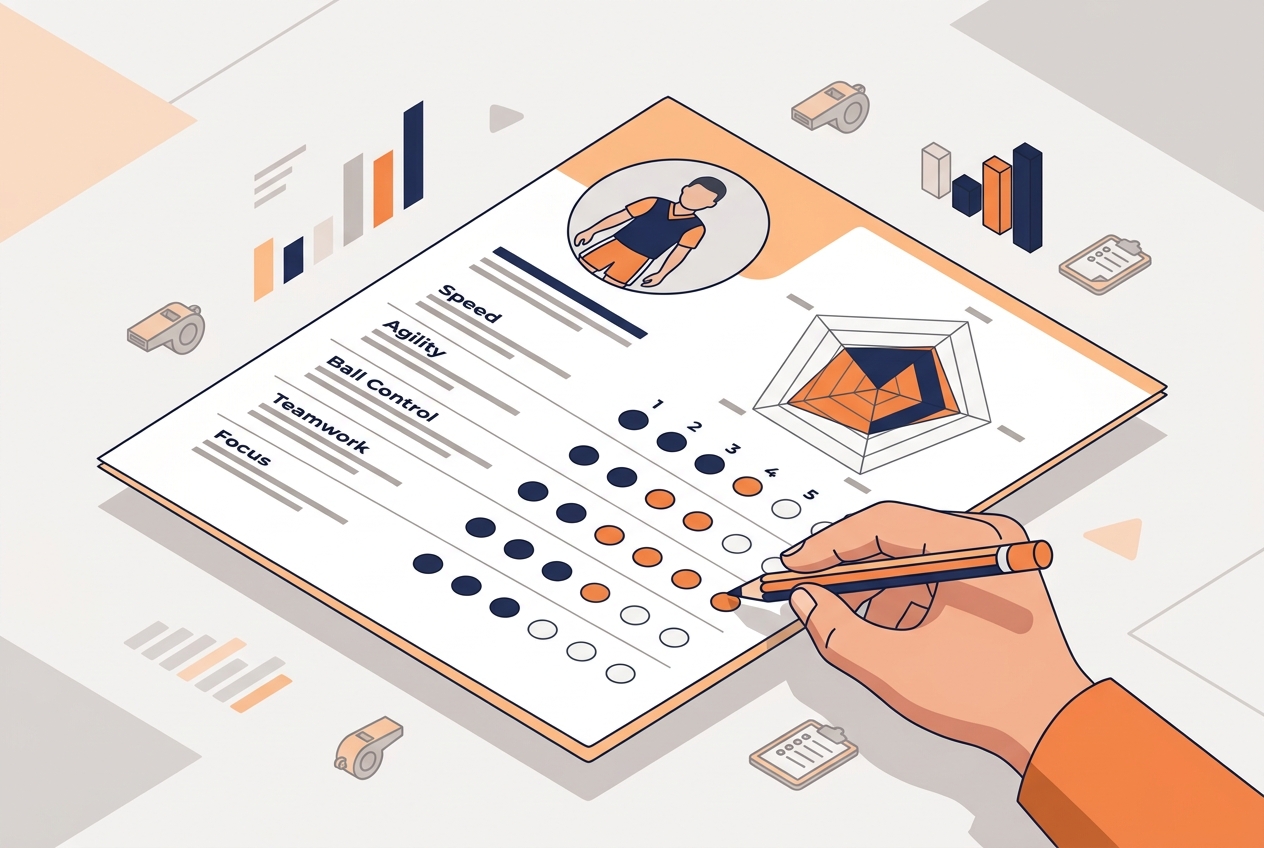
Player development
Track development all season, not just on tryout day
Score skills through the season, watch the trend lines move, and send parents a progress report they actually open.
Drill 4: Coach-Bounce Rallies
Purpose. Teach the three-contact habit before real serve receive makes it hard.
Setup. 3-on-3 on a lowered net, coach at the sideline with a ball cart.
Coach-Bounce Rallies
Steps. Coach starts every rally with an easy toss to the receiving trio, which must use all three contacts (pass, set, send) or the point goes over. Rally plays out; coach immediately feeds the next ball to the other side. Rotate trios every five minutes.
Coaching cues. "Three touches or it doesn't count" is the whole drill. Call the contacts out loud (one! two! three!) and the habit installs itself in a week.
Age scaling. Advance to the receiving team earning a bonus point when the third contact is a real attack from a step back, the doorway into hitting.
Drill 5: Queen of the Court, 3-on-3
Purpose. Maximum touches, natural competitiveness, and the game sense that 6-on-6 hides at this age.
Setup. Half or full lowered court, teams of three, one side is the "queen" side.
Volleyball · Youth
Queen of the Court, 3-on-3
Trio in line → challenger side → (win) queen side → back of the line; one colour per spot in the trio so the group moves together.
0:00 / 1:36
Steps. Challengers serve (or coach-toss for 10s) and play out the rally; win and you take the queen side, lose and you rotate off for the next trio. Three-contact rule stays on. Fifteen minutes, tracked by which trio holds the longest reign.
Coaching cues. Let them play. Save coaching for between rounds, one sentence per trio. Small-sided play is where the reads develop; interruptions spend the very touches the format exists to create.
Age scaling. This drill is also the honest tryout finisher for the age group, as used in the tryout drills plan.
Drill 6: The Two-Minute Finisher
Purpose. End practice on effort and laughter so kids beg to come back, which at 10 to 12 is a legitimate program KPI.
Steps. Two minutes, whole team: coach tosses balls anywhere, team must keep each alive for three contacts, every save counts one point, team total versus last practice's total. Wild saves are celebrated loudly. Then huddle, one takeaway, done.
A Session That Assembles Itself
String the six together and you have the age-perfect 75-minute practice: toss-pass-freeze as arrival warm-up (10), four-square stations (16), treasure-map serving (10), coach-bounce rallies (15), queens (15), finisher and huddle (9). Print-ready timing frames for exactly this structure are in the volleyball practice plans library. Between sessions, wall passing streaks and toss-pass-freeze reps travel home with any garage door; coaches on Rizzler assign them through Rizzler Reps, where a 10-year-old logging a 30-pass wall streak is exactly the kind of offseason win parents love seeing.
Frequently Asked Questions
What are the best volleyball drills for 10-12 year olds?
Short, countable, station-based drills: toss-pass-freeze for platform shape, four-square stations for mixed skill levels, treasure-map target serving at a shortened line, coach-bounce rallies for the three-contact habit, and 3-on-3 queens for touches and game sense.
How long should drills run for this age group?
Six to eight minutes per drill, matching the age's attention span, inside a 60 to 75 minute practice. Stations with countable scores let you run four short drills simultaneously, which quadruples touches and removes standing in line, the biggest hidden time cost at this age.
Should 10-12 year olds serve from the full court?
Not at first. Start at about 20 feet and move back as players earn it with consistent contact; most 12s reach the endline within a season. Full-distance serving too early produces service aces and zero rallies, which teaches nobody anything, including the server.
How do you coach a team with big skill differences at this age?
Stations and small-sided games: groups of three or four sorted quietly by level, each station scaled (catch-bridge versions for newer players, continuous versions for stronger ones). Whole-team lines expose weaker players and bore stronger ones; stations hide neither.
What can 10-12 year olds practice at home?
Wall passing streaks, toss-pass-freeze against a garage door, wall setting, and serving tosses with the freeze check. Ten minutes counts at this age; coaches on Rizzler assign home drills through Rizzler Reps so the reps get logged and streaks get celebrated.
Do these drills work for 8 to 10 year olds and 11 year olds?
Yes, with adjustments at the edges. For 8 to 10 year olds, use a lighter ball, lower the net, keep the catch step in every progression, and cap each drill at five minutes. Eleven and twelve year olds handle the full versions here, and the ones ready for more graduate to the middle school drills.
Talk to our team
Want to see how to develop players all season long? Let's talk.
Tell us about your team and we'll show you how season-long skill tracking becomes the progress report a parent opens, while players keep building between practices with Rizzler Reps.
Track skills all season, not just on tryout day
Turn evaluations into reports parents actually open
Players build habits between practices with Rizzler Reps
Tell us about your program
4 fields · takes 30 seconds
Lands in the same inbox as the Help button · human response only