
Blog
How to Plan Your Pitching Across a Tournament Weekend
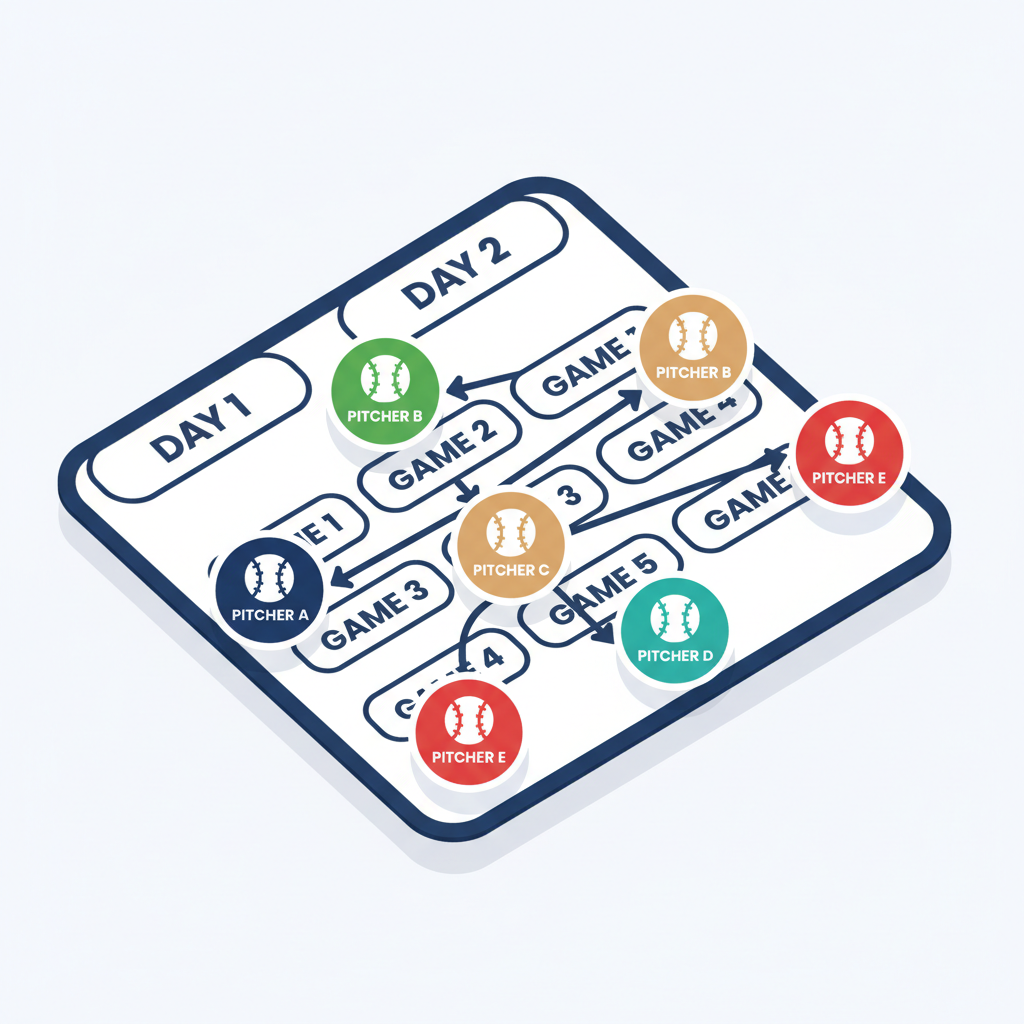
Planning pitching across a tournament weekend means mapping out which pitchers throw in which games, how many pitches each can throw while staying within rest-day rules, and which arms you're saving for elimination games. It's the single most important strategic decision in tournament baseball, and the one most coaches get wrong because they don't plan past game one. Here's how to do it right.
Why This Is the Hardest Part of Tournament Baseball
In a regular-season game, pitching decisions are relatively simple. You pick a starter, you have a plan for when to pull him, and you know who's available in relief. The math is straightforward.
In a tournament, everything compounds. Your game-one starter's pitch count determines who's available for game two. Your game-two decision affects game three. By Sunday afternoon, you're either executing a plan you built on Friday night, or you're scrambling because you burned your best arm in a pool play game that didn't matter.
The math isn't the hard part. The hard part is that every decision has downstream consequences across multiple games, and most coaches don't have a system for seeing those consequences in advance.
Step-by-Step: Planning Your Tournament Pitching
Step 1: Map the Tournament Structure
Before you assign a single pitcher, understand the format:
- How many games are guaranteed? (Pool play games are usually guaranteed; bracket games depend on winning.)
- What's the game schedule? (Three Saturday games? Two Saturday, two Sunday? Spread across three days?)
- Which games matter most? (Pool play determines seeding. Bracket games are win-or-go-home.)
- What's the weather/delay risk? (Compressed schedules mean less rest between games.)
Write this out. You need the full picture before you start allocating arms.
Step 2: List Your Available Arms
Create a pitcher depth chart for the weekend. For each pitcher, note:
- Maximum pitch count per game (based on league rules for their age)
- Current rest status (did they pitch earlier this week?)
- Role: starter, reliever, emergency-only
- Secondary positions (where do they play when they're not pitching?)
- Catcher status (if they've caught, catcher-to-pitcher rules may limit their availability to pitch)
A typical 12U travel team carries 4-6 viable pitchers. Some have clear starters. Some are swing guys who can start or relieve. Know who's who before the weekend.
Step 3: Work Backward from the Championship
This is the key insight most coaches miss. Don't plan forward from game one. Plan backward from the game that matters most.
Ask: If we make the championship game, who do I want on the mound?
That's your ace. Now work backward:
- Championship game: Ace starts. He needs to be fully rested, which means limiting or skipping him in the last pool play games.
- Semifinal: Your #2 starter. Plan his workload in pool play to keep him available.
- Pool play / early bracket: Use your #3-5 pitchers. This is where your depth earns its value.
If you spend your ace in pool play game one "to make sure we win it," you might not have him when it counts. Pool play seeding matters, but not as much as having your best arm available for elimination games.
Step 4: Set Pitch Count Targets Per Game (Not Maximums)
Don't plan for every pitcher to throw their maximum. Plan for targets that leave room for adjustment.
Example for a 12U weekend tournament (Little League rules, 85-pitch max):
| Game | Pitcher | Target Pitches | Rest Day Impact |
|---|---|---|---|
| Game 1 (Sat 9 AM) | Pitcher C | 55-65 | 3 rest days; eligible Wednesday, done for the weekend |
| Game 2 (Sat 1 PM) | Pitcher D | 40-50 | 2 rest days; eligible Tuesday, done for the weekend |
| Game 3 (Sat 5 PM) | Pitcher E + relievers | ≤20 each | 0 rest days; eligible to relieve Sunday |
| Semifinal (Sun 10 AM) | Pitcher B | 60-70 | Fresh; didn't pitch Saturday |
| Championship (Sun 2 PM) | Pitcher A (ace) | Full count | Fresh; saved all weekend |
Notice two things. The ace and the #2 don't pitch Saturday at all; that's what makes Sunday work. And the moment a Saturday pitcher passes 20 pitches, he's out of Sunday entirely (21-35 pitches means 1 rest day, which is Monday at the earliest). Pitcher C throwing a controlled 55-65 instead of 85 doesn't buy him Sunday availability, but it protects his arm and gets him back a day earlier the following week. The only Saturday arms that can help on Sunday are the ones capped at 20.
Step 5: Plan for the Scenarios That Go Wrong
Your game-one starter gets shelled in the second inning and you need 4 innings from your bullpen. Now what?
Before the tournament, plan two or three "what if" scenarios:
- What if a starter gets pulled early? Who comes in, and how does that affect tomorrow?
- What if a game goes extra innings? Who's your emergency arm?
- What if the schedule gets compressed due to weather? Who can pitch on short rest (within the rules)?
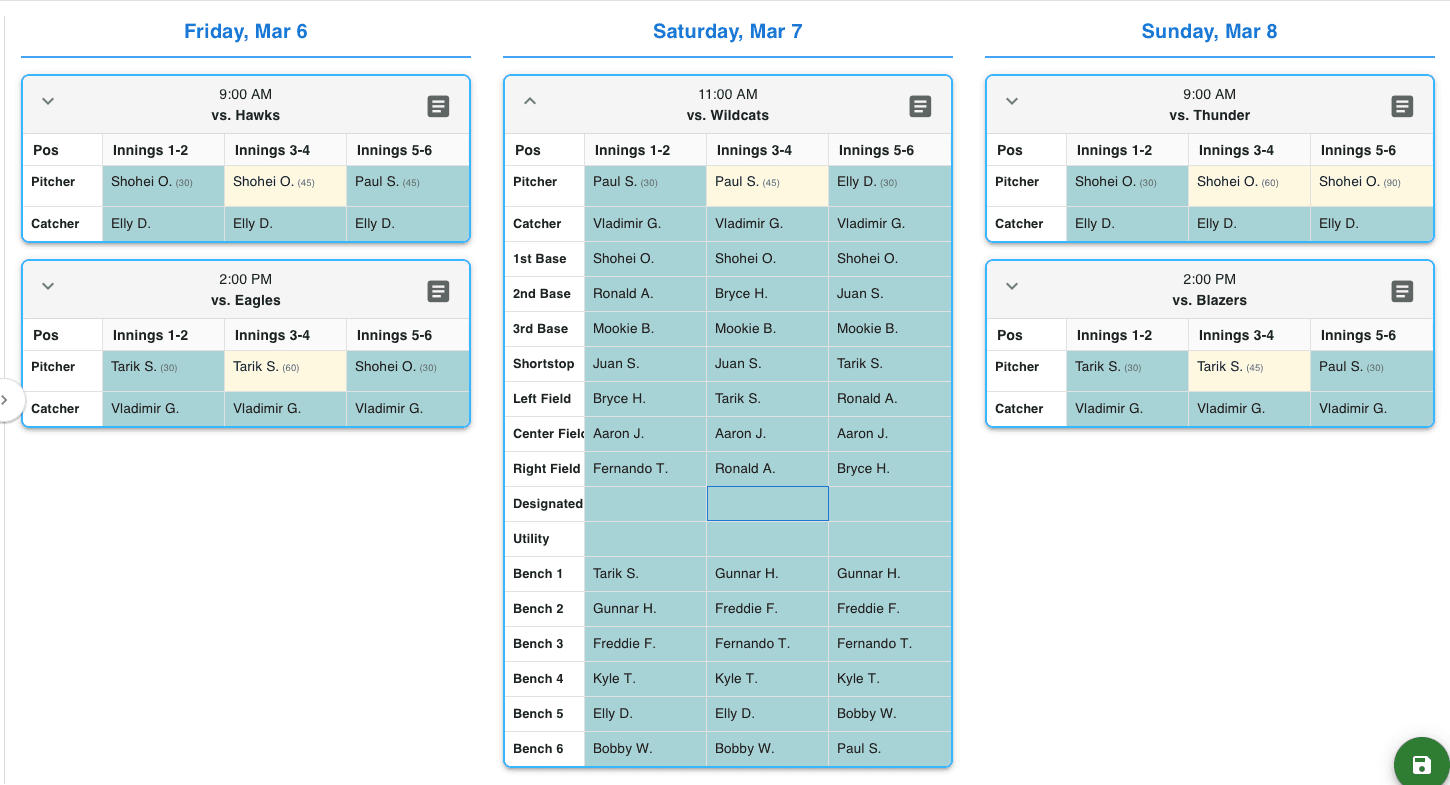
Rizzler's tournament planner lets you model these scenarios before they happen. Change a pitcher's workload in game one and see the cascading impact on games two through five in real time.
Step 6: Track Actuals and Adjust After Every Game
The plan will change. A pitcher might throw 15 more or fewer pitches than targeted. A game might get shortened by weather or extended by a tie. After every game, update actual pitch counts and recalculate availability for remaining games.
This is where most paper-and-pen systems break down. You're between games, exhausted, trying to do rest-day math on a whiteboard while also getting your team ready for the next game. Rizzler does the recalculation automatically: update the actuals and see the new availability grid immediately.

Common Tournament Pitching Mistakes
Burning your ace in pool play. You'll hear coaches say "we need to win this game to get a good seed." Maybe. But if winning that game costs you your ace for the bracket, you traded a good seed for a worse team in elimination rounds.
Not tracking catcher innings. The catcher-to-pitcher rule catches coaches off guard in tournaments. A kid who caught four innings on Saturday morning can't pitch Saturday afternoon in most leagues. Track it →
Planning for maximum pitch counts. If your pitcher is allowed 85 pitches, planning for him to throw 85 leaves zero margin. Target 65-70 and treat the extra pitches as emergency reserves.
Forgetting about rest days that cross into next week. A pitcher who throws 66+ pitches on Sunday needs 4 rest days and isn't eligible again until Friday. If you have a league game on Tuesday or Thursday, that matters.
How Rizzler Makes This Easier
Rizzler's tournament planning tool automates the hardest parts of this process:
- Enter your tournament schedule and Rizzler creates the multi-game view
- Assign pitchers to games and see rest-day impact across the weekend immediately
- Set your league rules and Rizzler enforces pitch count limits and rest requirements
- Model "what if" scenarios before the tournament starts
- Update actuals between games and get instant recalculations
- Track catcher innings and flag catcher-to-pitcher conflicts
Frequently Asked Questions
How many pitchers do I need for a tournament weekend?
Plan for at least 4-5 viable arms for a 3-game weekend and 5-7 for a 5+ game tournament. Depth is the difference between managing a tournament and surviving one.
Should my ace pitch in pool play?
Generally, no, or only in a limited role. Save your ace for the games that matter most. Use pool play to get your depth pitchers work. See a full weekend plan in action →
How do rest days work across tournament games?
Rest day requirements vary by league. In Little League, a pitcher throwing 66+ pitches needs 4 rest days. In USSSA, the rules are different. Rest day rules by league →
Can pitchers pitch back-to-back games?
It depends on the league and the pitch count. Under Little League rules, a pitcher may not appear in a second game on the same day; other leagues set their own limits on same-day work. On consecutive days, a pitcher is only available if his first outing stayed under the pitch count threshold that triggers a rest day. Back-to-back game strategies →
This is part of Rizzler's Tournament Planning Guide, the complete resource for managing multi-game weekends.
Rest-day math is unforgiving, and doing it on a whiteboard between games is where plans fall apart. The tournament planner handles it on the Coach and Club plans, and a free account gets you started.
Talk to our team
Want to spend more time coaching and less time with paperwork? Let's talk.
Tell us about your team and we'll show you how to plan games, set lineups, run the schedule, and develop players in one place, so you spend the season coaching instead of chasing admin.
Less admin, more coaching
Plan games, set lineups, and track the season in one place
Keep every family in the loop automatically
Tell us about your program
4 fields · takes 30 seconds
Lands in the same inbox as the Help button · human response only
Read Next
Strike Percentage: The Youth Pitching Development Stat
StatsHow to Run a Basketball Tryout: A Coach's Step-by-Step Guide
LearnTravel Baseball Age Chart 2026: Every League's Cutoff
RulesHow to Run a Cheer Tryout: A Coach's Step-by-Step Guide
LearnLittle League Substitution Rules: Re-Entry, Free Subs & More
RulesRizzler Sports Product Overview: Web App, iOS App & Free Tools
Blog