
Stats
Batting Stats: Definitions, Formulas & What They Mean
Batting stats measure offensive performance: AVG tells you how often a player gets a hit, OBP how often they reach base, SLG how much power they hit with, and OPS combines the last two into one number. This is the hub for every batting stat tracked in youth baseball, with links to detailed breakdowns, formulas, and age-appropriate context for each one.
Quick Reference
| Stat | Formula | What It Measures | Guide |
|---|---|---|---|
| Batting Average (AVG) | Hits ÷ At-Bats | How often a batter gets a hit | Batting average explained |
| On-Base Percentage (OBP) | (H + BB + HBP) ÷ (AB + BB + HBP + SF) | How often a batter reaches base (any way) | OBP explained |
| Slugging Percentage (SLG) | Total Bases ÷ At-Bats | A batter's power and extra-base hitting | SLG explained |
| OPS | OBP + SLG | Combined on-base ability + power | OPS explained |
| Strikeouts (K) | Count of strikeouts | How often a batter strikes out | Strikeouts explained |
| Quality At-Bat (QAB) | QABs ÷ Total At-Bats | Whether at-bats are productive, regardless of outcome | QAB explained |
Which Batting Stats Matter Most?
It depends on what you're trying to measure, and at what age.
For measuring offensive value: OPS is the best single number. It combines a player's ability to reach base (OBP) and hit for power (SLG). At 12U and above, OPS is more predictive of offensive contribution than batting average.
For measuring plate discipline: OBP is better than batting average because it credits walks and hit-by-pitches. A player who walks frequently is disciplined at the plate, and that matters.
For coaching youth players: Quality At-Bat (QAB) might be the most useful stat because it rewards process, not just outcomes. A hard line drive that's caught is a QAB. An 8-pitch at-bat that ends in a walk is a QAB. This reframes offensive assessment around what the batter can control. The Coach's Guide to Quality At-Bats covers it in depth.
For identifying development areas: Strikeout rate shows plate discipline and pitch recognition. A player who strikes out in 40% of at-bats at 12U needs a different coaching plan than one who strikes out 15% of the time.
How Rizzler Uses Batting Stats
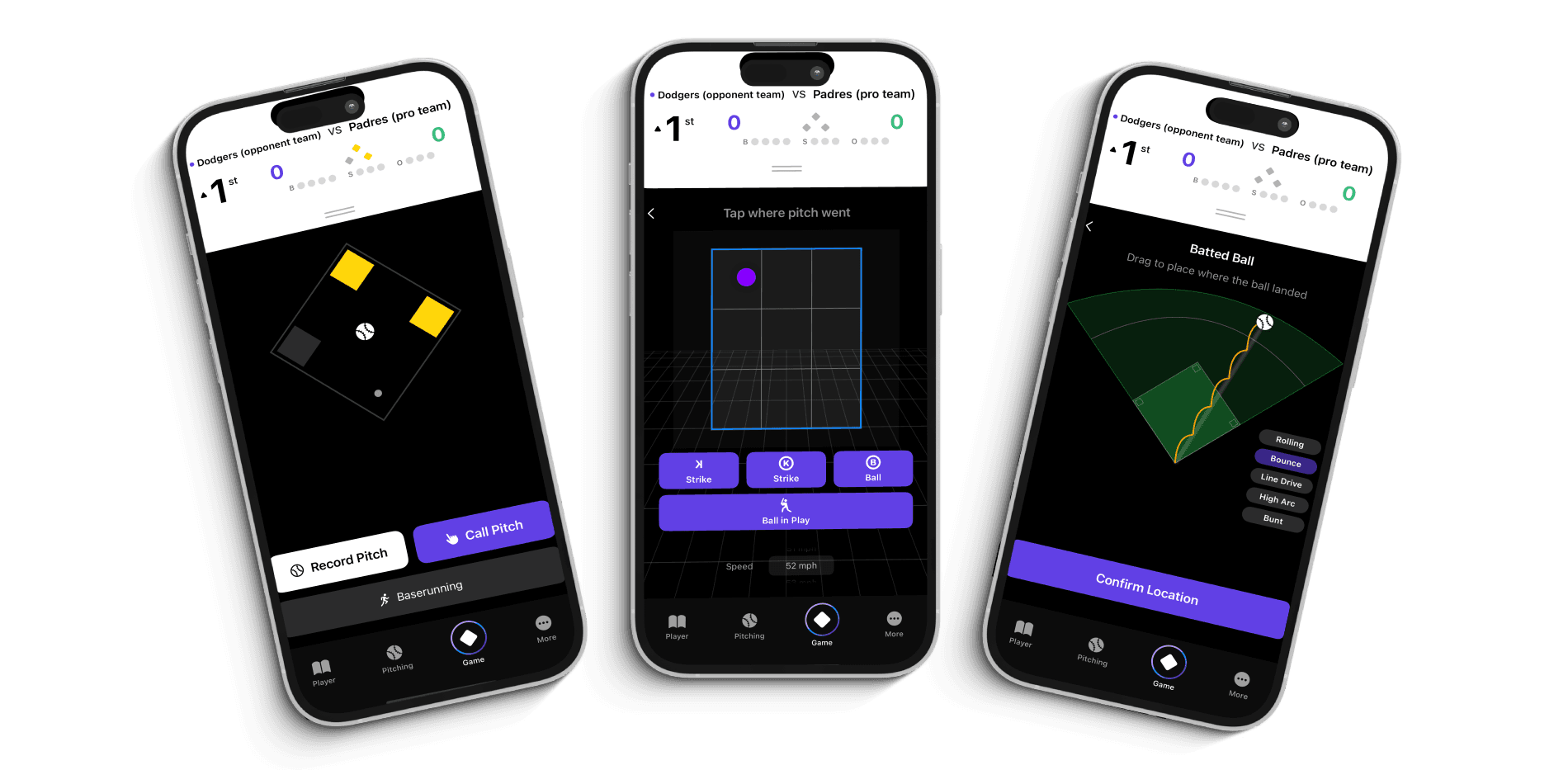
Rizzler's AI Batting Order, available on the Coach and Club plans, uses batting stats to generate optimized lineups. The AI weighs OBP for top-of-the-order spots (getting on base), SLG for middle-of-the-order spots (driving in runs), and strikeout rate for matchup considerations.
Score games in Rizzler on any plan. On Coach and Club, you can also import stats from GameChanger or a CSV file, so the AI has the data it needs to build lineups that reflect your players' actual performance rather than just your gut feeling.
Batting Stats by Age Group
Different ages need different emphasis. Here's a starting point:
| Age | Focus On | Don't Worry About |
|---|---|---|
| 8U-9U | Making contact, having fun, effort | Batting average, OPS, any rate stat |
| 10U-11U | Contact rate, walks, QAB | Slugging, power stats |
| 12U | OBP, QAB, strikeout rate | Exit velocity (unless travel ball) |
| 13U-14U | OPS, QAB, exit velocity | None; all stats are fair game |
Average batting stats by age has typical ranges for each level.
Frequently Asked Questions
What's a good batting average for a youth player?
It varies dramatically by age and competition level. At 10U rec ball, .400 is solid. At 14U travel, .300 is strong. The age benchmarks page linked above has full ranges.
What's the difference between OBP and AVG?
Batting average (AVG) counts only hits divided by at-bats. On-base percentage (OBP) counts every way a batter reaches base: hits, walks, and hit-by-pitches. OBP is the more complete number, and at the youth level it's usually the more important one. A player who hits .250 but walks often might have a .380 OBP; that's more valuable than a .300 hitter who never walks. Full breakdowns: batting average and OBP.
Should I track QAB for my team?
Yes, especially at 10U and above. QAB is the stat that best captures whether a player is having productive at-bats, even when the scoreboard doesn't show it.
Every stat on this page calculates automatically when you score games in Rizzler.
Read Next
How to Run a Track and Field Tryout: A Coach's Step-by-Step Guide
LearnHow to Run an Ice Hockey Tryout: A Coach's Step-by-Step Guide
LearnStrikeouts (K): Batting Stat Definition & Youth Context
StatsGameChanger Alternatives: 7 Options Compared for 2026
ComparisonHow to Build a Batting Order for 9U-10U Baseball
LearnStrike Percentage: The Youth Pitching Development Stat
Stats