
Learn
How to Coach T-Ball Without Losing Your Mind (or the Kids)
Coaching t-ball comes down to three rules: keep every kid moving, teach one thing at a time, and end every activity before the kids want it to end. You are not coaching baseball yet. You are running a movement class with baseball props for 4 to 6 year olds whose attention span is roughly one minute per year of age. Accept that, plan around it, and t-ball is the most fun you will ever have with a whistle. Fight it, and you will spend the spring pleading with an outfield that is picking dandelions.
Most t-ball coaches are parents who raised a hand at a signup meeting. This guide is the season you would want handed to you: what these kids can actually learn, how to structure a practice that works, a full worked practice plan, and how to survive game day.
What can 4 to 6 year olds actually learn?
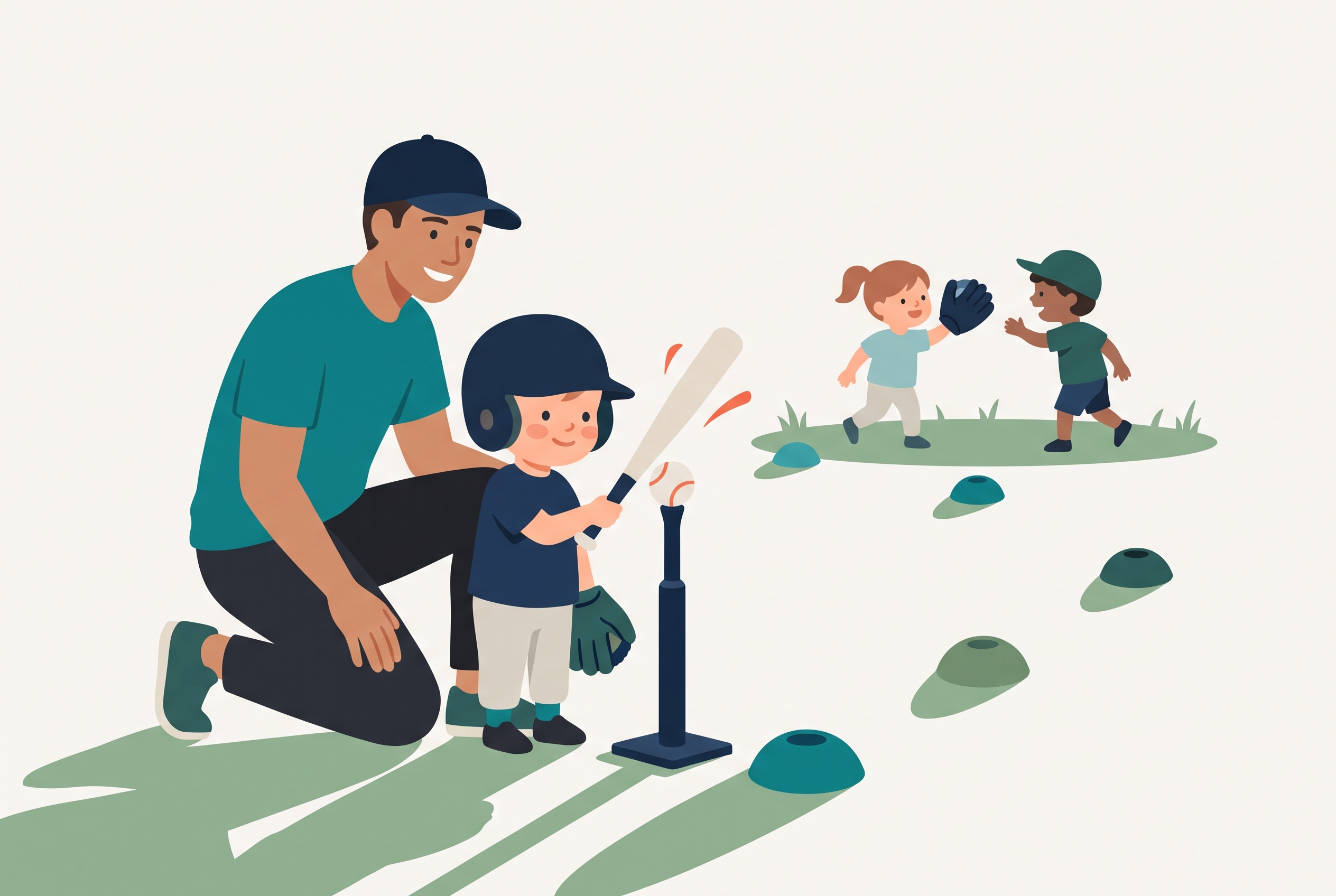
Four skills, and that is the whole season: hit off the tee with a full swing, throw with their body turned sideways, field a rolled ball with two hands, and run the bases in the right order. A kid who leaves t-ball doing those four things had an excellent season, and a coach who teaches those four things did an excellent job.
What they cannot do yet is just as important, because it tells you what to skip. Most 4 to 6 year olds cannot reliably catch a thrown ball out of the air, so never build a drill that depends on it, and warn your parent helpers to roll or bounce, not throw. They cannot track outs or force plays, so do not explain them. They cannot stand in a line for four minutes without inventing a sword fight. Little League's own Tee Ball curriculum is built around this reality: short stations, constant movement, everything is a game.
One more truth veteran t-ball coaches accept early: the swing matters more than the result. A full, aggressive swing that misses is better than a timid poke that dribbles fair. Cheer the swing.
How should you structure a t-ball practice?
Use stations. One hour, split into a warm-up and three or four small-group stations of 8 to 10 minutes each, with kids rotating on a loud, cheerful signal. Stations solve the two problems that sink first-year coaches: lines (a station of four kids means everyone gets constant reps) and attention (the activity changes before anyone melts down).
Stations require parent helpers, and this is where a new coach should be shameless. You need one adult per station, and the ask is easy because no baseball knowledge is required: roll grounders, flip soft toss, high-five. Recruit at your first parent meeting by naming the job out loud. "I need three adults every Tuesday. You do not need to know baseball. If you can roll a ball, you are qualified."
A few rules that hold every practice together:
- Every kid gets a ball or a glove in hand within 2 minutes of arriving. Early arrivals play catch-with-a-parent or hit off a tee. Idle kids find trouble.
- Demonstrate, never lecture. Show the sideways throw. Say "turn like a helicopter." Do not explain rotational mechanics to a five-year-old.
- One teaching point per station per week. This week's tee station teaches "squish the bug" with the back foot. That is it. Next week, "hands together."
- End with a scrimmage-ish game and a cheer. The last ten minutes are the reason they come back Tuesday.
A worked 60-minute t-ball practice plan
Here is a real first-month practice, timed to the minute, for a roster of 12 with three parent helpers. Steal it as-is for week one.
| Time | Activity | Detail |
|---|---|---|
| 5:30 to 5:38 | Arrival + freeze tag warm-up | Kids drop bags, grab gloves, play freeze tag in the outfield grass. Legs warm, wiggles out. |
| 5:38 to 5:42 | Huddle + one demo | Coach shows today's single teaching point: fielding a rolled ball with "alligator hands," two hands chomping. Ten seconds of words, three demos. |
| 5:42 to 5:52 | Station 1: Alligator grounders (4 kids) | Parent rolls slow grounders from 15 feet. Kid fields with two hands, runs it back, drops it in the bucket. Count catches out loud; kids love a number. |
| 5:52 to 6:02 | Station 2: Tee hitting (4 kids) | Coach runs this one. Five swings each off the tee into a fence or net, rotate. Teaching point: swing hard, no bunts, cheer the misses. |
| 6:02 to 6:12 | Station 3: Base-running relay (4 kids) | Parent at home plate. Two teams race: home to first on one whistle, full circuit on two. Teaches the base order without a single word of explanation. |
| 6:12 to 6:22 | Rotate all groups through remaining stations | Each group hits the two stations it has not seen. Yes, this compresses the math: shave a minute per station and keep it moving rather than keeping it exact. |
| 6:22 to 6:28 | Everybody-runs scrimmage | Whole team in the field, coach hits three balls, everyone chases (they will anyway), batter runs to first. Three batters, then switch the batting group next week. |
| 6:28 to 6:30 | Huddle, cheer, hand stamps | Name one kid who did the teaching point well. Team cheer. Stamp hands if you want a stampede of joy. |
Notice what is missing: no laps, no lines longer than four kids, no drill longer than ten minutes, and no activity that requires catching a thrown ball.
How do you survive t-ball game day?
Lower the stakes and choreograph the chaos. T-ball games are practices with jerseys, and the coaches who enjoy them treat them that way. Three things to prepare before the first game:
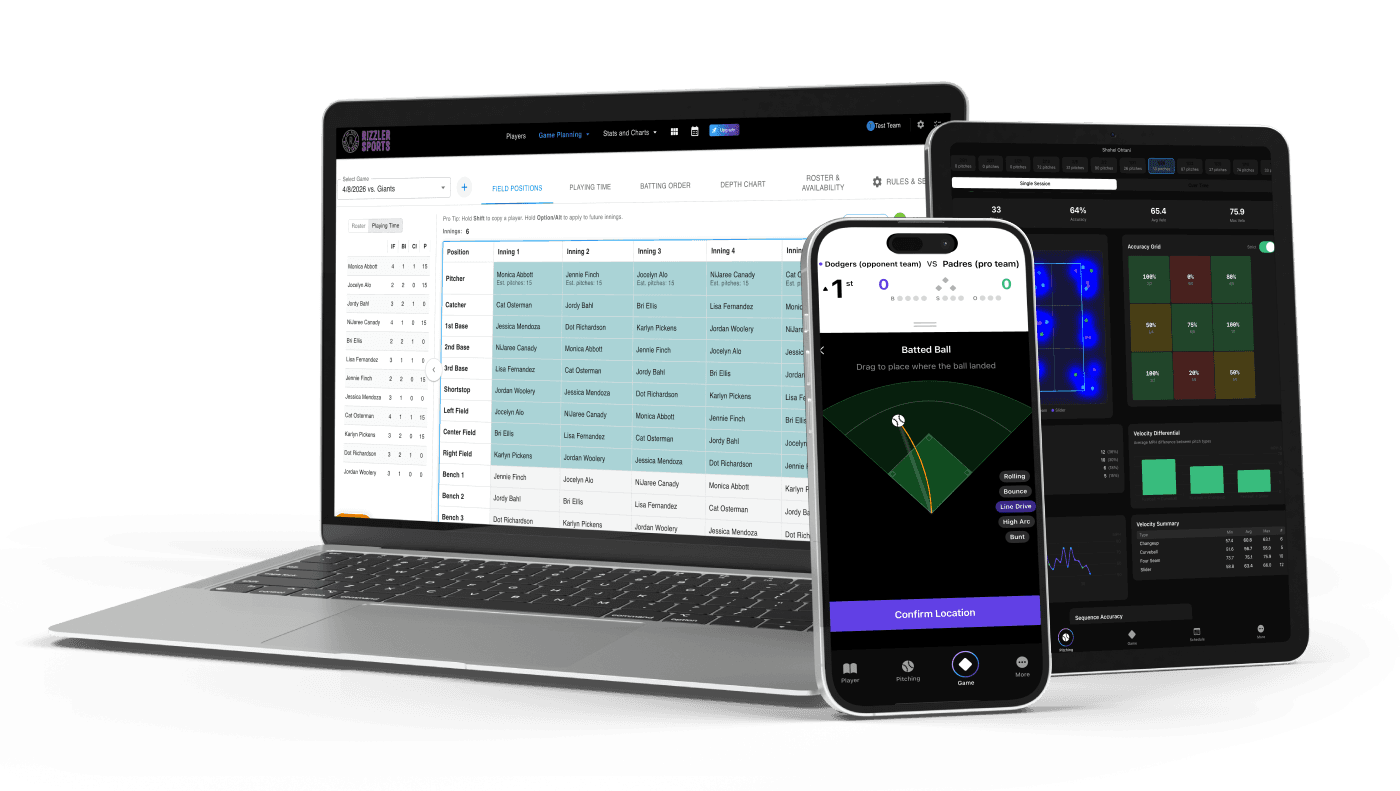
A batting order that rotates. Everyone bats every inning in most rec leagues, so the fairness issue is who bats first and who plays where. Rotate both mechanically so no parent can perceive favorites: this week's leadoff hitter bats last next week, infielders move to outfield. Rizzler's game planning tools handle lineups and printable lineup cards on the Free plan, which for t-ball mostly means one thing you will treasure: the rotation is written down somewhere other than your memory, and you can print it and hand it to the dugout parent.
A dugout parent. One adult whose entire job is keeping the next two batters helmeted and in order. This role, more than any tactical decision, determines whether the game feels calm.
Field positions with names, not explanations. Put a cone where each fielder stands. "Stand on your cone until the ball is hit" replaces four minutes of explaining positioning that will not survive contact with a butterfly.
The other half of game-day survival is knowing who is coming. Nothing unravels a t-ball Saturday like discovering at 8:50 that only six kids showed for a 9:00 game. A team app where parents RSVP to every event fixes this by Wednesday instead of Saturday morning. In Rizzler, availability and RSVP are free on every plan, parents get the whole season synced to their phone calendar, and you can see the headcount before you pack the equipment bag. When you set up your team, turning on RSVPs is the single highest-value five minutes of admin you will do all spring.
What matters by the end of the season
Two numbers, and neither is a score: how many kids improved at the four skills, and how many kids sign up again next year. If you want a simple frame for how you will make decisions all season, write down a coaching philosophy first, even three sentences. For t-ball it can be as short as: everyone plays everywhere, we cheer effort and full swings, and every kid leaves wanting more baseball.
Keep your practice plans in a template you reuse, swap one station a week, and by June you will look like a veteran. When the team moves up to coach pitch, the 8U baseball practice plan is the next step, and the baseball practice plans page covers every age after that. And when a couple of your players age up and want more, whether that is kid-pitch, tryouts, or just more reps at home, you will already know the families and the tools.
Frequently Asked Questions
What should I teach first in t-ball?
Fielding a rolled ball with two hands and hitting off the tee with a full swing. Those two skills give every kid something to do on every play and make the games feel like baseball. Sideways throwing and base order come next. Skip anything that depends on catching a thrown ball, because most 4 to 6 year olds are not developmentally there yet.
How long should a t-ball practice be?
One hour, once or twice a week. Structure it as a short warm-up, three or four stations of 8 to 10 minutes with no more than four or five kids per station, and a fun whole-team game at the end. Attention spans at this age run out around the ten-minute mark, so change activities before that happens, not after.
How many parent helpers do I need for t-ball?
One adult per station, so typically three per practice for a roster of about twelve. They need zero baseball knowledge; the jobs are rolling grounders, managing a tee line, and cheering. Recruit at the first parent meeting by describing the job that plainly, and you will get volunteers who would never have signed up to "help coach."
Do t-ball games keep score?
Most rec leagues do not keep official score at t-ball, and coaches should not either. Every kid bats each inning, everyone plays the field, and outs are usually celebrated and then ignored. The season's real scoreboard is skill growth and how many kids come back next year.
What app do t-ball coaches use to organize the team?
A team management app that handles the roster, the schedule, and RSVPs covers everything a t-ball coach needs. Rizzler's Free plan includes all three, including calendar sync so parents get every practice on their phone and self-serve RSVPs so you know your Saturday headcount by midweek, plus lineups and printable lineup cards when you want the batting rotation on paper.
Ready to spend your season coaching instead of chasing RSVPs?
Running a league full of t-ball teams and first-year coaches? Our team can help.
Talk to our team
Want to spend more time coaching and less time with paperwork? Let's talk.
Tell us about your team and we'll show you how to plan games, set lineups, run the schedule, and develop players in one place, so you spend the season coaching instead of chasing admin.
Less admin, more coaching
Plan games, set lineups, and track the season in one place
Keep every family in the loop automatically
Tell us about your program
4 fields · takes 30 seconds
Lands in the same inbox as the Help button · human response only
Read Next
Rizzler vs Blue Sombrero: Coaching Platform vs League Administration
ComparisonTop Approaches to Building a Baseball Batting Order
LearnHow to Coach Youth Basketball: A Practical Guide
LearnPitching Stats: Every Mound Stat Explained for Coaches
StatsFielding Stats: Defensive Numbers Explained for Coaches
Stats6-2 Volleyball Rotation: All 6 Rotations Explained
Volleyball