Volleyball Passing Drills That Survive a Real Serve
Passing drills earn their court time when three things are true: every ball has a target a setter could actually play, reps come fast enough that nobody stands in line longer than they play, and something gets counted. The eight drills below are ordered from technique to chaos, each with its purpose, setup, steps, the cue that fixes the most common mistake, and how to scale it up or down by age. They train the platform skill itself; the team-formation side of first contact, who stands where against a real server, lives in the companion serve receive drills guide.
Scoring Passes: The 3-2-1 Habit That Makes Every Drill Better
Before the drills, the measuring stick, because most of them use it. Chart every pass 3, 2, or 1: a 3 lands at the target with all attacking options alive, a 2 is playable but limits the offense, a 1 merely keeps the ball off the floor. Team average above 2.2 is strong youth passing; your libero candidates will announce themselves on this chart within a week. Call scores out loud during drills and players start scoring themselves, which is the point.
Drill 1: Platform Ladder (Technique Warm-Up)
Purpose. Groove platform shape and angle control before adding distance or a serve.
Setup. Pairs, one ball, starting three meters apart. No net needed.
Volleyball · Passing
Platform Ladder
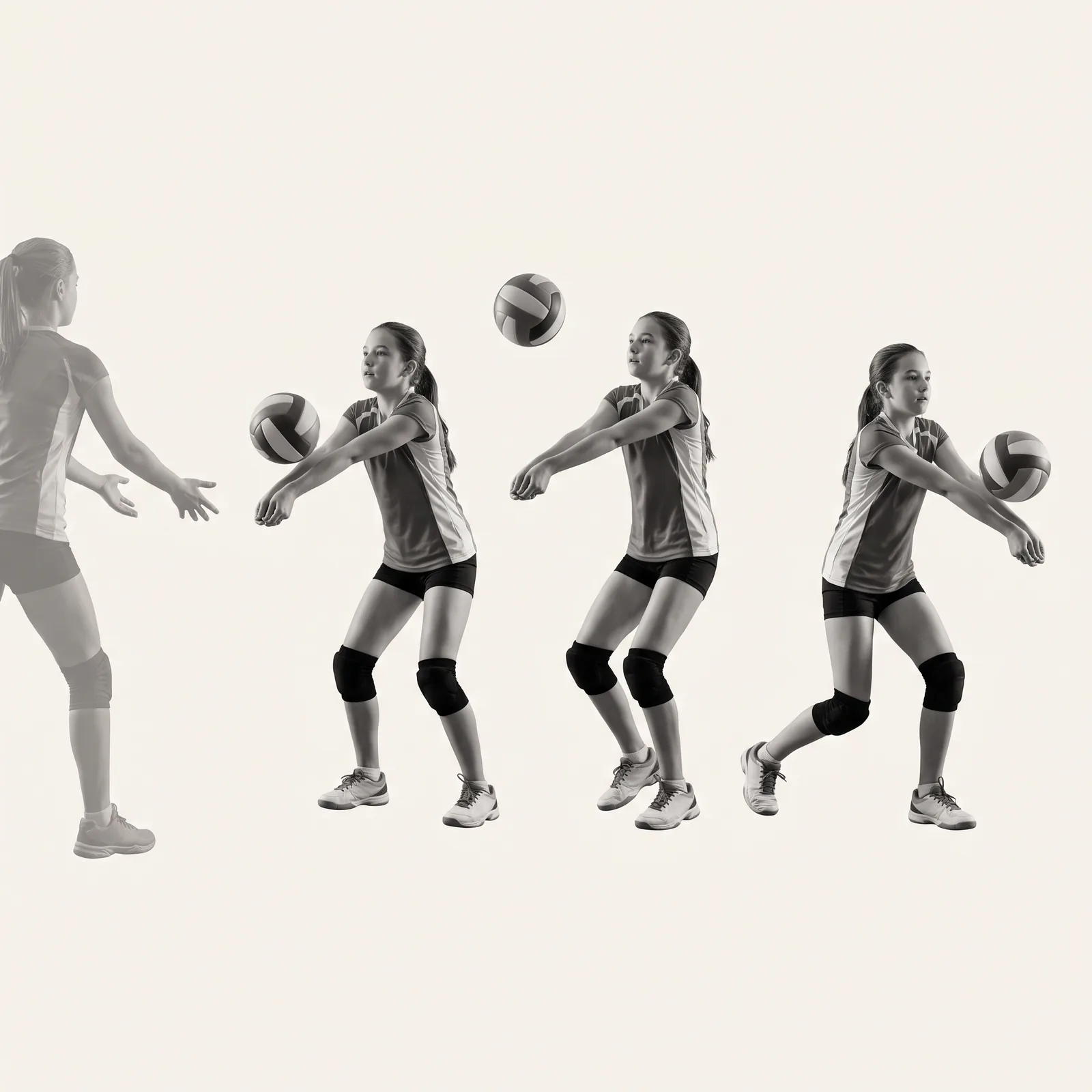
Pairs three to five metres apart: toss, controlled platform pass back, then add a shuffle step.
Steps. Rung one: partner tosses, passer returns off the platform, ten controlled passes. Rung two: step back to five meters, repeat. Rung three: passer must pass off a shuffle step left or right. Rung four: continuous pass-to-pass with no catch. Miss a rung's standard, repeat the rung.
Coaching cues. "Angle, don't swing": the platform's tilt aims the ball; arms stay quiet. "Face the ball, angle to target" starts mattering at rung three, when the feet arrive turned.
Common mistakes. Swinging arms to generate distance (fix at rung two: make distance with legs), and reaching instead of shuffling (fix at rung three: no pass counts if the feet never moved).
Age fit. All ages; beginners may live on rungs one and two for weeks, and the full ladder is a clean four-minute warm-up for varsity. The entry-level version of this progression, with catches between contacts, is in the beginner drills.
Drill 2: Pass and Weave
Purpose. Train seam decisions and re-forming coverage, the thing that actually causes youth shanks.
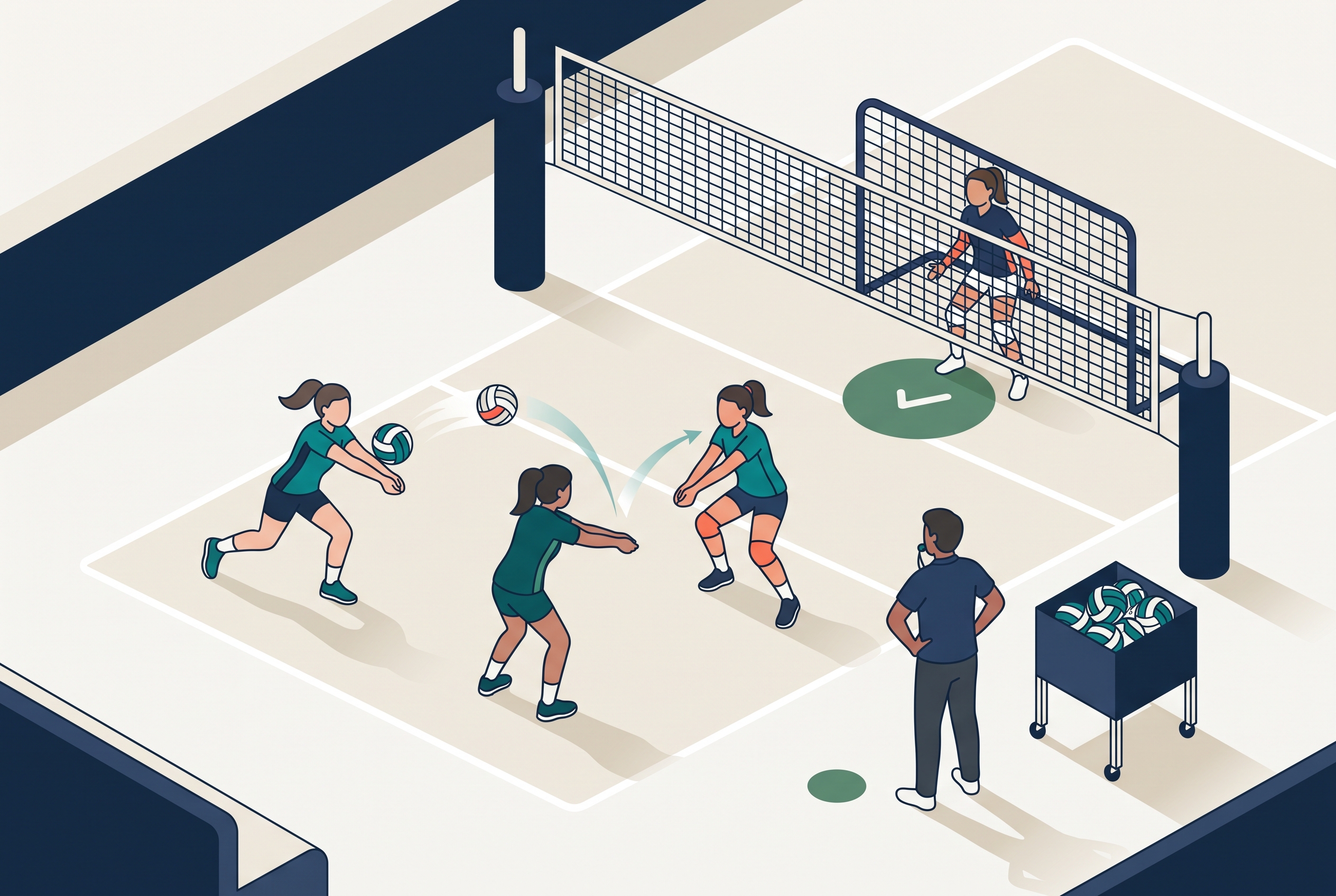
Setup. Three passers across the back court, one coach (or server) across the net, a target at the setter's spot. One ball in play, a cart behind the coach.
Volleyball · Passing
Pass and Weave
Coach feeds three back-row passers; the one who passes sprints behind the other two and re-enters on the far side while the seams re-form.
0:00 / 0:56
Steps. Coach initiates a down-ball or serve at the trio. Whoever passes sprints behind the other two and re-enters on the far side; the remaining two immediately re-negotiate the seams for the next ball, which comes within three seconds. Run waves of 12 balls, rotate a new trio in, and post each trio's 3-2-1 average.
Coaching cues. "Call early, call loud": the "mine" call must come before the ball crosses the net. New seam partners talk before the next serve, two words minimum ("my line").
Common mistakes. The weaving passer jogging her re-entry (the next seam forms without her, teaching the wrong lesson), and silent seams. Score a team-wide 1 for any untouched ball that lands in a seam, and silence cures itself.
Progressions. Feed faster, then serve live from the endline, then add a fourth zone of court to cover.
Age fit. 12U with coach tosses; middle school and up with real serves.
Drill 3: Serve Grid Passing
Purpose. Put passing under real serve pressure and produce a chartable score for every player, the drill that doubles as tryout and libero-selection data.
Setup. Split the far court into six zones with towels or tape. Three passers in receive spots, one target at the net, servers with a ball cart across the net.
Serve Grid Passing
Steps. Servers serve in turn, calling their zone target before contact (which trains them too; this drill is stolen jointly from our serving drills). Passers play every ball to the target; a scorer charts each pass 3-2-1 next to the passer's name. Twenty serves per trio, then rotate. Post averages where the team can see them.
Coaching cues. "Beat the ball, then pass": feet set before contact. For the scorer: chart honestly, a 2 that flatters nobody helps nobody.
Common mistakes. Passers creeping forward as servers tire; keep the trio honest by having servers alternate short and deep. Also charting only the trio's total; per-player numbers are the entire value.
Progressions. Restrict serves to seams only. Then let servers serve at will, no called zone, and watch whether communication holds.
Age fit. From 12U (coach serves) through varsity (live jump-float serving).
Drill 4: Shuttle Passing Lines
Purpose. High-volume movement passing: pass, follow, repeat, with no standing.
Setup. Two lines of three players facing each other, eight meters apart, one ball per shuttle.
Volleyball · Passing
Shuttle Passing Lines
Two lines of three face each other 8 m apart; each front player passes high, then sprints to the back of the opposite line.
0:00 / 0:40
Steps. Front player of line A passes to the front player of line B, then sprints to the end of line B. B passes back to the next player in A and follows the ball likewise. Count consecutive controlled passes as a group; restart on a drop. First shuttle to 25 wins.
Coaching cues. "Pass high, run after": the arc buys the next passer time, and the follow-run cannot leave before the pass is away, which quietly enforces a full finish.
Common mistakes. Flat passes that turn the drill into a reaction contest. Raise the required arc (over an imaginary two-meter line) until rhythm returns.
Progressions. Overhead passing only; then alternate platform and overhead by call.
Age fit. Every age; this is the standard filler drill that should replace lap-running whenever a practice block ends early. It also needs zero coach involvement, which makes it a favorite home-assignment pattern in Rizzler Reps with a wall standing in for the second line.
Player development
Track development all season, not just on tryout day
Score skills through the season, watch the trend lines move, and send parents a progress report they actually open.
Drill 5: Chaos Passing (Two Balls)
Purpose. Train vision and recovery: passing when the next ball is already in the air.
Setup. One passer mid-court, coach at the net with a cart, second coach or player tossing from an angle. Two balls alternate with no fixed rhythm.
Chaos Passing (Two Balls)
Steps. Coach one initiates a down-ball; the instant the passer releases it, coach two tosses to a different spot. Eight contacts per turn, then rotate. Score 3-2-1 and count recovery steps out loud.
Coaching cues. "Eyes up on the release": the passer's eyes leave the passed ball early to find the next one. It feels rude; it is the skill.
Common mistakes. Feeding a predictable left-right-left pattern (players start guessing) and running turns too long; quality collapses after about eight contacts, and the drill teaches nothing when it does.
Progressions. Extend to twelve contacts for conditioning blocks; add a third feeder at varsity.
Age fit. 13U and up. Younger players need the single-ball drills above until platform shape survives movement.
Drill 6: Three-Touch Tempo Passing
Purpose. Connect passing to what follows it: every pass becomes a set becomes a catch, so passers learn what their 3s and 2s actually buy the offense.
Setup. Passer, setter at target, catcher at the left antenna. Coach initiates from across the net.
Three-Touch Tempo Passing
Steps. Coach down-balls to the passer; setter plays whatever the pass allows; catcher catches the set at the antenna. Rotate after eight. The scoring rule that makes it work: the pass earns a 3 only if the setter could set a quick, a 2 if only high outside, a 1 if the setter played it with her platform or a scramble.
Coaching cues. For the passer: "give her hands," meaning the pass arrives at the setter's forehead height at the target spot. This drill is where the setter's and passer's training meet, and running it honestly teaches both.
Common mistakes. Letting the setter chase 1-passes into beautiful saves; that hides the pass grade the drill exists to reveal. The setter plays what the pass deserves.
Age fit. Any team with a functioning setter; for beginners substitute a catching target at the setter spot.
Drills 7 and 8: Make It a Game
Amoeba scoring. Any passing drill above becomes a game by giving the group a collective target: 20 team points where 3-passes count 3, 2s count 2, 1s count 1, and a shank subtracts 3. The subtraction is what teaches; suddenly the low-percentage heroic play matters less than the boring perfect one.
Passing king of the court. Two trios on one court, coach alternates serves to each side; the trio with the better charted average after ten balls holds the court, challengers rotate on. Losers serve the next round, which keeps everyone in the drill and sneaks in serve volume. Cap it at 15 minutes and it will be the block your team asks for by name, and a natural finisher for the practice plan your session is built on.
Between Practices
Passing is the most wall-trainable skill in volleyball: platform ladder rungs one and two, wall passing streaks, and shuttle passing against a garage door all need one ball and ten minutes. Coaches on Rizzler assign exactly these through Rizzler Reps, where players log reps and streaks between sessions, and the player evaluation template's passing category (platform control, footwork to the ball) gives you the formal 1-to-5 score to check against the 3-2-1 charts these drills produce. Chart, assign, re-evaluate: the passing average moves inside a month.
Frequently Asked Questions
What are the best volleyball passing drills?
For technique, the platform ladder; for seams and communication, pass and weave; for real serve pressure with chartable results, serve grid passing; for volume, shuttle lines. Together they cover the four things passing requires: shape, decisions, pressure, and repetitions.
How do you make passing drills game-like?
Add a live server, an honest 3-2-1 chart, and consequences shared by the team, like amoeba scoring where shanks subtract points. Game-like is less about scrimmaging and more about pressure plus a score someone cares about.
How many passing reps should a practice include?
A youth practice should put 60 to 100 charted passes on each primary passer, which two 12-minute blocks from this page comfortably deliver. Below that, passing stays a talent; above it, passing becomes a skill.
What is a good passing average on the 3-2-1 scale?
Above 2.2 wins most youth matches; 2.0 is serviceable; below 1.8, serve receive is deciding your sets and deserves the next three practices. Chart per player, not just per team, and the lineup decisions get much easier.
What passing drills work at home?
Platform ladder rungs against a wall, wall-passing streaks, and shuttle passing with the wall as a partner. Ten minutes daily moves a passer more than any single practice; teams on Rizzler assign these through Rizzler Reps so home reps get logged instead of promised.
Talk to our team
Want to see how to develop players all season long? Let's talk.
Tell us about your team and we'll show you how season-long skill tracking becomes the progress report a parent opens, while players keep building between practices with Rizzler Reps.
Track skills all season, not just on tryout day
Turn evaluations into reports parents actually open
Players build habits between practices with Rizzler Reps
Tell us about your program
4 fields · takes 30 seconds
Lands in the same inbox as the Help button · human response only