Setting Drills: Hands for Everyone, a Training Plan for Your Setter
Setting drills split into two jobs that most drill lists blur together. Every player needs functional hands, because every rally eventually asks a non-setter to deliver a settable ball. Your setter needs far more: footwork from every corner of the court, location under fatigue, back sets, and decisions. This page covers both, technique drills for the whole gym first, then the setter-specific training block, with diagrams for the drills where geometry is the content. The drills assume you know who your setter is; if you are still choosing, the traits worth testing are in our positions guide.
The Standard Every Drill Enforces
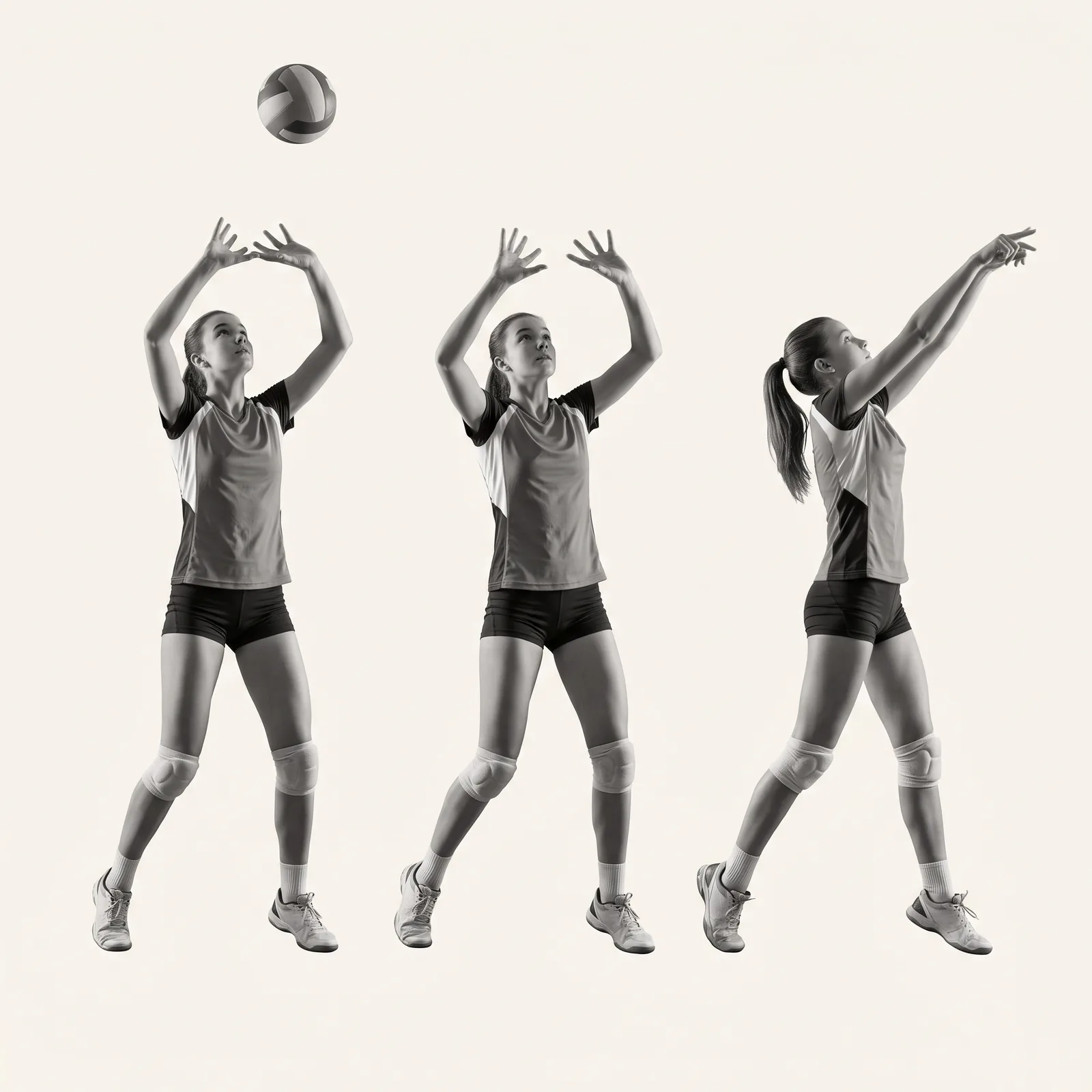
Hands above the forehead, ball contacted on all ten fingers in the shape it will leave in, wrists releasing forward, no spin worth mentioning, and shoulders square to the left antenna at delivery. Spin is the tell: a clean set floats with lazy rotation, while a slapped or thumbed ball spins hard. You can hear the difference too; a good set is nearly silent. Coach the sound and the spin, and the hand mechanics fix themselves.
Setting Technique for the Whole Team
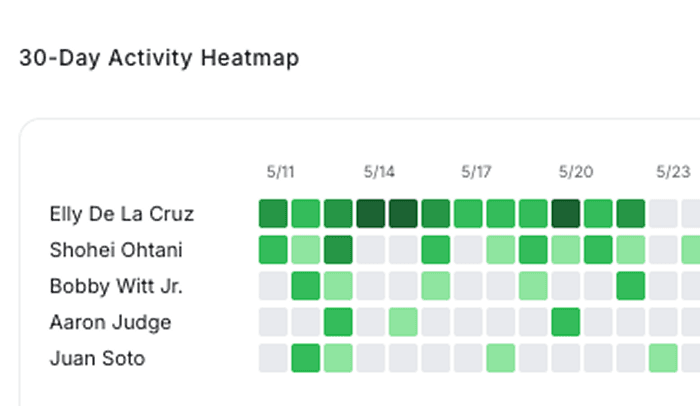
Wall setting ladder. Each player, a ball, a wall, a target spot above net height. Ten clean sets to the spot, step back, repeat; then set-bounce-set on the move; then alternate one high and one low quick set to build touch. Purpose: hand shape and rhythm at high volume with zero organization cost. Common mistake: drifting hands to the chest as fatigue arrives; end the set (the drill, not the ball) when hands drop, since tired reps groove exactly the fault you are trying to remove. Age fit: everyone, forever; this is the number one at-home assignment, and the natural one to log through Rizzler Reps.
Volleyball · Setting
Setting Technique
Hands above the forehead, extend through the ball, finish toward the target.
Partner set streaks. Pairs four meters apart, continuous setting, counting the streak out loud, restart on any catchable wobble. Progress the distance, then require a self-set before each delivery (set to yourself, then to your partner), which doubles contact volume and teaches ball-height discipline. Beginners can start with the catch-and-shape version described in our beginner drills.
Triangle setting. Three players in a triangle, seven meters apart, setting in sequence; on the coach's call ("reverse!") the direction flips. The direction change forces re-squaring the shoulders every contact, which is the drill's actual content. Score consecutive clean rotations of the triangle as a group.
The Setter Block: Footwork Before Hands
A setter's errors are usually footwork errors that show up in her hands. These three drills, run in this order, build the movement base:
Footwork square.
Volleyball · Setting
Setter Footwork Square
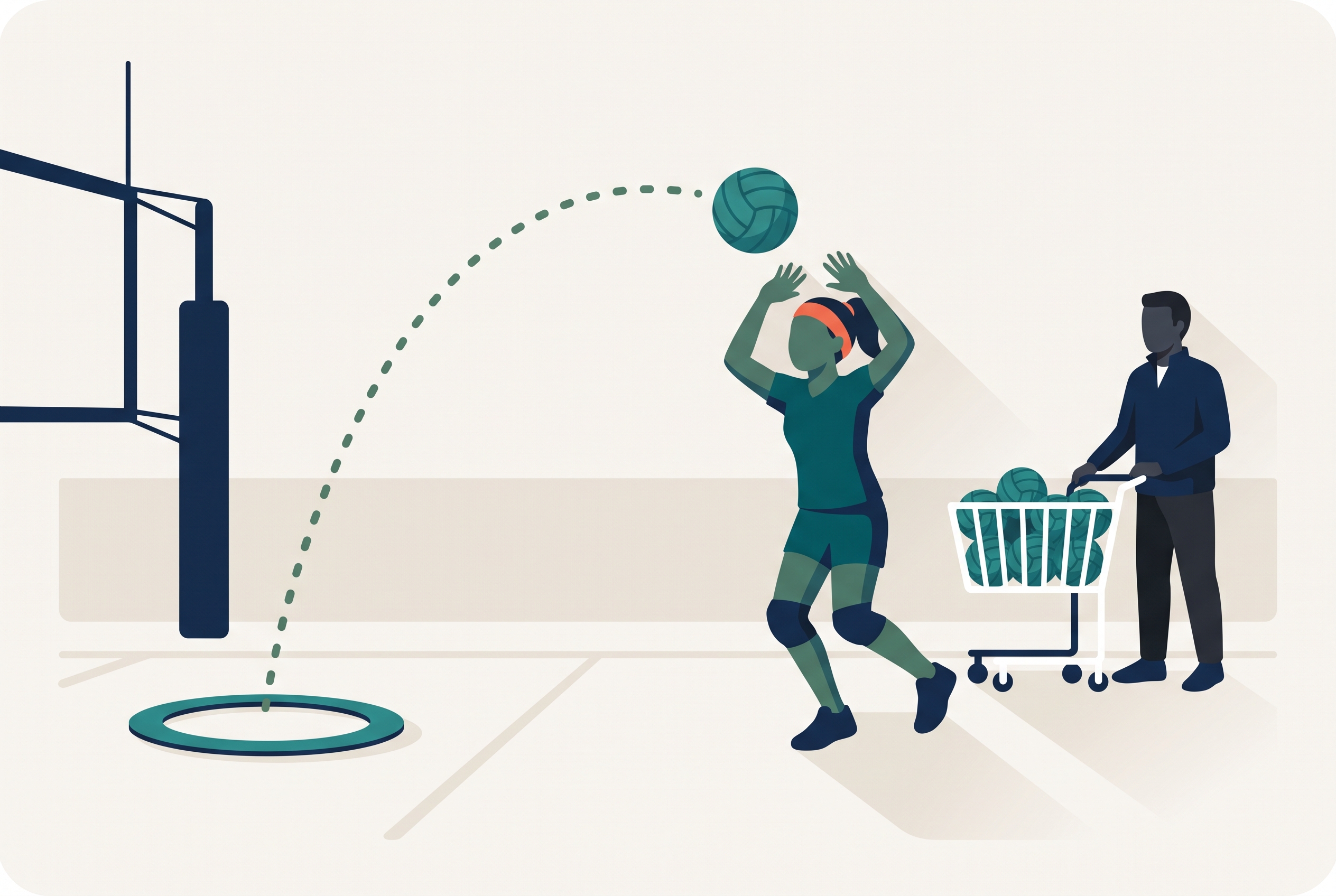
Four cones in a 3 m square by the setter's spot; the setter runs to the tossed cone, squares to the left antenna, sets high outside.
0:00 / 1:04
Purpose. Arrive-and-square mechanics from every direction. Setup. Four cones in a three-meter square near the target zone; coach with a ball cart mid-court. Steps. The setter starts at a random cone; coach tosses to a different cone's airspace; setter moves, squares shoulders to the left antenna, and delivers high outside. Eight balls per turn, four turns. Coaching cues. "Right foot closes": arriving with the right foot planted last squares the hips without thinking about it. Common mistakes. Setting while still drifting; require a full beat of stillness at contact, and give up a rep of speed for it. Progression. Coach calls the target ("four!" "back!") mid-flight. Age fit. Any dedicated setter from about 11 up.
Release sprints. The match-specific version of footwork: the sprint from serve-receive hiding spots to the target.
Setter Release Sprint
Purpose. Make the three back-row release runs automatic before they meet a live pass. Setup. Cones at the three legal hiding spots your system uses, right-back corner, the zone 6 stack, and deep zone 5, plus a passer and a coach serving free balls. Steps. Setter starts at a cone, coach serves to the passer, setter releases at contact and sets the pass high outside. Six from each spot. Score sets a hitter could attack. Coaching cues. "Release on contact, not before": leaving early is the overlap whistle every ref is watching for, as the 5-1 serve receive guide diagrams rotation by rotation. Common mistakes. Practicing only the short release; the zone 5 diagonal is the one that decides matches, so it gets double reps. Age fit. Required from the first season a team runs a back-row setter, which is exactly the transition covered in the 6-2 system guide.
Chase and square. Coach tosses balls progressively farther from the target; the setter chases, squares mid-scramble, and delivers something attackable. Purpose: the out-of-system save that separates match setters from practice setters. Score deliverable balls, not pretty ones; a squared-but-stumbling delivery to the antenna beats a balanced ball to nowhere.
Player development
Track development all season, not just on tryout day
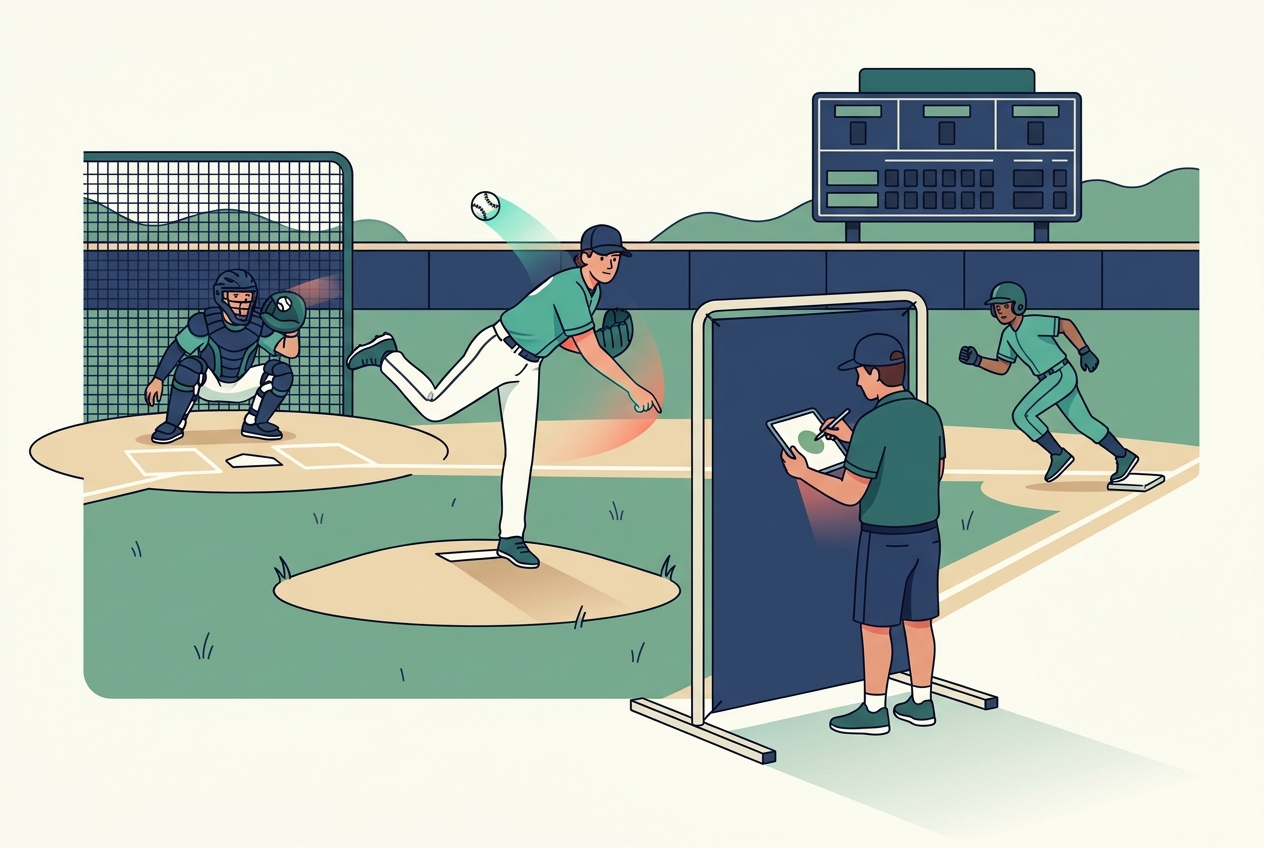
Score skills through the season, watch the trend lines move, and send parents a progress report they actually open.
Location, Back Sets, and Decisions
Target setting.
Target Setting
Purpose. Turn "good hands" into "repeatable location," the difference hitters actually feel. Setup. Hoops (or chairs with towels) at the three delivery spots: outside antenna, middle quick zone, right-side back-set lane. Feeder tosses passes of varying quality. Steps. Ten sets per spot, scored on landings in or on the hoop. Chart it: location percentage per spot per week is the single most motivating number a young setter can own. Coaching cues. For the back set: "hips through, eyes level," pushing the hips forward under an unchanged eye line, so the back set stays disguised. Common mistakes. Perfect feeds; a setter who only sets 3-passes is a passenger on match night, so feed her 2s and 1s on purpose. Progression. Call the spot after the toss is up. Age fit. From 12U up; hoop targets make it a favorite even younger.
Setter's choice, hitters live. Three hitters at the pins and middle, live pass in, setter chooses her target against a two-person block. Score decisions, not kills: a good choice into a stuff block counts, a bad choice that lands does not. This is where a setter starts running an offense rather than taking turns, and where her volleyball IQ shows up as a measurable thing rather than a vibe.
Second-ball scoring. Five minutes a week: front-row setter, live pass, and her only options are a dump or a back set. Defenses at youth level forget the setter can score; setters at youth level forget it too. The 6-1 framing of a setter as a sixth attacker starts in this drill.
A Weekly Setter Plan That Fits Real Practices
Most teams cannot give the setter a private hour, so split the block: ten minutes of footwork square or release sprints while the team warm-ups run, target setting integrated into every hitting line (the setter is setting anyway; put hoops down and chart it), and one five-minute decision block (setter's choice or second-ball scoring) inside the team's practice plan. Wall ladder and partner streaks go home as Reps assignments. That is roughly 200 quality contacts a week without costing the team a single shared minute, and the volleyball evaluation template's setting category (clean hands, location, decision making) gives you the mid-season checkpoint to prove it is working.
Frequently Asked Questions
What are the best volleyball setting drills?
Wall setting ladders for hand shape, footwork squares and release sprints for movement, target setting with hoops for location, and setter's choice for decisions. The order matters: hands, then feet, then location, then judgment.
What drills should a setter do every day?
Wall ladder (fifty contacts), footwork square (five minutes), and target setting at three spots (thirty contacts). Daily hands plus weekly decision work under live blocks is the standard development recipe for youth setters.
How do you train a setter's footwork?
Two drills carry the load: the footwork square, which teaches arriving and squaring from any direction with the right foot closing, and release sprints from the three serve-receive hiding spots, which make the match-specific runs automatic before they meet live passes.
What setting drills can be done at home?
Wall ladders, self-set streaks, and set-bounce-set on the move; a garage ceiling substitutes for a target hoop. Coaches on Rizzler assign these through Rizzler Reps so the daily fifty contacts get logged rather than assumed.
How is training a setter different from teaching setting?
Everyone learns hand shape and delivery; a setter additionally trains footwork from every corner, location under fatigue, back sets, and decision-making against live blocks. Roughly, the team learns technique while the setter learns a job.
Talk to our team
Want to see how to develop players all season long? Let's talk.
Tell us about your team and we'll show you how season-long skill tracking becomes the progress report a parent opens, while players keep building between practices with Rizzler Reps.
Track skills all season, not just on tryout day
Turn evaluations into reports parents actually open
Players build habits between practices with Rizzler Reps
Tell us about your program
4 fields · takes 30 seconds
Lands in the same inbox as the Help button · human response only