Rizzler Sports Logo
How it WorksPricingLearnFree Lineup Generator
Learn

14U Baseball Practice Plans: JV, High School, and Travel
A 14U baseball practice plan is built for the full-size field, and it differs from younger plans in three ways: pitchers work on a throwing schedule instead of whenever there is time, hitters face situations instead of just pitches, and baserunners have 90 feet and real leads to work with. This page has two complete plans, a 90-minute practice for 13U, 14U, and JV teams and a 120-minute practice for high school varsity and 15U to 18U travel teams. Both open in the free baseball practice planner, where you can change the length, swap a block, and print a one-page coach sheet.
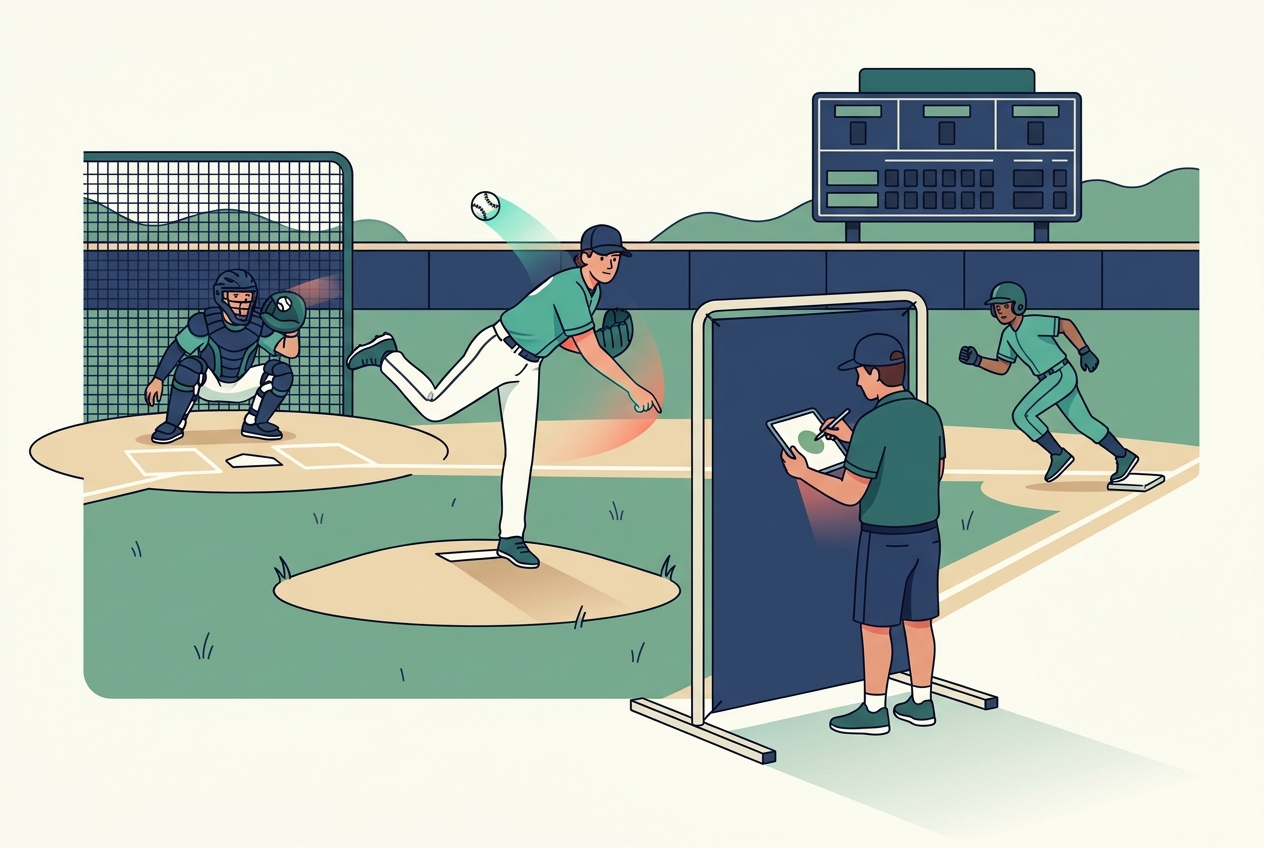
High school baseball pitcher throwing from a full-size mound to a catcher while a coach charts pitches on a tablet and a runner takes a lead off first base

The 90-Minute 14U and JV Practice Plan

The 14U and JV plan gives 26 minutes to arrival, warm-up, and throwing, 57 minutes to three core blocks (bullpens, live situational batting practice, and baserunning), and 7 minutes to arm care.
Baseball practice plan · 13-15 (13U-14U, junior high)

14U and JV Baseball Practice Plan (90 Minutes)

90 min · 7 segments

  1. 0:00

    8 min

    Short-Hop Hands Pairs

    Arriving players pair up for rolled ground balls and short hops — glove work with no throwing arm stress.

    Arrival
  2. 0:08

    8 min

    Dynamic Warm-Up Lines

    Whole-team dynamic movement lines: jogs, skips, lunges, shuffles, and arm circles across the outfield.

    Warm-Up
  3. 0:16

    10 min

    Throwing Progression Ladder

    Structured partner throwing that builds from wrist flips to long toss with a target-hitting focus.

    Warm-Up
  4. 0:26

    15 min

    Bullpen Strike Challenge

    Pitchers compete in a counted-strike bullpen game while catchers train receiving — measurable and competitive.

    Core
  5. 0:41

    30 min

    Live BP: Situations & Reads

    Controlled BP where defense plays every ball live and baserunners make real reads — three skills in one block.

    Core
  6. 1:11

    12 min

    Baserunning Reads & Dirt Balls

    Runners at every base react live to coach reads: dirt balls, steals, first-to-third, and tag-ups.

    Core
  7. 1:23

    7 min

    Cooldown Stretch & Arm Care

    Easy jog, partner stretching, and light arm-care holds to bring heart rates down and protect throwing arms.

    Cooldown

Equipment: gloves, bucket of balls, cones, one ball per pair, catcher's gear or strike-zone target nets, balls, chart sheets and pencils, portable mound or flat ground markers, L-screen, two buckets of balls, bats, helmets, bases, a few balls, light resistance bands (optional, 13+)

Change the length, swap modules for your age group, print a one-page coach sheet, and share it by link. No login.

Customize this plan free →Save to my account
Short-Hop Hands Pairs (8 minutes). Arrival glove work: rolled ground balls and short hops in pairs, with no throwing. Arms at this age carry heavier loads than they did a year earlier, and the arrival block should not add to them.
Dynamic Warm-Up Lines (8 minutes) and Throwing Progression Ladder (10 minutes). The ladder now reaches 120 feet or more for position players. Pitchers follow their own day: a light catch day after an outing, a full long-toss day in the middle of the week.
Bullpen Strike Challenge (15 minutes). Only the pitchers scheduled to throw that day. Each throws 25 to 30 pitches in counted groups, fastballs first and then the second pitch, with catchers working on receiving and blocking. Position players use the same 15 minutes for ground balls and fly balls at their positions.
Live BP: Situations and Reads (30 minutes). The center of the practice. The defense plays every ball live, runners start on base and read the ball off the bat, and each hitter gets a job before the round: move the runner from second with no outs, score him from third with fewer than two, hit and run, two-strike approach. One block trains hitting, defense, and baserunning at game speed, which is why it replaces traditional batting practice.
Baserunning Reads and Dirt Balls (12 minutes). Runners at every base react to a coach's reads: dirt balls, steal jumps, first-to-third decisions, and tag-ups. On 90-foot bases a good secondary lead and a quick dirt-ball read are worth more than raw speed.
Cooldown Stretch and Arm Care (7 minutes). Partner stretching and band work, and a check on every arm that threw a bullpen.

The 120-Minute High School Varsity Plan

The varsity plan adds a dedicated pitcher fielding block, runs a hitting circuit and live situational batting practice on the same day, and ends the defensive day with 21 Outs at full speed.
Baseball practice plan · 16-18 (high school, 16U-18U)

High School Baseball Practice Plan (120 Minutes)

120 min · 8 segments

  1. 0:00

    10 min

    Trickle-In Tee & Net

    Early arrivers rotate through tee-and-net swing stations at their own pace before practice starts.

    Arrival
  2. 0:10

    10 min

    Dynamic Warm-Up Lines

    Whole-team dynamic movement lines: jogs, skips, lunges, shuffles, and arm circles across the outfield.

    Warm-Up
  3. 0:20

    12 min

    Throwing Progression Ladder

    Structured partner throwing that builds from wrist flips to long toss with a target-hitting focus.

    Warm-Up
  4. 0:32

    15 min

    PFP: Pitcher Fielding Practice

    Classic PFP: comebackers, covering first, bunt plays, and 3-1 flips at game speed with quick lines.

    Core
  5. 0:47

    25 min

    4-Station Hitting Circuit

    Tee, front toss, live BP, and dry-work stations running at once — every hitter swinging, nobody in line.

    Core
  6. 1:12

    20 min

    Live BP: Situations & Reads

    Controlled BP where defense plays every ball live and baserunners make real reads — three skills in one block.

    Core
  7. 1:32

    20 min

    21 Outs Team Defense

    The classic: defense must record 21 clean outs off coach fungos with live situations — one error resets the count.

    Core
  8. 1:52

    8 min

    Cooldown Stretch & Arm Care

    Easy jog, partner stretching, and light arm-care holds to bring heart rates down and protect throwing arms.

    Cooldown

Equipment: tees, hitting nets or fence screens, buckets of balls, bats, helmets, cones, gloves, one ball per pair, fungo bat, bucket of balls, bases, catcher's gear, L-screen, portable cage or toss screen, nets, whistle or air horn, two buckets of balls, helmets for runners, light resistance bands (optional, 13+)

Change the length, swap modules for your age group, print a one-page coach sheet, and share it by link. No login.

Customize this plan free →Save to my account
Arrival, warm-up, and throwing (32 minutes). Easy tee swings, dynamic lines, and a throwing progression that reaches long toss for position players. Pitchers follow their own day.
PFP with position work beside it (15 minutes). Pitchers field comebackers, cover first, and handle bunts. Catchers block and throw to second, middle infielders work double-play feeds, corners work bunt defense, and outfielders work drop steps and throws to bases.
4-Station Hitting Circuit (25 minutes) and Live BP (20 minutes). The circuit gives mechanical reps, and Live BP turns them into at-bats with a purpose. Bullpens run on a separate mound during these blocks, scheduled by each pitcher's rest days.
21 Outs (20 minutes). The count resets on an error, and the situations rotate through cutoffs and relays, first-and-third defense, bunt coverages, and rundowns.
Arm care (8 minutes). Bands, stretching, and a check on every arm that threw.
A high school staff of three can split this plan cleanly: one coach with pitchers and catchers, one with infielders and the hitting circuit, and one with outfielders and baserunning.

What Changes on the Full-Size Field

Most players move to 60 feet 6 inches and 90-foot bases at 13 or 14. Little League's Junior division and most 14U travel divisions play full size, and some 13U divisions use an intermediate 54/80 field for a year. The throw from third to first grows from about 85 feet on a 60-foot diamond to about 127 feet, the pitching distance grows by roughly 6 to 14 and a half feet depending on the field a player is coming from, and the outfield gaps get wider.
Practice has to account for that in three ways. Give arms a longer ramp: a full throwing progression every practice, and no max-effort throws in the first week on the big field. Rebuild infield footwork, because a fielder who could be flat-footed at 60 feet now needs momentum through the throw. And reset expectations for pitchers. Velocity that dominated from 46 or 50 feet is ordinary from 60 feet 6 inches, so the bullpen emphasis moves to strike percentage and a second pitch the pitcher can throw for a strike.
Bats change as well. High school rules require BBCOR certification on non-wood bats, and wood is also legal. Travel organizations set their own bat standards by age division: some allow lighter drop weights at 13U and in some 14U divisions, while others require BBCOR at 14U. Check the rules of the body you play under before the season.

Pitch Limits and the Throwing Schedule

Above 12U, pitching rules depend on where you play. Little League limits pitchers aged 13 to 16 to 95 pitches in a day with required rest. The MLB and USA Baseball Pitch Smart guidelines recommend 95 a day for ages 13 to 16 and 105 for ages 17 and 18, with rest days tied to the count. Many travel and showcase events adopt Pitch Smart, some set their own limits, and some leave it to the coach. High school limits are set by each state association, so they differ from state to state. The pitch count rules comparison puts them side by side.
Whatever the rule, plan the practice week from the pitching schedule outward. Write down who threw on the weekend and how many pitches, who starts the next game, and therefore who throws a bullpen today, who plays long toss, and who only plays light catch. A pitcher's bullpen two days before a start should be short, 20 to 25 pitches. The arm-care block at the end of practice is where the staff hears about soreness before it becomes an injury.

Ready to take your game to the next level?

School Season vs. Travel Season

A high school team practices five or six days a week for a season of about three months, so each practice can carry one narrow focus and the week covers everything: bunt defense Monday, first-and-third Tuesday, situational hitting Wednesday. The 120-minute plan above is one of those days.
A travel or showcase team at 15U to 18U may practice twice a week and then play four to six games on a weekend. Build its week backward from the pitching: a recovery and light-throw day first, a bullpen day for the arms that are rested, and a short team-defense walk-through before travel. The 90-minute plan above fits that slot, with the bullpen list changing each week. Conditioning and strength work happen on the players' own time. Many players are on both kinds of team in the same year, so ask about the other team's schedule before you plan a heavy throwing day.

Using Game Data to Pick the Focus

Older players can act on information. If the charts show your pitchers falling behind in the count, the week's bullpens are about first-pitch strikes. If your hitters are rolling over outside pitches, the tee and front toss stations work the outer half. Pitch charting and hit charting in Rizzler record that data during games, and the pitch counting and charting overview shows how counts and charts connect.

Build Your Own 14U or High School Practice Plan

Open either plan in the free baseball practice planner with the "Customize this plan" button under it. Choose the 13-15 or 16-18 age group and the library shows the modules built for older players, including live situational batting practice, bullpens, pitcher fielding practice, and 21 Outs. Print the one-page coach sheet or share the plan with your staff by link. No login is required. The baseball practice plan template includes a filled 120-minute high school example.
Save a plan to a free Rizzler account and it lands in Practice Manager, attached to a practice on your schedule with RSVP counts, station assignments for each coach, and an equipment list. The baseball practice plans hub covers every age, and the 12U plan covers the last year on the small field.
Running a high school program, a travel organization, or a league? We will set up practice planning, tryouts, and evaluations for every team and show you how much staff time it saves.

Talk to our team

Want to spend more time coaching and less time with paperwork? Let's talk.

Tell us about your team and we'll show you how to plan games, set lineups, run the schedule, and develop players in one place, so you spend the season coaching instead of chasing admin.

  • Less admin, more coaching

  • Plan games, set lineups, and track the season in one place

  • Keep every family in the loop automatically

Tell us about your program

4 fields · takes 30 seconds

Lands in the same inbox as the Help button · human response only

Frequently Asked Questions

How long should a 14U baseball practice be?

Ninety minutes to two hours. Ninety minutes fits a travel team that practices twice a week; two hours suits a school team that needs bullpens, a hitting circuit, and team defense in the same session.

What is different about practice at 13U and 14U?

The field. Most players move to 60 feet 6 inches and 90-foot bases, so practices need a longer throwing progression, new infield footwork, scheduled bullpens, and baserunning with leads and secondary leads.

What does a JV baseball practice plan look like?

Arrival glove work, a dynamic warm-up, a throwing progression, bullpens for the scheduled pitchers with position work beside them, 30 minutes of live situational batting practice, baserunning reads, and arm care. That is the 90-minute plan on this page.

How should a travel baseball team practice between tournaments?

Plan around the weekend's pitch counts. Early in the week, focus on recovery and light throwing; midweek, run scheduled bullpens and situational hitting; the day before travel, keep it short and sharp with a walk-through of team defense.

How many pitches should a high school pitcher throw in a bullpen?

Between starts, 25 to 40 pitches is typical, shorter when the next start is close. Count bullpen pitches as part of the week's workload and follow your state association's rest requirements for game pitches.