
Basketball
Youth Basketball Drills by Age, 8U Through High School
A youth basketball drill earns its minutes when every player has a ball or a job, it isolates one skill long enough for a correction to land, and it ends with something that counts, a make total, a tag, a stop. This library is organized by the four grade groups a basketball coach actually plans for: 8U (grades 2 and 3), grades 4 through 6, middle school (grades 7 and 8), and high school (grades 9 through 12, JV and varsity). Each group gets the drills we would not cut, with the setup, the reps, and the one cue that fixes the most common mistake. The drills marked with a library name are the same modules the free basketball practice planner drags onto a timed plan, so the page and the tool agree on what the drill is called and how long it runs.
At a Glance: What Each Grade Group Can Handle
The ball, rim, and practice-length standards for the grade-school groups come from the USA Basketball and NBA youth guidelines, which also bar zone defense below age 12. Middle school and high school teams play under their division's rulebook, NFHS for school teams.
| Grades | Ball and rim | Practice length | Drill shape that works | Skip for now |
|---|---|---|---|---|
| 8U (grades 2-3) | Size 5 (27.5 in), 8 ft rim where possible | 30 to 60 minutes, one practice a week | Every player with a ball, games with a rule, blocks of 6 to 8 minutes | Zone defense, three-pointers, set plays, lines longer than three |
| Grades 4-6 | Size 6 (28.5 in), 9 ft rim where possible | 45 to 75 minutes, two practices a week | Pairs and stations, 1v1 and 3v2 decisions, form shooting tracked by makes | Zone defense, full-court press, five-out offense installs |
| Grades 7-8 (middle school) | Full-size ball for the division (28.5 in girls, 29.5 in boys under NFHS), 10 ft rim | 60 to 90 minutes, two to four practices a week | Shell defense, live closeouts, 3v3 and 4v4 with constraints, 70 to 90 percent of drill time against a defender | Conditioning without a ball, anything run 5v0 for more than ten minutes |
| Grades 9-12 (high school, JV and varsity, AAU 16U-17U) | 28.5 in girls, 29.5 in boys, 10 ft rim | Most school teams practice daily in season, usually 90 to 120 minutes; state associations set the season and contact limits | Shell with screens, advantage and disadvantage transition, scout-team defense, game-speed shooting with make targets | Long lines, drills with no score or clock, teaching a new concept the day before a game |
Two numbers carry across every level. A drill is pitched right when players succeed six or seven times out of ten; much higher and they coast, much lower and they quit on it. And the youngest group on this page is 8U: a seven-year-old playing up on an 8U team runs the same drills, with no separate curriculum below it.
8U (Grades 2-3): A Ball in Every Hand
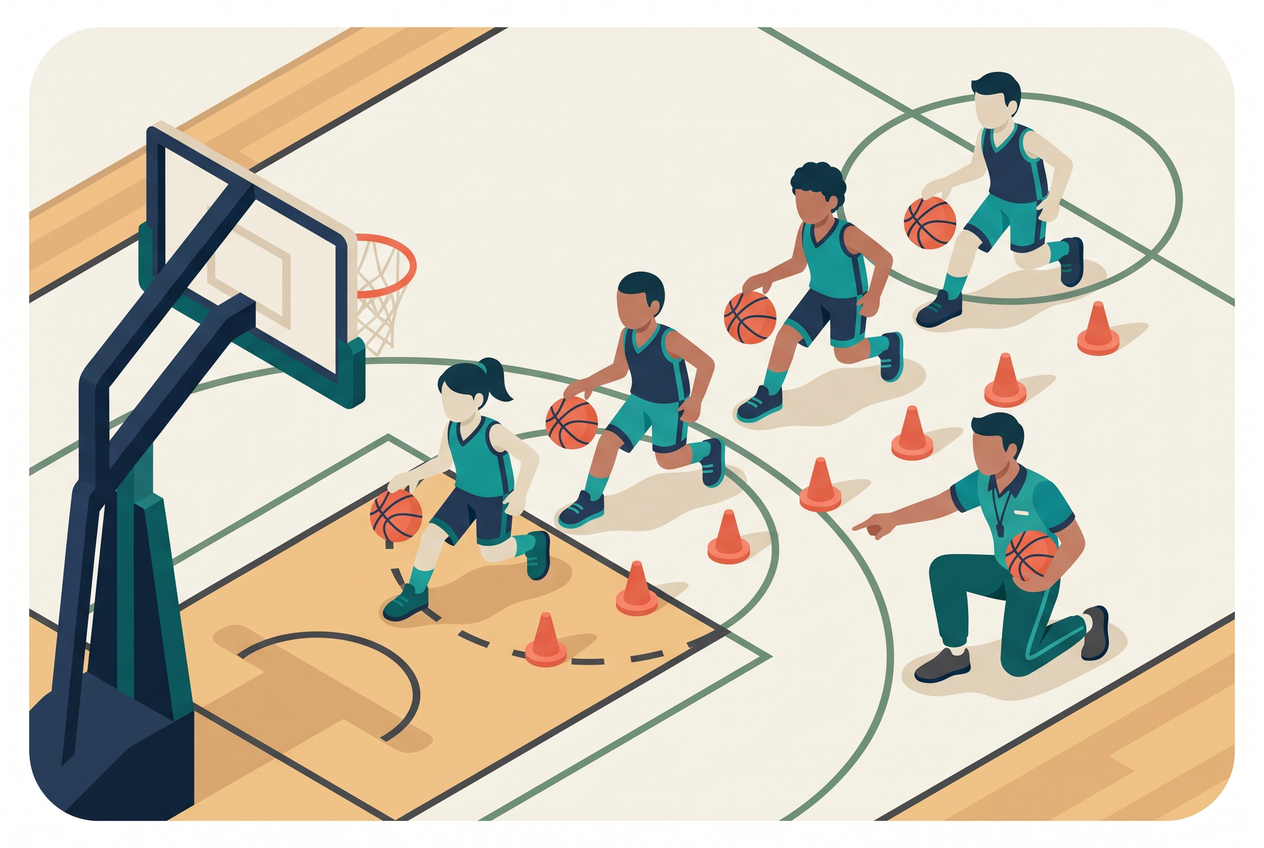
At this age the fight is with the ball itself. The goal of every drill is touches, not technique lectures, and the coaching happens one cue at a time while the group keeps moving. Keep every block under eight minutes, keep lines at two or three deep, and rename every drill a game.
Dribble Tag Zone (library module, 8 minutes). Cone off the lane for a small group or half court for a full team, every player with a ball. Everyone dribbles continuously inside the zone and tries to tag another player's ball or body while protecting their own; losing the dribble or leaving the zone costs a point. Shrink the zone every two minutes. Reps: three rounds of two minutes, second round weak hand only. Cue: eyes up, ball on the hip away from the tagger.
Dribbling Lines. Players spread across the baseline, one ball each, and dribble to the far line performing the move the coach calls: right hand, left hand, crossover at half court, stop and go. Reps: six trips, with a jump stop at the end of every trip. Cue: pound the ball below the waist and look at the far rim, not the floor.
Red Light, Green Light. Same baseline start. "Green light" means dribble forward, "red light" means a legal jump stop with the ball protected. A player who travels or keeps dribbling goes back to the baseline. Reps: four races. Cue: two feet land together on the stop, knees bent, ball on the hip. This is the first footwork drill most players ever learn and it teaches the jump stop without ever saying the word travel.
Partner Passing Series (library module, 8 minutes). Pairs twelve feet apart with one ball: ten chest passes, ten bounce passes, ten overhead passes, then the pair moves the length of the court passing on the run. For 8U, cut the overhead pass and the moving round if hands are not ready yet. Reps: ten of each type. Cue: step into the pass, thumbs down on the follow-through, and show a target with both hands before the ball arrives.
Form Shooting Progression (library module, 10 to 15 minutes). One basket per four to six players, five spots taped from three feet out. A player shoots one-hand form shots at spot one until five makes, then steps out one spot; the partner rebounds and chest-passes the ball back. At this age most players never leave spots one and two, and that is correct. Reps: five makes per spot. Cue: shooting hand under the ball, elbow in, hold the follow-through until the ball hits the rim.
Teaching layups in three progressions. Start with no ball and no dribble: a two-step rhythm from the block (right foot, left foot, jump) ending with a high right hand. Add the ball with no dribble. Add one dribble from the elbow. Reps: six per side per progression, left side included from day one. Cue: outside foot, inside foot, up. Breakthrough Basketball's three-progression sequence is the standard way to teach this, and the reason to teach the left side early is that the right-hand layup line is the one drill every youth team already does too much of.
Monkey in the Middle Passing. Groups of three in a ten-foot triangle, one defender in the middle, two passers with one ball. Passers complete as many passes as they can in thirty seconds; a deflection swaps the defender. Reps: three rounds. Cue: fake a pass to make a pass. This is the only "defense" drill this group needs; stance work waits for grade 4.
Free Throws & Stretch (library module, 8 minutes). Pairs at every basket, ten shots each from a line taped closer than the stripe for this group, partner rebounds and counts out loud, then five minutes of stretching led by a player. Cue: same routine on every shot.
Build the practice from these in the order the youth basketball practice plans use: a tag game to open, two skill blocks, a game with a rule, free throws to close, sixty minutes total. The youth basketball coaching guide covers the first-season adjustments: rules, parents, and running a practice alone.
Grades 4-6: Skills Become Decisions
This is the group where real instruction begins and where most rec and travel rosters sit. The ball goes up a size, the rim goes to nine feet where the gym allows, and the drills start asking for a decision: shoot or pass, slide or reach, box out or watch. Stations keep twelve players moving on three baskets with one coach and one parent helper, which is the format the 75-minute station practice on the template page runs.
Ball Handling Circuit (library module, 12 to 15 minutes). Four stations, three minutes each on a whistle: stationary two-ball dribbling, a cone weave with a crossover, a between-the-legs and a behind-the-back move at each cone, change-of-direction moves against a coach or a chair at half court, and a full-court speed dribble to a layup. Reps: one lap of the circuit, groups of three or four per station. Cue: every move ends with a change of pace.
Kill the Grass. Half court, one ball each, players spread out. Dribble as low and hard as possible in place, "killing the grass" under the ball, on a count: right hand, left hand, crossover, between the legs, each for twenty seconds. Reps: two rounds. Cue: fingertips, not palm, and the ball never rises above the knee. Three minutes of this before the circuit fixes more loose handles than any cone drill.
2-1-0 Drill. Players line up at half court with a ball and attack a cone at the top of the key with a move the coach names. Round one, two dribbles after the move; round two, one dribble; round three, no dribble, straight into the shot. Reps: four of each round per player. Cue: the move is only finished when the defender would be behind you. The dribble limit is what turns a move drill into a decision drill.
Cone Touch Dribbling Game. Twenty cones scattered in the half court, one ball each. On the whistle every player dribbles with the off hand and touches as many cones as possible in forty-five seconds, protecting the ball from a chaser. Reps: three rounds, switch hands. Cue: dribble with the hand away from the nearest player.
Form Shooting Progression (library module) now runs its full length: five makes at each of five spots, then catch-and-shoot from the elbow with a shot fake before every second shot. Track makes, not attempts, and post the number. Add Perfects on the second basket: three lines a few feet from the rim, every shot must swish, which lets the coach check the release from three angles at once.
Chase Down Layups. Offense at the elbow with a ball, a defender one step behind on the baseline. On "go" the attacker dribbles to the rim with the defender chasing. Reps: four per side, both hands. Cue: finish off the correct foot at full speed; slowing down is the mistake, not missing. This is the drill that makes the left-hand layup real, because nobody can cheat to the right hand with a defender on the hip.
Jump Stop and Pivots. Lines at the baseline, one ball each. Two hard dribbles to the free-throw line, a jump stop, a front pivot and a reverse pivot on each foot, then a chest pass to the next player. Reps: six trips. Cue: stay low through the pivot, the ball stays at the chin. Four Corners is the team version: four lines at the corners of the half court dribble to a middle cone, jump stop, pivot, and pass to the next line.
Defensive Slide Drill and Zig-Zag Slides. Lines at the baseline corner, no ball. Slide to the elbow, drop step, slide to the opposite sideline, repeat to half court. Reps: two trips, then two trips with an offensive player dribbling slowly in front. Cue: low hips, no crossed feet, hands active. Fourth graders run Defensive Mirrors first: partners facing, one moves and one mirrors for thirty seconds, which teaches the stance before the slide.
Closeout 1v1 (library module, 12 minutes). One basket per six players, defender under the rim, attacker at the wing. The defender rolls the ball out, sprints two-thirds of the distance, chops the last third with a high hand, and plays live; the attacker has two dribbles to score. Loser stays on defense. Reps: until every player has defended four times. Cue: sprint, chop, high hand, force one direction.
Box-Out Battle (library module, 10 to 12 minutes). Three offense around the lane, three defense inside them, coach shooting from the free-throw line. On the shot defenders hit, turn, and find the ball; offense crashes. First trio to five rebounds wins, loser stays on defense. Cue: contact first, then pursue; two hands, chin the ball, pivot away.
Transition 3v2 to 2v1 (library module, 12 to 15 minutes). Three attackers against two defenders one way, then the two defenders plus the shooter attack 2v1 the other way against the first player in line. Continuous. Reps: ten minutes, every player sees both sides. Cue: fill three lanes wide, ball in the middle by half court, pass on the commit. Continuous 3-on-2 from Basketball for Coaches is the same drill with the rotation written out; 3 on 2 Full Court No Dribble is the harder variant for sixth graders.
Count Em Up. Two teams of four in the half court, one ball, no basket. Complete ten passes without a turnover to score; defense scores on a steal or deflection. Reps: games to three. Cue: move after you pass. For fourth graders, run Stationary Keepings Off first, with the offense confined to a marked square.
The three plans on the basketball practice plans page sequence these for sixty, ninety, and one hundred twenty minutes, and the practice games page has the competitive versions that keep the last ten minutes honest.
Grades 7-8 (Middle School): Everything Against a Defender
By middle school the fundamentals are in place for most of the roster and the mistake is running them 5v0 for too long. Breakthrough Basketball's rule for developing seventh and eighth grade teams is that seventy to ninety percent of drill time belongs against a live defender, with the advantage tilted toward the offense when a drill is too hard and toward the defense when it is too easy. The ball is full size, the rim is ten feet, and the drills below assume both.
Shell Drill: Help & Recover (library module, 15 to 20 minutes). Four offense on the perimeter, four defense, coach with the ball at the top. Round one the offense only passes while the defense jumps to the ball, denies one pass away, and sinks to the help line two passes away. Round two adds a drive from each spot: help, recover, close out. Round three goes live 4v4 to a stop. Reps: three rounds per group, offense becomes defense. Cue: jump to the ball on every pass, one foot in the lane in help, talk on every screen and drive. This is the single most important drill for this group; if practice is short, cut something else.
3v3 Live From a Closeout. Three offense at the wing, top, and corner, three defense under the rim. The coach passes to any attacker; the defender on the ball sprints to close out and the possession goes live. Reps: games to five stops. Cue: closeout under control, then guard the drive before the shot. Score for Stops is the scoring variant: the defense earns a point for every stop and the first to seven wins, which flips the energy of a group that only celebrates makes.
3-Man Weave to Layups (library module, 12 minutes). Three lines on the baseline, pass and go behind the length of the court with no dribble, finish with a layup, and the shooter plus one passer defend 2v1 against the next group coming back. Reps: groups leave as the previous group crosses half court; eight minutes continuous. Cue: pass ahead, never backward, catch on the move.
1v1 Layup Drill With Chasing and 1v1 Small Space. The first is Chase Down Layups at full speed with a defender who can actually catch the attacker. The second confines a 1v1 to a ten-foot square with a three-dribble limit, which punishes the player who only has one move. Reps: four possessions each, alternate offense and defense. Cue: get to the rim in two dribbles or get off the ball.
4v4 Two-Dribble Limit. Half court 4v4, every player limited to two dribbles per catch, games to five baskets. Reps: three games. Cue: catch ready to shoot, then look to pass before the dribble. The limit is what teaches spacing; pair it with 5v0 Pass and Cut for the first week of the season only, then take the defense off the leash.
Transition 3v2 to 2v1 (library module) stays in the plan with the added rule that the defender who gives up a layup runs the next 2v1. Explode, Pivot, Pass replaces the 8U footwork drills: two explosive dribbles, jump stop, pivot away from an imaginary defender, chest pass, with a defender added by the second week.
Defensive Specialist. A continuous course: sprint from the baseline to the free-throw line, close out with a high hand, backpedal around a cone at the elbow, slide to the sideline, sprint to the next cone. Reps: three laps, ninety seconds between. Cue: every movement finishes balanced.
Box-Out Battle (library module) runs with a live putback and an outlet, and Creighton Rebounding adds a third variation: 3v3 with the offense starting outside the three-point line so the box-out happens on a longer flight.
5v5 Situations (library module, 15 to 20 minutes). Scripted game situations from the whistle with real stops and a clock: last possession tied, down three with twenty seconds, up two with thirty seconds and the ball, press break after a made basket. Reps: at least four situations, thirty-second debrief between. Cue: know score, time, fouls, and timeouts before the inbound. Middle school is the first level where situations earn a weekly slot; the ninety-minute middle school plan on the practice plans page puts it last.
17s & Line Touches (library module, 10 minutes) is the only standalone conditioning in the library, and at this age it runs with a ball in hand and the weak hand on the second set, because conditioning without a ball is time the planner would rather spend on the shell.
High School (Grades 9-12): JV, Varsity, and AAU
High school practice is built around the next opponent and the team's own system, so the drills are fewer, longer, and almost all live. The fundamentals from the younger groups do not disappear; they move into the warm-up and into the shooting block, where they run at game speed with a make target. Everything else is five-on-five pieces with a score and a clock.
Shell Drill With Screens. The middle school shell, with on-ball and off-ball screens added. Round one walks the team's screen coverage at every spot (switch, show and recover, or go under, whatever the staff teaches); round two runs it live 4v4 with the offense required to screen before it can score. Reps: three rounds per group. Cue: the defender on the screener calls the screen early and loud. The Shell Drill: Help & Recover library module is the base; the screens are what make it a high school drill.
Advantage and Disadvantage Transition. A 5v4 or 4v3 break where the trailing defender has to touch the baseline before sprinting back. The offense scores on the advantage; the defense earns a point for a stop or for forcing the offense into the half court. Reps: ten possessions each way. Cue on defense: stop the ball first, then match up from the rim out. Transition 3v2 to 2v1 stays in the library for the warm-up.
Game-Speed Shooting With a Target. Partners at each basket, two minutes per round, game shots only (catch-and-shoot off a pass, one-dribble pull-ups, shots from the team's own actions), and every round has a make number posted before it starts. Track the makes on a sheet so the number goes up across the season. Beat the Pro, a scoring game against an imaginary opponent where a miss costs more than a make earns, is the closing version that adds pressure.
Mikan Drill and Finishing Through Contact. Alternating layups under the rim without the ball touching the floor, left and right, then the same finishes with a coach bumping with a pad. Reps: thirty seconds of Mikans, then four contact finishes per side. Cue: high finish, ball protected, eyes on the square.
Scout-Team Defense. The second unit runs the next opponent's main sets and press break while the first unit defends, first at walk-through speed, then live. Reps: each set three times, then a live possession. Cue: name the set on the first pass and talk the coverage before the screen arrives.
5v5 Situations (library module) gets a daily slot in season, and 17s & Line Touches runs as the conditioning block, with two free throws shot at the end of every set so the free throw is practiced tired.
Turning the List Into a Practice
A drill list is not a practice plan. The pattern that works at every level is arrival shooting while players trickle in, a dynamic warm-up with the ball for the older groups, two or three core blocks that teach one thing, a game with a rule that tests that thing, and free throws to close. The free basketball practice planner builds exactly that: pick 60, 90, or 120 minutes and an age group, drag the library modules above onto a timed timeline, and print a one-page coach sheet with the setup and cues for each block, no login required. The basketball practice plans page has a finished session at each length, the youth basketball practice plans page has two sixty-minute sessions for younger teams, and the practice plan template is the same session sheet as a blank PDF and Excel file for coaches who plan by hand.
Game night has its own plan. The free basketball rotation generator turns the roster into a substitution chart with equal playing time or starters-weighted minutes and prints the rotation card, and the basketball playing time page explains the minutes math by format and roster size, which matters most in the grade-school groups, where the USA Basketball standards call for equal time.
Frequently Asked Questions
What are the best basketball drills for 8 year olds?
Drills where every player has a ball and the drill is a game: Dribble Tag, Red Light Green Light, Dribbling Lines with a move called out, form shooting from three feet with a partner rebounding, and layups taught in three progressions starting without a ball. Keep each block under eight minutes, use the size 5 ball and an 8-foot rim where the gym allows, and skip defense drills beyond Monkey in the Middle until grade 4. A seven-year-old playing up on an 8U team runs the same list.
What are good basketball drills for 10 year olds?
Grades 4 to 6 should run station circuits for ball handling, form shooting tracked by makes, Chase Down Layups on both sides, Closeout 1v1, Box-Out Battle, and Transition 3v2 to 2v1. These are the ages where drills start asking for a decision, shoot or pass, slide or reach, so pick drills with a defender in them for at least a third of practice.
How long should a youth basketball practice be?
The USA Basketball and NBA youth guidelines recommend 30 to 60 minutes once a week for ages 7-8, 45 to 75 minutes twice a week for ages 9-11, and 60 to 90 minutes two to four times a week for ages 12-14. High school teams usually practice daily in season for 90 to 120 minutes, inside the limits their state association sets. The practice plans on this site are built at 60, 75, 90, and 120 minutes to cover that range.
What basketball drills should a high school team run?
Fewer drills, run longer and live: shell drill with screens to install the team's coverage, advantage and disadvantage transition, game-speed shooting with a posted make target, finishing through contact, and scout-team defense against the next opponent's sets. Keep the fundamentals in the warm-up and give 5v5 situations a daily slot in season.
How do I run drills with one coach and twelve players?
Stations. Three baskets, four players each, three minutes per station on a whistle, with the parent helper on the station that only needs counting (partner passing or rebounding) so the coach stays at the basket where the teaching happens. The Ball Handling Circuit and Form Shooting Progression modules are built as stations for exactly this reason.
Should youth basketball drills include zone defense?
No. The USA Basketball standards bar zone defense for ages 7-8 and 9-11, so the defense drills at those ages are stance, slides, closeouts, and 1v1 containment. Shell drill and help-side positioning start in middle school, where player-to-player principles are in place.
Are these drills in the free practice planner?
The drills marked as library modules (Dribble Tag Zone, Partner Passing Series, Form Shooting Progression, Ball Handling Circuit, Closeout 1v1, Box-Out Battle, 3-Man Weave to Layups, Transition 3v2 to 2v1, Shell Drill, 5v5 Situations, 17s & Line Touches, Free Throws & Stretch) are in the planner's basketball library with the same names, filtered by age band. The other drills on this page are sourced from Breakthrough Basketball and Basketball for Coaches and can be added as free-text blocks on any plan.
Read Next
PONY Baseball Age Chart 2026: Divisions & Cutoff
RulesBest Baseball Tryout Management Tools in 2026
LearnSoftball Pitching Chart: Free Printable PDF + Excel Tracker
ResourcesHow to Run an Ice Hockey Tryout: A Coach's Step-by-Step Guide
LearnPractice Schedule Template: Session Plan and Weekly Grid
ResourcesTournament Planning for 10U-11U Baseball
Blog