
Basketball
Basketball Practice Games That Teach Something (8U to High School)
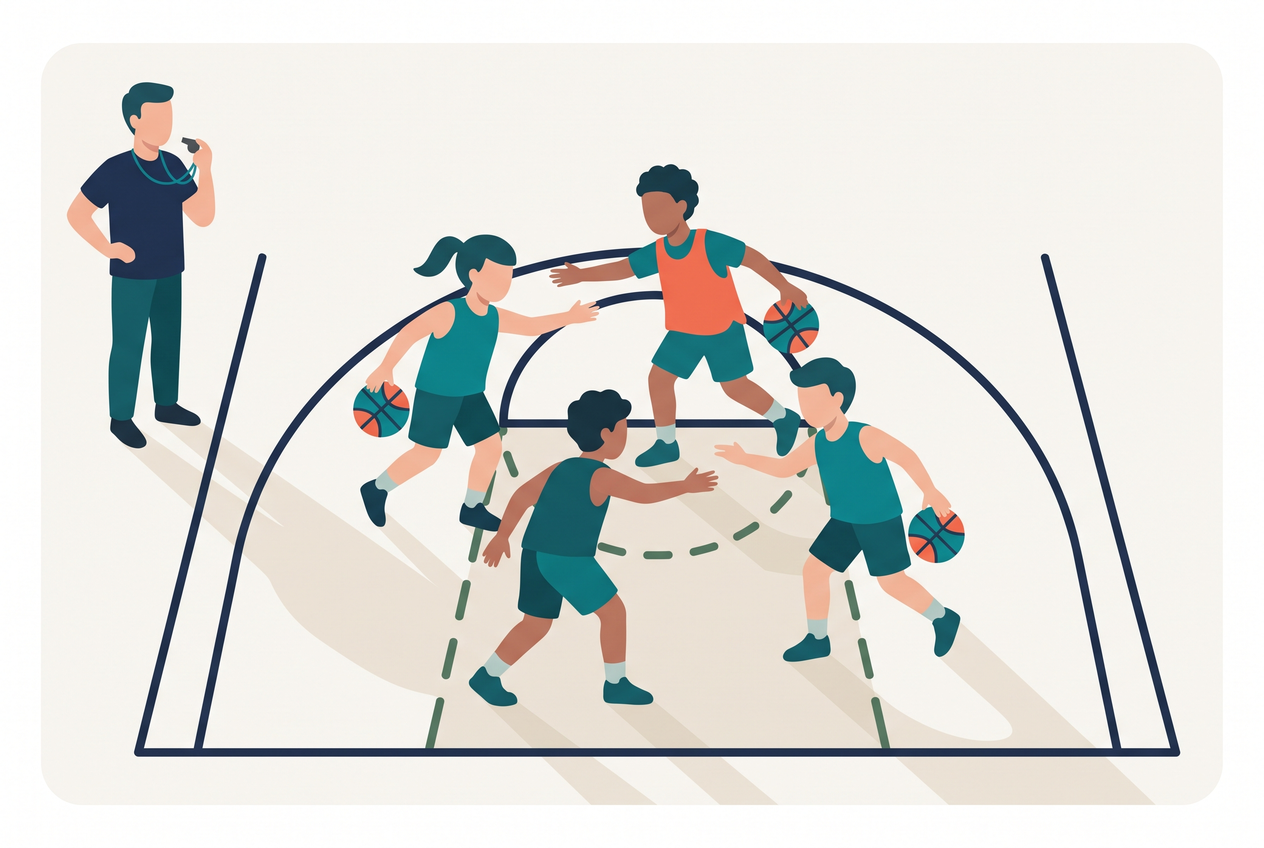
A basketball practice game is a drill with a score attached, and the score is the point: players dribble harder in Sharks and Minnows than in a dribbling line, shoot more carefully in Knockout than in a shooting line, and box out in Box-Out Battle because losing means staying on defense. The games below are organized by the skill each one trains and tagged by the grade group it fits, from 8U (grades 2 and 3) through high school, with the setup, the rules in three lines, and the one cue that keeps the game a lesson instead of recess. Most of them are standard youth games that coaches have run for decades; the versions here are the ones documented by Breakthrough Basketball and Basketball for Coaches, plus the competitive modules in the free basketball practice planner.
At a Glance: Which Game for Which Age
| Skill | 8U (grades 2-3) | Grades 4-6 | Middle school (grades 7-8) | High school (grades 9-12) |
|---|---|---|---|---|
| Dribbling | Sharks and Minnows, Red Light Green Light, Dribble Tag Zone | Dribble Knockout, Cone Tip Over, Dribble Relays | Dribble Knockout with a shrinking zone, Dribble Relays with moves | Dribble Knockout inside the lane as a warm-up |
| Shooting | Around the World from close spots | Knockout, 21 Cone Shooting, Pressure Free Throws | All-Star Shootout, 40 and a Half, Pressure Free Throws with a team target | Knockout from the three-point line, All-Star Shootout, Pressure Free Throws with a team target |
| Passing | Passing Tag, Monkey in the Middle | 10 in a Row, Ultimate Basketball | Ultimate Basketball, Count Em Up | Ultimate Basketball with a three-second hold limit |
| Finishing | Layup relays | Basketball Drag Race, Home Run | Pivot and Finishing Game to 21, Chase Down Layups scored | Pivot and Finishing Game to 21, Chase Down Layups scored |
| Defense and rebounding | None yet | Box-Out Battle, Closeout 1v1 | Score for Stops, Box-Out Battle, War | Score for Stops, Closeout 1v1, War |
| Whole-game play | 3v3 half court, no score | War, Small-Sided Games | War, 3v3 Shrink the Court, 5v5 Situations | 4v4 with a constraint, 5v5 Situations |
The rule that applies to every game: a youth player should win roughly six or seven times out of ten. If the same two players win every round, change the rule (weak hand only, one fewer dribble, a head start for the chaser) before the rest of the group checks out. And no game should last longer than ten minutes, because the lesson is in the first five and the complaints start at twelve.
Dribbling Games
Sharks and Minnows (8U to grade 6). Two sharks at half court with their backs to the group, the rest of the players (minnows) on the baseline with a ball each. On "go" the minnows dribble to the far baseline while the sharks turn and try to tag them; a tagged minnow becomes a shark, and a minnow who loses the ball or steps out is out for the round. Last minnow wins. Cue: eyes up and ball on the far hip from the shark. For 8U, let the sharks walk.
Red Light, Green Light (8U to grade 4). Everyone on the baseline with a ball, coach in the middle. "Green light" means dribble forward, "red light" means a legal jump stop with the ball protected; a travel or a continued dribble sends the player back. First to the far line wins. Cue: two feet land together on the stop. This is a footwork lesson disguised as a game, and the first place most players learn the jump stop.
Dribble Tag Zone (library module, 8U to middle school, 8 minutes). Cone off the lane for a small group or half court for a team, one ball each. Everyone dribbles continuously and tries to tag another player's ball or body; a tag scores a point, losing the dribble or leaving the zone costs one. Shrink the zone every two minutes and call "left hand only" on the second round. No elimination, so nobody stands around. Cue: ball on the hip away from the tagger. This is the arrival game that opens the youth practice plans.
Dribble Knockout (grade 4 to middle school). Every player dribbles inside the three-point line and tries to knock other players' balls out of the area while protecting their own. A player whose ball leaves the area steps out and shoots free throws until the round ends; the area shrinks as players leave. Last dribbler wins. Cue: head up, body between the ball and the nearest player. For middle school and high school, run it inside the lane.
Cone Tip Over (grades 4-6). Five to ten cones per half court. Team one dribbles and knocks cones over with the off hand; team two dribbles and stands them back up. Thirty to sixty seconds, count the cones standing, switch roles. A lost dribble costs that team a cone. Cue: dribble with the hand away from the cone. It is the rare dribbling game that also trains communication, because the standing team has to call out which cones are down.
Dribble Relays (grade 4 to middle school). Teams of four or five in lines on the baseline, one ball per team. The coach names the skill for the leg (speed dribble, crossover at each cone, weak hand, behind the back at half court); each player completes the leg, hands off, and sits. First team seated wins, then a new skill. Cue: a relay is only a lesson if the move is done correctly, so a sloppy move means the player repeats the leg.
Shooting Games
Knockout (grade 4 through high school). Players line up at the free-throw line (closer for younger groups), the first two with a ball. The first player shoots; the second shoots right behind. If the second player makes it before the first, the first player is out. Misses are rebounded and put back in from anywhere. Last player standing wins. Cue: follow your shot, and a putback counts. Run it from the elbow for grades 4-6, and from the three-point line for middle school and high school once the group reaches the rim with form.
Around the World (8U to grade 6). Shooting spots taped at the corners, wings, and top, close to the rim for 8U. One shooter per group advances a spot with each make; a miss means either restarting at the same spot next turn or taking a "chance" second shot, which sends the player back to the start if missed. First around wins. Cue: same form at every spot; if the form changes, the spot is too far.
21 Cone Shooting (grade 4 to middle school). Twenty-one cones in a pile at half court, two teams on matching spots on opposite sides of the lane, one ball each. After a make the shooter sprints to grab a cone for the team; after a miss the shooter rebounds and rejoins the line. When the cones are gone, the team with more wins. Cue: makes earn cones, so rush the rebound, not the shot.
Pressure Free Throws (grade 4 through high school). Everyone at the line with one ball. A make puts pressure on the next shooter, who must also make it or sit; a miss resets the pressure. Last player standing wins. Cue: same routine every time, no matter who is watching. The Free Throws & Stretch library module runs the team version: ten shots each, partner counts out loud, and if the team misses its target percentage everyone shoots five more.
All-Star Shootout (middle school and high school). Cones at six shooting spots on each half, two teams with a ball each. A player dribbles to a cone and shoots; a make brings the cone back, a miss means rebound, pass, back of the line. First team to collect a cone from every spot wins. Cue: shoot at game speed; the sprint to the cone is the conditioning. 40 and a Half is the longer version: ten makes from each of five spots, then a half-court shot to finish.
Home Run (grades 4-6). Two teams. The shooting team takes shots from a spot while the running team dribbles laps around a marked path one at a time; a runner who finishes a lap before a make scores a run, a make before the lap ends puts the runner out. Three outs, switch sides. Cue: the dribbler keeps the ball in the outside hand all the way around.
Passing Games
Passing Tag (8U to grade 4). Two taggers share a ball and can only move by passing; a tagger holding the ball cannot run. They tag runners by touching them with the ball; tagged runners become taggers. Cue: pass ahead of where the runner is going. It teaches passing on the move without a single line.
Monkey in the Middle (8U to grade 6). Groups of three in a triangle, one defender. Two passers complete as many passes as they can in thirty seconds; a deflection swaps the defender. Cue: fake a pass to make a pass.
10 in a Row (grade 4 to middle school). Two teams of four or five in the half court, no basket. Ten consecutive completed passes score a point; a deflection or a dropped ball gives the ball to the other team. Games to three. Cue: move after you pass. Count Em Up is the Basketball for Coaches version with a set pass count and a spacing rule: no two teammates within six feet.
Ultimate Basketball (grade 4 through high school). Two teams of four or five, end zones at each baseline. No dribbling; any ball that touches the floor is a turnover. A completed pass to a teammate standing beyond the baseline scores, and the other team takes over from that end zone. Cue: cut to the open space, not to the ball. For middle school and high school, add a three-second limit on holding the ball, which makes it the best spacing drill in the library.
Finishing Games
Basketball Drag Race (grades 4-6). Two teams in lines on opposite baselines, balls scattered at half court. The first player sprints to half court, grabs a ball, dribbles back, and finishes a layup; a miss means dribbling back to half court and trying again. Most layups in five minutes wins. Cue: outside foot, inside foot, up, at full speed.
Pivot and Finishing Game to 21 (middle school and high school). Pairs at a basket. The offensive player catches at the elbow, jump stops, pivots away from the defender's pressure, and finishes; a make is two points, a made free throw after a foul is one. First to twenty-one wins. Cue: pivot into space, not into the defender.
Chase Down Layups, scored (grade 4 through high school). The drill from the drills page becomes a game when each line keeps score: a made layup under a chase is a point for the offense, a stop or a forced miss is a point for the defense, first side to ten.
Defense and Rebounding Games
Box-Out Battle (library module, grade 4 through high school, 10 to 12 minutes). Three offense around the lane, three defense inside them, coach shooting from the line. On the shot the defenders hit, turn, and find the ball while the offense crashes; a defensive rebound is a point for the defense and a putback is a point for the offense. First trio to five wins, loser stays on defense, a third trio subs in each game. Cue: contact first, then pursue.
Closeout 1v1 (library module, grade 4 through high school). The defender rolls the ball out, sprints, chops, and plays live; the attacker has two dribbles. A stop or a steal wins for the defense, the loser stays on defense. Cue: sprint two-thirds, chop the last third, high hand.
Score for Stops (middle school and high school). Any 3v3 or 4v4 live segment where only the defense scores: a stop is a point, an offensive rebound resets the possession, first to seven. Cue: the possession ends when the defense has the ball, not when the shot goes up. Running one live block a week this way is the simplest fix for a team that only celebrates makes.
War (grade 4 through high school). Two teams on opposite sidelines, each assigned a basket, players numbered. The coach tosses the ball in and calls a number; the matching players race for it and play 1v1 to their basket, with a miss rebounded and attacked the other way. Call two numbers for 2v2, three for 3v3. Cue: get to the ball first, then get to the rim. It teaches reaction and reading a loose ball better than any set drill, and the numbers let the coach match players by ability.
Whole-Game Play
Small-Sided Games (grade 4 through high school). 3v3 or 4v4 on a half court with real rules and a score, which is where everything above shows up or gets exposed. 3v3 Shrink the Court confines the game to one side of the lane line, forcing spacing decisions in tight space. For 8U, run 3v3 with no score and a rule of the day (every player touches the ball before a shot).
4v4 with a constraint. Two-dribble limit, no dribble, or a required pass count before a shot; the constraint is the lesson, and it changes weekly. This is the live block in the ninety-minute middle school plan.
5v5 Situations (library module, middle school and high school, 15 to 20 minutes). Scripted game situations with a clock: last possession tied, down three with twenty seconds, up two with the ball, press break after a make. Not a game in the fun sense, but the group that runs it treats it like one, and it is the closing block of the high school plan.
High School: Games With a Scoreboard
High school practices keep the competitive games and drop the playground ones. What survives is anything with a live defender and a score: Score for Stops and War for effort and loose balls, Closeout 1v1 and Box-Out Battle as the daily defense work, Ultimate Basketball with the three-second rule for spacing, and 5v5 Situations with the clock running as the closing block. Shooting games move to game shots and posted targets, Pressure Free Throws with a team number to hit, and Knockout from the three-point line as the end-of-practice reward. The youth basketball drills by age page has the high school drill list these games sit beside.
Where Games Fit in a Practice
Three slots. The arrival game (Dribble Tag Zone, Sharks and Minnows) gets players moving before the coach says a word. The mid-practice game tests whatever the skill block just taught: Knockout after form shooting, Cone Tip Over after the ball handling circuit, Box-Out Battle after a rebounding block. The closing game (War, a small-sided game, Pressure Free Throws) sends everyone home having competed. The basketball practice plans page shows all three slots filled at sixty, ninety, and one hundred twenty minutes, the youth practice plans do the same for younger teams, and the practice plan template is the blank sheet for writing your own. In the free basketball practice planner the library games above drop onto the timed plan by name and the rest can be added as free-text blocks, then printed as a one-page coach sheet without an account.
When the games run on game night instead, the minutes have to be fair too: the free basketball rotation generator builds the substitution chart with equal playing time or starters-weighted minutes, and the basketball playing time page explains how the math works by roster size and format.
Frequently Asked Questions
What are fun basketball practice games for kids?
Sharks and Minnows, Red Light Green Light, Dribble Tag, Knockout, Around the World, Passing Tag, and War cover dribbling, shooting, passing, and competing from 8U through sixth grade. Each one on this page comes with the setup, the rules, and the skill it trains so it can replace a drill rather than add to the practice.
How long should a practice game last?
Five to ten minutes. The lesson is in the first few rounds; after ten minutes the same players keep winning and the rest stop trying. Change the rule (weak hand, one fewer dribble, a head start) when one player dominates, and end while the group still wants more.
Are practice games a waste of practice time?
Not if the game trains the skill the practice is about. A game with a rule is a drill where players try harder, and for the youngest players the USA Basketball youth guidelines favor exactly this: short practices with a ball in every hand. The waste is a game with no rule attached to a skill, like a scrimmage that runs twenty minutes because the coach ran out of plan.
Which games work for a team of six or seven players?
Dribble Tag Zone, Dribble Knockout, Knockout, Around the World, Pressure Free Throws, Monkey in the Middle, Closeout 1v1, and War with two numbers called. All of them run with as few as four players and none of them need a full court.
Are these games in the free practice planner?
Dribble Tag Zone, Box-Out Battle, Closeout 1v1, Free Throws & Stretch, and 5v5 Situations are modules in the planner's basketball library under those names, with the competitive rules built in. The rest can be added to any plan as a free-text block with the setup copied from this page.
Read Next
Rizzler vs Blue Sombrero: Coaching Platform vs League Administration
ComparisonRizzler iOS App: Coach from the Dugout
BlogVolleyball Positions: All 6 Roles, Explained With Diagrams
VolleyballSlugging Percentage (SLG): Definition, Formula & Youth Benchmarks
StatsCan I Use Rizzler with GameChanger?
FAQTop Approaches to Building a Baseball Batting Order
Learn