
Volleyball
Volleyball Positions, Explained: Who Does What, and Where
Volleyball has six playing positions: setter, outside hitter, middle blocker, opposite (right side), libero, and defensive specialist. Five of them rotate through the court; the libero works only in the back row. Each position owns a job in the rally, a home spot after the serve, and a distinct set of skills worth developing. This hub explains all six, plus the thing that confuses every new player and parent: the difference between a position (your role) and the six numbered zones (where the rotation happens to put you at the moment of serve).
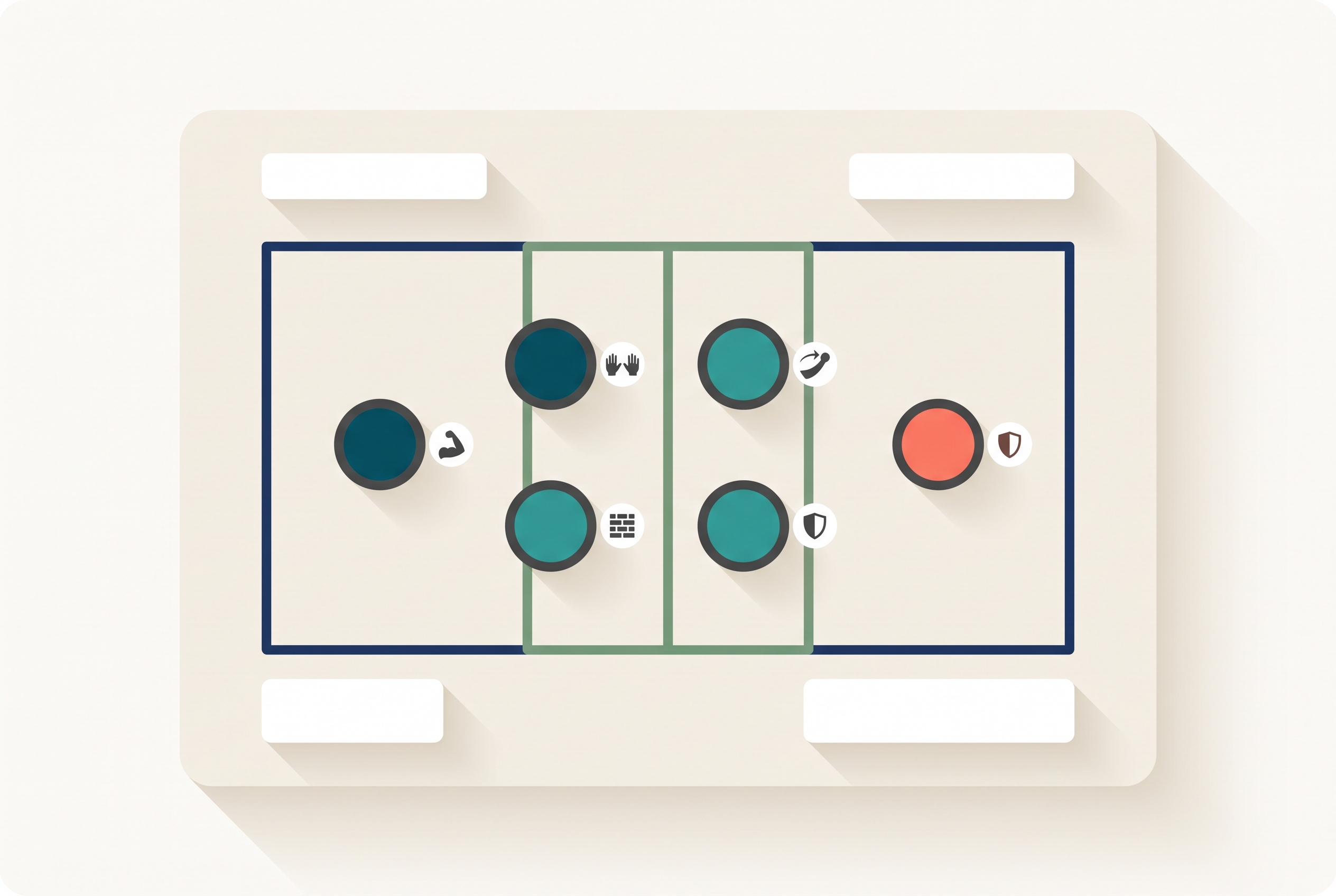
Positions Are Roles. Zones Are Real Estate.
When a broadcast says "position 4," it means a numbered zone on the floor: zone 1 is right back, then counterclockwise through 2 (right front), 3 (middle front), 4 (left front), 5 (left back), and 6 (middle back). Every player passes through all six zones as the team rotates.
A position, by contrast, is the job you are hired for. The setter is the setter whether the wheel currently has her in zone 1 or zone 3. At the moment of serve, players must stand in rotation order; the instant the ball is struck, everyone switches to their position's home spot. That switch, and the alignment rules that govern the moment before it, are the subject of our rotation rules guide. Here is the map of the roles themselves:
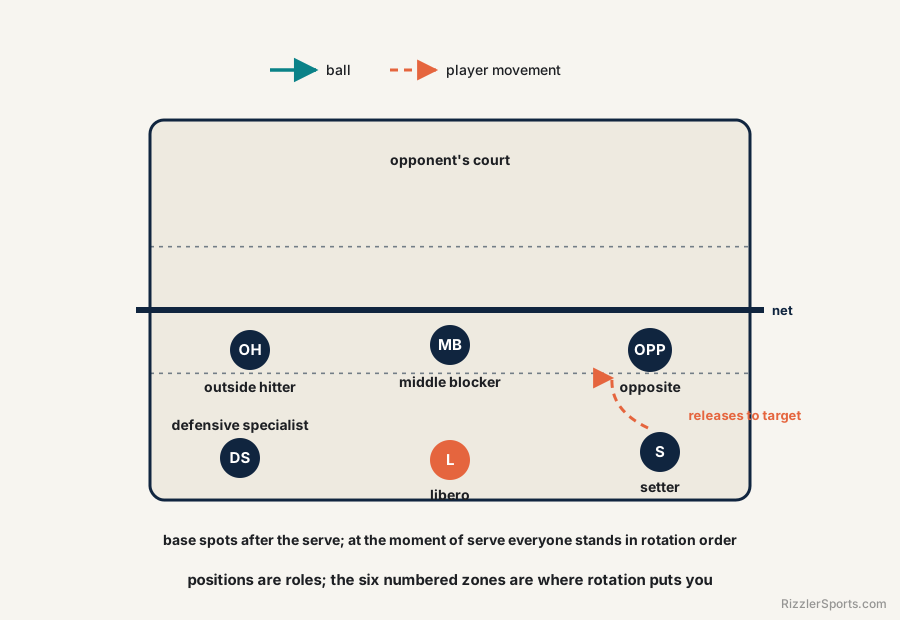
The Six Positions at a Glance
| Position | Abbrev. | Row | The job in one line |
|---|---|---|---|
| Setter | S | Both | Touches the second ball and decides who attacks |
| Outside hitter | OH | Both | Primary attacker from the left, plus serve receive |
| Middle blocker | MB | Front | First blocker everywhere, fast attacks in the middle |
| Opposite | OPP | Both | Right-side attacker, blocks the opponent's best hitter |
| Libero | L | Back only | Defense and serve receive specialist in the off-color jersey |
| Defensive specialist | DS | Back | Back-row substitute for defense and serving |
These six are the exact groupings coaches manage on a depth chart, and they map one-to-one onto how Rizzler's volleyball Game Manager organizes a roster, which we come back to at the end.
Setter: The Decision-Maker
The setter runs the offense: she takes the second contact of every possession and chooses, in about a second, which hitter attacks and with what tempo. The job is one-third hands, one-third feet, one-third judgment, and it shapes everything downstream, since how many setters you carry is literally what the rotation systems are named for, one in a 5-1, two in a 6-2 or 4-2. The full job description, skills in priority order, and how to develop one are in the setter position guide.
Outside Hitter: The Workhorse
The outside (also called left side or pin hitter) attacks from zone 4, the left antenna, and takes the largest share of swings on almost every team, because the out-of-system set defaults to her: high, outside, hit it. She also anchors serve receive as one of the standard three passers, which makes her the position with the heaviest two-way load, and a good one is measured by converted bad passes, not swing speed. The skills that separate outsides, and the OH-versus-opposite distinction, are in the outside hitter guide.
Middle Blocker: The Wall That Runs
The middle plays the net's center in the front row: first responsibility is blocking, closing to either antenna to build a two-person wall, and the second is fast offense, quick sets that score before the defense assembles. Most teams pair her with the libero, who takes her back-row turns, and evaluate her on block timing and lateral speed before height. The read-and-close skill, the libero trade, and the training plan are in the middle blocker guide.

Opposite: The Counterweight
The opposite plays the right side, diagonal from the setter in the rotation order, which is what "opposite" means. She attacks from zone 2, often against a single block, and her own block faces the opponent's outside hitter all match. At higher levels she is frequently the most explosive scorer on the floor; at youth levels the position is the most neglected, and a strong lefty belongs there before anywhere else. Why, plus the right-side training plan, is in the opposite hitter guide.
Libero and Defensive Specialist: The Back-Row Pros
The libero is the defensive specialist so valuable the rules gave her a different jersey: she plays only the back row, replaces teammates without using substitutions, digs the opponent's best attackers, and anchors serve receive. She cannot block or attack above net height, and her replacement mechanics follow specific rules that vary by governing body. She has her own full guide: what a libero is, her rules, and how to develop one.
The defensive specialist (DS) does similar back-row work through the normal substitution system, no special jersey, no special rules. A DS enters for a weak back-row player (often an opposite or an outside), digs and serves, then leaves when that spot rotates to the net. Rosters carry a DS for depth, for serving specialists, and because only one libero may be on the court at a time.
Which Position Should a Player Choose?
Honest answer for players and parents: at 12 and under, none yet; play everywhere, because early specialization narrows skills that every position needs later. From about 13 on, match traits to roles. Quick decision-makers with steady hands gravitate to setting. Long, springy players who love the net become middles. Competitive all-arounders who want the ball on match point become outsides. Lefties and big swings fit the opposite. Fearless, low, fast movers with short memories make liberos, and "best position" questions usually resolve to "the one whose job description sounds like fun rather than work."
Coaches can make this concrete at tryouts: run stations that isolate position skills (setting hands, approach and touch, platform control, block footwork) and score them consistently, then slot players where their scores, not their preferences alone, point.
Positions on Paper: Depth Charts and Evaluations
A position list becomes a program when you track it. Rizzler's volleyball Game Manager includes a Depth Chart tab grouped by these exact six positions, setter, outside, middle, opposite, libero, DS, so a coach can see the second setter and the emergency libero before a tournament weekend forces the question. The volleyball player evaluation template scores the skills behind each role in eight categories (serving, passing, setting, attacking, blocking, floor defense, athleticism, and volleyball IQ), which lets you staff the depth chart from measured skills rather than height and reputation, and re-score mid-season to see who is outgrowing their slot. Where you place each position in the service order, and what that does to your offense, is the rotations hub's department.
Frequently Asked Questions
What are the 6 positions in volleyball?
Setter, outside hitter, middle blocker, opposite (right side), libero, and defensive specialist. The first four rotate through front and back row; the libero plays back row only, and the DS is a back-row substitute role rather than a spot in the starting rotation.
What is the difference between positions and zones in volleyball?
Zones are the six numbered spots (1 through 6) that rotation moves every player through; positions are the jobs players are trained for, like setter or middle blocker. Players stand in rotation order at the serve, then switch to their position's home spot the moment the ball is struck.
What is the hardest position in volleyball?
Setter, by consensus: she touches the ball on nearly every possession, must reach the target from anywhere on the court, and makes a decision under pressure every rally. Libero is the hardest defensively; outside hitter carries the heaviest combined attacking and passing load.
What is the best volleyball position for a beginner?
Beginners should rotate through everything rather than pick early. When a first role helps confidence, outside hitter teaches the most transferable skills (passing, approach, attacking), while naturally quick, fearless movers often fall in love with defense and grow into liberos.
What position do the tallest players play?
Usually middle blocker, where reach over the net matters on every rally, with tall attackers also landing at opposite or outside. But timing and footwork beat raw height: a shorter middle who closes the block fast is worth more than a tall one who arrives late.
What does the opposite hitter do?
She attacks and blocks on the right side, positioned diagonal from the setter in the rotation order. Her block matches up against the opponent's outside hitter, and her attacks often come against a single block, which makes the position a scoring engine at higher levels.
What do the volleyball position abbreviations mean (S, OH, MB, OPP, L, DS, RS)?
S is setter, OH is outside hitter (also called left side), MB is middle blocker (sometimes MH, middle hitter), OPP is opposite (also RS, right side, or RSH), L is libero, and DS is defensive specialist. Outside hitters and opposites together are the pin hitters, because they attack from the antennas (the pins) at each end of the net.
What are volleyball positions 1 to 6?
Those are the six rotation zones, not the playing positions: zone 1 is right back (the server's spot), 2 is right front, 3 middle front, 4 left front, 5 left back, and 6 middle back. Every player rotates through all six; the rotations guide covers how the wheel moves and where each position ends up after the serve.
What are base positions in volleyball?
Base position (some coaches say "home") is the spot each player moves to right after the serve, before the opponent's attack develops: front-row players at the net ready to block, back-row players spread across the court. From base, defenders adjust to their read positions as the set goes to a hitter. It is different from the rotation-order spot you must hold at the moment of serve.
Talk to our team
Want to spend more time coaching and less time with paperwork? Let's talk.
Tell us about your team and we'll show you how to plan games, set lineups, run the schedule, and develop players in one place, so you spend the season coaching instead of chasing admin.
Less admin, more coaching
Plan games, set lineups, and track the season in one place
Keep every family in the loop automatically
Tell us about your program
4 fields · takes 30 seconds
Lands in the same inbox as the Help button · human response only
Read Next
How to Run a Cross Country Tryout: A Coach's Step-by-Step Guide
LearnTournament Planning for Youth Baseball: Plan Your Whole Weekend
FeaturesEarned Run Average (ERA): Definition, Formula & Youth Context
StatsRule Compliance: Never Violate a Rule You Didn't Know Existed
FeaturesOn-Base Percentage (OBP): Definition, Formula & Youth Benchmarks
StatsBasketball Tryout Drills: 12 Drills That Actually Evaluate Players
Learn