
Volleyball
The Middle Blocker: The Wall That Runs, Explained
The middle blocker plays the center of the net in the front row with two jobs that pull in opposite directions: block every opposing attack from antenna to antenna, and run the fastest sets in the offense before the defense can assemble. She is usually the tallest player on the roster and always the one doing the most sprinting that nobody notices, because middles move laterally on every rally whether or not the ball ever comes to them. Here is the real job description, the trade with the libero that defines the position's rhythm, and what to train and measure.
Half the Job: First Blocker Everywhere
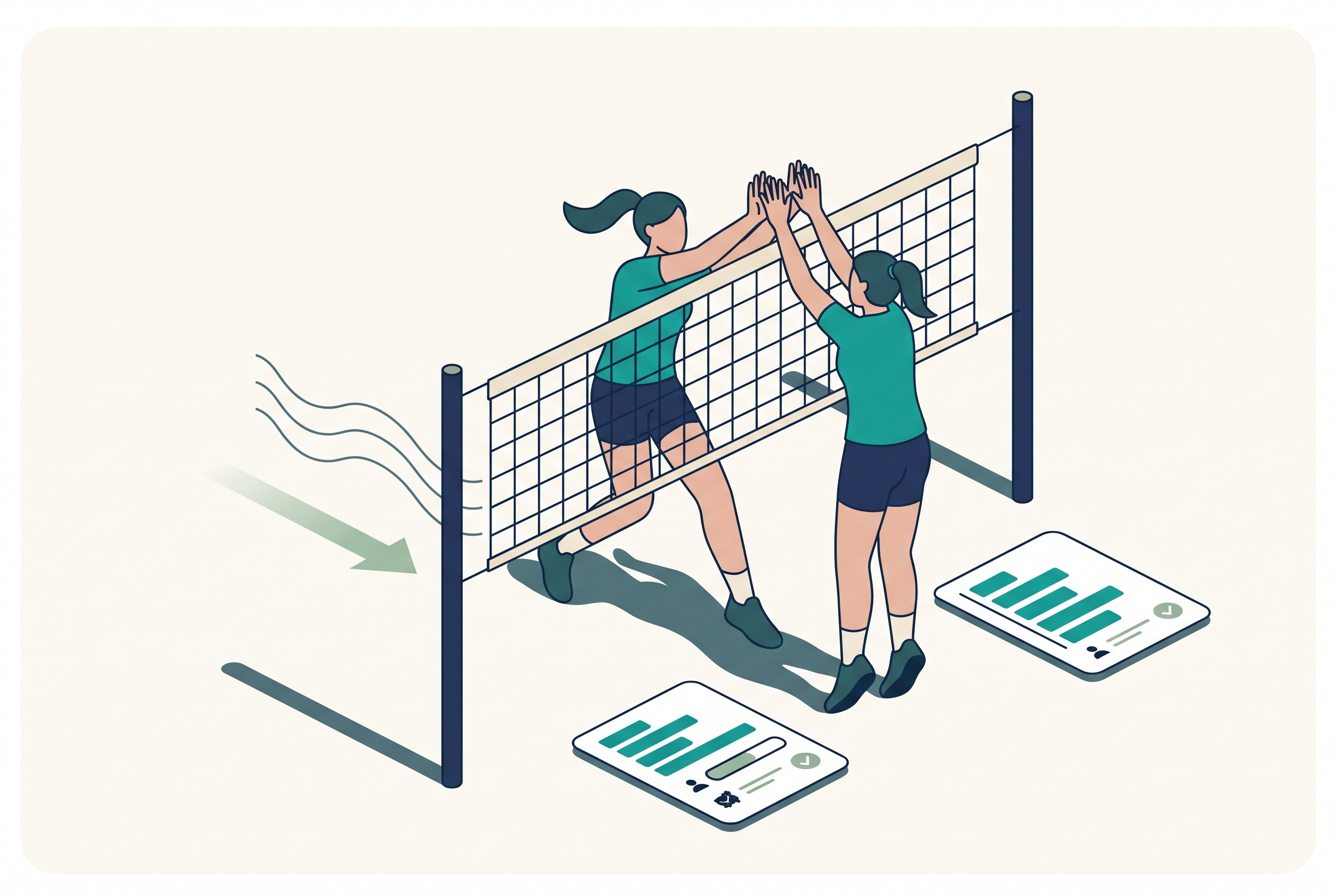
On defense the middle is the block's anchor. She starts in the center, reads the setter, and closes to whichever antenna the set goes to, joining the pin blocker to build a two-person wall. That read-and-close sequence, three to five meters of lateral movement ending in a maximum jump, repeats on every opposing possession. A middle who reads early and closes cleanly turns her team's entire defense playable; a late middle leaves seams that no back-row defender can cover, which is why the blocking drills library leads with footwork and reading before hands.
The blocking numbers understate the impact. A good middle deflects and channels far more balls than she stuffs: slowing an attack for a defender to dig, or taking away the line so the dig comes from a predictable angle, wins rallies that never show in the box score.
The Other Half: The Fast Offense
On offense the middle attacks first tempo: quick sets delivered a step from the setter, hit before the opposing middle can load and jump. The quick attack is the most efficient swing in volleyball when the pass allows it, and its mere threat is half its value, because a middle who runs a convincing route on every rally freezes the opposing block and buys her outside hitters one-on-one matchups. That is the hidden tax of a lazy middle: when she stops running routes on bad passes, the whole offense gets easier to defend.
The catch is that first tempo requires an in-system pass, which makes the middle's production heavily dependent on her team's serve receive. Youth middles and their parents should hear that early: five swings a set is normal, the routes still matter, and hitting percentage on those few swings should be the highest on the team.
The Libero Trade: Why Middles Vanish From the Back Row
Watch any club or college match and the middle disappears when she rotates to the back row, replaced by the libero without a substitution being charged. The logic is a straight trade of specialties: the rules give teams a free defensive replacement, and the middle, whose value is concentrated at the net, is the natural player to trade out. She typically serves her turn, plays the rally out, and swaps at the next dead ball; the exact mechanics, including whose rotation slot she holds and when she must return, are stepped through in the libero rotation guide.
Two consequences for development. First, back-row skills still matter, because the middle plays back row at every level where a team carries no libero, and at serve-and-swap moments even where it does. Second, the swap makes middle the least-conditioned position by rally count, which is why smart programs give middles extra transition and movement work in practice.

What Makes a Good Middle, and How to Measure It
Recruit feet and timing before height. A 5'8" middle who reads the setter early and closes fast beats a 6'1" middle who guesses and arrives late, at every level short of college. The traits that project: lateral quickness along the net, a fast second jump (block, land, immediately available to attack), hands that press over the net rather than wave at the ball, and the discipline to run attack routes on passes that will never come to her.
Rizzler's volleyball player evaluation template measures the position directly: the Blocking category scores timing and hand position, Athleticism covers vertical jump and lateral quickness, and the optional metric skills record approach touch and block touch in inches, the two numbers college programs ask about first. Score candidates in a dedicated net station at tryouts, then rank your middle group in the Depth Chart tab of the volleyball Game Manager. Depth matters disproportionately here: middles foul out of matches on ankle injuries at the net more than any other position, and the second middle plays in every match where the swap rhythm needs a rest.
Coaching the Position at Youth Level
Three practice habits build middles faster than anything else. Footwork without a ball: shuffle and crossover patterns along the net, ten minutes a session, because the feet are 80 percent of youth blocking. Eye discipline: teach the read sequence (pass, setter, ball, hitter) explicitly, since young blockers watch the ball and jump with the crowd. And route integrity: require the quick route on every transition rep, whether or not the set comes, with praise tied to the route rather than the kill. Middles trained this way arrive at high school with the habits that coaches at the next level cannot easily teach.
Frequently Asked Questions
What does a middle blocker do in volleyball?
She anchors the block, closing from the center to either antenna to build a two-person wall against every opposing attack, and runs quick first-tempo attacks in the middle of the offense. Middles trade out for the libero in the back row at most levels, concentrating their impact at the net.
Is middle blocker a hard position?
It is the most physically repetitive: maximum-effort lateral movement and jumping on every rally, on both sides of the ball. The skills are learnable, but the position punishes late reads instantly, and its offensive production depends on the team's passing, which the middle cannot control.
How tall do you need to be to play middle blocker?
Middles are usually the tallest players on the roster, but timing and lateral speed beat raw height through high school: a shorter middle who closes the block on time is worth more than a tall one who arrives late. College programs typically look for touch heights rather than standing height.
Why does the middle blocker leave the game in the back row?
She swaps with the libero, the back-row specialist whose replacements do not count as substitutions. The team trades net-front value for ball-control value at zero cost, which is why nearly every club, school, and college team runs the middle-libero swap.
What is the difference between a middle blocker and a middle hitter?
Same position, two names: "middle blocker" emphasizes the defensive half of the job and "middle hitter" the offensive half. Rosters and stat sheets use MB for both. The job is always both halves: first blocker everywhere, first-tempo attacker in the middle.
How do you evaluate middle blockers at a tryout?
Run a net station that isolates the position: read-and-close blocking reps graded on timing and hand position, quick-attack reps graded on route speed and contact point, plus measured approach and block touch. Score each 1 to 5 across multiple reps rather than trusting the scrimmage impression.
Do middle blockers serve in volleyball?
Often not. Most teams replace the middle with the libero as soon as she rotates to the back row, and under NFHS, USAV, and NCAA rules the libero may serve in one rotation slot, which coaches commonly assign to a middle's spot. When there is no libero, or the coach keeps the middle in for her serve, she serves like anyone else.
Talk to our team
Want to spend more time coaching and less time with paperwork? Let's talk.
Tell us about your team and we'll show you how to plan games, set lineups, run the schedule, and develop players in one place, so you spend the season coaching instead of chasing admin.
Less admin, more coaching
Plan games, set lineups, and track the season in one place
Keep every family in the loop automatically
Tell us about your program
4 fields · takes 30 seconds
Lands in the same inbox as the Help button · human response only
Read Next
Youth Sports Seasons Calendar: Tryout Windows and Season Timing (US and Canada)
LearnHow to Build a Batting Order for 8U Baseball
LearnRizzler Sports Features: Every Coaching Tool in One Place
FeaturesHow to Run a Swim Team Tryout: A Coach's Step-by-Step Guide
Learn8U Baseball Practice Plan: A Complete 60-Minute Coach-Pitch Practice
LearnVolleyball Stats: Every Stat Explained, and What to Track
Volleyball