
Volleyball
How the Libero Rotates (Without Ever Rotating to the Front Row)
The libero does not rotate the way her teammates do. She replaces a back-row player, holds that player's spot in the rotation order while it travels through the back row, and steps off when the spot reaches the front row, handing it back to its owner. Then she does it again for the next back-row target. The result is a player who is on the court for most of the match yet never once rotates to the net. This guide covers the mechanics: where the replacements happen, what the libero inherits, who she can replace, the one place she can serve, and how to keep the paperwork straight.
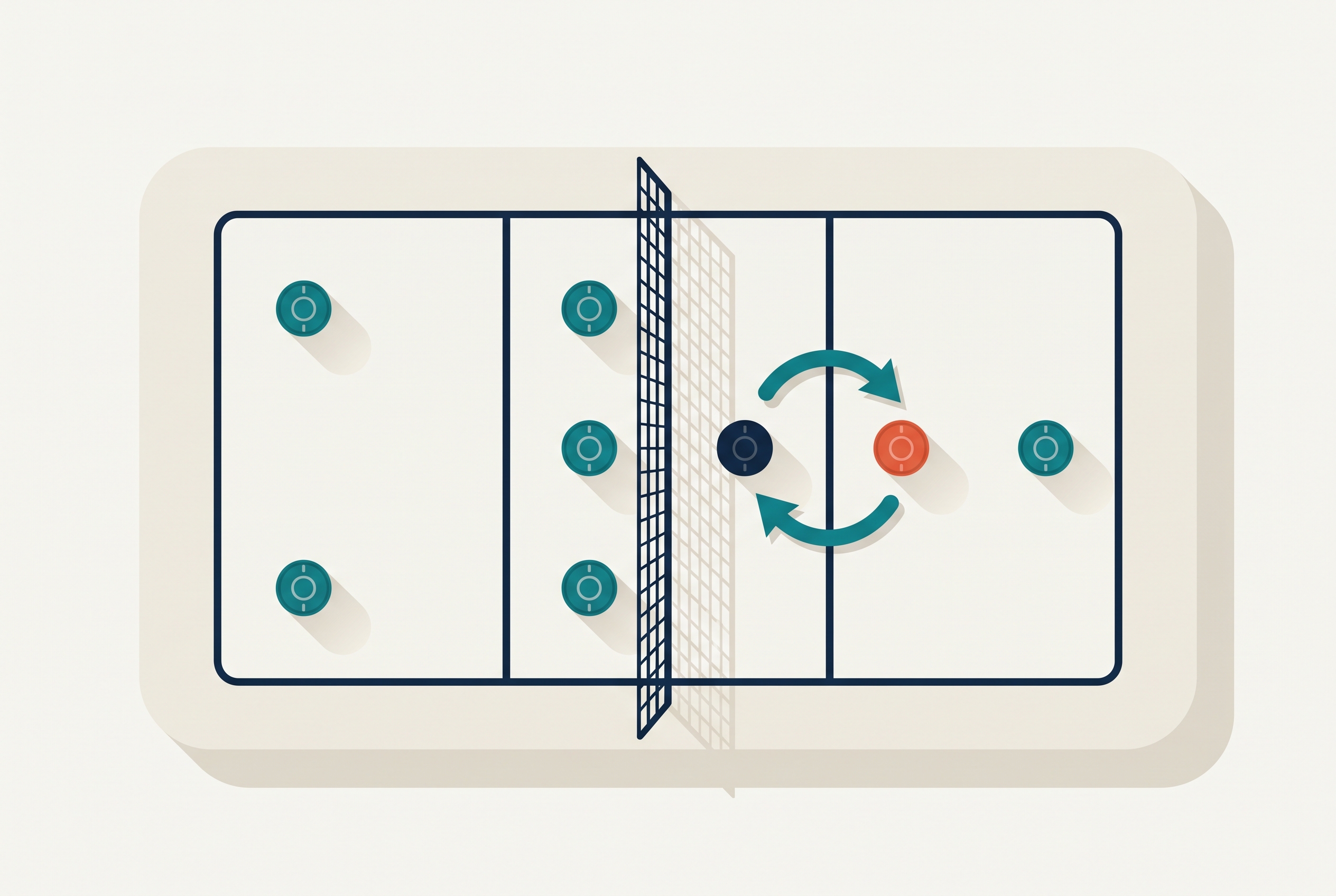
5-1 rotations — One setter sets in all six rotations; opposite hits right side.
Rotation 1
Rotation 2
Rotation 3
Rotation 4
Rotation 5
Rotation 6
Build this with your roster — free →
No login required
The Replacement Cycle, Step by Step
Take the standard case: your libero covers for both middle blockers. Middle 1 rotates from zone 4 into the back row after her front-row turn ends. Between rallies, the libero walks on, Middle 1 walks off, and the libero now occupies Middle 1's slot in the rotation order. She passes, digs, and moves through zones 5, 6, and 1 exactly as Middle 1 would have.
When that slot is about to rotate into the front row, the libero must come off: Middle 1 returns for her net rotations. One rally later (the rules require at least one rally between libero replacements involving the same exchange), the libero goes back in, this time for Middle 2, who has just arrived in the back row. Over a full wheel the libero is on the court for roughly four of the six rotations, off only while the two middles pass through the moment of exchange.
Replacements are not substitutions. They happen between rallies without a referee's authorization, through the libero replacement zone, the sideline area between the attack line and the endline, and they are unlimited in number. The scorer tracks them on a separate libero sheet, which is why the exchange must happen in that zone where the scorer can see it.
What the Libero Inherits (and What She Can't Do)
The libero takes on everything about the slot she occupies. She serves in the rotation order position of the player she replaced, if the rule set allows her to serve at all (next section). She owes the same overlap obligations that player would owe: if she is in zone 6, she must stay behind the zone 3 player and between zones 5 and 1 at serve contact. There are no alignment allowances for the off-color jersey.
The restrictions come with the role: she may not attack a ball that is entirely above net height from anywhere on the court, may not block or attempt to block, and may not overhand finger-set a teammate's attack from on or in front of the attack line (the attack off her front-zone hand set is illegal, not the set itself; platform sets are always fine). These limits are the price of her freedom of movement, and they are the same in every American rule set. The role, skills, and how to develop a libero are their own subject, covered in our libero position guide.
Serving: The Rule That Depends on Who Governs Your Match
Whether your libero serves is the biggest practical difference between rule sets, and it changes your rotation planning:
| Rule set | Liberos per set | May the libero serve? |
|---|---|---|
| NFHS (high school) | 1 (2 beginning 2026-27, one on court at a time) | Yes, in one rotation slot per set |
| USAV (club) | 0, 1, or 2 designated | Yes, in one rotation slot per set |
| NCAA (college) | 1 per set | Yes, in one rotation slot per set |
| FIVB (international) | 2 designated | No |
The American bodies converge on the same idea: the libero may replace a player who is due to serve and serve from that one slot for the rest of the set. Choose the slot deliberately. Replacing your weakest server at the service line turns a rotation you used to concede into a scoring one, and once the choice is made, it is locked: she may only serve from that slot for the remainder of the set.
International matches your players watch on TV run the FIVB rule, no libero serving at all, which is why "can the libero serve?" produces so many confident wrong answers in the gym. The answer under NFHS, USAV, and NCAA rules is yes, one slot.
Running Two Liberos, and the 6-2 Question
Where two liberos are designated (club now, high school beginning 2026-27), only one is on the court at a time, and they exchange with each other freely between rallies. The pair still follows every rule above as if they were one player; the second libero is depth and specialization, not a second simultaneous specialist.
Coaches ask most often how the libero interacts with a 6-2 system, because the 6-2 already has two setters crossing the back row. The standard answer: the libero still covers the middles, not the setters. A back-row setter in a 6-2 is doing a job (running the offense) that the libero cannot do from her restricted role, since hand-setting in front of the attack line would make the ensuing attack illegal. Some teams instead have the libero replace the opposite. The principle when choosing her targets: replace the players whose back-row rotations cost you the most, provided their front-row returns line up with the replacement zones. The free rotation generator applies the libero pairing to whichever system you build and shows who she covers rotation by rotation, under the governing body you pick.
Tracking It Without Losing the Plot
Libero errors in youth matches are bookkeeping errors: a replacement outside the zone, a libero left on as her slot reaches the front row, or a serve from a second slot. All three are prevented by the bench knowing two things at all times: whose spot the libero currently holds, and which slot (if any) she serves in.
Print those two facts. The rotation sheet your bench reads should mark the libero pairing on each of the six rotation diagrams, and the serving slot gets a circle. The generator's print pack does this automatically, and inside Rizzler the volleyball Game Manager carries the same libero assignment through the Rotation Plan and Serve Order tabs, with the governing body set once in Rules & Config so the constraints your plan enforces match the rule set your match is played under. When the libero rules differ between your league season and your club season, change the setting, not your memory.
Frequently Asked Questions
Does the libero rotate in volleyball?
She holds a rotating spot but never completes the trip: she occupies a back-row player's slot as it moves through zones 1, 6, and 5, then steps off when the slot reaches the front row and the original player returns. Her replacements are unlimited and do not count as substitutions.
Who does the libero replace in the rotation?
Most teams have her replace both middle blockers, covering each one's back-row rotations. Nothing in the rules requires that; she may replace any back-row player. Middles are the convention because their back-row skills are usually the weakest trade.
Can a libero serve?
Under NFHS, USAV, and NCAA rules, yes, in exactly one rotation slot per set; once she serves in a slot, that is her only serving slot for the set. International FIVB rules do not allow the libero to serve, which is the source of most confusion.
Why does the libero leave the court every few rotations?
Her slot is about to rotate into the front row, where she cannot play. The player she replaced returns for her net rotations, and the libero re-enters for the next back-row player, which is why her exits always happen at the same two points in the wheel.
Does the overlap rule apply to the libero?
Fully. She inherits the alignment obligations of the slot she occupies: at serve contact she must be legal relative to the player in front of her and the players beside her in the back row. The off-color jersey grants no alignment exceptions.
Can you play without a libero?
Yes, in every rule set. Leaving the libero line blank on the lineup sheet simply means all six starters rotate through all six positions, and back-row defense is handled by whoever the wheel puts there.
Talk to our team
Want to spend more time coaching and less time with paperwork? Let's talk.
Tell us about your team and we'll show you how to plan games, set lineups, run the schedule, and develop players in one place, so you spend the season coaching instead of chasing admin.
Less admin, more coaching
Plan games, set lineups, and track the season in one place
Keep every family in the loop automatically
Tell us about your program
4 fields · takes 30 seconds
Lands in the same inbox as the Help button · human response only
Read Next
AI Batting Order: Build Statistically Optimized Lineups in Seconds
FeaturesFielding Stats: Defensive Numbers Explained for Coaches
StatsBaseball Spray Chart: How to Read One, Use One, and Print One
LearnHow to Track Attendance for a Youth Sports Team
LearnHow Does In-Game Scoring Work in Rizzler?
FAQBest Softball Coaching Apps in 2026
Learn