
Volleyball
The Volleyball Overlap Rule, Explained With the 7 Checks Refs Actually Make
The volleyball overlap rule says that at the exact moment the server contacts the ball, every player except the server must be in rotational order relative to two neighbors: the player directly in front of or behind them, and the player beside them in their own row. That is seven total comparisons, they are judged by feet, and there is no such thing as diagonal overlap. Once the serve is struck, everyone may go anywhere.
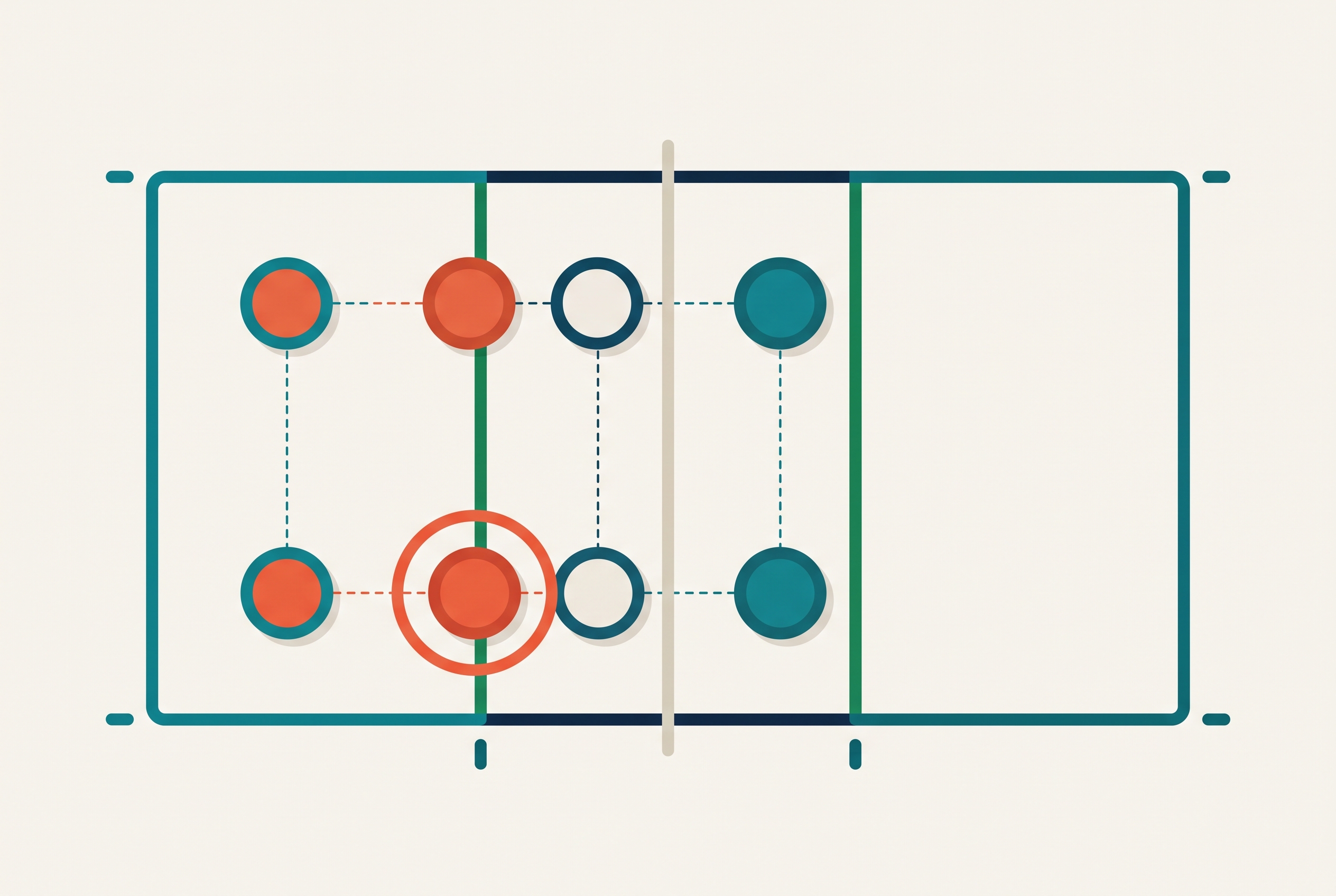
5-1 rotations — One setter sets in all six rotations; opposite hits right side.
Rotation 2 — Setter in 6
Build this with your roster — free →
No login required
The Rule in One Paragraph
Referees call it illegal alignment in high school and a positional fault in club, and both mean the same thing. When the ball is contacted for serve, each front-row player must have part of one foot closer to the center line than both feet of the back-row player behind them, and each right or left side player must have part of one foot closer to their sideline than both feet of the middle player in their own row. Positions are judged only at that instant. The penalty is a point and the serve for the other team.
Note the phrase "part of one foot." A passer standing deeper than her front-row teammate is legal as long as that teammate keeps a toe closer to the center line. The rule is far more forgiving than most players believe, which is exactly why teaching it precisely matters.
The 7 Checks
Zones run 1 (right back, the server's spot) through 6 (middle back): 2, 3, 4 across the front from right to left, and 1, 6, 5 across the back. Here is the complete list of relationships a referee can check. There are no others.
| # | Check | Who | Rule |
|---|---|---|---|
| 1 | Front to back, left side | Zone 4 vs zone 5 | Zone 4 keeps a foot closer to the net |
| 2 | Front to back, middle | Zone 3 vs zone 6 | Zone 3 keeps a foot closer to the net |
| 3 | Front to back, right side | Zone 2 vs zone 1 | Zone 2 keeps a foot closer to the net |
| 4 | Side to side, front left | Zone 4 vs zone 3 | Zone 4 keeps a foot closer to the left sideline |
| 5 | Side to side, front right | Zone 2 vs zone 3 | Zone 2 keeps a foot closer to the right sideline |
| 6 | Side to side, back left | Zone 5 vs zone 6 | Zone 5 keeps a foot closer to the left sideline |
| 7 | Side to side, back right | Zone 1 vs zone 6 | Zone 1 keeps a foot closer to the right sideline |
When your team is serving, the server is exempt, so checks 3 and 7 disappear for your side until the next rotation. The receiving team is always checked on all seven.
There Is No Diagonal Overlap
This is the single most common misconception in the sport, held by players, parents, and more than a few coaches and referees. The player in zone 4 has no positional relationship with the players in zones 6, 1, or 2. None. She can stand deeper than the zone 6 player, further right than a creeping zone 1 player, anywhere she likes, as long as she honors her two actual neighbors: zone 5 behind her and zone 3 beside her.
Every legal stack, every hidden setter, every serve receive pattern in volleyball is built on that fact. When a back-row setter in zone 6 tucks in tight behind the zone 3 middle at the attack line, she looks wildly out of position to the untrained eye. She is legal, because her only obligations are to stay behind zone 3 and between zones 5 and 1.
Where the Whistles Actually Come From
Alignment calls almost never come from a broken lineup. They come from small drifts in the four or five seconds before the serve, and the fix is usually six to twelve inches. The classic ones:
- The right-side drift. The zone 2 hitter slides toward the middle to start her approach and loses check 5, no longer having a foot closer to the right sideline than the zone 3 player. Give her a sideline landmark.
- The deep outside. The zone 4 hitter backs up to pass and ends up deeper than the zone 5 passer behind her, breaking check 1. The zone 5 player can simply take a half step back.
- The eager setter. A back-row setter releasing toward the net a beat before contact, or stacking slightly to the wrong side of her middle. This is the number one call against 5-1 and 6-2 teams, and it is worst in the setter-run rotation, where she starts on the far left.
- The wandering server exemption. Players forget the server exemption applies only to the server. The receiving team's zone 1 player is fully bound by checks 3 and 7.
A useful bench habit: before each serve, scan only the two or three players your current rotation puts at risk, not all six. In a 4-2 with a W serve receive there is usually nothing to scan at all, which is one reason young teams should start there.
Rule Set Differences That Matter
The geometry above is identical in high school (NFHS), club (USAV), and college (NCAA) volleyball, and all three judge it at the moment of serve contact and check both teams. The penalty is likewise the same: loss of rally, point to the opponent.
One international footnote, because players see it on TV and get confused: the international federation began exempting the serving team from positional faults in 2025, checking only the receiving team. United States high school, club, and college rules did not adopt that change. In every match your team plays under NFHS, USAV, or NCAA rules, both teams are checked, minus the server.
For the libero, the rule is simple: she inherits the overlap obligations of the player she replaced. If she is in for the middle in zone 6, she is checked exactly as that zone 6 player would be.
How to Teach It in One Practice
Put six players on the court in a real rotation and walk the seven checks out loud, having each player point at their two neighbors. Then run your serve receive patterns and freeze everyone at the moment of an imaginary contact, checking feet. Ten minutes of this beats a season of yelling "watch your overlap" from the bench, the free rotation generator checks all seven relationships live while you build the lineup, and it belongs in your regular practice plan the week before the first match. Rotation-savvy players also make lineup decisions easier at tryouts, because coaches can see who understands the court.
Frequently Asked Questions
What is the overlap rule in volleyball?
At the moment of serve contact, every player except the server must be in rotational order relative to the player directly in front of or behind them and the player beside them in their own row. It is judged by feet: a front-row player needs part of one foot closer to the center line than the back-row player behind her, and a side player needs part of one foot closer to her sideline than her row's middle player.
Is there diagonal overlap in volleyball?
No. Overlap relationships exist only between a front-row player and the back-row player directly behind her, and between adjacent players in the same row. Diagonal players have no positional relationship at all.
When is overlap judged?
Only at the instant the server contacts the ball. Before that moment players may lean, creep, and stack; after it they may run anywhere, which is how setters release to the target and hitters switch to their favorite side.
What is the penalty for illegal alignment?
Loss of the rally: the opponent gets a point and the serve. In high school the referee signals illegal alignment; in club it is called a positional fault. Same violation, same cost.
Does the overlap rule apply to the libero?
Yes. The libero takes on the exact overlap obligations of the back-row player she replaced. There are no special alignment allowances for the libero position.
Talk to our team
Want to spend more time coaching and less time with paperwork? Let's talk.
Tell us about your team and we'll show you how to plan games, set lineups, run the schedule, and develop players in one place, so you spend the season coaching instead of chasing admin.
Less admin, more coaching
Plan games, set lineups, and track the season in one place
Keep every family in the loop automatically
Tell us about your program
4 fields · takes 30 seconds
Lands in the same inbox as the Help button · human response only
Read Next
How to Build and Manage a Volleyball Roster
VolleyballSoftball Practice Plans: 8U, 12U, 14U, and High School Sessions
LearnRizzler Plans & Pricing: Free vs Coach vs Club
ComparisonBest Baseball Tryout Management Tools in 2026
LearnAmerican Legion Baseball Age Chart 2026: Eligibility
RulesAI Fielding Positions: Automated Defensive Rotations
Features