
Volleyball
The 6-2 Volleyball Rotation: Three Hitters in Every Rotation
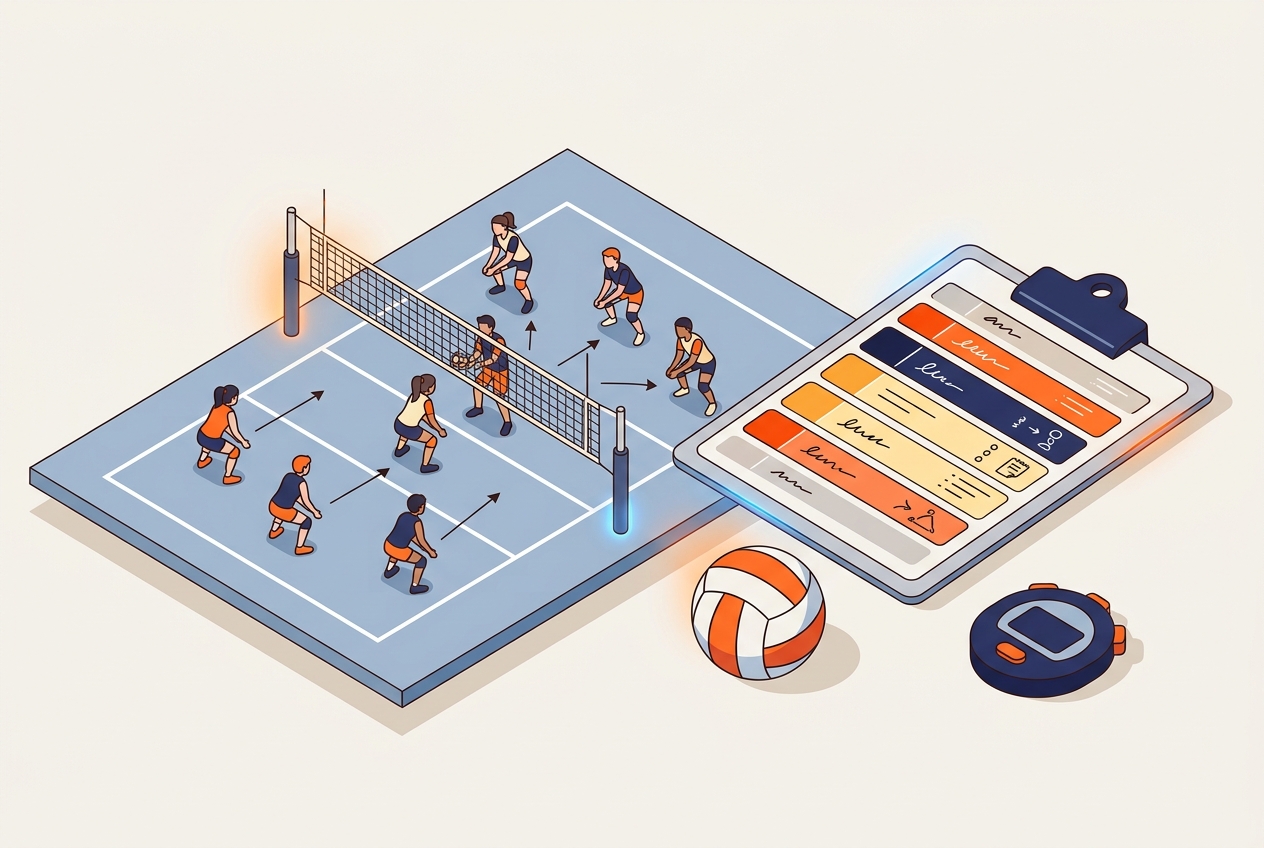
The 6-2 volleyball rotation uses two setters placed on opposite sides of the rotation, and whichever setter is in the back row does the setting. The payoff is the whole point of the system: three front-row attackers in every single rotation, all match long. Here is how the wheel works, all six rotations with a worked lineup, and the one stack that draws most of the overlap whistles.
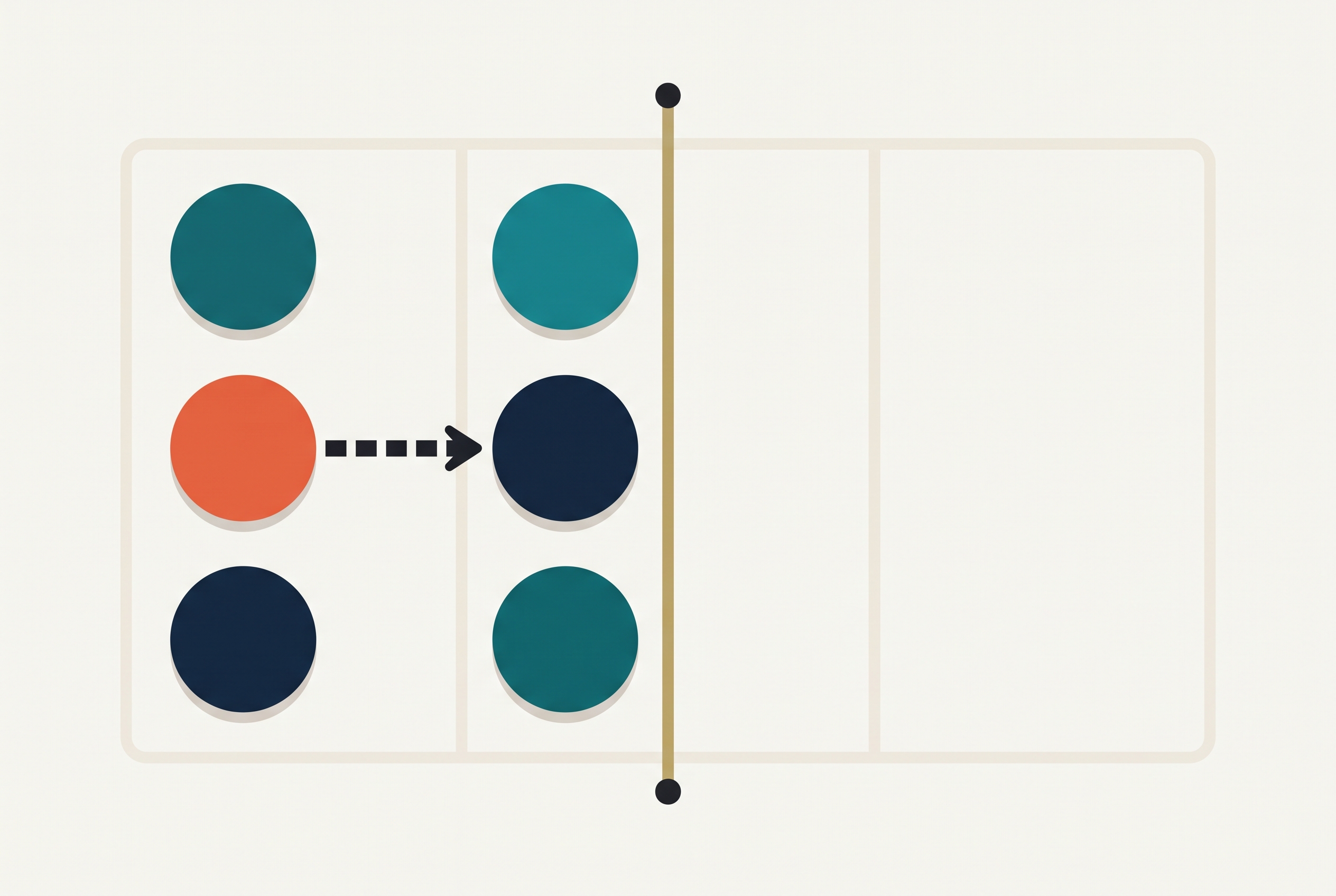
6-2 rotations — Two setters; the back-row setter sets so three hitters are always front row.
Rotation 1
Rotation 2
Rotation 3
Rotation 4
Rotation 5
Rotation 6
Build this with your roster — free →
No login required
What Is a 6-2 Volleyball Rotation?
A 6-2 means six attackers and two setters. The two setters stand three rotation spots apart, so one is always front row and one is always back row. The back-row setter runs the offense, penetrating from the back court to the target after the serve, while the front-row setter plays as a right-side hitter. When they trade rows on a side-out, they trade jobs.
The math is the sales pitch. A 5-1 gives you two-hitter rotations half the time. A 6-2 never does: three eligible front-row attackers in all six rotations. The costs are real too. You need two setters of comparable quality, both must learn to penetrate from the back row, and your offense can feel like two different teams if the setters deliver a different ball.
Many school and club teams run a substitution version: when a setter rotates to the front row, she subs out for a hitter. That spends substitutions quickly, which is why the sub-heavy 6-2 lives in high school, where teams get 18 substitutions a set, more than USAV club at 12 or college at 15.
A Worked 6-2 Lineup
The skeleton is identical to a 5-1 with one change: the opposite is replaced by a second setter. Paired players still stand three apart, which keeps them in opposite rows. Here is our example team, the Ridgeview Hawks, in service order:
| Service order slot | Player | Number | Role |
|---|---|---|---|
| I (starts zone 1) | Maya | 7 | Setter 1 |
| II (starts zone 2) | Jordan | 12 | Outside 1 |
| III (starts zone 3) | Priya | 4 | Middle 2 |
| IV (starts zone 4) | Sofia | 11 | Setter 2 |
| V (starts zone 5) | Kayla | 3 | Outside 2 |
| VI (starts zone 6) | Dre | 15 | Middle 1 |
Alina (#2) is the libero, swapping for the back-row middle exactly as she would in any system.
All 6 Rotations of the 6-2
Rotations are named for setter 1's zone, and the setting job flips halfway around the wheel:
| Rotation | Setter 1 (Maya) is in | Who sets | Front row (zones 4, 3, 2) | Front-row hitters |
|---|---|---|---|---|
| 1 | Zone 1 (back) | Maya | Sofia, Priya, Jordan | 3 |
| 2 | Zone 6 (back) | Maya | Kayla, Sofia, Priya | 3 |
| 3 | Zone 5 (back) | Maya | Dre, Kayla, Sofia | 3 |
| 4 | Zone 4 (front) | Sofia | Maya, Dre, Kayla | 3 |
| 5 | Zone 3 (front) | Sofia | Jordan, Maya, Dre | 3 |
| 6 | Zone 2 (front) | Sofia | Priya, Jordan, Maya | 3 |
In rotations 1 through 3 Maya sets and Sofia hits right side. In rotations 4 through 6 they swap. If you run the substitution version, Maya subs out for a right-side hitter when she reaches zone 4, and Sofia enters in the back row, so the "front-row setter hits" column becomes "sub enters."
Notice each setter's three setting rotations are exactly the back-row-setter rotations of a 5-1. If your players already know a 5-1, they know two thirds of a 6-2.
The Stack: Where 6-2 Teams Get Whistled
The 6-2's defining skill is the back-row setter releasing to the target without an alignment call, and serve receive is where it goes wrong. The classic look is rotation 2: the setter in zone 6 stacks tight behind the middle at the attack line, then sprints to the net at contact. Until the serve is struck she must stay behind the zone 3 player and laterally between the zone 5 and zone 1 players. A half step early or six inches too far right and the whistle comes.
The same seven overlap checks apply to a 6-2 as to every system, and none of them are diagonal. Each front-row player needs part of a foot closer to the net than the player directly behind them, and each side player needs a foot closer to their sideline than their row's middle player. When your passers spread to receive and your setter creeps to release, someone eventually drifts. Teach the checks once with the diagrams in our overlap rule guide and assign each player one landmark to hold.
A worked example from the table above, rotation 2 in serve receive: Kayla, Alina, and Jordan pass in a three-person pattern, Priya and Sofia hold the net, and Maya stacks behind Priya. Jordan pulls back off the right side to pass, which is legal as long as Maya keeps a foot behind Priya rather than beside her.
6-2 vs 5-1 vs 4-2: Picking the Right System
Choose a 6-2 when two setters are close in ability, when your outsides and middles are your best weapons and deserve three-hitter rotations all match, or when you are developing setters and want both getting real reps. Choose a 5-1 when one setter is clearly better: consistency of delivery usually beats the extra hitter. Choose a 4-2 for younger teams, because the front-row setter never has to penetrate and serve receive stays simple.
The typical development ladder runs 4-2 or 6-3 at 12U to 14U, a 6-2 for 14U and JV teams as setters learn to run from the back row, then a 5-1 at 16U and varsity. The 6-2 is the bridge system: it teaches back-row setting with a safety net, because there is always a second setter on the floor.
Game Day Mechanics Worth Getting Right
Two bookkeeping details bite 6-2 coaches. First, the lineup sheet lists service order, not court positions, so slot I is your first server if you serve and the right-front player if you receive. The rotation generator fills it out correctly for either case. Second, if you run the substitution version, count your subs: swapping both setters and both right sides every three rotations costs 4 substitutions per full wheel, and a long five-set match can push a high school team toward its 18. Plan your practice blocks so the second setter's rotations get equal reps, and make the setter decision with real tryout data rather than a hunch when you run tryouts.
Frequently Asked Questions
What does 6-2 mean in volleyball?
Six attackers, two setters. Both setters count as attackers when they are front row, which is how six plus two equals six players on the court. The back-row setter always does the setting, so the team keeps three front-row hitters in every rotation.
Does the back-row setter ever attack in a 6-2?
Not above the net in front of the attack line. As a back-row player the setting setter cannot complete an attack above net height, which is one reason teams with one dominant setter prefer the 5-1, where she gets three front-row rotations.
How many substitutions does a 6-2 use?
The pure 6-2 uses none for the setters, since both stay on the court and the front-row setter hits. The substitution variant, common in high school, spends around 4 per full rotation cycle swapping setters and right sides, which is manageable under the NFHS limit of 18 per set but tight under the USAV club limit of 12 and the college limit of 15.
Who does the libero replace in a 6-2?
Same as any system: the back-row middle. Some 6-2 teams also use their second libero, where the rule set allows two, to manage the back-row setter's serve receive rotations, but the standard pattern is middle replacement.
Is a 6-2 good for youth teams?
It is the right bridge for 14U and JV rosters with two developing setters. Below that age most coaches prefer a 4-2 or 6-3, which teach positions without back-row penetration timing.
Talk to our team
Want to spend more time coaching and less time with paperwork? Let's talk.
Tell us about your team and we'll show you how to plan games, set lineups, run the schedule, and develop players in one place, so you spend the season coaching instead of chasing admin.
Less admin, more coaching
Plan games, set lineups, and track the season in one place
Keep every family in the loop automatically
Tell us about your program
4 fields · takes 30 seconds
Lands in the same inbox as the Help button · human response only
Read Next
Bullpen Tracking: Chart Practice Pitching Sessions
FeaturesBest Free Baseball Lineup Generators in 2026
LearnQuality At-Bat (QAB): Definition, Criteria & Youth Benchmarks
StatsHow to Sync Your Team Schedule to Google Calendar
LearnVolleyball Practice Plan Template: Printable Session Sheet and Weekly Grid
VolleyballStrike Percentage: The Youth Pitching Development Stat
Stats