
Volleyball
The 4-2 Volleyball Rotation: The Right First System for Young Teams
The 4-2 volleyball rotation uses two setters placed opposite each other, and the setter in the front row does the setting. Because the setter is already at the net, nobody has to time a back-court penetration, serve receive stays simple, and young players can focus on passing and swinging. That is why the 4-2 is the standard first system for 12U club, middle school, and first-year teams.
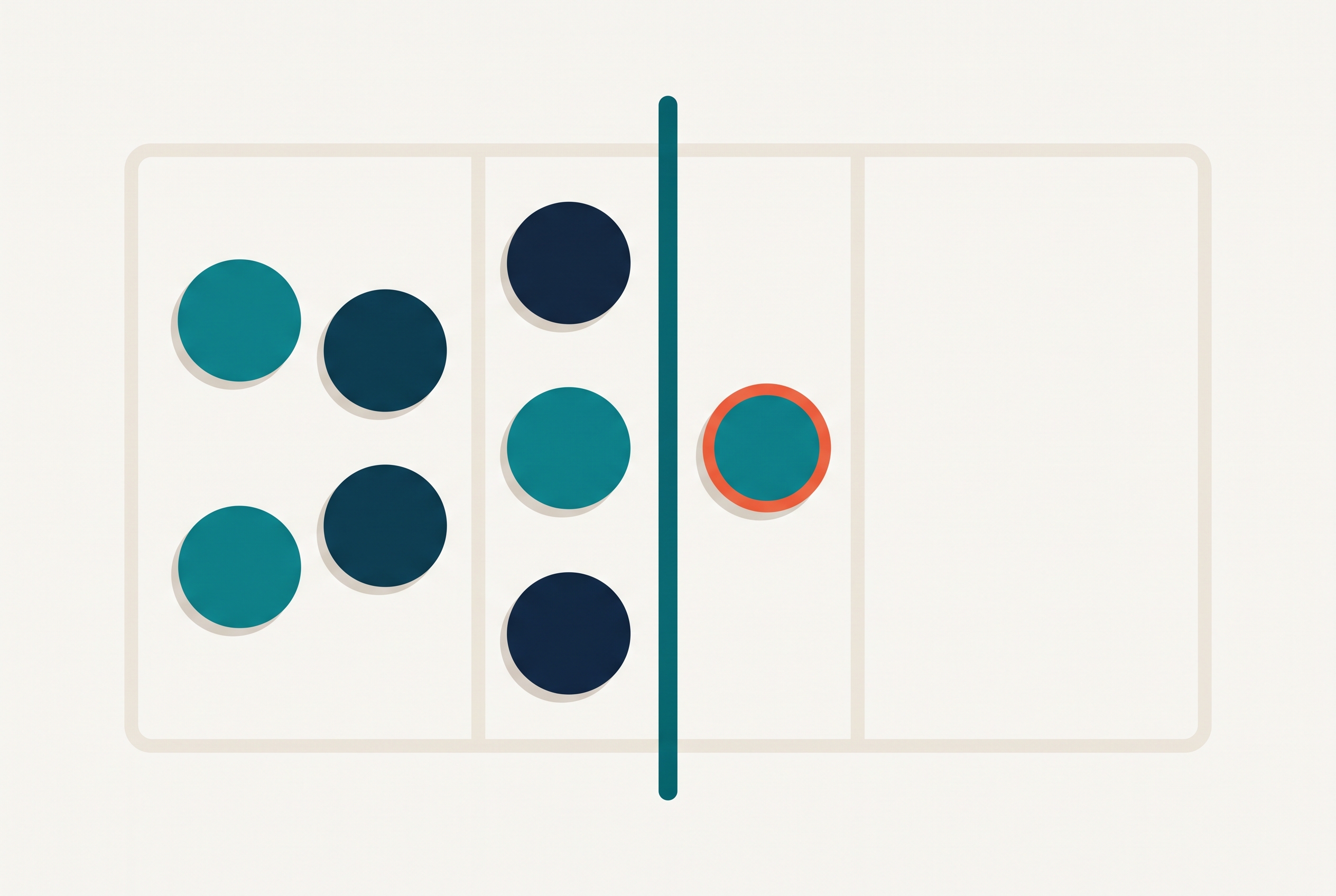
4-2 rotations — Two setters on opposite rotations; the front-row setter sets.
Rotation 1
Rotation 2
Rotation 3
Rotation 4
Rotation 5
Rotation 6
Build this with your roster — free →
No login required
What Is a 4-2 Volleyball Rotation?
A 4-2 means four attackers and two setters. The setters stand three rotation spots apart so one is always front row, and that front-row setter runs the offense from the middle or right side of the net. The back-row setter simply plays defense and passes.
Compare the jobs across the three common systems. In a 5-1 one setter sets everything and penetrates from the back row half the time. In a 6-2 two setters set only when they are back row, which buys three hitters but demands penetration timing. The 4-2 asks the least of everyone: the setter sets when she is front row, standing where the ball is going anyway. The price is attack options, since only two front-row hitters flank the setter.
For a team still learning where to stand, that trade is correct. Coaches consistently find that the skills a 4-2 builds, clean passing, honest approaches, a setter who squares to her target, transfer directly to the 6-2 and 5-1 those players will run at 14U and beyond.
A Worked 4-2 Lineup
Paired players stand three apart: setter opposite setter, and hitters opposite each other. Here is a worked middle school lineup for our example team, the Ridgeview Hawks, in service order:
| Service order slot | Player | Number | Role |
|---|---|---|---|
| I (starts zone 1) | Maya | 7 | Setter 1 |
| II (starts zone 2) | Jordan | 12 | Hitter |
| III (starts zone 3) | Priya | 4 | Hitter |
| IV (starts zone 4) | Sofia | 11 | Setter 2 |
| V (starts zone 5) | Kayla | 3 | Hitter |
| VI (starts zone 6) | Dre | 15 | Hitter |
At this level many teams skip the libero entirely, and that is fine. The libero is legal at 12U in most rule sets, but a 4-2 works cleanly without one while players learn the basics.
All 6 Rotations of the 4-2
Rotations are named for setter 1's zone. Whoever is front row sets, and the setting job flips every three rotations:
| Rotation | Setter 1 (Maya) is in | Who sets | Front row (zones 4, 3, 2) | Notes |
|---|---|---|---|---|
| 1 | Zone 1 (back) | Sofia | Sofia, Priya, Jordan | Sofia slides from 4 toward the target |
| 2 | Zone 6 (back) | Sofia | Kayla, Sofia, Priya | Setter already in the middle, easiest look |
| 3 | Zone 5 (back) | Sofia | Dre, Kayla, Sofia | Sofia sets from the right side |
| 4 | Zone 4 (front) | Maya | Maya, Dre, Kayla | Jobs flip: Maya sets, Sofia passes |
| 5 | Zone 3 (front) | Maya | Jordan, Maya, Dre | Setter in the middle again |
| 6 | Zone 2 (front) | Maya | Priya, Jordan, Maya | Maya sets from the right side |
Teach it as two halves. Rotations 1 to 3 are Sofia's front-row tour, rotations 4 to 6 are Maya's, and inside each half the setter simply walks the net from left to middle to right. Players only need to learn three pictures, then swap the setter's face.
The known hard spot is the rotation where the setter starts in zone 4 and must set from the left side or slide across the net (rotation 1 and rotation 4 in the chart). Most youth coaches either let the setter set from the left that rotation or teach a simple slide to the middle after the serve. Pick one and drill it; do not improvise on game day. The rotation generator draws both variants so you can hand players the picture you chose.
Serve Receive in a 4-2: The W
The 4-2 pairs naturally with the five-person W formation, the beginner serve receive where every non-setter helps pass. The front-row setter stands at the net, out of the passing pattern, and the other five arrange in a W shape: three across the middle of the court, two behind the gaps. Nobody hides, nobody stacks, and overlap risk is close to zero because everyone stands in their natural rotational order.
That is the quiet superpower of the 4-2 for young teams: it is the system least likely to draw an alignment whistle. The seven overlap checks still apply at the moment of serve, and the most common youth violation, a front-row player wandering deeper than the back-row player behind her, still happens. When it does, the fix is inches. The overlap rule guide shows each check with the exact foot rule referees use.
As passers improve, shrink the pattern: move from five receivers to four, then three, keeping your best passers on the ball. That progression, not a new system, is usually the right next step for a strong 12U or 13U team.
When to Move On From the 4-2
Move on when your setters are ready to penetrate from the back row, typically around 14U or JV. The natural next step is the 6-2, which keeps two setters but flips the setting job to the back row, buying three front-row attackers. Teams with one standout setter eventually land in a 5-1 at 16U or varsity.
A useful rule from the development world: below 12U, consider not specializing at all and letting everyone set in a 6-6, or run a 6-3 with three setters. The 4-2 sits one rung up that ladder, first real positions, simplest possible execution. Whatever the system, assign roles from what you saw at tryouts, and give the second setter equal reps in practice so game day is not her first tour of the net.
Frequently Asked Questions
What does 4-2 mean in volleyball?
Four attackers and two setters. The setters stand opposite each other in the rotation so one is always front row, and the front-row setter runs the offense from the net.
What is the difference between a 4-2 and a 6-2?
Both use two setters. In a 4-2 the front-row setter sets, leaving two front-row attackers. In a 6-2 the back-row setter sets, keeping three front-row attackers, but she must penetrate from the back court after the serve, which is a harder skill.
What ages should run a 4-2?
It is the standard system for 12U club, middle school, and first-year teams of any age. Most programs transition to a 6-2 around 14U or JV as setters learn back-row penetration, then a 5-1 at 16U or varsity.
Do you need a libero in a 4-2?
No. The system works cleanly without one, and many 12U and middle school teams skip it while players learn court movement. When you do add a libero, she replaces the back-row middle or your weakest back-row defender, same as any system.
Where does the setter stand in a 4-2 serve receive?
At the net, out of the passing pattern, usually near the target between zones 2 and 3. The remaining five players pass in a W formation. Because the setter is already where she needs to be, the 4-2 has the simplest serve receive in volleyball.
Talk to our team
Want to spend more time coaching and less time with paperwork? Let's talk.
Tell us about your team and we'll show you how to plan games, set lineups, run the schedule, and develop players in one place, so you spend the season coaching instead of chasing admin.
Less admin, more coaching
Plan games, set lineups, and track the season in one place
Keep every family in the loop automatically
Tell us about your program
4 fields · takes 30 seconds
Lands in the same inbox as the Help button · human response only
Read Next
Rizzler Sports Product Overview: Web App, iOS App & Free Tools
BlogSoccer Practice Schedule Template: Session Plan by Age Group
SoccerVolleyball Blocking Drills: 7 Drills for Timing and Footwork
VolleyballPlayer Development: Track Every Player Across the Season
FeaturesLittle League Pitch Count Limits by Age (2026 Rules)
RulesHow to Run a Football Tryout: A Coach's Step-by-Step Guide
Learn