Volleyball
The 6-3 Volleyball Rotation: Three Setters, Zero Early Specialization
The 6-3 volleyball rotation uses three setters placed in alternating rotation spots, and each one sets for the two rotations she spends in the front right and middle of the court. Six attackers, three setters, everyone does a bit of everything. Development-minded coaches recommend it for 12U to 14U teams precisely because it refuses to specialize anyone too early, and because it quietly prepares every one of those setters to run a 5-1 later.
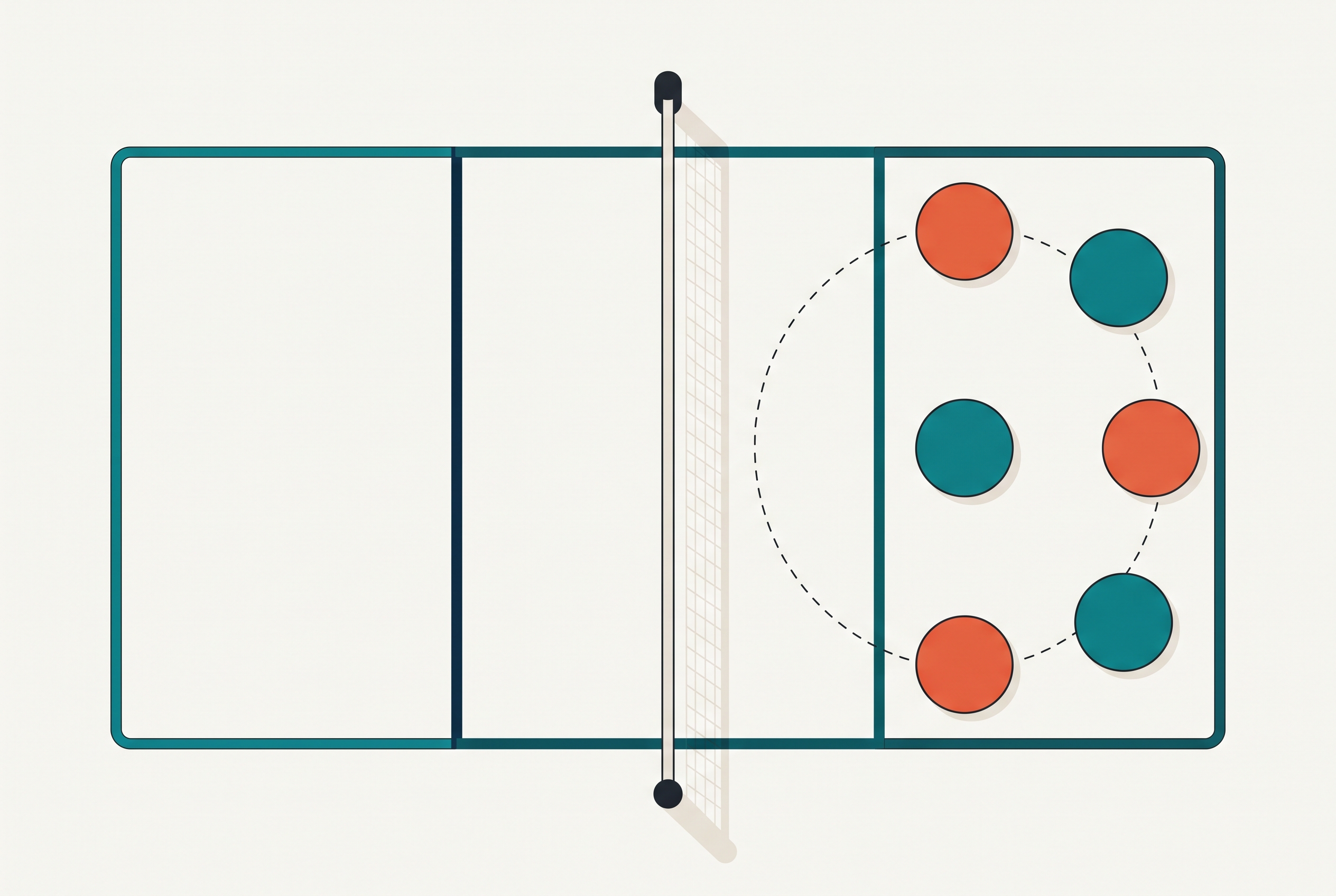
6-3 rotations — Three setters alternating with hitters; each sets the two rotations they reach zones 3 and 2.
Rotation 1
Rotation 2
Rotation 3
Rotation 4
Rotation 5
Rotation 6
Build this with your roster — free →
No login required
What Is a 6-3 Volleyball Rotation?
A 6-3 places three designated setters in non-adjacent lineup slots, every other position around the wheel, with a hitter between each pair. Each setter takes the setting job for the two consecutive rotations in which she occupies zone 2 or zone 3, the right front and middle front. Rotate twice and the job hands off to the next setter around the wheel.
The pattern that results is simple to teach: two rotations of setting, four rotations of hitting and passing, repeating for each of the three setters. No back-row penetration, no substitution machinery, no one frozen into a single identity for the season.
A Worked 6-3 Lineup
Setters go in alternating slots, here slots I, III, and V for our Ridgeview Hawks 13U roster:
| Slot | Player | # | Role |
|---|---|---|---|
| I | Maya | 7 | Setter A |
| II | Jordan | 12 | Hitter |
| III | Sofia | 11 | Setter B |
| IV | Tess | 9 | Hitter |
| V | Nia | 5 | Setter C |
| VI | Dre | 15 | Hitter |
The setting schedule falls out of the wheel automatically. When Maya reaches zone 3 she sets that rotation and the next one (zone 2), then hands off to Nia, who has just arrived in zone 3 behind her. Around the wheel it goes: Maya sets rotations where she is front middle and front right, Sofia the same two spots three side-outs later, Nia in between. Every player passes in serve receive at some point, every hitter hits, and all three setters get equal setting time, enforced by geometry instead of by a coach's memory.
Why Development Coaches Like It
The 6-3 solves the problem that shows up in every youth program: a coach picks the one coordinated kid to set in September, and by the following June that is the only player who has touched the second ball all year. Three setters means three players learning the position for real, and the two-rotation shifts mean the job never disappears into one identity.
The other argument is subtler. Setting from zones 2 and 3, at the net, teaches target footwork and tempo without the hardest part of setting, the back-row penetration run that a 6-2 demands. When one of those three setters eventually earns the full-time job, the step up to a 5-1 is short: she already knows the front-row half of it, and overlap habits are already built. Compared to a 4-2, the 6-3 trades a little simplicity for double the setter development and a fairer distribution of touches.
The trade-offs are real: your offense changes flavor every two rotations, three players need setter training in practice, and the system caps out. Nobody runs a 6-3 at varsity. It is scaffolding, and that is the point.
Overlap and Serve Receive in the 6-3
Because the setter is always front row when she sets, the 6-3 has nearly the same low overlap risk as a 4-2. There is one relationship worth teaching explicitly: in the rotation where a setter sits in zone 3 with the next setter arriving behind her in zone 6, the two of them form a front-back pair, and the zone 6 setter creeping up early is the system's one common whistle. The full set of checks is short, and the overlap rule guide covers all seven in ten minutes of practice time.
Serve receive works cleanly as a five-person W at the younger ages, shrinking to four and then three passers as the group matures. The front-row setter stays out of the pattern at the net, exactly as in a 4-2.
Setting Up a 6-3 for Your Roster
Pick your three setters from tryout data rather than by reputation; passing quality and hand consistency matter more than height at this stage, which is exactly what structured tryout scoring surfaces. Slot them alternately, balance the hitters between them, and print the rotation chart so every player can see which two rotations belong to each setter. The rotation generator supports the 6-3 directly, builds all six diagrams from your names, and flags any overlap issues in the receive shapes you choose, which matters double here because most printable resources online skip the 6-3 entirely.
Frequently Asked Questions
What does 6-3 mean in volleyball?
Six attackers and three setters. The setters occupy alternating rotation spots, and each sets for the two consecutive rotations she spends in the front middle and front right of the court. Everyone hits and passes when not setting.
What ages should run a 6-3?
It is built for 12U to 14U development teams, or any young roster where the coach wants multiple players learning to set. Programs typically move to a 6-2 or 5-1 by 15s and 16s once a setting hierarchy emerges.
How is a 6-3 different from a 6-2?
A 6-2's two setters set from the back row, penetrating to the net after the serve, which keeps three front-row hitters. A 6-3's three setters set from the front row, no penetration required. The 6-3 is easier to execute and develops more setters; the 6-2 produces a stronger attack.
Does the 6-3 use a libero?
Usually not at the ages that run it. The system works fine with straight six-player rotation, and many 12U leagues barely use liberos anyway. Adding one later is no different than in any other system: she replaces a back-row player and inherits that spot's overlap duties.
Who invented the 6-3?
No one owns it, but it is closely associated with youth development coaching circles in USA Volleyball, where it has long been recommended as the bridge between everybody-sets beginner play and specialized systems.
Talk to our team
Want to spend more time coaching and less time with paperwork? Let's talk.
Tell us about your team and we'll show you how to plan games, set lineups, run the schedule, and develop players in one place, so you spend the season coaching instead of chasing admin.
Less admin, more coaching
Plan games, set lineups, and track the season in one place
Keep every family in the loop automatically
Tell us about your program
4 fields · takes 30 seconds
Lands in the same inbox as the Help button · human response only
Read Next
Best Apps for Little League Coaches in 2026
LearnHow to Start a Volleyball Club
LearnVolleyball Conditioning Drills: Court-Specific Work That Transfers
VolleyballSoftball Tryout Evaluation Form: What to Score (Free Template)
LearnErrors (E): Definition & What They Mean in Youth Baseball
StatsHow to Coach Youth Basketball: A Practical Guide
Learn