
Features
Run Player Evaluations That Actually Mean Something
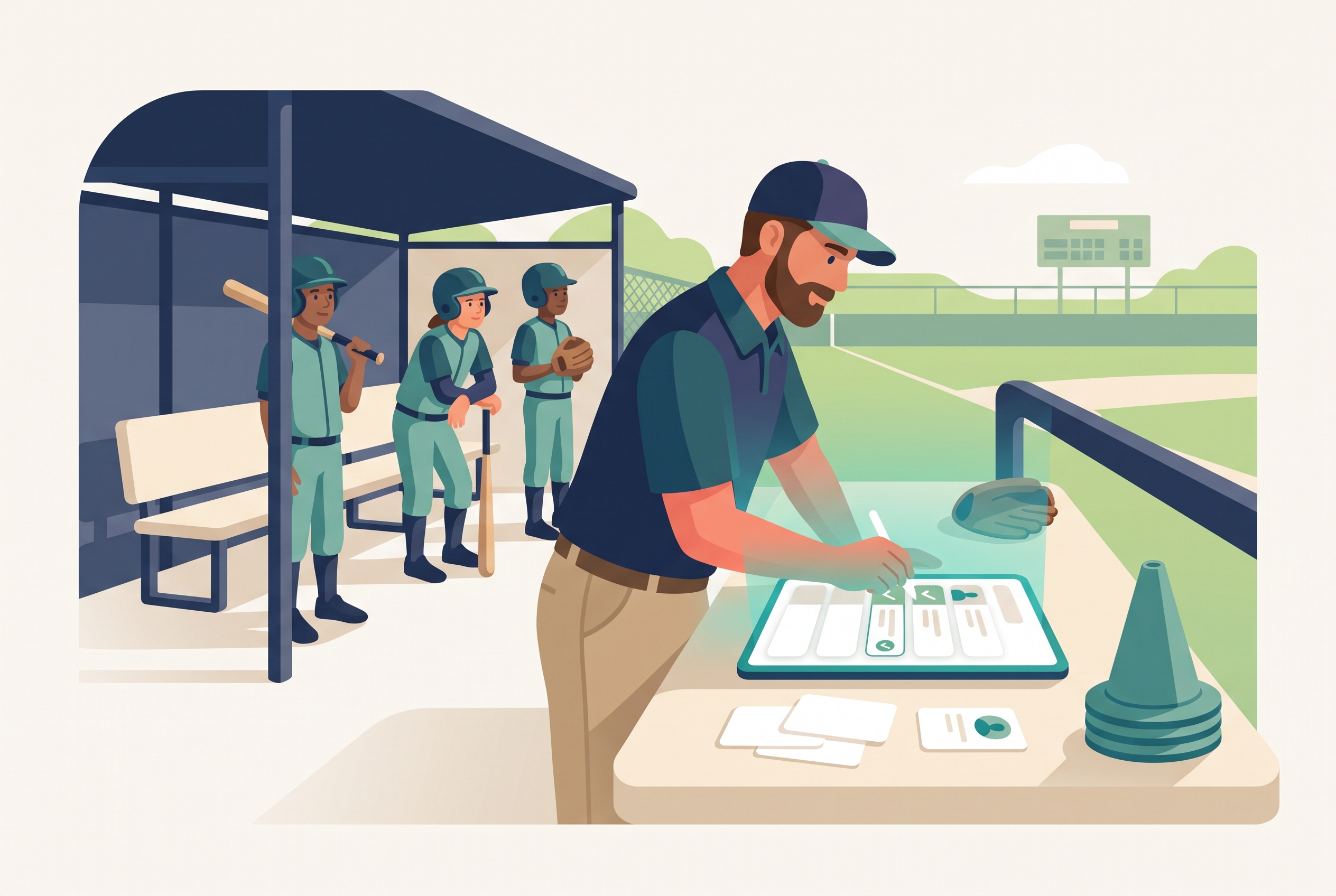
Rizzler's player evaluations let coaches run a structured baseball player evaluation from their phone, with customizable rubrics, support for measurables like exit velocity and pitch speed, and side-by-side comparison of pre-season, mid-season, and end-of-season results. When a parent asks "how is my kid doing?" you've got a data-backed answer, not a feeling.

What a Baseball Player Evaluation Covers
A player evaluation is a structured assessment of someone already on your roster: you score a set of skills on a consistent scale, add notes, and repeat later in the season so you can measure change. It's different from evaluation events, which assess unrostered players before a league draft, and from tryouts, which decide who makes a travel team. All three run on the same evaluation engine in Rizzler, but they answer different questions at different points in the year.
The categories most coaches score:
| Category | Example criteria |
|---|---|
| Hitting | Swing mechanics, bat speed, contact quality, plate discipline, pitch recognition |
| Fielding | Footwork, glove work, range, throwing accuracy, game awareness |
| Throwing | Arm strength, accuracy, mechanics |
| Pitching (if applicable) | Command, pitch variety, composure, strike percentage |
| Speed and athleticism | Sprint speed, baserunning instincts, agility |
| Baseball IQ | Situational awareness, coachability, hustle, leadership |
| Measurables | Exit velocity, pitch speed, pop time, 60-yard dash |
You choose which categories matter for your team and age group. An 8U evaluation might be six line items about fundamentals and effort. A 14U travel evaluation might run twenty criteria plus measurables.
What a Finished Evaluation Looks Like
Blank templates don't tell you much, so here's a filled-out example: a 12U middle infielder, scored on a 1-to-10 scale pre-season and again mid-season.
M. Alvarez, 12U, SS/2B. Scale: 1–10, where 5 is average for the age group.
| Category | Pre-season (Mar 14) | Mid-season (May 9) | Change |
|---|---|---|---|
| Contact and swing mechanics | 5 | 7 | +2 |
| Plate discipline | 3 | 5 | +2 |
| Glove work and footwork | 7 | 7 | steady |
| Throwing accuracy | 6 | 7 | +1 |
| Arm strength | 6 | 6 | steady |
| Speed and baserunning | 7 | 7 | steady |
| Baseball IQ | 6 | 7 | +1 |
| Exit velocity, off tee | 54 mph | 58 mph | +4 mph |
| 60-yard dash | 9.4 sec | 9.2 sec | -0.2 sec |
Coach note (May 9): "Swing decisions are the story of his spring. In March he chased everything up; since we adjusted his hands and drilled two-strike approach in April, he's laying off the high fastball and driving mistakes. Next focus is the backhand deep in the hole. The arm is fine, the feet get lazy on slow rollers."
That comparison is the whole point. The March evaluation alone says "decent player, chases pitches." March plus May says "the plate discipline work is landing, keep it up, and shift practice time to defensive footwork." One is an opinion. The other is a development plan with evidence behind it.
Picking a Scale Your Whole Staff Scores the Same Way
There's no single correct scale, but there is a correct way to use one: pick it before you evaluate, write down what every number means, and hold the whole staff to it. Three scales cover almost every youth program.
A 1–5 scale is the classic clipboard format, and it's the one to reach for on paper: fast, hard to get wrong, and coarse enough that two coaches usually land on the same number. The tradeoff is resolution. Score a deep roster on five points and everyone bunches in the middle, so you finish with a pile of ties to break by hand.
A 1–10 scale is what we default to in Rizzler, and it's the one to use once the app is doing the bookkeeping. It gives you room to separate players without inventing distinctions nobody can see, and it normalizes straight to a percentage, so a 7 reads as 70% on every rubric no matter how many categories it has. That is what makes ranking a big group, and comparing Alvarez's March score to his May score, actually hold up.
The 20–80 scale is the one pro baseball and softball scouts use: 50 is average, and each 10 points is a step up or down. If your staff already thinks in 60-grade runners and 45 arms, it carries the same information as a 1–10 in a vocabulary experienced evaluators trust.
Whichever you choose, the anchors matter more than the range. "7 = above average for 12U" means something; a bare "7" means whatever mood the evaluator is in. Rizzler rubrics carry a written description for every score on every criterion, so your assistant grading fielding at station two is scoring against the same definitions you are. That anchoring is exactly why a 10-point scale holds up in the app when it would fall apart on a clipboard.
How Evaluations Work in Rizzler
- Choose or build your rubric. Start from a pre-built template (the 10-point default, a 5-point scale, or the 20–80 scouting scale) and adjust categories, scales, and score descriptions to fit your team.
- Run the evaluation. Open it on your phone during practice and score each player skill by skill. Tap a score, add an optional note, move on. A 12-player roster usually fits inside one practice.
- Record measurables. Exit velocity, pitch speed, pop time, 60 time. Enter the numbers and Rizzler stores them alongside the rubric scores.
- Review results. See each player's scores, averages, and strengths and weaknesses, and compare players side by side.
- Repeat and compare. Run it again mid-season or end-of-season and Rizzler shows the change per criterion, exactly like the Alvarez table above. This is what makes an evaluation a development tool instead of a one-time snapshot.
Player skills assessments and season-long tracking are included on the Coach and Club plans.

When to Run Evaluations
Three per season is the practical rhythm for most teams; even two beats the one-and-done evaluation that most rosters get.
| Timing | Purpose |
|---|---|
| Pre-season | Establish baselines and set the first practice priorities. |
| Mid-season, 6-8 weeks in | Measure progress, adjust practice focus, update parents. |
| End-of-season | Final comparison against the baseline; set off-season goals. |
| Post-tournament | Quick notes on what you saw under real pressure. |
The mid-season check is the one coaches skip and shouldn't. It arrives while there's still season left to act on what you find.
Pair the Rubric with Game Data
Evaluations are opinions with structure; stats are what actually happened in games. Together they're much harder to argue with. A rubric score of 3 for plate discipline means more when it sits next to the player's on-base percentage and strikeout rate, and a kid whose fielding score jumped a full point should eventually show it in fewer errors.
Rizzler puts game stats and evaluation scores on the same player profile, so the subjective read and the objective record sit side by side. When they disagree, that's not a problem with the system. That's the system telling you where to look closer.
Who Uses Player Evaluations
Travel coaches run the full three-evaluation cycle to track development across seasons, inform roster decisions, and back up playing-time conversations with something better than memory.
Little League coaches run lighter versions, often just mid-season and end-of-season check-ins, to decide where practice time goes and to give every family a real answer about their kid's progress.
Club directors look across teams: evaluation data at the organizational level shows which age groups are developing, supports advancement decisions, and keeps coaches in the program evaluating against the same standards.
Frequently Asked Questions
Is this the same as evaluation events?
No. Player evaluations assess players already on your team, typically pre-season, mid-season, and end-of-season. Evaluation events are league-wide assessments of unrostered players before a draft, and they're a Club plan feature. Both use the same evaluation engine.
Are player evaluations available on the Free plan?
Player skills assessments require the Coach plan or the Club plan (built for organizations running up to 20 teams and 300 players). Compare plans to see what else each tier includes.
Can I share evaluation results with parents?
Yes. You can generate a report for an individual player showing rubric scores, measurables, and the comparison to prior evaluations, and share it with their family. You control what's included, so a report can show growth areas without broadcasting every internal note.
What scale should I use for youth baseball evaluations?
In the app, default to 1–10: it spreads a roster out, it normalizes to a percentage so scores compare cleanly across rubrics and across the season, and Rizzler anchors every number so coaches still grade consistently. A 1–5 scale is the right call on a paper form or when you want the simplest sheet possible, and if your staff comes from a scouting background, the 20–80 scale works too. The scale you pick matters far less than defining what each number means before the first player steps on the field.
What age should I start doing evaluations?
Structured evaluations make sense starting around 9U or 10U. Before that, plain observations are more useful than scores. There's a longer discussion of age-appropriate measurement in using stats without overcoaching.
Ready to run evaluations from your phone instead of a clipboard?
Talk to our team
Want to see how to develop players all season long? Let's talk.
Tell us about your team and we'll show you how season-long skill tracking becomes the progress report a parent opens, while players keep building between practices with Rizzler Reps.
Track skills all season, not just on tryout day
Turn evaluations into reports parents actually open
Players build habits between practices with Rizzler Reps
Tell us about your program
4 fields · takes 30 seconds
Lands in the same inbox as the Help button · human response only
Read Next
Slugging Percentage (SLG): Definition, Formula & Youth Benchmarks
StatsRizzler Sports Product Overview: Web App, iOS App & Free Tools
BlogRizzler vs TeamSnap: The Team App That Also Coaches
ComparisonTop Approaches to Building a Baseball Batting Order
LearnPlaying Time Fairness Across Your Little League
For LeaguesBatting Stats: Every Offensive Stat Explained for Coaches
Stats