Volleyball
Volleyball Serve Receive Patterns: Who Passes, Who Hides, Rotation by Rotation
Serve receive in volleyball is the formation your team takes at the moment of the opponent's serve: who passes, who stays out of the way, and how the setter gets to the target without an alignment whistle. Modern teams put three passers on the ball, both outsides and the libero, in every rotation. Beginners use the five-person W. Everything between is a variation on one question: how few passers can you trust, and where do you hide everyone else?
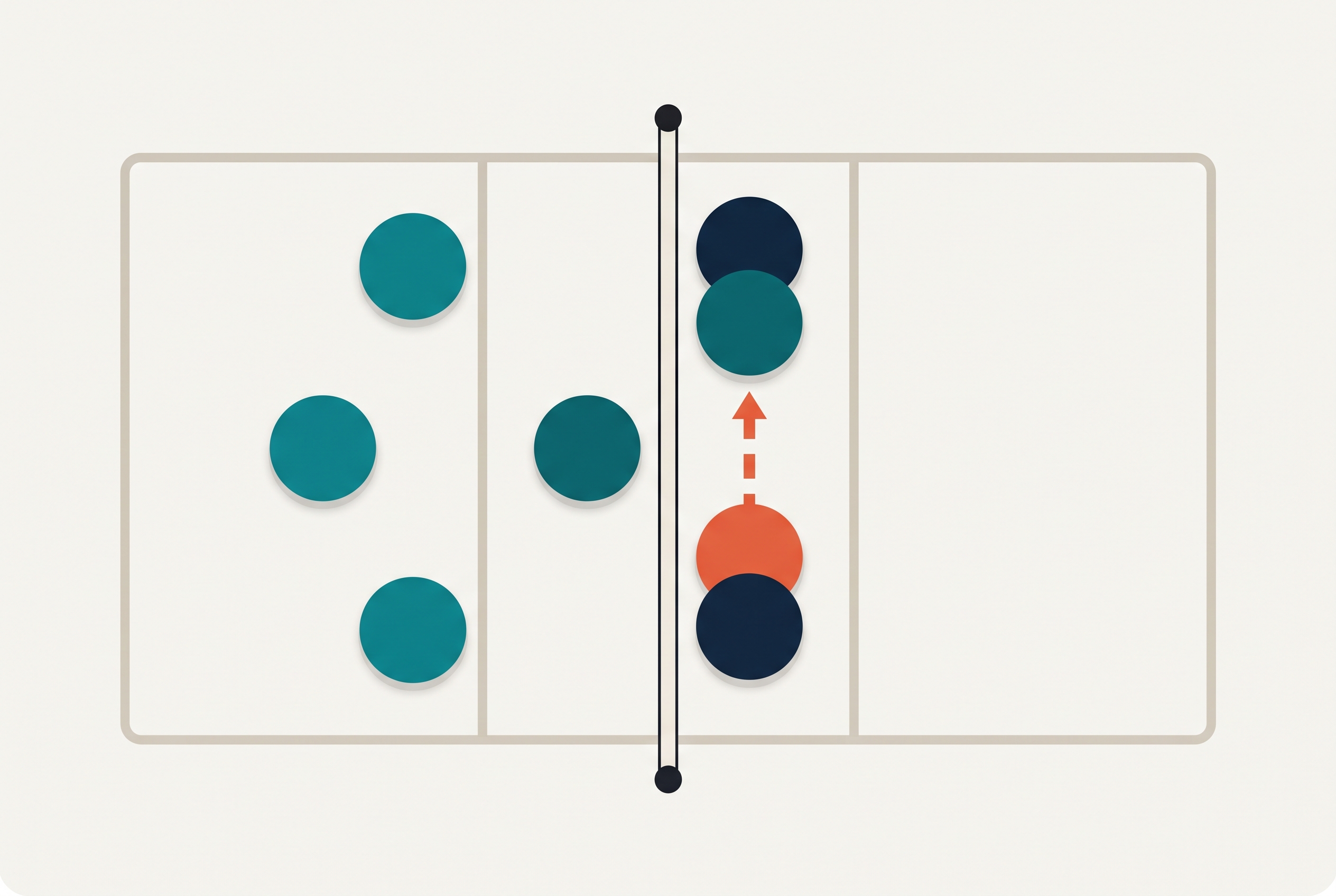
5-1 rotations — One setter sets in all six rotations; opposite hits right side.
Rotation 2 — Setter in 6
Build this with your roster — free →
No login required
The Standard: 3-Person Serve Receive
At every level above beginner, the default pattern is three passers arranged in a shallow arc: outside hitter, libero, outside hitter. The middles and the setter stay out of the pattern, either tight to the net or tucked short, and release to their jobs at contact. Three passers means each covers a manageable slice of court, the seams are wide enough to negotiate, and both outsides stay available to attack after passing.
The count is the variable. Two-passer receive appears at high club and college levels when a libero and one outside can cover the whole court, freeing everyone else early. Four-passer looks add the opposite or a defensive specialist for teams with shaky passing. The five-person W, all five non-setters in a W shape, is the youth standard because nobody hides and overlap risk nearly disappears; it pairs naturally with the 4-2 system.
The progression across a program's life is passer subtraction: W at 10U and 12U, four passers as skills firm up, three by 14U club, and situational two-passer looks at varsity. Shrink the pattern when your passing ratings say so, not when the calendar does.
Hiding Players Without Getting Whistled
Every serve receive pattern lives inside the overlap rule: at the moment of serve, each player must honor exactly two relationships, the player directly in front of or behind them and the player beside them in their own row. There is no diagonal overlap, and that single fact is what makes hiding legal.
A front-row middle can stand a step off the net with a passer pulled deeper behind her. A back-row setter can creep to the attack line stacked behind her own front-row player. The design principles that experienced coaches follow: get the setter to the target with the shortest legal run, keep your best passer on the biggest slice of court, never take your outside out of her approach path, and give every rotation two attack options even if the pass is off.
Serve Receive in the 5-1, Rotation by Rotation
In a 5-1, the interesting rotations are the three where the setter is back row and has to travel. (This table is the summary; the 5-1 serve receive walkthrough diagrams all six rotations interactively, trap by trap.) Using our Ridgeview Hawks lineup (Maya setting, Jordan and Kayla outside, Priya and Dre middle, Tess opposite, Alina libero):
| Rotation | Passers (left to right) | Where Maya hides | The trap |
|---|---|---|---|
| 1 (setter zone 1) | Kayla, Alina, Jordan | Right corner, tucked behind Jordan | Jordan must keep a foot in front of her |
| 2 (setter zone 6) | Kayla, Alina, Jordan | Stacked behind Priya at the attack line | Stay behind zone 3, between zones 5 and 1 |
| 3 (setter zone 5) | Jordan, Alina, Kayla | Far left behind Dre, longest run | Stay left of the zone 6 passer until contact |
| 4 (setter zone 4) | Jordan, Alina, Kayla | No hiding, she is front row at the net | Opposite hides short right instead |
| 5 (setter zone 3) | Jordan, Alina, Kayla | At the target already | Front-row outside must not drift inside her |
| 6 (setter zone 2) | Tess or Kayla, Alina, Jordan | At the target already | Keep a foot in front of the zone 1 passer |
Treat the hide spots as house style rather than law. Different staffs stack in different places, and the only hard constraints are the seven overlap checks. What should not vary is the passers: the same three people pass in all six rotations, which is precisely why the pattern is teachable.
Serve Receive in the 6-2
A 6-2 runs the 5-1's three back-row-setter patterns twice. Whichever setter is back row hides and releases exactly as Maya does in rotations 1 through 3 above, while the other setter plays right side at the net. The added wrinkle is that the front-row setter is a legal attacker, so she stays out of the pattern at the net rather than tucking short. The stack behind the middle in the zone 6 rotation remains the most-whistled moment in the system; drill the freeze-at-contact habit there first. The 6-2 serve receive walkthrough diagrams the full mirror, rotation by rotation.
Teaching It: Freeze Drills and Printed Cards
Serve receive patterns stick when players see themselves in the picture. Print the six receive shapes from your rotation sheet, walk each one on the court, then run a freeze drill: a coach tosses a serve, blows a whistle at the imaginary contact, and everyone holds position while the group checks the seven relationships out loud. Ten minutes per practice for two weeks covers all six rotations twice. The rotation generator draws each rotation's receive pattern with your players' names on it, which beats a whiteboard sketch that gets erased before anyone memorizes it.
Frequently Asked Questions
What is serve receive in volleyball?
The formation a team takes at the moment of the opponent's serve: designated passers arranged to cover the court, non-passers positioned out of the way but inside the overlap rules, and a plan for the setter to reach the target once the ball is struck.
How many passers should receive the serve?
Three is the standard above beginner level, usually both outside hitters and the libero. Youth teams start with the five-person W so nobody has to hide. Shrink from five to four to three as passing improves, and reserve two-passer looks for teams with elite passers.
Who passes in a 5-1 serve receive?
The same three players in every rotation: the two outside hitters and the libero. The middles and the setter stay out of the pattern. Keeping the passing trio constant across all six rotations is the biggest simplification in the whole system.
How does the setter hide in serve receive?
By standing where the overlap rule allows and releasing at contact: tucked behind a front-row player near the sideline, or stacked behind the middle at the attack line. She only has to honor her two neighbors, front-back and side-side. There is no diagonal overlap to worry about.
What is the W formation?
The five-person beginner serve receive: all five non-setters arranged in a W shape, three across the middle and two behind the gaps. Nobody hides, overlap risk is minimal, and it pairs with the 4-2 system most young teams run first.
Talk to our team
Want to spend more time coaching and less time with paperwork? Let's talk.
Tell us about your team and we'll show you how to plan games, set lineups, run the schedule, and develop players in one place, so you spend the season coaching instead of chasing admin.
Less admin, more coaching
Plan games, set lineups, and track the season in one place
Keep every family in the loop automatically
Tell us about your program
4 fields · takes 30 seconds
Lands in the same inbox as the Help button · human response only
Read Next
Volleyball Practice Schedule Template: Gym-Ready Session Plan
VolleyballHow to Build a Batting Order for 15U-18U Baseball
LearnPlaying Time Fairness Across Your Little League
For LeaguesPlayer Evaluation Form: Printable Template for Any Sport
ResourcesTeam Schedule App: Schedule, RSVP & Attendance in One Place
FeaturesDoes Rizzler Work on Android?
FAQ