Rizzler Sports Logo
How it WorksPricingLearnFree Lineup Generator
Learn

Baseball Practice Plans You Can Run Tonight
A baseball practice plan is a timed sequence of blocks, each with one teaching point, that keeps every player throwing, fielding, hitting, or running for the whole field slot instead of standing in a line. The four plans below are complete and runnable as written: a 60-minute 8U practice, a 90-minute 12U practice, a 90-minute 14U and JV practice on the full-size field, and a two-hour high school varsity practice. Each one is built from the same curated drill modules that power the free baseball practice planner, so you can open any plan there, change the length, swap a block, and print a one-page coach sheet without retyping anything.
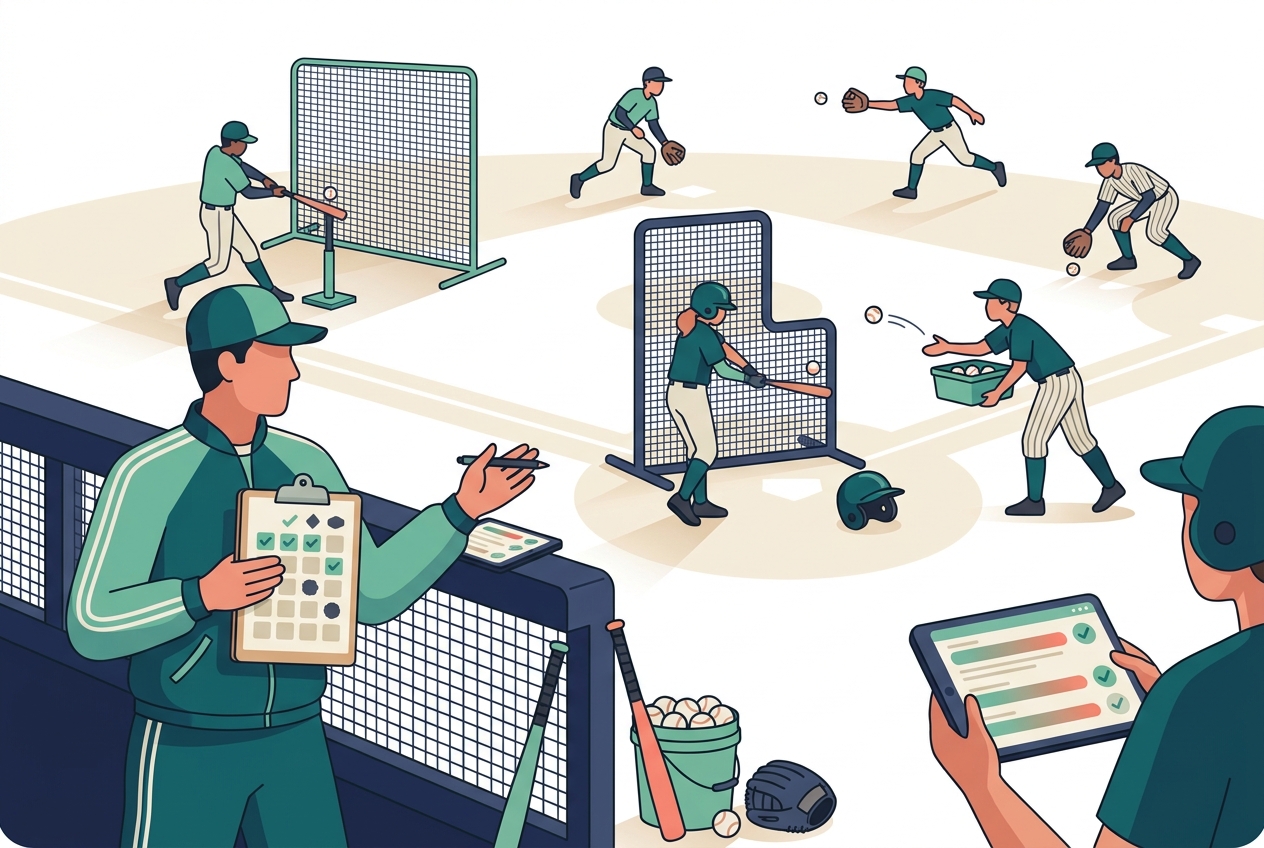
Baseball coach with a clipboard practice plan at the dugout fence while players rotate through hitting stations on the infield

What Every Good Baseball Practice Plan Has in Common

Every effective baseball practice solves the same problem: baseball is a game where one player acts and eight watch, and a practice that copies the game copies the standing around. The plans that work break the team into small groups, run two or three things at once, and save the full-team blocks for the things that actually need nine defenders.
The structure that holds up at every age is five phases. An arrival block gives early players something to do with a bat or a glove the moment they walk through the gate, so the first ten minutes are not lost waiting on carpools. A warm-up gets the body moving and then builds the arm with a throwing progression, because playing catch is the most important skill in the sport and the one most often rushed. The core block, usually two or three segments, carries the night's focus: hitting, team defense, pitchers and catchers, or baserunning. A conditioning segment, when you use one, is a game. A cooldown protects arms and ends with a short talk.
Three rules govern the timing. First, one focus per night. A practice that tries to fix the cutoff system, install bunt coverage, and rebuild swings sharpens none of them. Second, no line longer than four players. If eight kids are waiting for one fungo, split the group and start a second drill. The station format exists for exactly this problem, and it is why the hitting block in every plan below is a circuit and not one hitter with a coach throwing. Third, count the throws. Pitchers who threw a bullpen do not also need 25 minutes of long toss and a night at shortstop, and the arm-care cooldown is where a coach asks how arms feel before the week's pitching plan is set.

8U Baseball Practice Plan: 60 Minutes

The right 8U practice is 60 minutes, moves to something new every 10 to 15 minutes, and keeps score in at least one block, because seven and eight year olds will do anything for points. At coach-pitch age the goals are narrow: catch the ball with two hands, step and throw to a target, field a ground ball out front, and drive a hittable pitch on a line.
Baseball practice plan · 6-8 (T-ball, coach pitch)

8U Baseball Practice Plan (60 Minutes)

60 min · 6 segments

  1. 0:00

    10 min

    Trickle-In Tee & Net

    Early arrivers rotate through tee-and-net swing stations at their own pace before practice starts.

    Arrival
  2. 0:10

    10 min

    Throwing Progression Ladder

    Structured partner throwing that builds from wrist flips to long toss with a target-hitting focus.

    Warm-Up
  3. 0:20

    12 min

    Ground Ball Triangle

    Continuous rolled ground balls in a three-cone triangle — footwork, funnel, and feeds at maximum rep speed.

    Core
  4. 0:32

    15 min

    Line Drive Derby

    Point-scoring front-toss game: line drives score big, grounders one, popups zero. Kids beg to play again.

    Core
  5. 0:47

    8 min

    Around-the-Horn Base Race

    Two-team relay race around the bases — sprint conditioning disguised as the loudest game of the night.

    Conditioning
  6. 0:55

    5 min

    Circle Up: Wins & One Thing

    Coach-led reflection circle: name today's wins, one thing to improve, and the message for the next game.

    Cooldown

Equipment: tees, hitting nets or fence screens, buckets of balls, bats, helmets, gloves, one ball per pair, cones, bucket of balls, L-screen, bases, helmets optional, stopwatch

Change the length, swap modules for your age group, print a one-page coach sheet, and share it by link. No login.

Customize this plan free →Save to my account
  • Trickle-In Tee and Net (10 min). One adult at the tees, one hitter per tee, and the first player to arrive is swinging within a minute.
  • Throwing ladder (10 min). Stop at about 40 feet. The lesson is the step toward the target and the two-hand catch.
  • Ground Ball Triangle (12 min). Rolled balls give every player 25 or more clean reps.
  • Line Drive Derby (15 min). Front toss with a scoreboard: line drives score three, grounders one, popups zero. Kids stop trying to lift the ball without hearing a word about swing plane.
  • Base race relay (8 min) and circle (5 min). The relay is the conditioning. Five minutes is how long the attention holds.
The 8U practice plan page covers station setup, 6U and 7U adjustments, and what to leave out. For younger teams, start with the tee ball coaching guide.

12U Baseball Practice Plan: 90 Minutes

A 90-minute 12U practice adds two things the 8U plan does not have: pitchers who need to field their position, and a team defense block with consequences. Eleven and twelve year olds can hold a situation in their heads, so this is the age where "know the play before the ball is hit" stops being a slogan and becomes a drill.
Baseball practice plan · 9-12 (Little League, 10U-12U)

12U Baseball Practice Plan (90 Minutes)

90 min · 7 segments

  1. 0:00

    10 min

    Trickle-In Tee & Net

    Early arrivers rotate through tee-and-net swing stations at their own pace before practice starts.

    Arrival
  2. 0:10

    8 min

    Dynamic Warm-Up Lines

    Whole-team dynamic movement lines: jogs, skips, lunges, shuffles, and arm circles across the outfield.

    Warm-Up
  3. 0:18

    10 min

    Throwing Progression Ladder

    Structured partner throwing that builds from wrist flips to long toss with a target-hitting focus.

    Warm-Up
  4. 0:28

    22 min

    4-Station Hitting Circuit

    Tee, front toss, live BP, and dry-work stations running at once — every hitter swinging, nobody in line.

    Core
  5. 0:50

    12 min

    PFP: Pitcher Fielding Practice

    Classic PFP: comebackers, covering first, bunt plays, and 3-1 flips at game speed with quick lines.

    Core
  6. 1:02

    20 min

    21 Outs Team Defense

    The classic: defense must record 21 clean outs off coach fungos with live situations — one error resets the count.

    Core
  7. 1:22

    8 min

    Cooldown Stretch & Arm Care

    Easy jog, partner stretching, and light arm-care holds to bring heart rates down and protect throwing arms.

    Cooldown

Equipment: tees, hitting nets or fence screens, buckets of balls, bats, helmets, cones, gloves, one ball per pair, L-screen, portable cage or toss screen, nets, whistle or air horn, fungo bat, bucket of balls, bases, catcher's gear, helmets for runners, light resistance bands (optional, 13+)

Change the length, swap modules for your age group, print a one-page coach sheet, and share it by link. No login.

Customize this plan free →Save to my account
  • Warm-up and throwing (18 min). A 12U team that plays clean catch wins more games than one with a better cleanup hitter.
  • 4-Station Hitting Circuit (22 min). Tee, front toss, live batting practice, and dry work run at once, with shaggers rotating in. Each hitter gets 40 or more swings counting dry work.
  • Pitcher Fielding Practice (12 min). Comebackers, covering first on a ball to the right side, and bunt plays. It is the most skipped drill in youth baseball, and many 12U innings fall apart on a dribbler.
  • 21 Outs (20 min). The defense records 21 clean outs off fungos with live situations. An error resets the count.
The 12U practice plan page has the tournament-week version, and the 10U plan covers the first year of kid pitch.

14U and JV Baseball Practice Plan: 90 Minutes

The 14U and JV plan is built for the full-size field, 60 feet 6 inches and 90-foot bases, and it spends its time on the three things that change most when players get there: pitchers on a throwing schedule, hitters facing situations instead of just pitches, and baserunners who now have room to take real leads and real risks.
Baseball practice plan · 13-15 (13U-14U, junior high)

14U and JV Baseball Practice Plan (90 Minutes)

90 min · 7 segments

  1. 0:00

    8 min

    Short-Hop Hands Pairs

    Arriving players pair up for rolled ground balls and short hops — glove work with no throwing arm stress.

    Arrival
  2. 0:08

    8 min

    Dynamic Warm-Up Lines

    Whole-team dynamic movement lines: jogs, skips, lunges, shuffles, and arm circles across the outfield.

    Warm-Up
  3. 0:16

    10 min

    Throwing Progression Ladder

    Structured partner throwing that builds from wrist flips to long toss with a target-hitting focus.

    Warm-Up
  4. 0:26

    15 min

    Bullpen Strike Challenge

    Pitchers compete in a counted-strike bullpen game while catchers train receiving — measurable and competitive.

    Core
  5. 0:41

    30 min

    Live BP: Situations & Reads

    Controlled BP where defense plays every ball live and baserunners make real reads — three skills in one block.

    Core
  6. 1:11

    12 min

    Baserunning Reads & Dirt Balls

    Runners at every base react live to coach reads: dirt balls, steals, first-to-third, and tag-ups.

    Core
  7. 1:23

    7 min

    Cooldown Stretch & Arm Care

    Easy jog, partner stretching, and light arm-care holds to bring heart rates down and protect throwing arms.

    Cooldown

Equipment: gloves, bucket of balls, cones, one ball per pair, catcher's gear or strike-zone target nets, balls, chart sheets and pencils, portable mound or flat ground markers, L-screen, two buckets of balls, bats, helmets, bases, a few balls, light resistance bands (optional, 13+)

Change the length, swap modules for your age group, print a one-page coach sheet, and share it by link. No login.

Customize this plan free →Save to my account
  • Short-hop pairs (8 min). Glove work with no throwing, because arms now carry heavier loads.
  • Bullpen Strike Challenge (15 min). That night's scheduled arms only, in a counted-strike game with catchers receiving. Position players take ground balls and fly balls at their spots.
  • Live BP: Situations and Reads (30 min). The defense plays every ball live, runners read the ball off the bat, and each hitter gets a job. One block does the work of batting practice, a defensive drill, and a baserunning drill.
  • Baserunning Reads (12 min). Dirt-ball reads, first-to-third decisions, and tag-ups on 90-foot bases.
The 14U practice plan page goes deeper on the move to the big field, JV teams, and travel schedules.

Ready to take your game to the next level?

High School Baseball Practice Plan: 120 Minutes

A two-hour varsity practice needs what the shorter plans cannot fit: a dedicated pitcher fielding block, a full hitting circuit and live situational hitting on the same day, and a team defense block run at game speed with a standard the players know.
Baseball practice plan · 16-18 (high school, 16U-18U)

High School Baseball Practice Plan (120 Minutes)

120 min · 8 segments

  1. 0:00

    10 min

    Trickle-In Tee & Net

    Early arrivers rotate through tee-and-net swing stations at their own pace before practice starts.

    Arrival
  2. 0:10

    10 min

    Dynamic Warm-Up Lines

    Whole-team dynamic movement lines: jogs, skips, lunges, shuffles, and arm circles across the outfield.

    Warm-Up
  3. 0:20

    12 min

    Throwing Progression Ladder

    Structured partner throwing that builds from wrist flips to long toss with a target-hitting focus.

    Warm-Up
  4. 0:32

    15 min

    PFP: Pitcher Fielding Practice

    Classic PFP: comebackers, covering first, bunt plays, and 3-1 flips at game speed with quick lines.

    Core
  5. 0:47

    25 min

    4-Station Hitting Circuit

    Tee, front toss, live BP, and dry-work stations running at once — every hitter swinging, nobody in line.

    Core
  6. 1:12

    20 min

    Live BP: Situations & Reads

    Controlled BP where defense plays every ball live and baserunners make real reads — three skills in one block.

    Core
  7. 1:32

    20 min

    21 Outs Team Defense

    The classic: defense must record 21 clean outs off coach fungos with live situations — one error resets the count.

    Core
  8. 1:52

    8 min

    Cooldown Stretch & Arm Care

    Easy jog, partner stretching, and light arm-care holds to bring heart rates down and protect throwing arms.

    Cooldown

Equipment: tees, hitting nets or fence screens, buckets of balls, bats, helmets, cones, gloves, one ball per pair, fungo bat, bucket of balls, bases, catcher's gear, L-screen, portable cage or toss screen, nets, whistle or air horn, two buckets of balls, helmets for runners, light resistance bands (optional, 13+)

Change the length, swap modules for your age group, print a one-page coach sheet, and share it by link. No login.

Customize this plan free →Save to my account
  • First 32 minutes. Easy tee swings on arrival, a dynamic warm-up, and a full throwing progression.
  • Pitcher Fielding Practice (15 min). Early, while legs are fresh. Catchers, infielders, and outfielders do position work beside it.
  • Hitting circuit (25 min) and situational BP (20 min). Mechanical reps first, then at-bats with a job.
  • 21 Outs (20 min). Run with the full cutoff and relay system, first-and-third defense, and bunt coverages.
  • Arm care (8 min). The pitching coach confirms who is available for the next game.
Bullpens at this level usually run alongside the hitting block on a separate mound, scheduled by each pitcher's rest days, not as a whole-team segment.

High School, JV, and Travel Teams: What Changes at 13 and Up

The plan changes at 13 because the field changes. Most players move to the 60/90 diamond at 13 or 14, depending on the organization: Little League Juniors and most 14U travel divisions play full size, while some 13U divisions use an intermediate 54/80 field. The throw from third to first grows from about 85 feet on a 60-foot diamond to about 127 feet on a 90-foot one, and a practice plan has to give arms time to adapt. That is why the 14U and high school plans above carry a longer throwing progression and a real arm-care block.
Pitch limits get more complicated at the same time. Little League enforces daily pitch counts by rule. Travel events often reference the MLB and USA Baseball Pitch Smart guidelines (95 pitches a day at 13 to 16, 105 at 17 and 18, with rest days tied to the count) but enforce them only as strictly as the tournament director chooses. High school pitch limits are set by each state association under an NFHS requirement, so the numbers and rest days differ from state to state. The pitch count rules comparison lays them side by side. A practice plan for this age starts with the week's pitching schedule: who threw on the weekend, who is starting Tuesday, and therefore who throws a bullpen today and who does not.
School and travel seasons pull in different directions. A high school team practices almost daily for a short season, so each day can carry one narrow focus. A 15U to 18U travel team practices less and plays more, so its practices lean toward recovery, scheduled bullpens, and situational work. Bat rules differ too: high school rules require BBCOR certification on non-wood bats, and travel divisions set their own standards by age, so check the sanctioning body before a player buys one. The 14U and high school page has a plan for each kind of week.
Finally, older players can use information. A JV or varsity staff that tracks where balls are hit and what pitches are getting outs can aim practice at real weaknesses. Pitch charting and hit charting in Rizzler turn game data into next week's practice focus.

Build Your Own Baseball Practice Plan

Open the free baseball practice planner, pick 60, 90, or 120 minutes and an age group, and drag curated baseball modules onto the timed timeline; the duration meter shows when the plan is over, and every module carries its own coaching points and equipment list. Print the one-page coach sheet or share the plan by link. No login is required. Any plan on this page opens in the planner with its blocks already loaded through the "Customize this plan" button beneath it.
When you want the plan attached to a real practice on your schedule, with RSVP counts on the summary bar, station assignments for your assistants, and the equipment list assembled from the drills, save it to a free Rizzler account and it lands in Practice Manager with every module unlocked. The practice planner overview covers what the full product does for a season.
Coaches who plan by pencil can start from the baseball practice plan template. The baseball tryout guide covers the weeks before the first practice.
Running a high school program, a travel organization, or a league? We will set up practice planning, tryouts, and evaluations for every team and show you how much staff time it saves.

Talk to our team

Want to spend more time coaching and less time with paperwork? Let's talk.

Tell us about your team and we'll show you how to plan games, set lineups, run the schedule, and develop players in one place, so you spend the season coaching instead of chasing admin.

  • Less admin, more coaching

  • Plan games, set lineups, and track the season in one place

  • Keep every family in the loop automatically

Tell us about your program

4 fields · takes 30 seconds

Lands in the same inbox as the Help button · human response only

Frequently Asked Questions

How long should a baseball practice be?

Sixty minutes for 8U and younger, 75 to 90 minutes for 9U through 12U, 90 minutes to two hours for 13U and 14U, and about two hours for high school. Younger players lose focus after an hour no matter how good the plan is. Older teams need the extra time for bullpens, situational hitting, and team defense, not for more of the same drills.

What should a youth baseball practice plan include?

An arrival activity, a throwing progression, two or three skill blocks run in small groups or stations, one game that keeps score, and a short closing talk. It should not include one-hitter batting practice with the rest of the team standing in the field, laps, or any line longer than four players.

How do you structure a 90-minute baseball practice?

Ten minutes of tee work on arrival, 18 minutes of dynamic warm-up and throwing, a 22-minute hitting circuit, 12 minutes of pitcher fielding practice, 20 minutes of team defense, and eight minutes of stretching and arm care. That is the 12U plan above, and it can be opened and edited in the free planner.

What does a high school baseball practice plan look like?

About two hours: arrival tee work, a dynamic warm-up, a full throwing progression, pitcher fielding practice with position-specific work running beside it, a four-station hitting circuit, live situational batting practice, a team defense block such as 21 Outs, and arm care. Bullpens run on a separate mound according to each pitcher's rest schedule.

How is a travel baseball practice different from a rec practice?

A travel team usually practices less often and plays more games, so its practices focus on bullpens, situational hitting, and team defense, and they are planned around the weekend's pitch counts. A rec team plays fewer games and needs more fundamental reps, so its practices spend more time on catch, ground balls, and station hitting.

Can I print a baseball practice plan?

Yes. Every plan built in the free baseball practice planner prints as a one-page coach sheet with a time column, every segment, the coaching points, and the equipment list, without an account. The baseball practice plan template is a blank printable version with filled examples for coaches who plan by hand.