
Learn

The Basketball Tryout Evaluation Form, Criterion by Criterion
A basketball tryout evaluation form scores every player on the same set of basketball skills, usually eight to ten criteria covering ball handling, shooting, finishing, defense, rebounding, and passing, plus athleticism, effort, and scrimmage play. Every evaluator uses one scale, scores total per player, and the ranked list drives your roster decisions. This page gives you the full criterion list, a filled-out example you can copy, scale anchors for the contested categories, and adjustments by grade level. If you just want a blank form to print, the free basketball pack is in the download section below, no email required. If you are planning the whole event, start with how to run a basketball tryout.
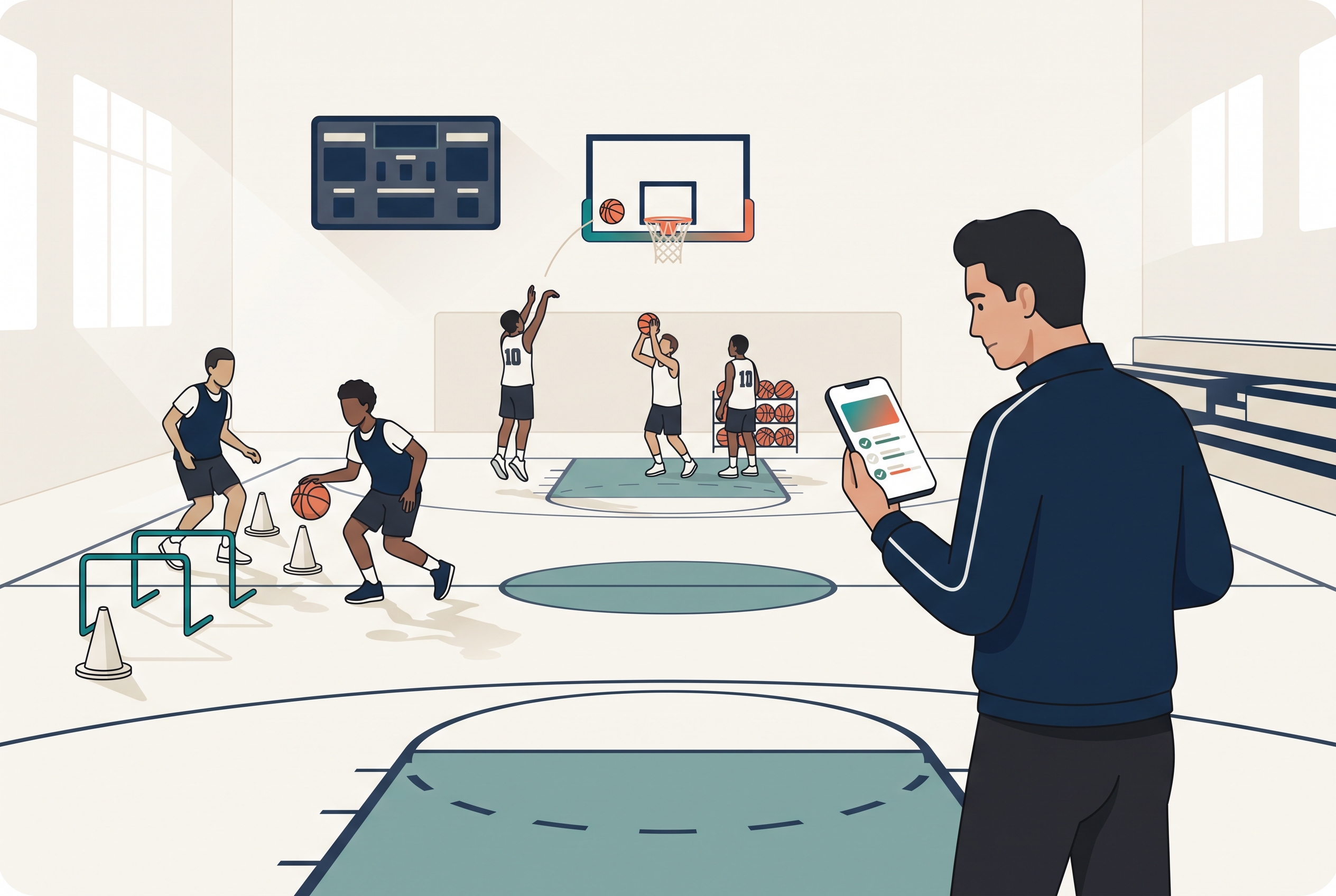
Basketball coach scoring a player evaluation form on a phone at the baseline during a gym tryout

The 9 criteria that belong on a basketball tryout evaluation form

Score nine criteria: ball handling, shooting form and range, finishing at the rim, on-ball defense, rebounding and box-outs, passing and decision-making, athleticism and speed, effort and coachability, and game play in scrimmage. Each one answers a different roster question. Ball handling and passing decide who can initiate offense. Shooting and finishing sort players into scoring roles. Defense, rebounding, and athleticism tell you who holds up when the other team has the ball. Effort and scrimmage play tell you who you can actually coach for four months.
CriterionSkills to scoreWhat to watch for
Ball handlingControl with either hand, change of paceEyes up through the cone course, or staring at the ball
Shooting form and rangeMechanics, balance, realistic rangeSame release on make and miss; does range hold past the first spot
Finishing at the rimFootwork, either hand, through contactRight-hand layup line is easy; watch the left side and the chaser drill
On-ball defenseStance, slides, containmentBeats the dribbler to the spot in zigzag, or reaches and grabs
Rebounding and box-outsContact first, pursuit, timingHits a body before chasing the ball, or watches the flight
Passing and decision-makingAccuracy, vision, shot vs pass choice3-on-2 reads: hits the open player on time, or forces the contested look
Athleticism and speedSprint speed, lateral quickness, bounceLane agility and transition drills; separates in the open floor
Effort and coachabilityMotor, response to correctionSprints the "last" rep; applies a fix the next time through
Game play (scrimmage)Spacing, communication, competingMoves without the ball, talks on defense, keeps playing when tired
Resist adding more rows. Nine criteria with two or three observable skills each is already close to 20 marks per player. At a school tryout with 40 kids and four evaluators, a longer form stops getting filled in by the second rotation, and a form that is only half filled in ranks nobody fairly.

A filled-out example: what a scored form actually looks like

Here is a completed form for one 7th-grade wing candidate, scored 1 to 10, the way it reads at the end of his second session. A real filled-in form teaches more about how the scoring works than any blank template.
Player: #23, wing candidate Group: 7th-8th grade, Court 1 Session: 2 of 2
CriterionScore (1-10)Evaluator note
Ball handling5Fine right hand, picked up his dribble twice vs pressure
Shooting form and range77 of 10 off the catch from the elbow, flat off the dribble
Finishing at the rim8Finished left-handed through contact, best in his group
On-ball defense6Good stance, late on the second slide
Rebounding and box-outs7Hits first in the circle drill, pursues out of area
Passing and decision-making5Forced two contested shots in 3-on-2 with a shooter open
Athleticism and speed7Top-three lane agility time in the group
Effort and coachability8Fixed his closeout angle the rep after being shown
Game play (scrimmage)6Competes, but drifts to the corner and ball-watches
Total: 59 / 90 Projects: rotation wing on the A team, starter if the handle improves
Notice what the notes do. "Forced two contested shots in 3-on-2 with a shooter open" is evidence you can explain to a parent weeks later. A bare 5 is not. Train every evaluator to write one short note per criterion, scored right after the rep while it is fresh.

Define the scale before the first whistle

A 1-to-5 scale works best on paper, and 1-to-10 works best in an app. Five points is fast to mark with a pen: 1 is well below grade level, 3 is right at level, 5 is exceptional. Digital scoring earns the wider 1-to-10 scale because tapping 7 is as fast as tapping 4, and the extra spread separates a 40-player field far better, then converts straight to a percentage for ranking.
Whichever scale you pick, write one sentence per number for your two most contested criteria. For shooting: a 5 means the release repeats and shots fall from realistic game range; a 3 means clean form inside 15 feet but range is a project; a 1 means the mechanics need a rebuild. For on-ball defense: a 5 beats the dribbler to the spot without fouling; a 3 contains in a straight line but loses on the crossover; a 1 reaches on every drive.
Then calibrate: have two coaches score the same three players in the first rotation, compare numbers, and close any gap before groups spread across baskets. If your assistant's 7 is your 5, the ranked list is noise.
In Rizzler, evaluators score each skill on a 1-to-10 slider from their own phone, so the calibration conversation happens around live numbers instead of two clipboards in the hallway. The player evaluations engine averages every evaluator's scores automatically.
Rizzler evaluation scoring screen with slider controls for rating basketball skills on a phone

Adjust the weighting by position

Use one form for everyone, then weight it by the role a player is trying out for. Guards: ball handling and passing and decision-making carry the evaluation, and watch the handle against pressure rather than in an empty cone course. Wings: shooting and finishing matter most, with defense as the tiebreaker, because a wing who cannot guard gives back the points he scores. Bigs: rebounding, finishing, and on-ball defense in the post, and do not let a rough handle sink the best rebounder in the gym, since almost nobody asks him to bring the ball up anyway.
Keep everyone on all nine criteria even when you weight them. Scoring every player on the full form is what lets you compare a guard-heavy group honestly and spot the wing who is secretly your backup point guard.

Ready to take your game to the next level?

Adjust the form by grade level

For 3rd-6th grade tryouts, cut the form to ball handling, finishing, athleticism, and effort, and score layups as made or missed rather than by technique. Most players at this level are still winning or losing the fight with the ball itself, so range scores and scheme awareness mean little. By middle school and JV, the full nine criteria apply as written. At the varsity level, add discrimination inside criteria you already have: shooting off movement instead of standstill catch-and-shoot, defending ball screens instead of straight-line containment, and scrimmage reads against pressure. Varsity evaluations also earn measurable rows, lane agility time and vertical touch, because numbers travel across tryout days in a way opinion scores never do.
AAU programs map the same cuts onto age groups: the 3rd-6th grade form fits 9u-12u, the middle school form fits 13u-15u, and the varsity additions fit 16u-17u. If you are new to coaching the younger bands, the youth basketball coaching guide covers what skill development actually looks like at each grade level, which is the context these cut-downs come from.

Two formats: one sheet per player, or the whole group on one page

Run the form in one of two formats, or both. The per-player sheet is the format above: one page per player, nine criteria as rows, an evidence note beside every score. Use it at stations and for the players your cut decisions hinge on. The compact team sheet flips the layout: one row per player, criteria abbreviated across the top, a whole court's group on a page or two. Use it when one coach watches scrimmage across a full court and wants every wing candidate comparable at a glance.
Court / group: ______ Evaluator: ______ Date: ______ Score each cell 1 to 5.
#PlayerHndlShootFinDefRebPassAthEffortGameTotalRec
1
2
3
4
5
Rec: Y = yes, B = bubble, N = no. Columns: Ball Handling, Shooting, Finishing, On-Ball Defense, Rebounding, Passing & Decisions, Athleticism, Effort & Coachability, Game Play.
The team sheet gives up the notes column, and "forced two contested shots with a shooter open" is exactly the note that settles a hard conversation with a parent, so keep per-player sheets for the bubble players. The downloadable pack below includes both formats plus a draft board that ranks the group from the scores.

Download the free basketball tryout evaluation pack

The pack is free and ungated: a printable PDF and an editable Excel workbook, both built on the nine criteria above.

PDFDownload the printable evaluation pack PDF

Three pages: a per-player sheet with the 9 criteria, scale anchors, and a note line per row; a landscape team sheet that fits a full tryout group; and a draft board for ranking and offers.

ExcelDownload the Excel evaluation workbook

Four tabs: Player Sheet, Team Sheet with live totals that count only scored cells, a Draft Board that ranks automatically as scores come in, and a filled example so evaluators see what good notes look like.
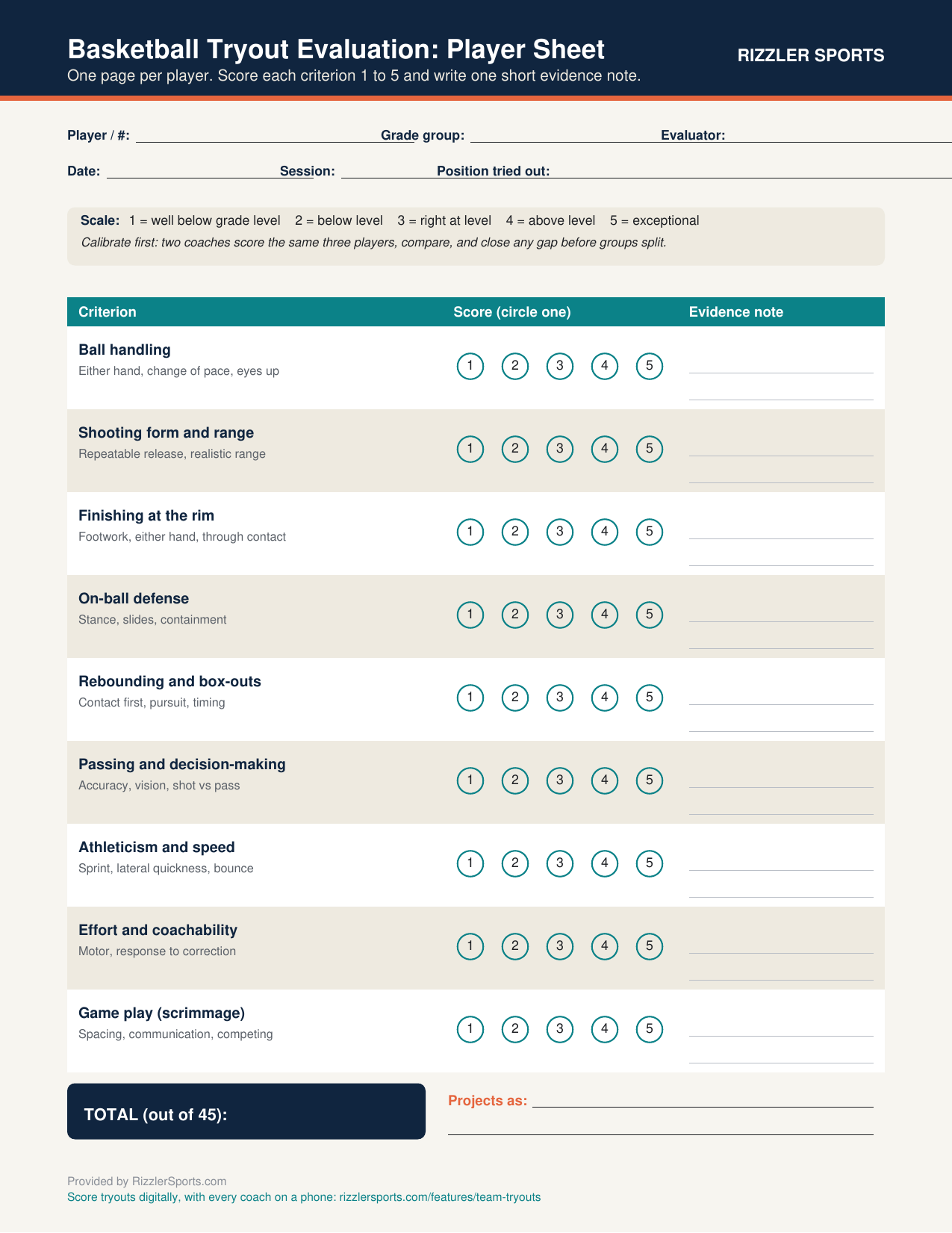
The printable basketball tryout evaluation player sheet with nine criteria rows, a 1-5 scale, and a note line per criterion

From clipboard to phone on tryout day

The form is half the system; collecting and tallying it is the other half. On paper, plan one runner per court collecting sheets each rotation, and budget a late evening adding totals in a spreadsheet before cut decisions. A 40-player tryout with nine criteria and four evaluators is over 1,400 individual marks to transcribe.
Scored digitally in Rizzler, each coach enters scores at their station and the ranked list builds itself as the tryout runs, so the coaches' meeting starts from a sorted board instead of a stack of paper. The Team Tryouts workflow handles registration, check-in, station scoring, and offer tracking for up to 300 players on the Club plan, and the basketball evaluation template ships editable so your program can match its own criteria. See the basketball tryouts page for the full workflow, and pair this form with the basketball tryout drills that make each criterion visible in under ten seconds of observation. Once the roster is set, the basketball practice plans hub covers the first weeks after cuts.
Rizzler tryout results screen comparing a group of players with score breakdown charts

Frequently Asked Questions

How many criteria should a basketball tryout evaluation form have?

Eight to ten. Fewer than eight and you cannot separate roles; more than ten and evaluators stop filling in rows by mid-tryout. The nine on this page cover ball handling, shooting, finishing, defense, rebounding, passing, athleticism, effort, and scrimmage play, with two or three observable skills inside each.

What scale should I use to score basketball tryouts?

Use 1 to 5 on paper and 1 to 10 in an app. Five points is fast with a pen; ten points separates a large field better when tapping is as fast as writing. Either way, define what the middle number means for shooting and defense before the tryout, and calibrate evaluators on the first few players.

Should guards and bigs use different evaluation forms?

Same form, different weighting. Score everyone on all nine criteria so you can compare across the whole field, then weight ball handling and decision-making for guard candidates and rebounding and rim finishing for bigs when you rank by role. A separate form per position makes cross-position comparisons impossible, and those are the comparisons cut night runs on.

Is a printable form or an app better for basketball tryouts?

Paper works fine under about 25 players with two or three evaluators. Above that, totaling sheets becomes the bottleneck: a 40-player school tryout generates well over a thousand individual marks. Digital scoring totals continuously and lets you sort the field between sessions, which is when callback and cut decisions actually get made.

Talk to our team

Running basketball tryouts at scale? Let's talk.

Tell us about your club, league, or school and we'll come back within one business day with a walkthrough of registration, check-in, evaluations, invites, and offers in one place.

  • Cut tryout admin from days to minutes

  • Online registration and check-in for hundreds of players

  • Evaluate, rank, invite, and track offers in one place

Tell us about your program

4 fields · takes 30 seconds

Lands in the same inbox as the Help button · human response only