
Learn
12 Basketball Tryout Drills, Each Mapped to What It Measures
The best basketball tryout drills isolate one scoreable skill, give every player identical reps, and let an evaluator mark a 1-to-5 score in under ten seconds. That is a different standard from a good practice drill, which exists to teach. The 12 drills below cover ball handling, shooting, finishing, defense, rebounding, and decision-making, and each one states what it isolates, what a 5 and a 1 look like, and which row it feeds on your tryout evaluation form. The 90-minute station plan at the bottom runs all of it with 40-plus players and four evaluators.
What makes a drill a tryout drill
A tryout drill has four properties: it isolates one skill, every player gets the same number of reps, it produces a visible pass-fail moment an evaluator can score fast, and it maps to a criterion on the evaluation form. Most practice drills fail at least one of these. Three-man weave looks like basketball, but it mixes passing, catching, finishing, and conditioning into one blur, so a player who botches it gives you no idea which skill failed. Keep the teaching drills for the season. At a tryout, you are not improving players, you are measuring them, and a drill you cannot score is a drill wasting gym time.
One logistical rule before the drill list: number every player with a pinnie or bib and have evaluators score by number. Names come later; numbers keep the scoring honest.
Ball handling drills
Two drills cover the handle: one at speed with a decision, one that exposes the weak hand. Both feed the ball handling row on the form.
1. Full-court change-of-pace dribble. Each player dribbles baseline to baseline through three cones that force a crossover, a between-the-legs move, and a burst. It isolates control with either hand at speed. A 5 keeps eyes up and never slows into the move; a 3 completes everything but stares at the ball; a 1 loses the dribble or circles a cone twice. Two reps per player, one each direction. Feeds the ball handling row.
2. Two-ball stationary dribble. Thirty seconds pounding two balls together, then alternating. It isolates weak-hand control with nowhere to hide, because the strong hand cannot cover for the weak one. A 5 keeps both balls at waist height with eyes on the coach; a 1 is chasing a ball by second ten. Skip this one below middle school, where almost everyone scores a 1 and the drill measures nothing.
Shooting drills
Score shooting with a fixed shot count from fixed spots, so every player's number comes from the same sample. Both drills feed the shooting form and range row.
3. Catch-and-shoot spots. Five shots from each of three spots (both elbows and the top of the key for middle school, extended a step for varsity). It isolates repeatable form and realistic range. Score the release, not just makes: a 5 repeats the same mechanics on make and miss and hits around half; a 3 is clean inside but changes the shot to reach range; a 1 pushes from the shoulder. Fifteen shots per player gives a real sample where ten does not.
4. Free throws under fatigue. Two free throws immediately after a timed sprint, then two more to close the night. It isolates mechanics under a heart rate, which is the only free throw that matters. Simple scoring: made shots out of four, with a note for anyone whose form holds while gassed.
Finishing drills
Finishing needs two looks: rhythm at the rim with no pressure, then the same finish at speed with a body closing. Together they feed the finishing row.
5. Mikan series. Thirty seconds of alternating right-hand and left-hand finishes off the backboard. It isolates footwork and the weak hand at the rim. A 5 never breaks rhythm and uses the correct foot-hand pairing both sides; a 1 finishes everything with the strong hand regardless of side. Feeds the finishing row.
6. Transition layups with a chaser. Player attacks full court for a layup with a defender releasing one step behind. It isolates finishing through contact and at speed, which standing layup lines never show. A 5 finishes or draws the foul at pace; a 3 finishes untouched but shies when the chaser closes; a 1 slows down to avoid the contact entirely.
Defense and rebounding drills
Three drills here, because defense and rebounding are where the eye test lies most: technique shows in isolation, and want-to shows when there is a body in the way.
7. Zigzag slides. Defender slides corner to corner up the floor guarding a dribbler at half speed, then live on the second rep. It isolates stance, slide technique, and containment. A 5 beats the dribbler to every spot without crossing feet; a 3 contains in straight lines but loses the first crossover; a 1 turns and chases. Feeds the on-ball defense row.
8. Closeout 1-on-1. Defender starts under the rim, rolls the ball to a shooter at the wing, and closes out into live one-on-one with a three-dribble limit. It isolates the closeout angle and the hardest individual defensive moment in basketball. Score the approach and the containment separately in your note: plenty of players sprint the closeout and then fly past the shot fake.
9. Circle box-out. One ball on the floor between two players at the free-throw circle; on the whistle, each fights to box the other off the ball for three seconds. It isolates contact-first rebounding habits with no height advantage involved. A 5 hits a body before looking for the ball every rep. This drill finds the rebounder the eye test misses, the kid who is 5-foot-6 and boxes out like a varsity forward. Feeds the rebounding row.
Decision-making and game play
10. 3-on-2 to 2-on-1 continuous. Classic advantage drill: three attack two, the stop or score sends two back against one. It isolates shot-versus-pass decisions at speed. Score decisions, not outcomes: a 5 makes the right read on time even when the layup rolls out; a 1 forces contested shots with a teammate open. Feeds the passing and decision-making row, and it is the single best predictor on this list for how a player will look in your offense.
11. Lane agility and sprint. Timed lane agility (around the key: sprint, slide, backpedal, slide) plus a baseline-to-baseline sprint. It isolates pure athleticism with a stopwatch instead of an opinion. Record times, then convert to 1-5 within each grade group. Numbers beat impressions here, and they settle arguments on cut night.
12. 4-on-4 half-court scrimmage, last. Short shifts, four minutes per group, each group watched by every evaluator at once. It isolates spacing, communication, and competing, the things no station shows. Give each evaluator two players to watch per shift instead of the ball. The kid who talks on every screen and sprints back in transition is telling you what practice will look like in a few weeks.
Scrimmage goes last for a fairness reason, not a scheduling one: by then every player has identical station scores on the evaluation form, so a quiet scrimmage shift cannot erase a strong measured skill set. The cut conversation starts from the numbers and uses scrimmage to break ties, not the other way around. For the offer-and-cut process itself, see how to run a basketball tryout.
The 90-minute station plan for 40+ players
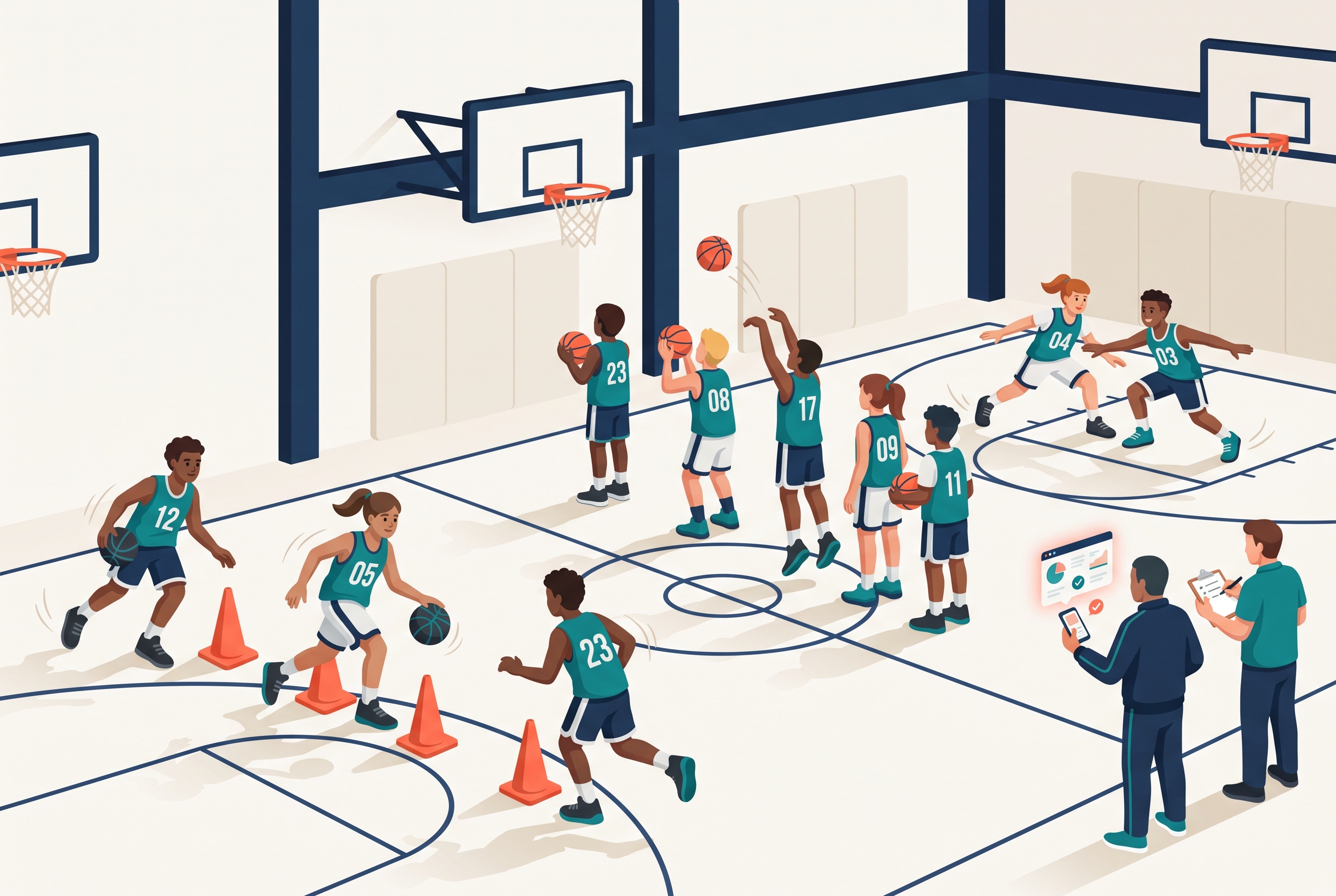
Split 40 players into four numbered groups of ten and run four stations of about 11 minutes with one evaluator each, then close with scrimmage shifts in front of the whole panel. Every player hits every station, and every evaluator scores the same drill all night, which keeps the 1-to-5 scale consistent inside each criterion.
| Time | Block | What runs |
|---|---|---|
| 0:00-0:10 | Check-in and dynamic warmup | Numbers handed out, groups posted on the wall |
| 0:10-0:21 | Station round 1 | A: cone dribble + two-ball · B: catch-and-shoot · C: Mikan + chaser layups · D: zigzag + closeouts |
| 0:21-0:32 | Station round 2 | Groups rotate A→B→C→D |
| 0:32-0:43 | Station round 3 | Rotate again |
| 0:43-0:54 | Station round 4 | Every group has now hit all four stations |
| 0:54-1:04 | Circle box-out + lane agility | Whole group, two courts, times recorded; two free throws right after each timed sprint |
| 1:04-1:26 | 3-on-2 continuous, then 4-on-4 shifts | All evaluators watching, two assigned players each |
| 1:26-1:30 | Closing free throws | The second pair, spread across four baskets, while coaches compare boards |
With 60 players, make six groups, keep the same stations, and either stretch to two hours or cut the two-ball and free-throw blocks. The structure holds as long as groups stay at ten or fewer, because an evaluator can score ten players in eleven minutes and cannot score fifteen.
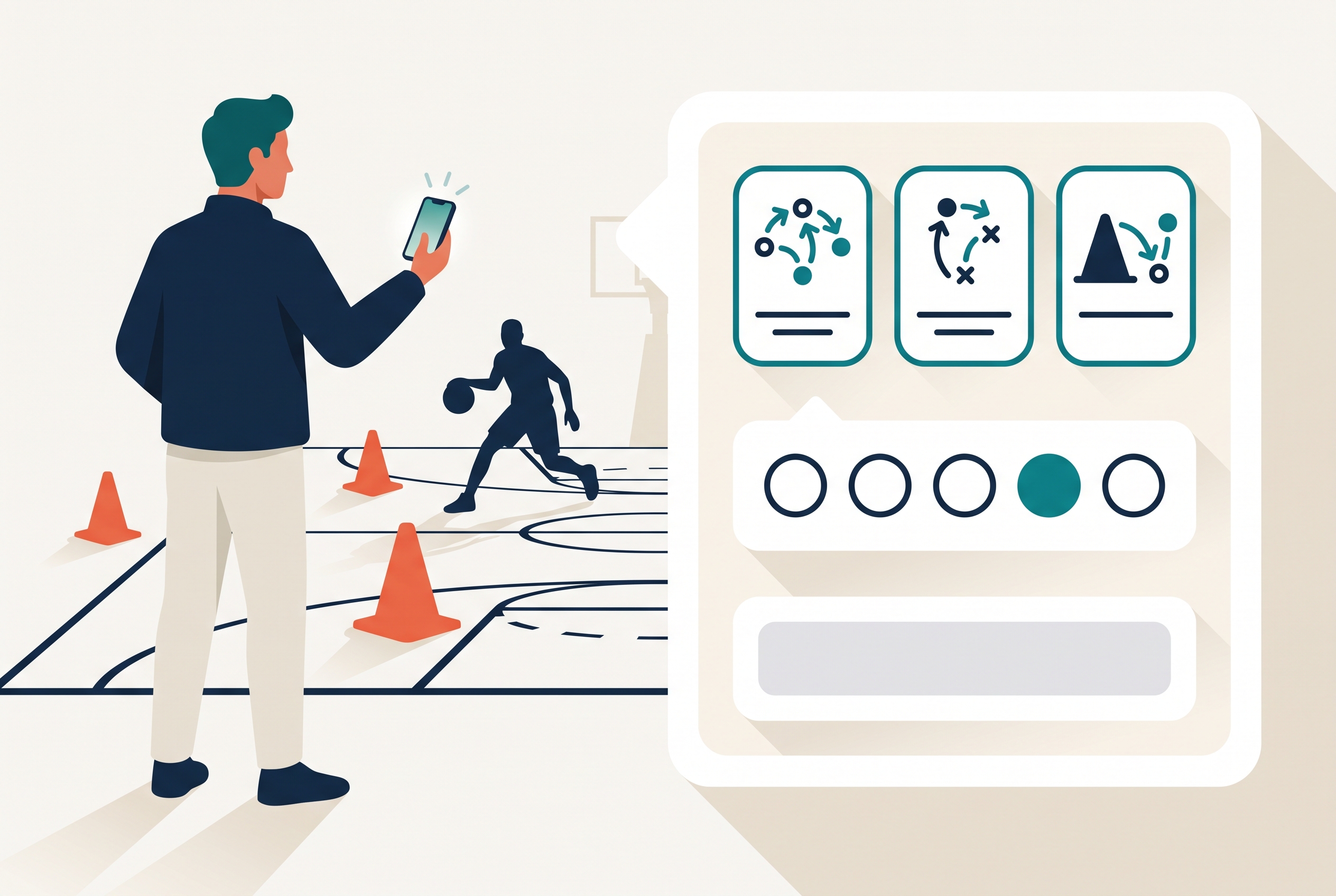
If evaluators score on phones instead of clipboards, the rotation gets simpler: no runner collecting sheets, and the ranked board is already built when scrimmage starts. That is how the Rizzler tryout workflow runs station scoring, with each coach rating their drill from the baseline.
Adjusting the drill list by grade level
For 3rd-6th grade tryouts, run six drills instead of twelve: cone dribble, catch-and-shoot from short corners, Mikan, zigzag at half speed, circle box-out, and 3-on-3 instead of 4-on-4. Use the smaller ball and lower goals your league plays with, drop the two-ball drill entirely, and score layups as made or missed. Middle school and JV run the list as written. Varsity tryouts add difficulty inside the same drills: catch-and-shoot becomes shooting off movement, closeouts become ball-screen defense reps, and scrimmage runs against pressure. AAU tryouts map the same tiers onto 9u-12u, 13u-15u, and 16u-17u age groups.
Whatever the level, keep the drill list identical for every player in a grade group. The moment one group gets an easier shooting spot, the scores stop being comparable and the form stops protecting you on cut night. Most of these drills double as season staples, and the basketball practice plans hub shows where they fit once the roster is set; the youth basketball coaching guide covers what to expect developmentally from the 3rd-6th grade band.
Frequently Asked Questions
How many drills should a basketball tryout have?
Six to eight stations plus a scrimmage for a single 90-minute session. Twelve drills fit across two sessions, which is the better format: skills on day one, scrimmage-heavy day two, so no player is cut on one bad hour. Fewer, longer stations beat many short ones, because evaluators need enough reps per player to score honestly.
What are the best drills for 3rd-6th grade basketball tryouts?
Cone dribbling, short-range catch-and-shoot, the Mikan series, half-speed zigzag slides, circle box-outs, and small-sided 3-on-3. At that age you are measuring control of the ball, effort, and listening, not range or scheme. Score made-or-missed rather than technique wherever you can.
How do you score basketball tryout drills?
Score each drill 1 to 5 against a written anchor, immediately after the player's rep, with a short evidence note. Define the anchors before the tryout: for the zigzag, a 5 beats the dribbler to every spot, a 3 contains straight lines, a 1 turns and chases. Every drill should feed one criterion on your evaluation form so the totals mean something when you rank the group.
How long should each tryout station run?
About ten to twelve minutes per group of ten players. That gives each player two to four scored reps per drill, which is the minimum for a fair number. Below eight minutes, evaluators are guessing; past fifteen, the players waiting in line are getting cold and the gym is wasting time.
Talk to our team
Running basketball tryouts at scale? Let's talk.
Tell us about your club, league, or school and we'll come back within one business day with a walkthrough of registration, check-in, evaluations, invites, and offers in one place.
Cut tryout admin from days to minutes
Online registration and check-in for hundreds of players
Evaluate, rank, invite, and track offers in one place
Tell us about your program
4 fields · takes 30 seconds
Lands in the same inbox as the Help button · human response only
Read Next
Rest Day Rules by League for Tournament Baseball
BlogSports Team Management App: Your Whole Season in One Place
FeaturesHow to Start a Volleyball Club
LearnRizzler vs LineupGen: Lineup Generator Comparison
ComparisonThe Coach's Guide to Quality At-Bats (QAB)
StatsLittle League Age Eligibility: League Age Determination
Rules