
Basketball
Basketball Playing Time: How to Split Minutes Fairly (With a Free Calculator)
Equal playing time in youth basketball means equal minutes, not an equal number of trips to the scorer's table. The math is one line: court minutes times five players on the floor, divided by the number of players who showed up. A 4 x 8 game with ten players is 32 x 5 / 10, so 16 minutes each; the same game with nine players is 17.8, which in practice means five kids play 20 and four play 16, because subs happen at the shift, not at the decimal. Most leagues never ask for equality anyway. They set a floor (half the game, 12 minutes, every player in every period) and leave the rest to the coach. This page gives you the minutes table for every common format and roster size, the two fair policies and when each is right, the substitution patterns that keep the plan honest when a kid shows up late or picks up three fouls, and a free calculator that builds the shift chart for your names.
How Many Minutes Each Player Gets
The equal share for any game is (periods x minutes per period x 5) / players present. The table below is that formula for the formats youth basketball actually uses, and it is the same number the free basketball rotation generator shows in its playing-time column. Court minutes are the total for one team, so a 4 x 8 game has 32 court minutes, and each of the five spots on the floor is filled for all 32.
| Game format (court minutes) | 7 players | 8 | 9 | 10 | 11 | 12 | 13 |
|---|---|---|---|---|---|---|---|
| 4 x 6 min quarters (24) | 17.1 | 15 | 13.3 | 12 | 10.9 | 10 | 9.2 |
| 4 x 7 min quarters (28) | 20 | 17.5 | 15.6 | 14 | 12.7 | 11.7 | 10.8 |
| 4 x 8 min quarters (32) | 22.9 | 20 | 17.8 | 16 | 14.5 | 13.3 | 12.3 |
| 4 x 10 min quarters (40) | 28.6 | 25 | 22.2 | 20 | 18.2 | 16.7 | 15.4 |
| 2 x 16 min halves (32) | 22.9 | 20 | 17.8 | 16 | 14.5 | 13.3 | 12.3 |
| 2 x 20 min halves (40) | 28.6 | 25 | 22.2 | 20 | 18.2 | 16.7 | 15.4 |
Two things the table hides. First, the decimals only exist on paper. If you sub every 4 minutes, the smallest unit you can hand a player is 4 minutes, so a 17.8 share becomes 20 for some players and 16 for others, and the fair plan is the one where nobody is more than one shift from the share. Second, the shift length is the real lever. Two shifts per 8-minute quarter (sub at the 4-minute dead ball) gives you eight shifts and lands minutes on whole shifts for 8, 10 and 12 players; for 9 and 11 the chart has to alternate who gets the extra shift, and a printed rotation chart does that for you so you are not doing it in your head with the clock running.
Equal vs Starters-Weighted: Which Policy Is Right
Equal minutes is the right default through 12U rec and most church, park district and Jr. league programs, and many of those leagues write it into the rules. The NBA and USA Basketball youth guidelines recommend equal playing time throughout the game at 8U (the guidelines' ages 7 to 8 group), and equal time through the first three periods for ages 9 to 11, with coach's discretion in the fourth. That three-and-one shape is a good template for any rec league: it protects the development minutes and still lets a coach close a game.
Starters-weighted is the honest policy for school and club teams where everyone plays but the better players play more. The generator's weighted mode gives each starter a 1.5x share and every other player a 1x share, then ranks players by progress toward their own share before each shift. On a ten-player 4 x 8 roster with five starters, that works out to roughly 19 minutes for a starter and 13 for a reserve, instead of 16 across the board. State the ratio out loud at the parent meeting. "Starters get about half again as many minutes as the bench, and every player plays in every half" is a sentence a parent can accept in advance and cannot argue with in the moment.
Manual is the third policy, and it is what varsity coaches use: the plan is a starting point and the coach sets every shift. Rizzler's presets default 8U through 12U rec to equal, 10U to 14U travel and middle school to starters-weighted, and high school to manual, which matches what those leagues expect.
League Minimum-Play Rules and How to Read Them
Most leagues enforce a minimum, not equality, and the wording matters because it decides how you build the chart. Four real examples from published league rules:
| League | Rule, as written | What it means for the chart |
|---|---|---|
| McMinnville (OR) Parks and Rec Youth Basketball (rules) | "Each player present will play at least half of the game and have playing time in each period." Subs at the 5-minute mark of each 10-minute quarter. | Every player in every quarter, so no one sits a full period; the two-shifts-per-period chart satisfies it automatically. |
| York County (VA) Parks and Rec 13U (rules) | "Eligible players must play more than 12 minutes in every game." Subs only on a fixed schedule midway through each of the first three quarters; everyone must appear in the fourth. | A 12-minute floor on a 32-minute game is three 4-minute shifts; with ten players the equal plan gives 16, so the floor is met with a shift to spare. |
| Town of Fort Mill (SC) Youth Basketball (rules) | Mandatory substitutions at the dead ball near the 4-minute mark of each quarter; free substitution in the fourth only once every player has reached a 12-minute minimum over the first three. | The classic three-and-one: equal shifts for three quarters, then coach's call. Failure to meet the minimum is a forfeit. |
| NBA and USA Basketball youth guidelines (standards) | Equal playing time throughout the game at 8U (ages 7 to 8 in the guidelines); equal through the first three periods for ages 9 to 11. | The recommendation most rec leagues copy. Build the fourth quarter as its own decision. |
Read your own league's rule for three things: whether the floor is minutes or periods (a "must play in every period" rule bans the common mistake of giving a kid all his minutes in one half), when subs are allowed (fixed-mark subs mean your shifts are chosen for you), and what happens to late arrivals (York County cuts the minimum to 8 minutes after the first quarter starts and 4 after halftime). Write the rule on the first line of the playing time tracker (download below) so the assistant running the bench can see it. League administrators looking at this from the other side, enforcing a floor across twenty teams, will find the league view on the playing time fairness page.
Substitution Patterns That Keep the Plan Fair
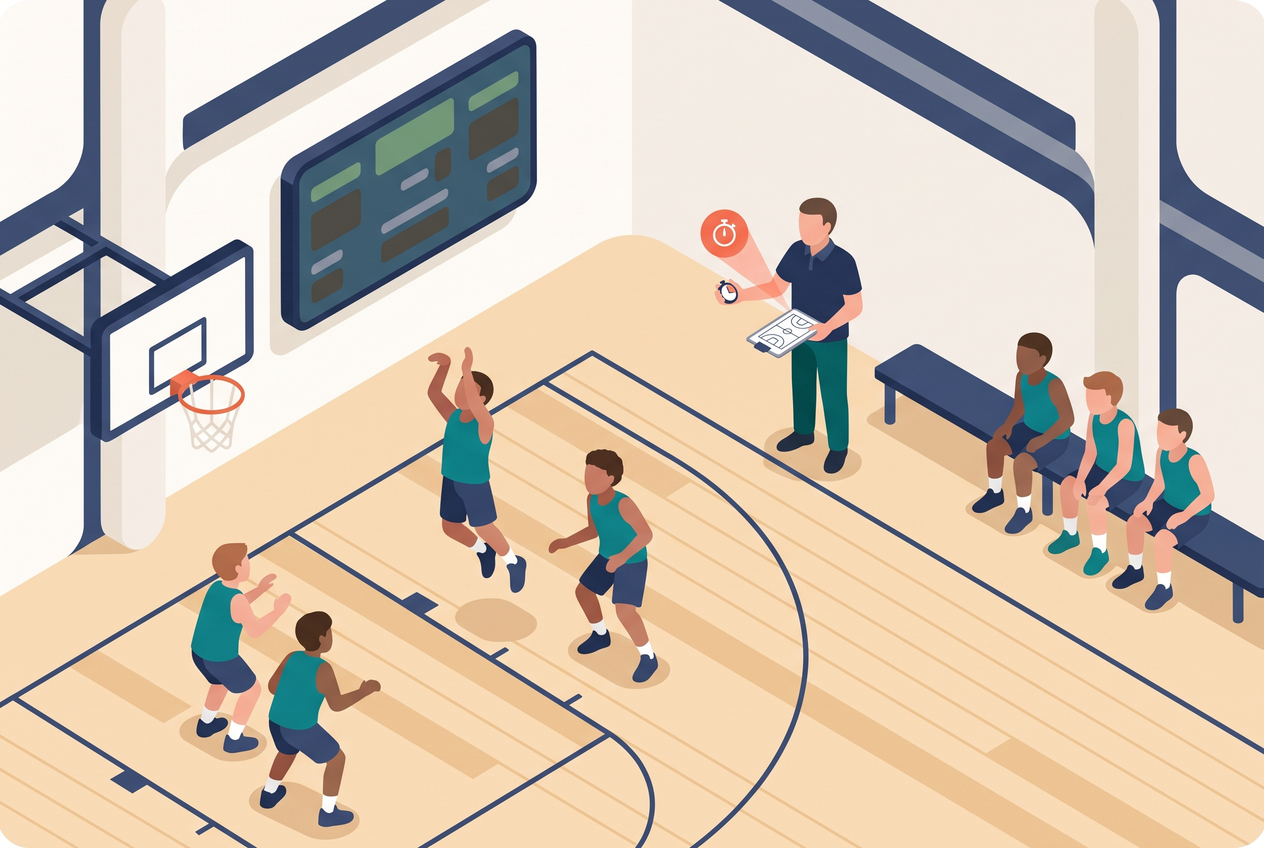
Sub on a fixed shift, at the first dead ball after the clock reaches the mark. Two shifts per quarter at the 4-minute mark is the standard for 8-minute quarters; three shifts per quarter is better for rosters of 11 or 12 so nobody sits a whole quarter, and the shift length is the sub-interval setting in the generator's setup panel. Fixed shifts beat "feel" because they are checkable by a parent in the stands, and because they are the only way a chart drawn on Thursday survives Saturday.
The four traps the generator warns about are the same four an assistant should watch for on paper:
- Missed half. A player who gets all four of their shifts in the first half and none after halftime has "equal minutes" and a furious parent. The engine flags any player with zero minutes in either half; on the printed chart, check that every row has a teal cell on both sides of the halftime line.
- Bench streak. No one sits more than two shifts in a row by default (the "longest sit" setting). Three straight shifts on the bench is 12 real minutes of a 60-minute game spent watching, which is where the "my kid never plays" conversation starts.
- No ball handler. An equal-time chart that ignores positions will eventually put five forwards on the floor against a press. When positions are set, the generator swaps the highest-minute non-forced pick for the best available point guard in any shift that has none, and the printed chart assumes you pencil a guard into every shift.
- Unfair minutes. Under the equal policy, any player more than one shift away from the equal share gets flagged. That is the check to run at halftime, not after the game.
Late arrivals and foul trouble are where fixed charts earn their keep. A kid who arrives at the start of the second quarter is added to the roster from that shift on, and the remaining shifts are re-dealt (regenerating in the tool keeps the shifts you have already set and replans the rest); on paper, cross out their first-half cells and give them the next two open shifts. A player with three fouls in the first half comes off at the next shift boundary, not the next dead ball, so the chart holds. A player who fouls out is removed from every remaining shift and the gap goes to whoever has the lowest minutes, which is the one calculation worth doing live.
The Parent Conversation
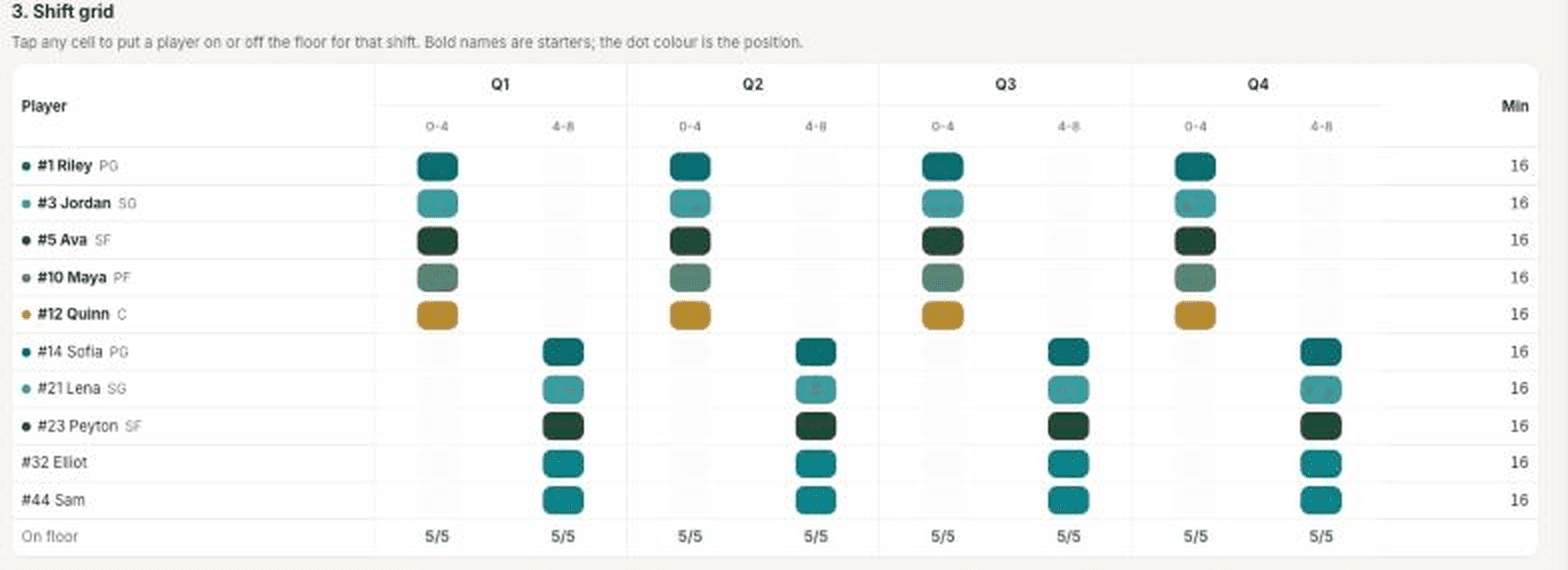
Have the chart before the game, and the season total after it. A parent who can see the shift grid on the bench, or a printed rotation chart taped to the clipboard, knows their kid's minutes are planned rather than improvised, and that single fact removes most of the heat. The follow-up is the season view: saved rotation plans in Rizzler's Game Manager roll into an every-game minutes total per player, so "she only played 12 minutes Saturday" can be answered with "she is at 15.8 a game across six games, which is the team average." The free playing time tracker below does the same thing on paper with a season tab.
When minutes are not equal on purpose, say the policy, not the player. "At this level starters get about half again the minutes of the bench, every player plays in every half, and we revisit the starters every four games" is a policy. "He is better than your son" is a fight. The general version of this conversation, for any sport, is on the balancing playing time guide; the basketball-specific rule is that the number you show should be minutes, because that is what the parent counted from the bleachers.
The Calculator: Build the Chart for Your Roster
The free basketball rotation generator is the calculator for this page. Pick the division preset (8U rec through high school NFHS; the preset sets the period structure, foul rules and default shift length), type the roster, star the starters if you want them weighted, and generate. The shift grid shows who is on the floor for every shift with the planned minutes per player down the right side, and the playing-time table underneath it shows each player against the equal share. Tap any cell to put a player on or off the floor for that shift and the minutes recalculate; the four warnings above appear as you edit. Print the rotation card for the bench or share the plan by link. No login is needed.
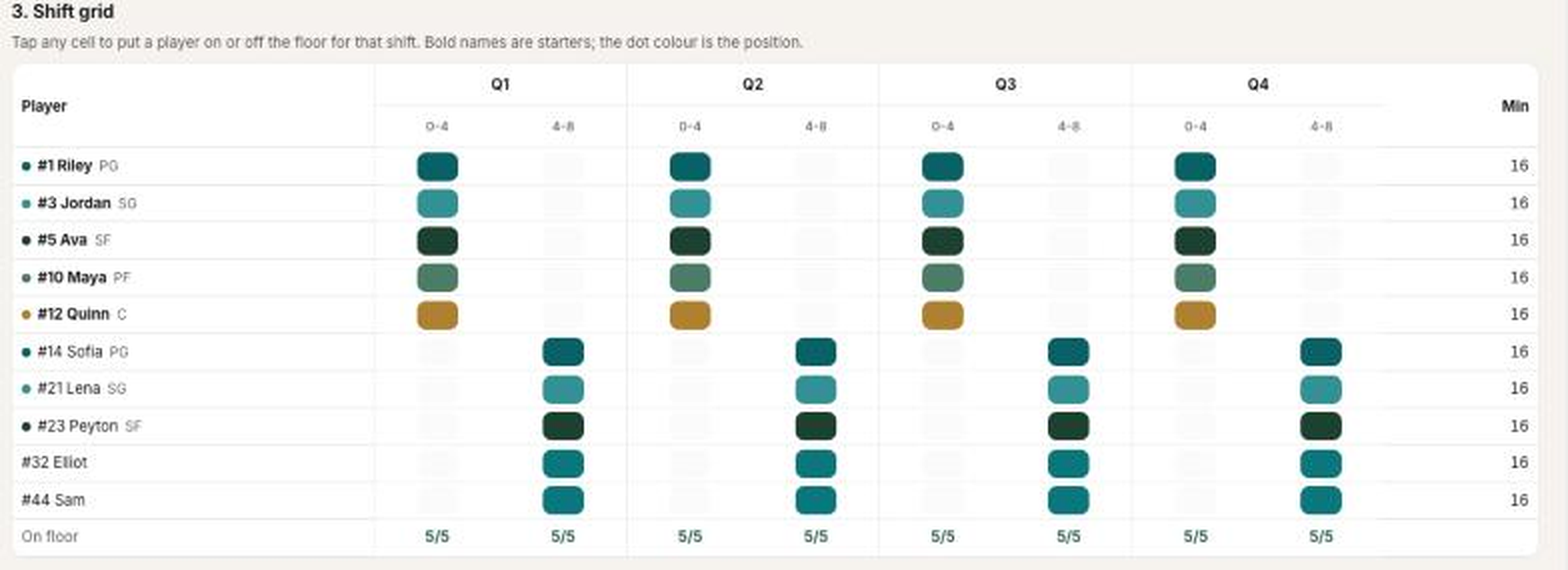
Save the plan to a free Rizzler account and it lands in Game Manager for basketball, where the Playing Time tab keeps this game and every game, the Depth Chart tab shows who backs up each position, and the rotation card prints from the same plan. Rizzler does not score basketball games yet, so the minutes it tracks are planned minutes from the chart; the official scorebook stays the record of who actually played, which is why the scorebook guide covers how participation is recorded there.
Download the Playing Time Tracker
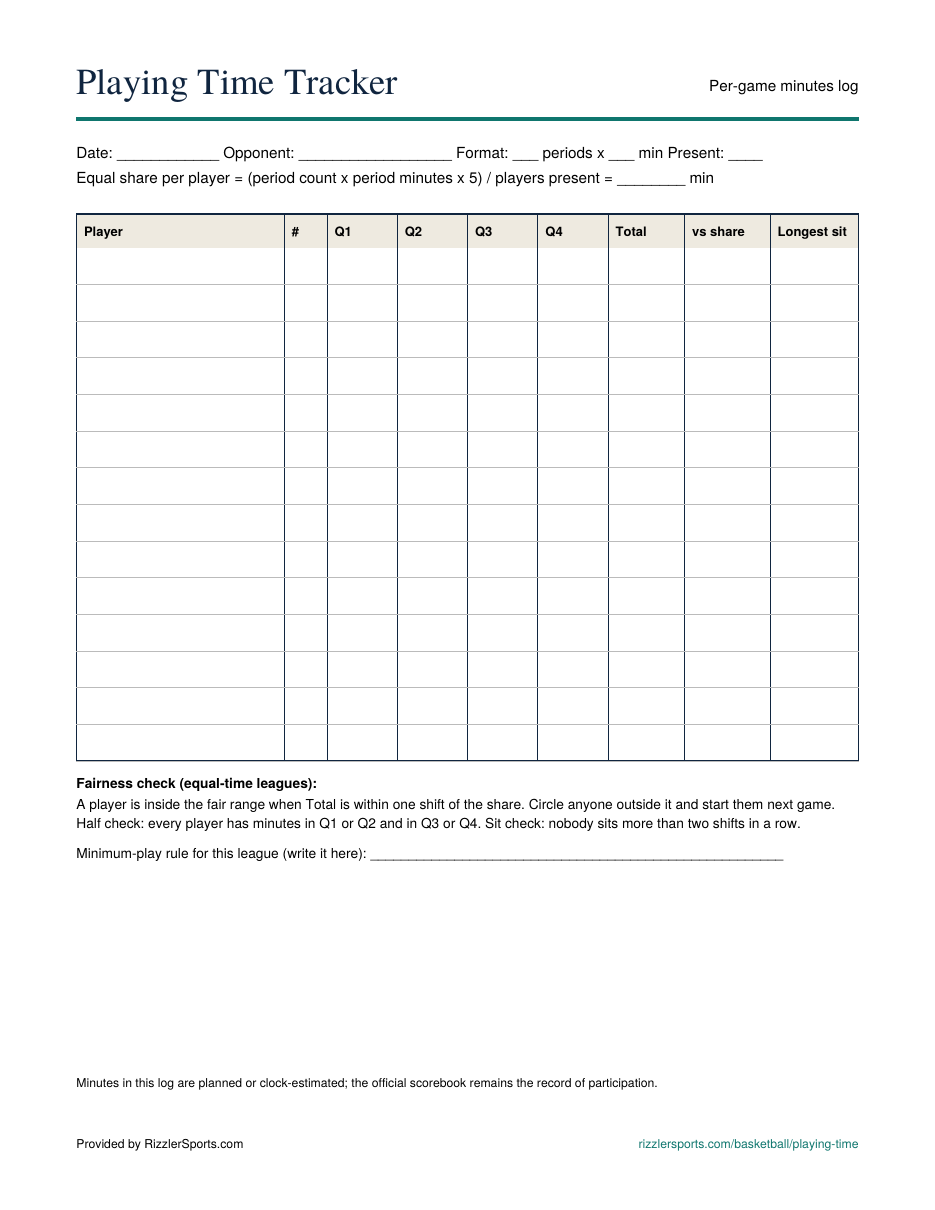
PDFDownload the printable PDF
Three pages: a per-game minutes log with the fairness, half and sit checks, a season tally for eight games, and the equal-minutes reference table above.
ExcelDownload for Excel
Eight game tabs that compute the equal share from your roster and format, flag anyone outside one shift of fair, and check both halves, plus a Season tab that totals and averages every game.
The tracker pairs with the printed rotation charts (plan before, log after) and with the basketball stat sheet if a bench parent is already keeping a line per player; minutes are the one column on that sheet that decides the fairness question. The lineup sheet you hand the scorer is where the official record of who played begins. And if the roster you are splitting minutes for came out of a tryout, the basketball tryouts page covers the evaluation side that justifies the starters.
Frequently Asked Questions
How many minutes should each player get in youth basketball?
Divide the court minutes times five by the players present. In a 4 x 8 game that is 20 minutes each for 8 players, 16 for 10 and 13.3 for 12; in a 4 x 6 game it is 15, 12 and 10. Because subs happen on whole shifts, the fair plan is the one where every player is within one shift of that share.
Is equal playing time required in youth basketball?
It depends on the league. The NBA and USA Basketball youth guidelines recommend equal time throughout the game at 8U (ages 7 to 8 in the guidelines) and through the first three periods at ages 9 to 11. Many rec leagues instead set a floor, such as half the game, 12 minutes, or an appearance in every period, and leave the rest to the coach. Read your league's rule for the floor, the sub timing and the late-arrival clause.
How do you track playing time in basketball?
Plan the shifts before the game on a rotation chart, then log actual minutes per quarter on a tracker and compare each player's total to the equal share. The free rotation generator plans the shifts and shows planned minutes; saved plans in Rizzler Game Manager total minutes across the season. The official scorebook remains the record of who entered the game.
What is a good rotation for 8, 9 or 10 players?
With 8 players and two shifts per quarter, everyone gets 20 of 32 minutes and the chart is clean. With 9, five players get 20 and four get 16, alternating who gets the extra shift. With 10, two full fives alternate every shift for 16 each. The printable rotation chart page has the engine-generated chart for each roster size from 7 to 12.
What do I do when a player arrives late?
Add them to the chart from the next shift and re-deal the remaining shifts so they catch up without anyone else dropping below the floor; regenerating in the tool after adding the player does this for you. Check your league's rule, since some reduce the minimum for late arrivals (York County, for example, cuts it to 8 minutes after the first quarter starts).
Does the free calculator work for halves and 6-minute quarters?
Yes. The generator's presets cover 4 x 6, 4 x 7, 4 x 8 and 2 x 16 formats, and every period length is editable, with up to four shifts per period. The minutes table on this page uses the same formula the tool uses.
Read Next
Playing Time Tracking: Fair Rotation, Backed by Data
FeaturesHow to Run a Swim Team Tryout: A Coach's Step-by-Step Guide
LearnHow Does In-Game Scoring Work in Rizzler?
FAQBaseball Lineup Template for Excel & Google Sheets (Free)
ResourcesYouth Baseball Arm Care Program by Age (Free Printable Routine)
LearnSoftball Age Chart 2026: USSSA, USA, PGF & Alliance Cutoffs
Rules