
Basketball
Printable Basketball Rotation Chart (7 to 12 Players)
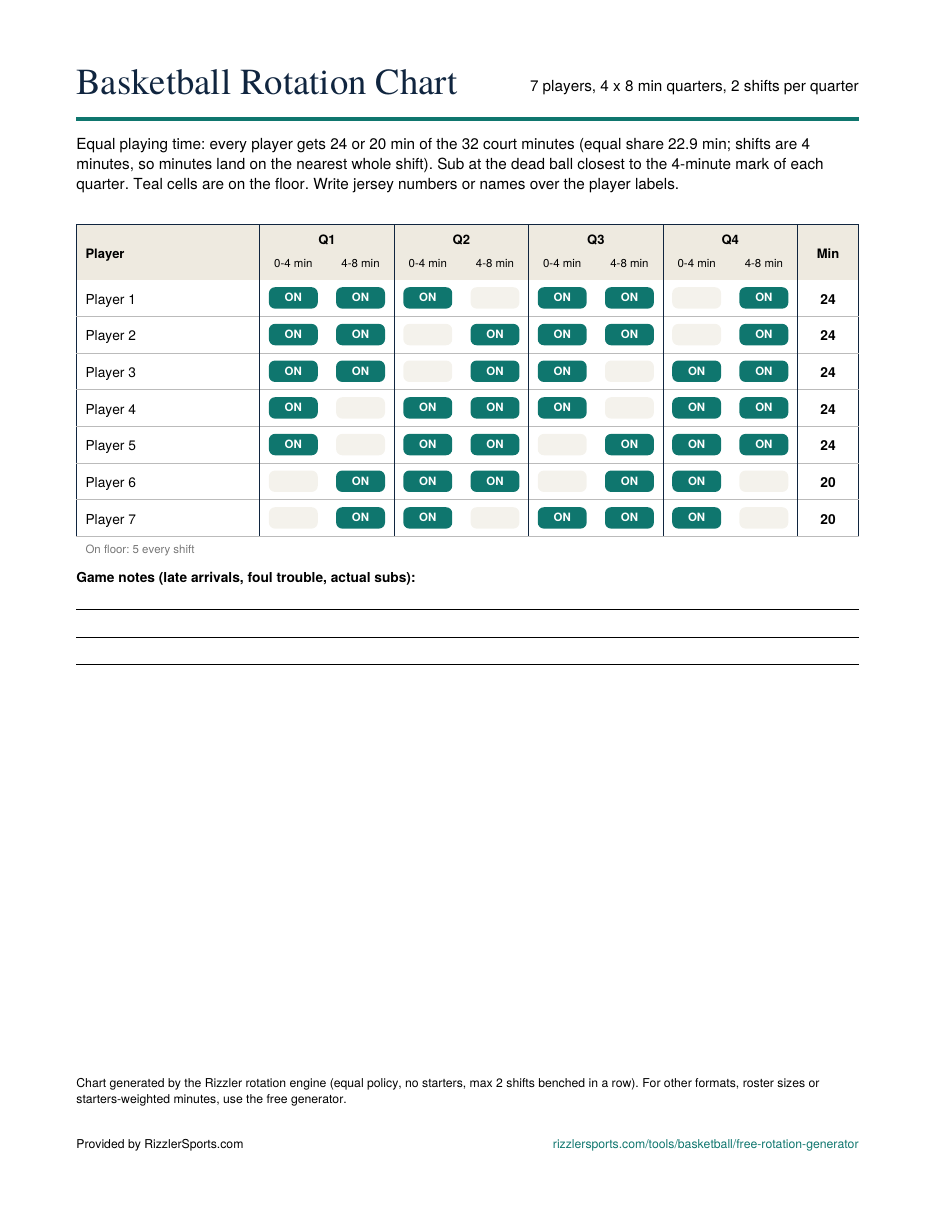
A basketball rotation chart is a grid with your players down the side and the game's shifts across the top, with a mark in every cell where that player is on the floor, so the bench knows who goes in at every sub without a huddle. The charts on this page are for the most common youth format, four 8-minute quarters with a sub at the 4-minute mark of each, for rosters of 7, 8, 9, 10, 11 and 12. Every chart gives equal playing time, keeps five on the floor, never sits anyone more than two shifts in a row, and was produced by the same rotation engine that runs the free basketball rotation generator, so if your roster, format or starters are different, the generator builds the matching chart for your names in about a minute.

Download the Rotation Charts
PDFDownload the printable PDF (6 charts)
One page per roster size from 7 to 12 players, 4 x 8 minute quarters with two shifts each, equal minutes, with a notes block for actual subs. Write jersey numbers over the player labels.
ExcelDownload for Excel
The same six charts as editable tabs: type 1 or 0 in any cell and the minutes, difference from the equal share, on-floor count and longest-sit check recalculate, plus an equal-minutes table for every format.
For Google Sheets, upload the Excel file to Drive and open it; the formulas carry over.
The Charts, by Roster Size
Each chart below is the plan the engine generates for that roster under the equal policy with no starters set. The number in the right column is each player's planned minutes out of the 32 court minutes; the equal share is in the caption, and because every shift is 4 minutes, the plan lands each player on the nearest whole shift of that share. Players are labeled 1 through 12 in roster order; the engine breaks ties by roster order, so the first names you list get the first extra shift when the roster is odd.
7 players (22.9-minute share: five play 24, two play 20)
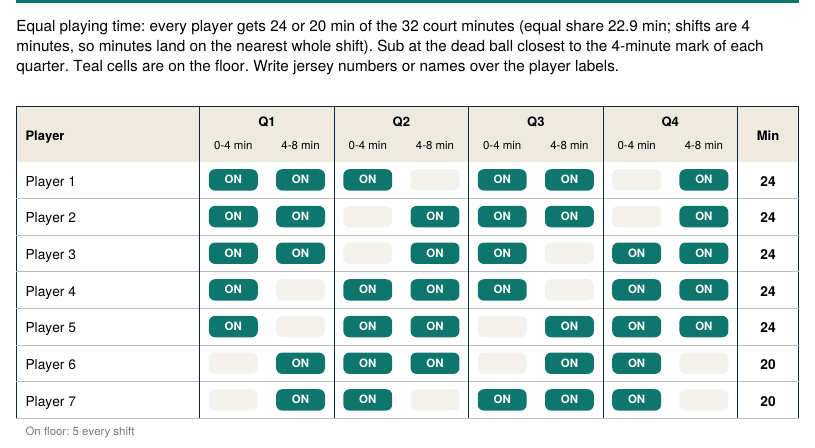
With seven, only two players sit at a time, so every shift is five on and two off and the two off rotate through the roster. The engine never benches the same two players twice in a row, which is why the chart looks like a staircase.
8 players (20-minute share: everyone plays 20)
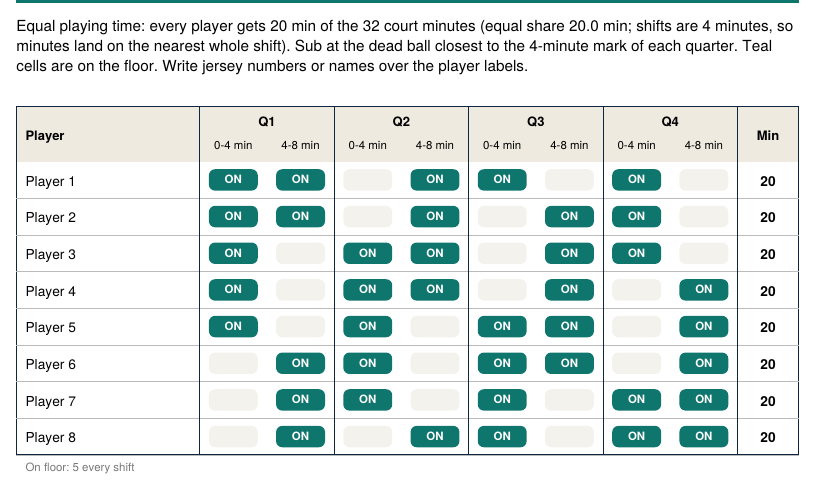
Eight is the cleanest roster for equal time at this format: 40 player-shifts split eight ways is five shifts each, so there is no odd shift to hand out and no one can argue the arithmetic.
9 players (17.8-minute share: four play 20, five play 16)
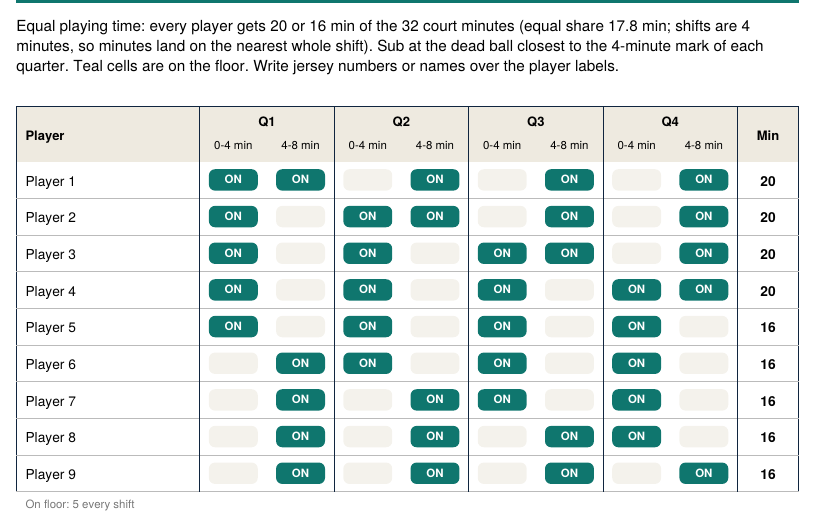
Nine is the roster where a chart earns its keep, because 40 player-shifts do not divide by nine. Four players get a fifth shift and five get four; rotate which four get the extra shift from game to game by re-ordering the roster in the generator, and the season evens out.
10 players (16-minute share: everyone plays 16)
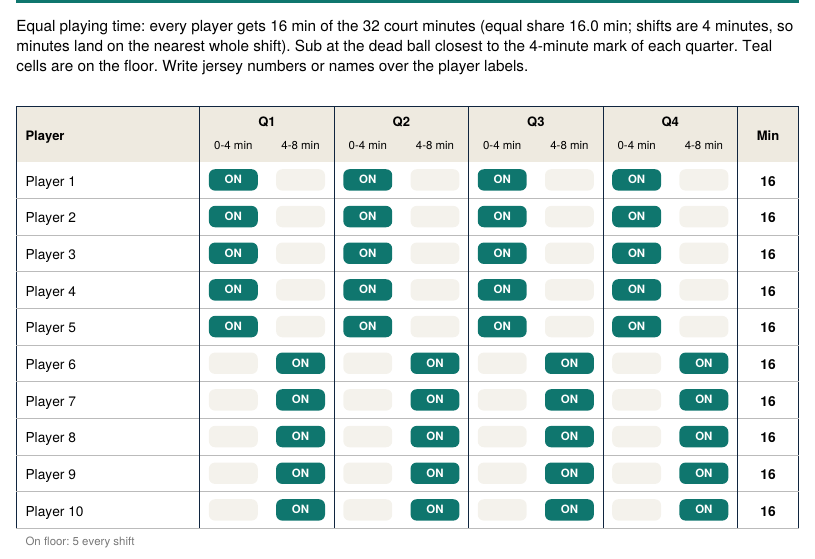
Ten players is two fives that alternate shifts, which is how most rec leagues with buzzer subs run anyway. The weakness is the matchup: the same five always play together, so set positions in the generator and let it keep a ball handler in each group, or hand-swap one guard between the two units.
11 players (14.5-minute share: seven play 16, four play 12)
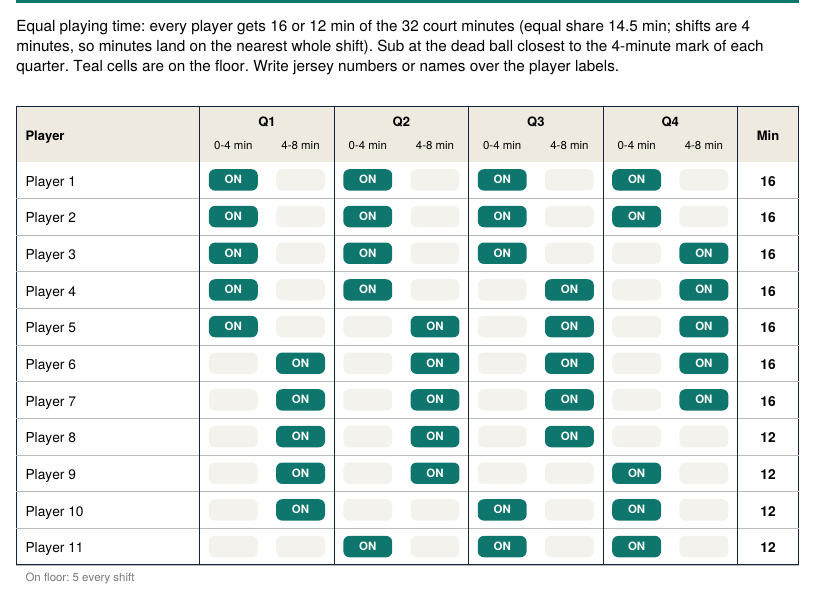
At eleven, three shifts per quarter is often the better format (twelve shifts of 2 minutes 40 seconds, so the four-shift players are only one short shift behind); the generator can produce that version. The two-shift chart printed here is the one that matches a league with fixed subs at the 4-minute mark.
12 players (13.3-minute share: four play 16, eight play 12)
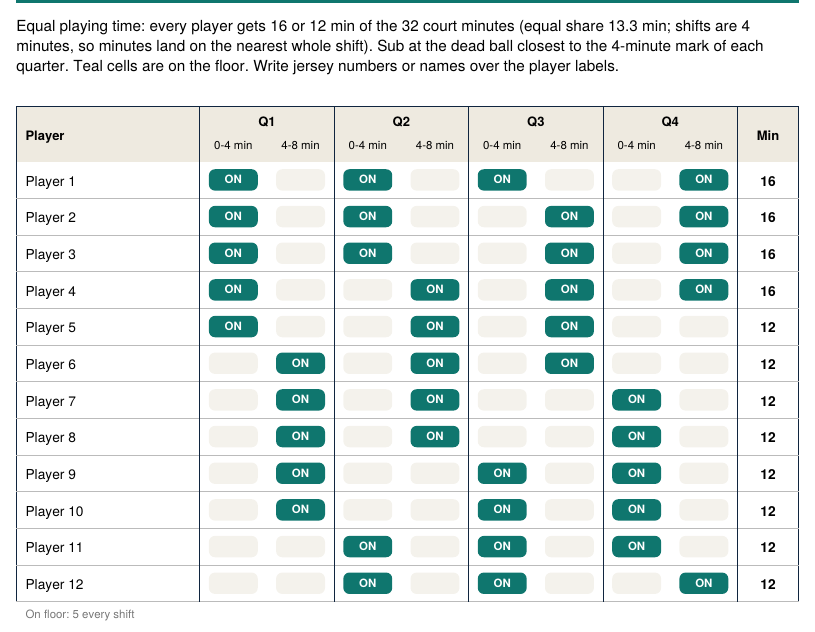
Twelve means seven on the bench every shift and a third of the roster watching for a third of the game, which is the roster size where a coach should ask the league for 6-minute shifts or a second team. If twelve is what you have, the generator's "longest sit" setting at two shifts is the thing that keeps every kid moving.
How to Run the Chart From the Bench
Give the chart to an assistant or a parent, not yourself. The coach watches the game; the chart-keeper watches the clock, and at the first dead ball after it reaches the 4-minute mark (or at the buzzer, in leagues that stop play for subs), reads the next column aloud, sends the incoming players to the scorer's table, and ticks the cell when they check in. Under NFHS rules a substitute reports to the scorer and waits to be beckoned by an official, so the chart-keeper's job is to have the next five at the table before the whistle, not after it.
Mark actual subs on the paper. The printed chart is the plan; the pencil marks are what happened, and the gap between the two is what you review Monday. A player who missed a shift because a free throw was being shot when the clock crossed 4:00 simply takes the next one, and the chart-keeper notes it in the game notes block so the minutes are recorded right on the playing time tracker afterward.
Adjusting on the Fly
Four situations break a printed chart, and each has a fixed response so nobody has to improvise with the clock running:
- Late arrival. Cross out the player's cells in the shifts already played, pencil them into the next open shift, and give them the shifts of whoever has the most minutes so far until they are within a shift of the group. If the league reduces the minimum for late arrivals, note the time they arrived on the sheet.
- Foul trouble. Three fouls in the first half: the player comes off at the next shift boundary, not the next whistle, so the chart holds and the sub is the one already written. Four fouls: swap their remaining second-half shifts with the lowest-minutes player.
- Injury or fouling out. Remove the player from every remaining cell. Their open shifts go to whoever has the fewest minutes, one shift at a time; do not give them all to one player.
- Blowout. The chart does not change. Equal-time leagues do not have a mercy rule for minutes, and the fourth quarter of a 30-point game is exactly when the players at the bottom of the chart should be on the floor.
The rule that makes all four work: a change in shift 2 cascades. Every edit after the first shift changes the minutes of at least two players, so the person holding the chart should fix the current shift and then recount the right-hand column before the next one, which is a 30-second job on paper and automatic in the generator, where tapping a cell on or off recalculates every player's minutes and re-runs the fairness warnings.
Position-Aware Rotations
A pure equal-time chart does not know who can dribble. Deal eight shifts across ten players by minutes alone and sooner or later a shift comes up with no point guard, which against a pressing 12U team is a turnover a possession. The printed charts leave positions to you: pencil a guard into every shift before the game, and if two guards share a bench shift, swap one of them with a forward in the adjacent shift.
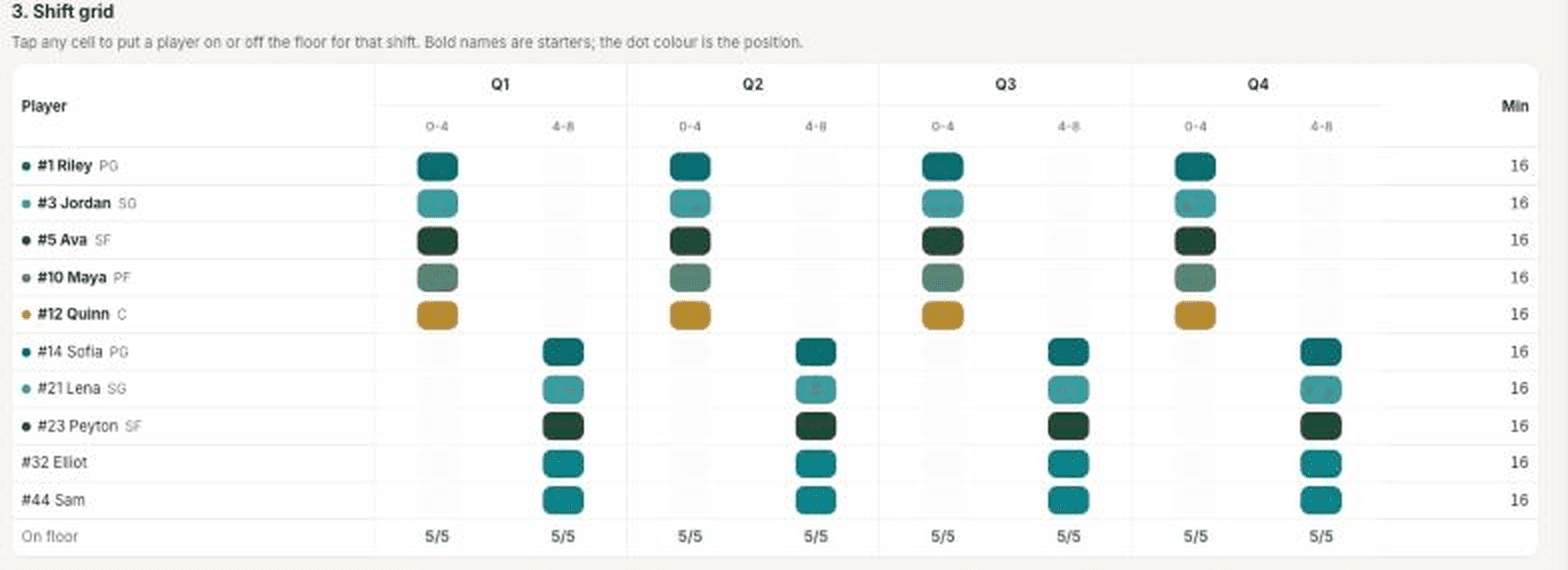
The free basketball rotation generator does this part automatically when positions are set in the roster. If a planned shift has no point guard, the engine swaps the highest-minute player in that shift who is not being forced on by the bench-streak rule for the best available point guard, and the shift grid colors each player by position so a lineup of five forwards is visible at a glance. It also carries the three checks a paper chart cannot: a warning for any player who misses a whole half, any player benched more than two shifts in a row, and, under the equal policy, any player more than one shift away from the equal share. Star the starters and switch to starters-weighted and the same engine gives each starter a 1.5x share of the minutes, which is the honest version of a chart for a travel or school team.
When to Use the Generator Instead of the Print
Print when your league plays 4 x 8 with subs at the 4-minute mark and you want a chart on a clipboard tonight. Use the generator when anything else is true: 6-minute quarters, 16-minute halves, three shifts per quarter, a roster of 13, starters who should play more, a point guard who must always be on the floor, or a roster that changes every Saturday. It builds the chart for your actual names, prints a rotation card for the bench, and shares the plan by link so the assistant has it on their phone. Save the plan to a free Rizzler account and it lands in Game Manager for basketball, where the Playing Time tab keeps the minutes across every game of the season.
The chart is the game-night half of the week. The basketball practice plans cover the other half with timed sessions by level, and the lineup sheet for the scorebook is the other piece of paper the chart-keeper needs at the table.
Frequently Asked Questions
How many players should rotate in youth basketball?
Everyone on the roster, in every half. At eight to ten players with two shifts per quarter, every player gets 16 to 20 minutes of a 32-minute game. Past eleven, ask for shorter shifts or three shifts per quarter so no one sits a whole quarter.
Is this rotation chart equal playing time?
Yes. Every chart uses the equal policy with no starters: each player is planned for the equal share of court minutes rounded to the nearest 4-minute shift, and nobody is more than one shift from the share. The 7, 9, 11 and 12 player charts have to give some players one extra shift because the shifts do not divide evenly; rotate who gets it from game to game.
Can I use the chart for 6 x 8 minute periods or 2 x 16 halves?
Not as printed; the charts are built for four 8-minute quarters with two shifts each. The free generator produces the same chart for 6-minute, 7-minute and 10-minute quarters, 16 and 20-minute halves, and one to four shifts per period, for any roster size.
Where do I log minutes after the game?
On the playing time tracker, which has a per-game minutes log with the fairness checks and a season tally, or in Rizzler Game Manager when the plan is saved to an account. The official scorebook records who entered the game; the tracker records how long they played.
What is the difference between a rotation chart and a substitution chart?
Nothing in practice. Some leagues call the grid a substitution chart, some a rotation chart, and a few a shift chart; all three mean the same grid of players by shifts. The term rotation chart is more common for basketball, substitution chart for soccer.
Read Next
OPS: Definition, Formula & Youth Benchmarks
StatsVolleyball Serving Drills: 7 Drills for Accuracy Under Pressure
VolleyballHow to Run a Flag Football Tryout: A Coach's Step-by-Step Guide
LearnVolleyball Lineup Sheet: How to Fill Out the Official Form
VolleyballBaseball Position Chart: Printable Fielding Rotation (Free)
ResourcesSoftball Pitching Chart: Free Printable PDF + Excel Tracker
Resources