The Youth Baseball Arm Care Program, Age Band by Age Band
The three rules that outrank every exercise
- A real offseason. No overhead throwing of any kind for at least 2 to 3 months per year (4 is preferred), and no competitive pitching for at least 4 months per year.
- An annual cap. No more than 100 innings pitched in games in any calendar year, counted across every team the player pitches for.
- Pain means stop. Elbow or shoulder pain is not soreness to push through. The player stops throwing and gets evaluated by a sports medicine professional before resuming.
The program at a glance
| Age band | Routine | Resistance | Frequency | Daily pitch max |
|---|---|---|---|---|
| 7-8 | Shortened Youth Thrower's Ten, 1x10 | Bodyweight or lightest band | 2x per week | 50 |
| 9-12 | Full Youth Thrower's Ten, 2x10 | Light band | 2x per week + throw days | 75 (9-10), 85 (11-12) |
| 13-15 | Full Youth Thrower's Ten, 2x10 | Light band | 2-3x per week | 95 |
| 16-18 | Standard Thrower's Ten, 2x10 | Band and light dumbbells | 2-3x per week | 105 (17-18) |
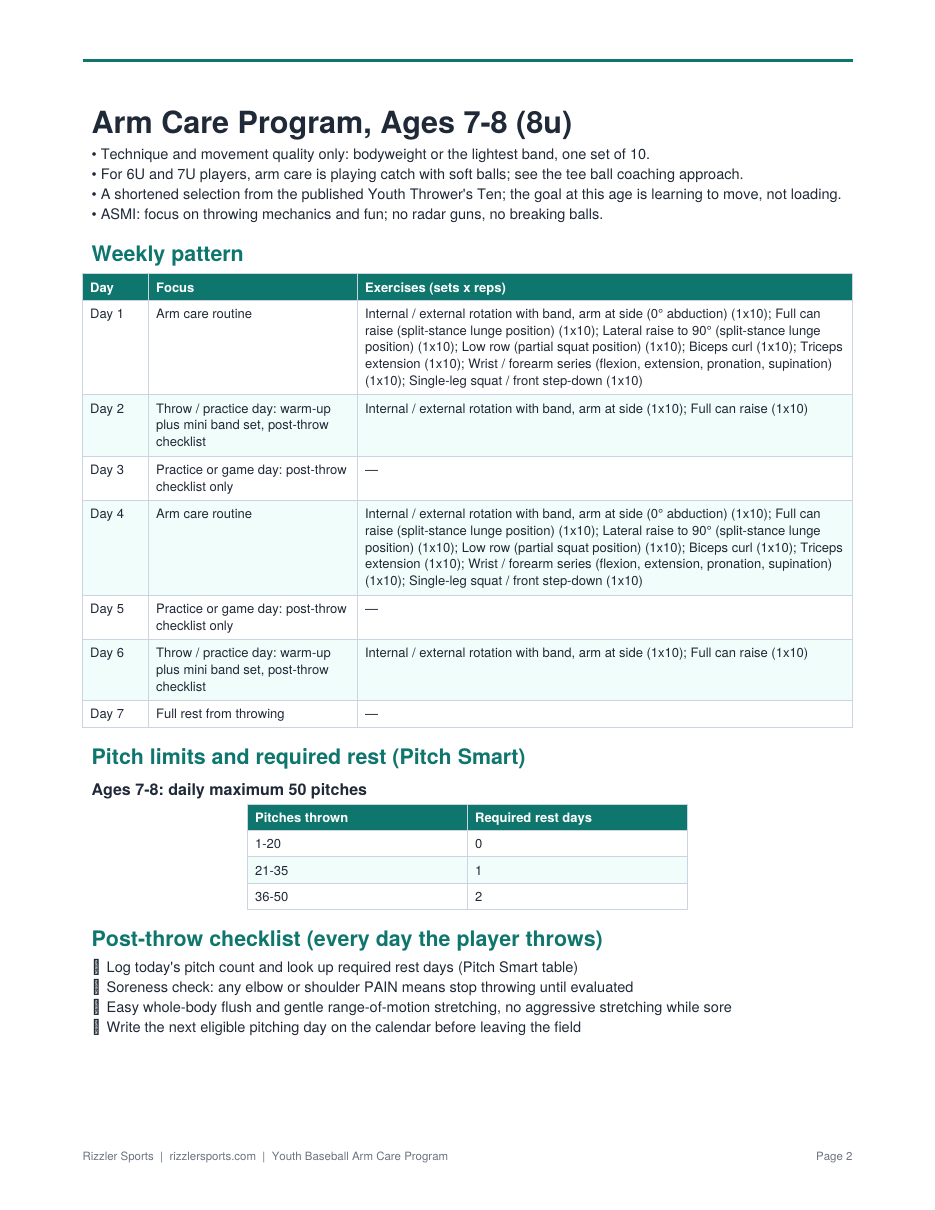
Ages 7-8: technique, not load
- One set of 10 each: rotation work with the arm at the side, full can raises, lateral raises, low rows, biceps, triceps, the wrist series, and single-leg step-downs
- Twice a week, 10 minutes, and the only coaching point is that the movements look right
- Per ASMI, this is the age to learn throwing mechanics and keep the game fun: no radar guns, no breaking balls
- For 6U and 7U, arm care is playing catch with soft balls; the tee ball coaching guide covers that first season
| Pitches thrown | Required rest |
|---|---|
| 1-20 | None |
| 21-35 | 1 day |
| 36-50 | 2 days |
Ages 9-12: the Youth Thrower's Ten, as published
- The routine: 12 exercises at 2 sets of 10 with a light band: split-stance full cans and lateral raises, partial-squat low rows and high rows, the modified robbery, side-lying external rotation, biceps, triceps, the wrist and forearm series, single-leg step-downs, and lateral slides
- Frequency: twice a week, plus a two-exercise mini set (rotations and full cans) before warming up on throw days
- The multi-roster trap: a pitcher on two fall rosters needs one combined pitch count. Per Pitch Smart, tracking across teams is where most violations happen
- No pitching and catching for the same team
| Pitches thrown | Required rest |
|---|---|
| 1-20 | None |
| 21-35 | 1 day |
| 36-50 | 2 days |
| 51-65 | 3 days |
| 66+ | 4 days |
Ages 13-15: full prescription, full ASMI rules
- The 100-inning annual cap is counted across every team, and somebody has to be the one counting
- The multi-month shutdown is the program here; the band work just supports it
- Any elbow or shoulder pain ends the outing and triggers an evaluation, full stop
| Pitches thrown (13-14) | Pitches thrown (15-16) | Required rest |
|---|---|---|
| 1-20 | 1-30 | None |
| 21-35 | 31-45 | 1 day |
| 36-50 | 46-60 | 2 days |
| 51-65 | 61-75 | 3 days |
| 66+ | 76+ | 4 days |
Ages 16-18: graduating to the standard Thrower's Ten
- D2 diagonal patterns, rotation work, abduction to 90 degrees, scaption, side-lying external rotation, the prone series, press-ups and push-ups, and the elbow and wrist work
- The age-specific risk is the showcase calendar: ASMI ties injury risk directly to year-round throwing, so the shutdown stays in the program even when a winter camp invite arrives
- The return from shutdown is a multi-week flat-ground ramp, not a first bullpen at full effort
| Pitches thrown | Required rest |
|---|---|
| 1-30 | None |
| 31-45 | 1 day |
| 46-60 | 2 days |
| 61-80 | 3 days |
| 81+ | 4 days |
The weekly pattern
| Day | What happens |
|---|---|
| Day 1 | Arm care routine (15-20 minutes) |
| Day 2 | Throw or practice day: mini band set before warming up, post-throw checklist after |
| Day 3 | Routine day (13-18) or post-throw checklist only (7-12) |
| Day 4 | Arm care routine |
| Day 5 | Practice or game day: post-throw checklist |
| Day 6 | Throw or practice day: mini band set, post-throw checklist |
| Day 7 | Full rest from throwing |
| Phase | What happens |
|---|---|
| In season | Routine 2x per week, pitch counts and rest tiers enforced every outing |
| Shutdown (2-4 months) | No overhead throwing at all; routine continues as the only arm work |
| Rebuild | Routine at full frequency, general strength work, still no mound |
| Ramp | Multi-week flat-ground throwing progression back to competitive innings |
PDFDownload the arm care program PDF
All four age bands in one printable: each band's weekly pattern, exercise list with sets and reps, the Pitch Smart pitch limit and rest table for that age, the post-throw checklist, and full source citations.
PDFDownload the post-pitching routine one-pager
A single page to run after every outing: the four-line checklist, the complete Pitch Smart rest table for ages 7-18, and an eight-row outing log. Print a stack and keep them in the scorebook.
ExcelDownload the Excel tracking log
A team log with one row per player per day: routine completion, pitch counts, required rest, next eligible pitching day, and soreness notes, plus the full Pitch Smart reference and each band's weekly pattern on their own tabs.
What about softball?
From printout to habit
Frequently Asked Questions
What is arm care in baseball?
How many days a week should a youth pitcher do arm care exercises?
Is the arm care program free?
How long should a youth pitcher rest after pitching?
Should young pitchers throw year-round?
Talk to our team
Want to spend more time coaching and less time with paperwork? Let's talk.
Tell us about your team and we'll show you how to plan games, set lineups, run the schedule, and develop players in one place, so you spend the season coaching instead of chasing admin.
Less admin, more coaching
Plan games, set lineups, and track the season in one place
Keep every family in the loop automatically
Tell us about your program
4 fields · takes 30 seconds
Lands in the same inbox as the Help button · human response only
Read Next
8U Baseball Practice Plan: A Complete 60-Minute Coach-Pitch Practice
LearnVolleyball Drills for Beginners: 8 Drills That Actually Work
VolleyballBest Apps for Little League Coaches in 2026
LearnLibero Rotation Rules: How the Libero Fits the Wheel
VolleyballHow to Plan a Youth Baseball Tournament Weekend
LearnRule Compliance: Never Violate a Rule You Didn't Know Existed
Features