
Learn
How to Balance Playing Time Without Losing Games (or Parents)
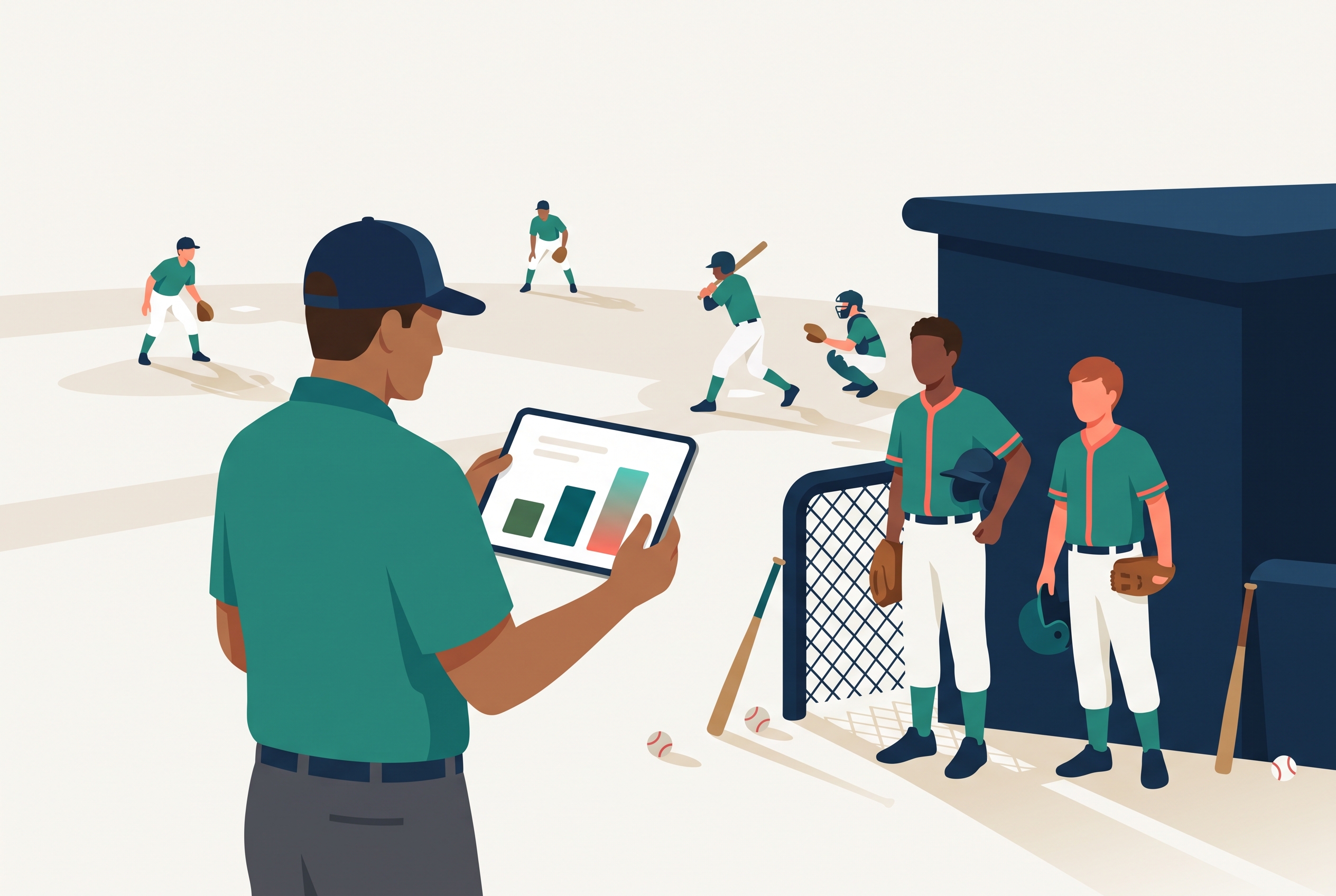
Balancing playing time is the most common source of conflict in youth baseball: between coaches and parents, between the desire to win and the responsibility to develop every kid on the roster, and between kids who are ready to compete and kids who are still learning which hand the glove goes on.
There's no formula that makes everyone happy. But there is a system that makes playing time fair, trackable, and defensible. Here's how to build it.
The Two Rules
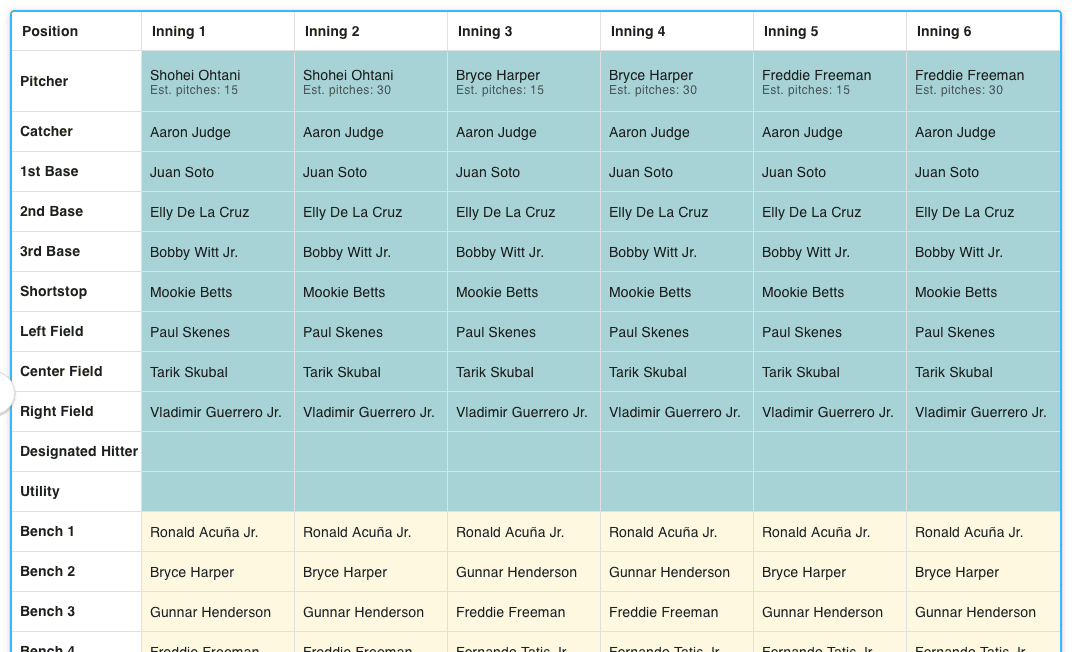
Rule 1: Track it. If you don't measure playing time, you can't prove it's fair. Rizzler tracks playing time automatically across every game: innings played, positions covered, batting order placement. No extra work. When a parent asks "why did my kid only play 3 innings?" you have data, not memory.
Rule 2: Be transparent about your philosophy. At the first parent meeting, state your approach clearly: "Every player will play a minimum of X innings per game. In competitive games, lineup decisions are based on performance and development." Parents don't need to agree with every decision, but they need to understand the framework.
Playing Time by Level
Rec League / Developmental
Equal playing time. Full stop. Every kid plays at least 4 of 6 innings. Rotate batting order positions across games. Rotate fielding positions so nobody is stuck in right field all season. This isn't optional. Most rec leagues require it, and violating minimum play rules can mean forfeits.
Use Rizzler's game planning to build rotations that guarantee minimum play, and AI Fielding Positions to generate the defensive assignments automatically.
Little League (Competitive Divisions)
Little League requires minimum play, typically 1 at-bat and 6 consecutive defensive outs per game. Beyond the minimum, playing time should reflect a mix of development and competition. At Majors (11-12), coaches have more discretion, but every kid should still get meaningful innings, not just the minimum.
Travel / Select
Playing time is earned, not guaranteed. But "earned" doesn't mean "the same 9 kids play every inning while 3 kids sit." Even on travel teams, bench players need development innings. The best travel coaches are intentional: competitive lineups in bracket games, development lineups in pool play and blowouts.
Track it with Rizzler so you can see the season-long picture. If your 12th player has played 40% of total innings while your starter has played 95%, you might be fine, but you should know the number. Rizzler for travel coaches →
The Parent Conversation
When a parent raises a playing time concern:
- Listen first. Don't get defensive. Their perception might be accurate.
- Show the data. Pull up the playing time dashboard in Rizzler. Show innings played, position distribution, and batting order history across the season. Sometimes the data confirms their concern, and that's useful. Sometimes it shows the rotation is actually fair, and the parent's memory was skewed by the last 2 games.
- Explain the plan. "I'm tracking playing time across the full season. Here's the distribution. Here's what I'm planning for the next few games."
- Don't make promises you can't keep. "I'll try to get him more time at shortstop" is a trap. "He'll get 2 innings at shortstop in the next 3 games" is a commitment you can track.
Practical Rotation Systems
Block rotation: Divide your roster into 3 blocks. Block A plays the first 2 innings at premium positions, Block B plays the middle 2, Block C plays the last 2. Rotate blocks each game.
Position ladder: Each player moves "up" one position each game. Right field → center → left → third → short → second → first → catcher → pitcher. Over 9 games, every player has played every position.
AI rotation: Let Rizzler's AI Fielding Positions handle it. The AI generates position assignments based on roster skills and depth chart data, and you can check the result against your season-long playing time numbers before locking it in.
Frequently Asked Questions
What's the minimum play rule for Little League?
Typically 1 at-bat and 6 consecutive defensive outs per game. Some local leagues have stricter requirements. Rizzler checks minimum play rules automatically.
How do I balance playing time during a tournament?
Pool play is for development, so rotate more freely. Bracket games are for competition, so optimize your lineup. Track it across the full tournament so the aggregate is fair even if individual games aren't equal. Tournament planning guide →
What if I have 13 players and only 9 can play at once?
In a 6-inning game, plan your rotation so every player gets at least 4 innings. Some players sit 2 innings each game. Rotate who sits so the same kid isn't benched every game. Rizzler tracks this automatically.
Playing time tracking is included on every Rizzler plan, so you can start proving your rotation is fair this weekend. The free plan covers one team.
Coaching in a league that wants playing time visibility across every team? We can show your board how it works.
Talk to our team
Want to spend more time coaching and less time with paperwork? Let's talk.
Tell us about your team and we'll show you how to plan games, set lineups, run the schedule, and develop players in one place, so you spend the season coaching instead of chasing admin.
Less admin, more coaching
Plan games, set lineups, and track the season in one place
Keep every family in the loop automatically
Tell us about your program
4 fields · takes 30 seconds
Lands in the same inbox as the Help button · human response only
Read Next
Rule Compliance: Never Violate a Rule You Didn't Know Existed
FeaturesBest Pitch Count Tracking Apps in 2026
LearnVolleyball Drills at Home: Solo Work That Actually Transfers
VolleyballLittle League Batting Rules: Continuous Batting Order & More
RulesTournament Planning for 13U-14U Baseball
BlogTeamSnap vs SportsEngine: Which One Do You Actually Need?
Comparison