Rizzler Sports Logo
How it WorksPricingLearnFree Lineup Generator
Learn

10U Baseball Practice Plan (75 Minutes)
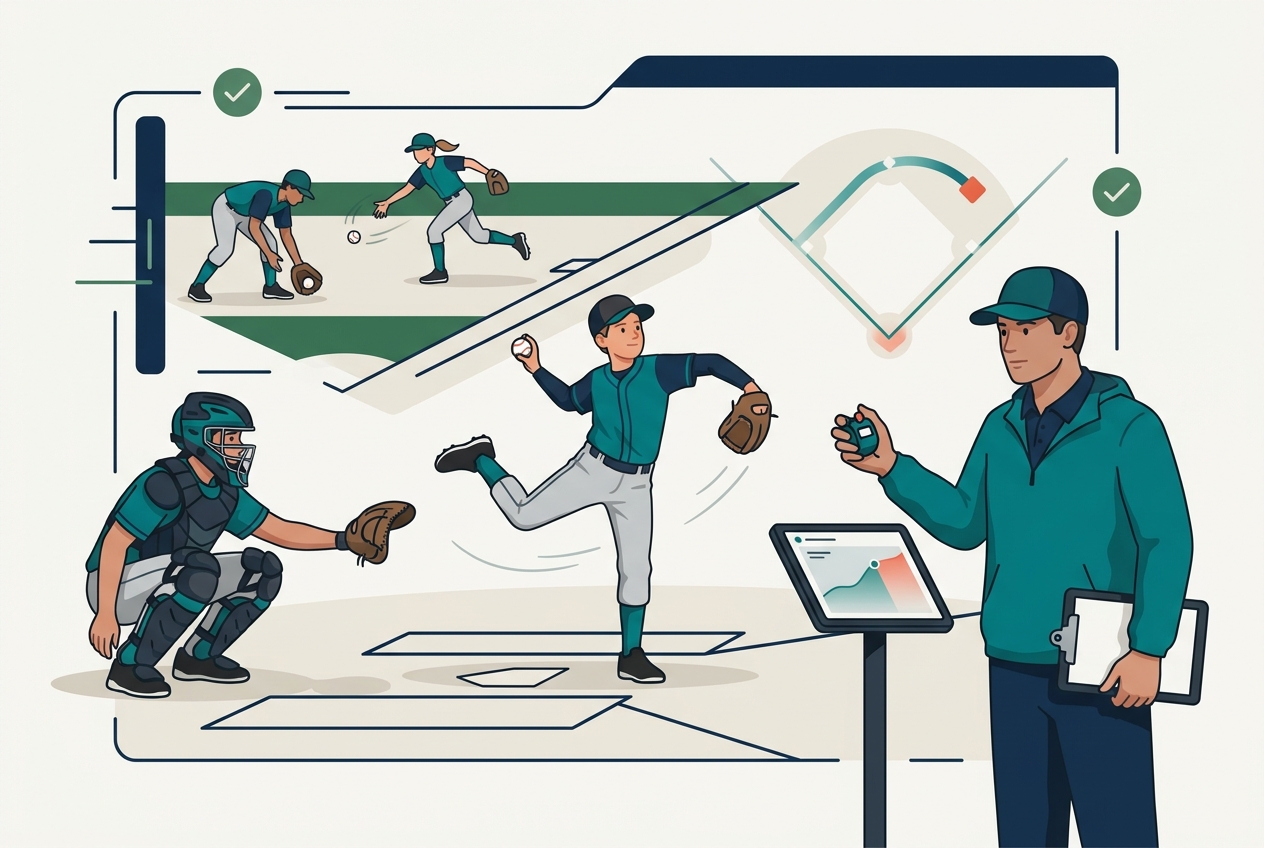
A 10U baseball practice plan should run 75 to 90 minutes and give pitchers and catchers their own work every practice, because 9U and 10U are the first years of kid pitch and most games at this age are decided by strikes, passed balls, and whether the defense can make the routine play. The 75-minute plan below has six blocks: tee work on arrival, a throwing progression, a ground ball triangle, a counted bullpen that runs beside it, a four-station hitting circuit, and a short circle. Open it in the free baseball practice planner to change the length or swap a block.
Ten year old pitcher throwing a bullpen to a catcher in full gear while a coach counts strikes on a clicker and teammates field ground balls behind them

The 75-Minute 10U Practice Plan

The plan gives 10 minutes to arrival tee work, 10 to throwing, 10 to ground balls, 15 to a bullpen for that night's pitchers and catchers, 25 to a hitting circuit, and 5 to a closing circle.
Baseball practice plan · 9-12 (Little League, 10U-12U)

10U Baseball Practice Plan (75 Minutes)

75 min · 6 segments

  1. 0:00

    10 min

    Trickle-In Tee & Net

    Early arrivers rotate through tee-and-net swing stations at their own pace before practice starts.

    Arrival
  2. 0:10

    10 min

    Throwing Progression Ladder

    Structured partner throwing that builds from wrist flips to long toss with a target-hitting focus.

    Warm-Up
  3. 0:20

    10 min

    Ground Ball Triangle

    Continuous rolled ground balls in a three-cone triangle — footwork, funnel, and feeds at maximum rep speed.

    Core
  4. 0:30

    15 min

    Bullpen Strike Challenge

    Pitchers compete in a counted-strike bullpen game while catchers train receiving — measurable and competitive.

    Core
  5. 0:45

    25 min

    4-Station Hitting Circuit

    Tee, front toss, live BP, and dry-work stations running at once — every hitter swinging, nobody in line.

    Core
  6. 1:10

    5 min

    Circle Up: Wins & One Thing

    Coach-led reflection circle: name today's wins, one thing to improve, and the message for the next game.

    Cooldown

Equipment: tees, hitting nets or fence screens, buckets of balls, bats, helmets, gloves, one ball per pair, cones, bucket of balls, catcher's gear or strike-zone target nets, balls, chart sheets and pencils, portable mound or flat ground markers, L-screen, portable cage or toss screen, nets, whistle or air horn

Change the length, swap modules for your age group, print a one-page coach sheet, and share it by link. No login.

Customize this plan free →Save to my account
Trickle-In Tee and Net (10 minutes). Tees into a net, open from the moment the first player arrives. Coaching point: hit the ball, not the tee, and hold a balanced finish.
Throwing Progression Ladder (10 minutes). Wrist flips, then 30, 45, and 60 feet. Every throw has a target, the partner's chest. At 10U, add a quick-feet finish: the last ten throws are catch, shuffle, throw, as an infielder would.
Ground Ball Triangle (10 minutes), with the bullpen beside it. Position players work the triangle for footwork, funnel, and feeds. After the first ten minutes they stay with an assistant for a second round that adds a throw to a base, while the head coach takes the bullpen.
Bullpen Strike Challenge (15 minutes). Two or three pitchers and their catchers. Each pitcher throws 20 to 25 pitches and counts strikes out of each group of ten. The catcher's job is as important as the pitcher's: set a target, stick the pitch, and block anything in the dirt. Record each pitcher's strike percentage on the plan sheet. In most rec leagues, a 10U pitcher who throws 55 to 60 percent strikes is one of the better pitchers around, and the number gives players a goal other than velocity.
4-Station Hitting Circuit (25 minutes). Tee, front toss, live batting practice, and a dry-work station, six minutes each, with shaggers rotating in. Every hitter takes 40 or more swings counting dry work. With two coaches, one throws live batting practice and one throws front toss. The tee and dry-work stations run on a posted instruction with a parent watching spacing: one bat per station, everyone else behind a cone line.
Circle Up (5 minutes). Wins by name, one thing to improve, and the plan for the next game.

The Kid-Pitch Transition

The move from coach pitch to kid pitch changes what practice is for. Hitters now face pitches that are not all strikes, so they need to learn the strike zone and get used to pitches thrown by someone their own age. Add a "track it" rule to live batting practice: the first two pitches of each round, the hitter does not swing and calls ball or strike out loud. Walks are a large share of offense at 9U and 10U, and a hitter who knows the zone gets on base.
Every player should learn to pitch at this age, not only the two or three with strong arms. Bodies change, and the best 12U pitcher is often a player who could not find the plate at nine. Rotate the whole roster through short bullpens over a few weeks and keep a list of who throws strikes.
Catchers need gear time in practice. A catcher who only wears the gear in games will be afraid of the ball in games. Ten minutes of receiving and blocking in every practice, in full gear, is what makes a 10U catcher, and a catcher who can stop the ball ends more rallies than any other player on the field.

First-Year Pitchers: Counts and Rest

Plan practice bullpens around the week's games. Under Little League rules a pitcher aged 9 or 10 may throw 75 pitches in a day, with required calendar days of rest that increase with the pitch count, and the MLB and USA Baseball Pitch Smart guidelines use the same daily limit for that age. Many travel events set their own limits or none at all. The pitch count limits guide and the pitch count rules comparison cover the details.
Two practical rules protect young arms. A pitcher who threw more than 20 pitches on Sunday, or more than 35 on Saturday, does not throw a bullpen on Monday, which mirrors the Little League rest-day table. And a player who pitched does not catch in the same game, and the reverse, because those are the two positions with the most throws. A pitch count tracking sheet keeps the record straight across games and practices.

Ready to take your game to the next level?

Leads, Steals, and Dropped Third Strikes

Baserunning rules at 9U and 10U depend on your league. Little League does not allow leads at this age; runners leave when the pitch reaches the batter. Many travel organizations allow leads and steals at 9U or 10U. Find out which applies before you spend practice time on it. If your league allows steals, add a five-minute segment to the bullpen: a runner on first, the pitcher works from the stretch, and the catcher throws through. If your league holds runners until the pitch reaches the batter, work on jumps as the ball crosses the plate, passed-ball reads, and running hard through first base.
Ask about the dropped third strike too. Little League Majors plays it, the Minor divisions do not, and most travel rules do. If it is live in your league, give each catcher three reps a practice of block, recover, and throw to first.

9U and 11U Adjustments

For 9U, keep the same plan, shorten the bullpen to 15 pitches per pitcher, and use the easier version of the hitting circuit with front toss replacing live batting practice on some nights. For 11U, stretch the plan to 90 minutes by adding Pitcher Fielding Practice or the 21 Outs team defense block; the 12U baseball practice plan shows that version. Players coming up from coach pitch may need a few weeks of the 8U plan's scoring games mixed in.

Build Your Own 10U Practice Plan

Open this plan in the free baseball practice planner with the "Customize this plan" button under the plan above. Choose the 9-12 age group and the module library shows the drills built for this age, including the bullpen and pitcher fielding modules that do not appear for younger groups. Print the one-page coach sheet or share the plan by link, with no login required. The baseball practice plan template is the paper version.
Save the plan to a free Rizzler account and it lands in Practice Manager, attached to a practice on your schedule with RSVP counts and station assignments for your assistants. The baseball practice plans hub has sessions for every age through high school.
Running a league or a club with many teams? We will set every coach up with shared practice plans, tryouts, and evaluations, and show you how much volunteer time it saves.

Talk to our team

Want to spend more time coaching and less time with paperwork? Let's talk.

Tell us about your team and we'll show you how to plan games, set lineups, run the schedule, and develop players in one place, so you spend the season coaching instead of chasing admin.

  • Less admin, more coaching

  • Plan games, set lineups, and track the season in one place

  • Keep every family in the loop automatically

Tell us about your program

4 fields · takes 30 seconds

Lands in the same inbox as the Help button · human response only

Frequently Asked Questions

How long should a 10U baseball practice be?

Seventy-five to 90 minutes. That is long enough for a bullpen, a full hitting circuit, and a defensive block, and short enough that nine and ten year olds stay sharp to the end.

What should a 10U baseball practice focus on?

Throwing strikes, catching the ball behind the plate, playing clean catch, fielding routine ground balls, and learning the strike zone as hitters. Those five things decide most games in the first years of kid pitch.

How many pitches should a 10U pitcher throw in practice?

A practice bullpen of 20 to 25 pitches is enough. Count it toward the player's weekly workload, and skip the bullpen for anyone who threw a heavy count in a game in the previous two days.

How do you run a 10U practice with one coach?

Recruit two parents. One watches a tee station and a dry-swing station that run on posted instructions, with one bat per station and everyone else behind a cone line. The other feeds ground balls. You run the bullpen. The scoring games from the 8U plan also work well at 10U with one coach.

When do players start leading off and stealing?

Leads and steals start at 9U or 10U in many travel organizations. In Little League Minors and Majors, runners may steal only after the pitch reaches the batter; true lead-offs begin in the Intermediate (50/70) division, ages 11 to 13. Check your league's rules before planning practice time around it.