Rizzler Sports Logo
How it WorksPricingLearnFree Lineup Generator
Learn

Baseball Practice Plan Template
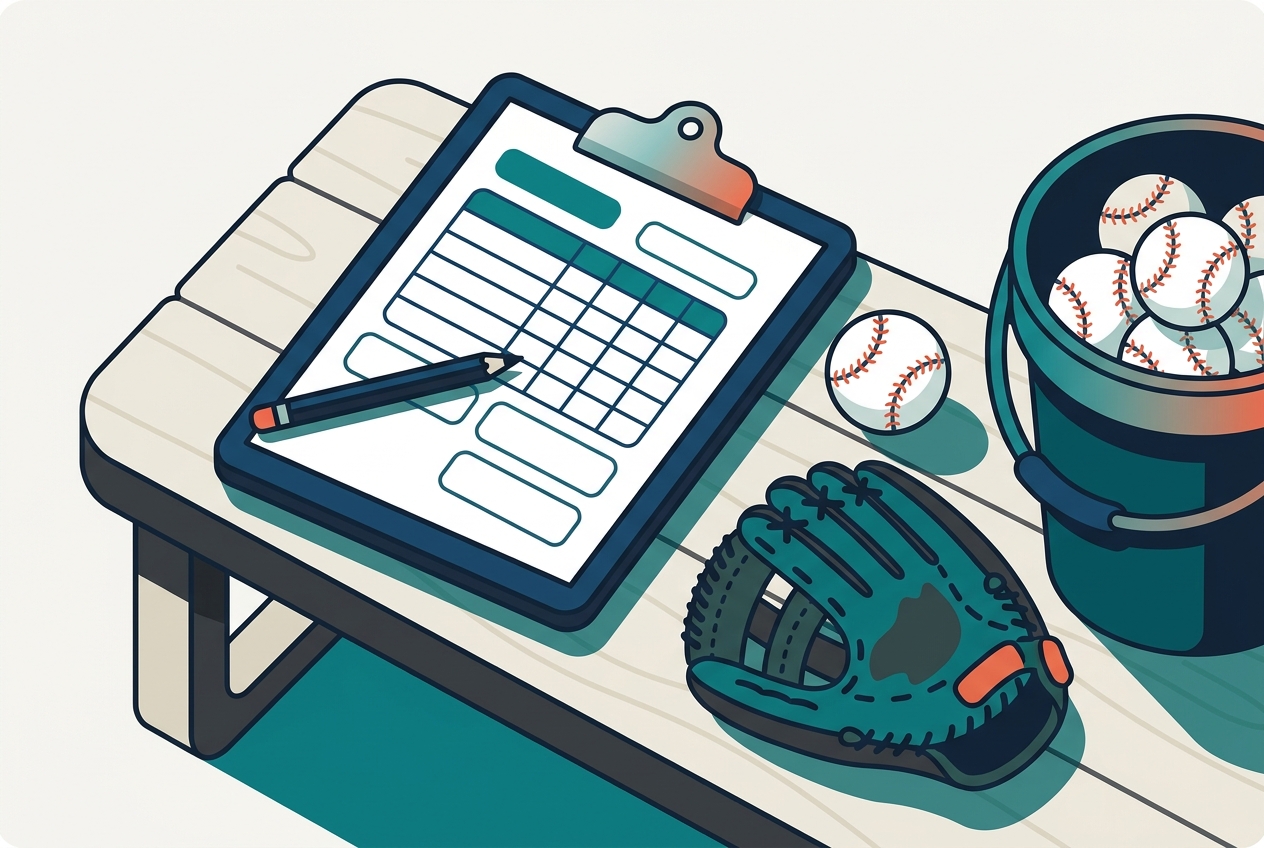
A baseball practice plan template is a one-page session sheet with a time column, a block for each drill, the teaching point for that block, and the equipment it needs, so a coach can fill it in on Sunday night and run it from the dugout on Tuesday. The template on this page comes two ways: a printable PDF for pencil planners and an Excel sheet whose time column adds itself up so the plan cannot run long by accident. Both include a blank sheet and two filled examples, a 90-minute station practice for a 9U to 12U team and a two-hour high school varsity practice. Every block in the examples can be opened in the free baseball practice planner if you would rather build than write.
Blank baseball practice plan template on a clipboard with a pencil beside a glove and a bucket of balls on a dugout bench

Download the Baseball Practice Plan Template

ExcelDownload for Excel

Timed session sheet with a start-time column that calculates from the practice start and each block's minutes, a live total against your field slot, a phase dropdown per row, and two example tabs: the filled 90-minute station practice and the 120-minute high school practice.

PDFDownload the printable PDF

The same sheet as a blank print page, plus the two filled examples on pages two and three, for coaches who plan by hand.

For Google Sheets, upload the Excel file to Drive and open it; the time formulas carry over. No email is required for either file.

What the Template Includes

The template has six columns because six is what a coach can read at a glance from the dugout: start time, minutes, phase, block name, teaching point, and equipment. The start time column is the one most homemade plans skip and the one that matters most, because a plan that says "hitting, 25 minutes" tells you nothing when it is 6:20 and you cannot remember whether hitting started at 5:55 or 6:05. The phase column (arrival, warm-up, core, conditioning, cooldown) keeps the plan honest about its shape; if you have five core rows and no cooldown, you will see it before the players' arms do.
Above the grid is a header block for the date, the field, the roster count, the number of coaches, and the one focus for the night. The focus line is deliberate: writing "know where the throw goes" at the top of the sheet is what keeps a coach from spending 20 minutes on something else when the point of the night was that. The coach count matters more in baseball than in most sports, because it decides how many stations you can run at once. Below the grid is a short notes area for what to carry into the next practice, which is the part of the sheet worth keeping after the season.

How to Fill It In: Five Minutes on Sunday Night

Filling in the template takes five minutes if you work in this order. Write the focus first, one line. Put in the fixed blocks next: arrival, warm-up, throwing, and cooldown are nearly the same every practice, so they cost no thought. Then give the focus the biggest core block and put it early, while attention is fresh. Add one block that is a game with a score. Last, check the total against your field slot and cut a skill block if you are over. In the Excel version the total updates as you type and the sheet tells you how many minutes you are over or under.
Two details save practices. Write the equipment for each block, because discovering that the tees are in the other coach's trunk costs ten minutes you planned for ground balls. And write who runs each station when you have helpers; a parent can run a tee station or count reps, which frees the coaches for the stations where teaching happens.

The Filled Example: A 90-Minute Station Practice

The first filled example is a 90-minute practice for a 12-player 9U to 12U roster with two coaches and one parent helper, built around a 30-minute station rotation, because stations are how two coaches keep twelve players moving on one field.
Baseball practice plan · 9-12 (Little League, 10U-12U)

Baseball Practice Plan Template: Filled Example (90 Minutes)

90 min · 7 segments

  1. 0:00

    10 min

    Trickle-In Tee & Net

    Early arrivers rotate through tee-and-net swing stations at their own pace before practice starts.

    Arrival
  2. 0:10

    8 min

    Dynamic Warm-Up Lines

    Whole-team dynamic movement lines: jogs, skips, lunges, shuffles, and arm circles across the outfield.

    Warm-Up
  3. 0:18

    10 min

    Throwing Progression Ladder

    Structured partner throwing that builds from wrist flips to long toss with a target-hitting focus.

    Warm-Up
  4. 0:28

    30 min

    Stations: Infield / Outfield / Tee Work

    A ready-made 3-4 station rotation shell: structure, timing, and rotation rules — you plug in the skills.

    Core
    Universal
  5. 0:58

    12 min

    Baserunning Reads & Dirt Balls

    Runners at every base react live to coach reads: dirt balls, steals, first-to-third, and tag-ups.

    Core
  6. 1:10

    15 min

    Controlled Scrimmage: Coach Pitches, 3 Outs and Switch

    Reduced-numbers scrimmage with a single constraint so every player gets maximum touches and decisions.

    Core
    Universal
  7. 1:25

    5 min

    Circle Up: Wins & One Thing

    Coach-led reflection circle: name today's wins, one thing to improve, and the message for the next game.

    Cooldown

Equipment: tees, hitting nets or fence screens, buckets of balls, bats, helmets, cones, gloves, one ball per pair, cones to mark zones, whistle or timer, station gear as chosen, bases, a few balls, sport balls, cones or boundary markers, pinnies

Change the length, swap modules for your age group, print a one-page coach sheet, and share it by link. No login.

Customize this plan free →Save to my account
Tee work on arrival and a dynamic warm-up bring players in, and the throwing ladder gets ten full minutes. The station block runs three ten-minute stations at once: infield ground balls with one coach, outfield fly balls and drop steps with the other, and a tee station that the parent helper supervises: one hitter per tee, everyone else behind a cone line. Baserunning Reads is the one team concept of the night. The controlled scrimmage that follows is coach pitch with three outs and switch, every ball live, and the coach freezes one play per half inning to ask where the throw should have gone, which is the focus written at the top of the sheet. A five-minute circle closes it. Every block is a module from the planner's library, so the whole plan opens there with the "Customize this plan" button.

The High School and Travel Example: 120 Minutes

The second filled example is a two-hour practice for a high school varsity team with three coaches, and it shows how the same sheet handles a bigger staff and a longer slot: more core rows, a pitcher fielding block that runs beside position work, and a carry-forward note that tracks pitchers.
Baseball practice plan · 16-18 (high school, 16U-18U)

High School Baseball Practice Plan (120 Minutes)

120 min · 8 segments

  1. 0:00

    10 min

    Trickle-In Tee & Net

    Early arrivers rotate through tee-and-net swing stations at their own pace before practice starts.

    Arrival
  2. 0:10

    10 min

    Dynamic Warm-Up Lines

    Whole-team dynamic movement lines: jogs, skips, lunges, shuffles, and arm circles across the outfield.

    Warm-Up
  3. 0:20

    12 min

    Throwing Progression Ladder

    Structured partner throwing that builds from wrist flips to long toss with a target-hitting focus.

    Warm-Up
  4. 0:32

    15 min

    PFP: Pitcher Fielding Practice

    Classic PFP: comebackers, covering first, bunt plays, and 3-1 flips at game speed with quick lines.

    Core
  5. 0:47

    25 min

    4-Station Hitting Circuit

    Tee, front toss, live BP, and dry-work stations running at once — every hitter swinging, nobody in line.

    Core
  6. 1:12

    20 min

    Live BP: Situations & Reads

    Controlled BP where defense plays every ball live and baserunners make real reads — three skills in one block.

    Core
  7. 1:32

    20 min

    21 Outs Team Defense

    The classic: defense must record 21 clean outs off coach fungos with live situations — one error resets the count.

    Core
  8. 1:52

    8 min

    Cooldown Stretch & Arm Care

    Easy jog, partner stretching, and light arm-care holds to bring heart rates down and protect throwing arms.

    Cooldown

Equipment: tees, hitting nets or fence screens, buckets of balls, bats, helmets, cones, gloves, one ball per pair, fungo bat, bucket of balls, bases, catcher's gear, L-screen, portable cage or toss screen, nets, whistle or air horn, two buckets of balls, helmets for runners, light resistance bands (optional, 13+)

Change the length, swap modules for your age group, print a one-page coach sheet, and share it by link. No login.

Customize this plan free →Save to my account
The early blocks are the same shape as the youth example, only longer: the throwing progression reaches long toss for position players while pitchers follow their own schedule. Pitcher Fielding Practice takes 15 minutes with position-specific work beside it. The hitting circuit and live situational batting practice fill 45 minutes between them, and 21 Outs finishes the defensive day. Notice the carry-forward line on this example: it records two missed cuts to fix and how many pitches Friday's starter threw in the bullpen. A 15U to 18U travel staff fills the sheet the same way with fewer rows: two practices a week, a short bullpen list taken from the weekend's pitch counts, and one team period. JV coaches can run the 90-minute example as written. At this level the notes area doubles as the pitching log between practices, and it pairs with a pitch count tracking sheet for game days.

Ready to take your game to the next level?

Adapting the Template to 60, 75, 90, or 120 Minutes

The template scales by changing the core block, not the shape: a 60-minute practice has two short skill blocks plus a game, a 90-minute practice has three core segments, and a 120-minute practice fits live situational hitting, a team defense block such as 21 Outs, and pitcher fielding practice on the same day. The arrival, warm-up, and cooldown blocks stay close to the same length at every duration, because a warm-up does not get longer just because the practice does.
SlotArrivalWarm-up and throwingCoreConditioningCooldown
60 min (8U)101027 (two short blocks + a scoring game)8 (relay game)5
75 min (10U)101050 (ground balls, bullpen, hitting circuit)folded into drills5
90 min (12U, 14U, JV)8 to 101854 to 57 (three blocks)folded into drills5 to 8
120 min (high school)102280 (four blocks incl. team defense)folded into drills8
The one number to protect at every length is the throwing progression, and the second is the live-play block. If the practice runs long, cut a skill block. The baseball practice plans page has a complete session at each of the 60, 90, and 120-minute lengths.

Printable, Excel, or Blank: Which Version to Use

Use the printable PDF if you plan with a pencil and want the sheet on a clipboard in the dugout; page one is the blank baseball practice plan template and can be copied as many times as you need. Use the Excel version if you reuse plans, because you can duplicate the tab for each practice and the start times recalculate when you change one block. Coaches with several teams usually keep one workbook per team with a tab per week.

Template vs. Practice Schedule Template

This page is a practice plan template: a session sheet for what happens inside one practice. The practice schedule template is the blank timing grid and weekly frame for laying out when practices happen and how the week's sessions fit together. Use that one to plan the week and this one to plan the night; most coaches keep both in the same folder.

When to Stop Using the Template

The template stops being enough the week you want to run the same plan for a second team, attach it to a real practice on the calendar, or hand it to an assistant who was not in the planning conversation. That is what the free baseball practice planner does without an account: the same blocks as the template, pulled from a curated baseball module library with coaching points built in, timed automatically, printed as a one-page coach sheet, and shareable by link. Save a plan to a free Rizzler account and it lands in Practice Manager, attached to the practice event with RSVP counts, station assignments for assistants, and an equipment list assembled from the drills.
The baseball practice plans page has complete sessions for 8U, 12U, 14U, and high school built on the same template, and the baseball tryout guide covers the evaluation days before the first practice.
Running a league or a club with many teams? We will set every coach up with shared practice plans, tryouts, and evaluations, and show you how much volunteer time it saves.

Talk to our team

Want to spend more time coaching and less time with paperwork? Let's talk.

Tell us about your team and we'll show you how to plan games, set lineups, run the schedule, and develop players in one place, so you spend the season coaching instead of chasing admin.

  • Less admin, more coaching

  • Plan games, set lineups, and track the season in one place

  • Keep every family in the loop automatically

Tell us about your program

4 fields · takes 30 seconds

Lands in the same inbox as the Help button · human response only

Frequently Asked Questions

Is the baseball practice plan template free?

Yes. Both the printable PDF and the Excel file download directly from this page with no email and no account.

What should a baseball practice plan template include?

A start time and minutes for every block, the phase of practice, the drill or block name, one teaching point per block, the equipment, a header with the night's single focus and the number of coaches, and a notes area for what carries into the next practice.

Does the template work for high school and travel teams?

Yes. The sheet is the same at every level; what changes is the number of core rows and the staff. The download includes a filled 120-minute high school varsity example, and the blank sheet has twelve rows, which is enough for a two-hour practice.

Can I edit the template in Google Sheets?

Yes. Upload the Excel file to Google Drive and open it with Sheets. The start-time formulas, the running total, and the phase dropdown all carry over.

How many drills should go on one practice plan?

Five to seven blocks for 60 to 90 minutes and seven to nine for two hours. More than that and each block is too short to teach anything; fewer and players stand in one drill too long.

Is there a digital version of this template?

Yes. The free baseball practice planner is the same sheet as a tool: pick a length and an age group, add curated drill modules to a timed timeline, and print or share the plan. No login is required.