Volleyball Blocking Drills That Fix Feet Before Hands
Blocking is the skill youth teams practice least and complain about most, and the gap has one cause: teams jump before they can move. A block is footwork that ends in a jump, sequenced off a read, and the drills below train it in that order: movement patterns first, then eyes, then the press over the net, then live closing and transition. Each drill carries its setup, cues, the mistake that hollows it out, and age scaling. The back-court half of the defensive system, where the dig happens once your block channels the attack, is covered in the companion defense drills guide.
Before the Drills: What a Youth Block Is For
Set expectations or the drills get judged by the wrong number. Below college, most blocks do not stuff the ball; a good youth block takes away one shot (usually the line), channels the attack toward your best digger, and slows hard swings into playable ones. Chart "block touches that helped" alongside stuffs and the position starts getting coached instead of wished about. That framing matters most for your middle blockers, who close to every antenna and get judged unfairly when only stuffs count.
Drill 1: Footwork Lanes
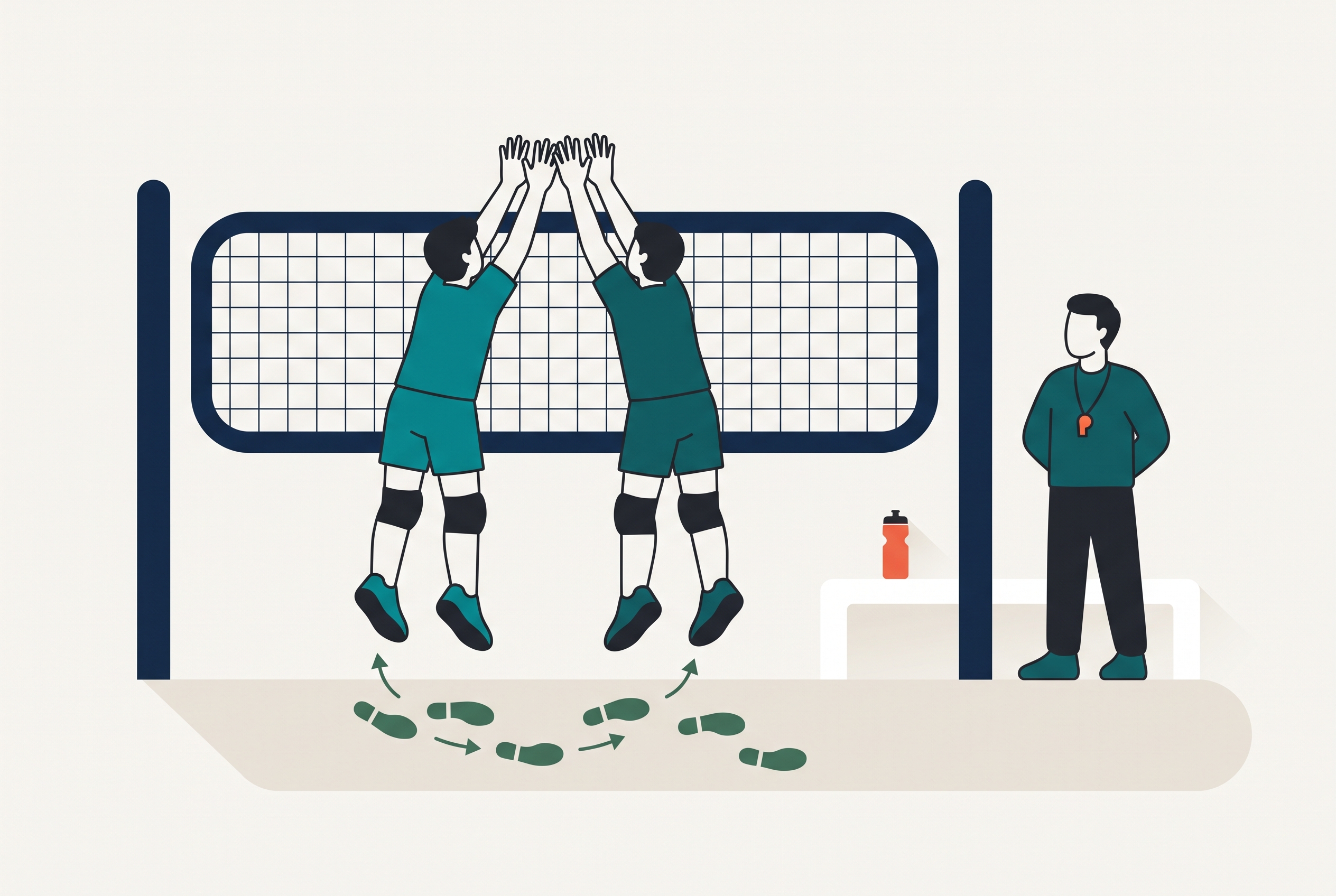
Purpose. Groove the two travel patterns every blocker needs: the two-step shuffle for short distances and the three-step crossover for antenna-to-antenna closes.
Setup. Players spaced along the net, no ball. Tape marks or cones at start and end points.
Footwork Lanes
Steps. On "shuffle," players travel two meters with shuffle steps and execute a block jump; on "crossover," they run the crossover pattern to the antenna, plant square, and jump. Ten reps per pattern, both directions. Hands stay at shoulder height or above throughout; the drill fails silently if arms swing low between reps.
Coaching cues. "Square before air": shoulders parallel to the net at takeoff, every rep, because a drifting blocker opens the seam the attacker wants. "Penetrate, don't slap" starts here even without a ball: hands reach over on every jump.
Common mistakes. Traveling with a hop instead of steps (kills balance at the plant) and letting players face the direction of travel at takeoff. Fix both by scoring only reps that finish square.
Age fit. Every age; this is the daily vitamin. Three minutes at the start of any net block keeps patterns honest.
Drill 2: Mirror Blocking
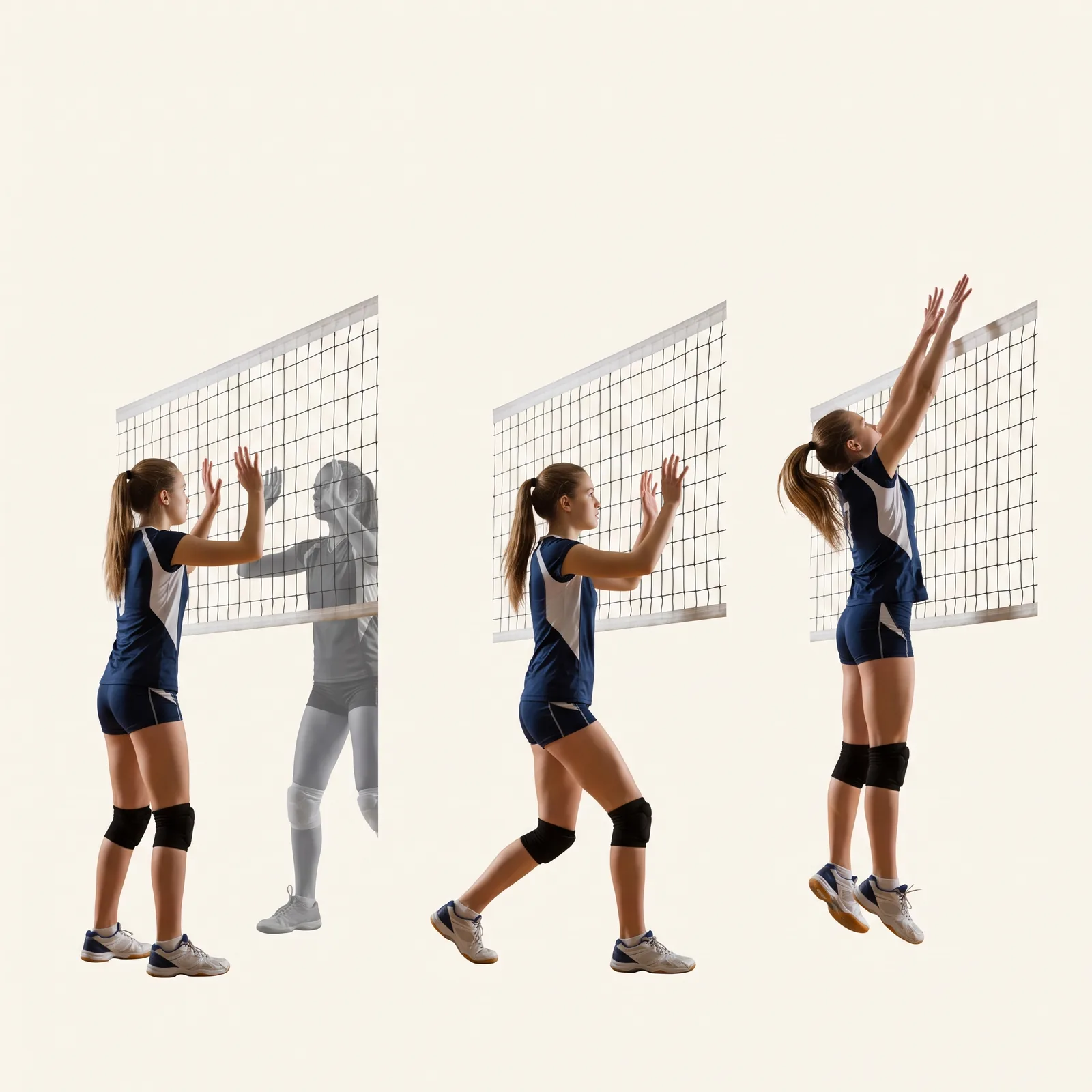
Purpose. Attach the footwork to a moving stimulus and train blockers to move with, not after, their assignment.
Setup. Pairs facing each other across the net, no ball.
Volleyball · Blocking
Mirror Blocking
Pairs across the net mirroring shuffle steps and block jumps.
Steps. One player leads, shuffling and crossing along the net with fake jumps mixed in; the partner mirrors in real time, staying nose to nose. Thirty seconds per lead, two rounds each. A jump by the leader must be met by a jump from the mirror, on time, both pressing over.
Coaching cues. "Eyes on her hips, not her face": hips tell the truth about direction. Late mirrors are usually watching the wrong thing, not moving too slow.
Common mistakes. Leaders performing dance moves instead of blocking patterns. Constrain the leader to game movements and the drill stays a blocking drill.
Age fit. 11U and up; it is also a warm-up favorite because it needs no coach.
Drill 3: Read-and-Press From the Box
Purpose. Train the read sequence (setter, ball, hitter) and the press over the net, the two skills that turn jumping into blocking.
Setup. Coach on a box across the net with a ball, two hitters (or stand-ins) at the pins, one or two blockers on the near side.
Volleyball · Blocking
Read-and-Press From the Box
Coach on a box shows a set and turns to one pin; outside and middle blockers read, close to that pin and press as the ball is hit at them.
0:00 / 1:04
Steps. Coach shows a setting motion, then turns shoulders toward one pin; blockers read, travel, and press as the coach attacks the ball into their hands. Eight reps per blocker, then rotate. Score two points for a clean press with penetrating hands, one for arriving on time with soft hands, zero for guessing early even if it worked.
Coaching cues. "Read, run, press." Hands pierce over the plane of the net toward the ball, thumbs up, fingers spread wide. Late is fixable; guessing is the habit to punish, which is why the scoring rewards process over luck.
Common mistakes. Coaches telegraphing the same direction pattern, and blockers reaching sideways at contact instead of traveling first. If hands reach, feet were lazy.
Age fit. 12U with the coach tossing over a lowered net; full box work 13U and up.
Player development
Track development all season, not just on tryout day
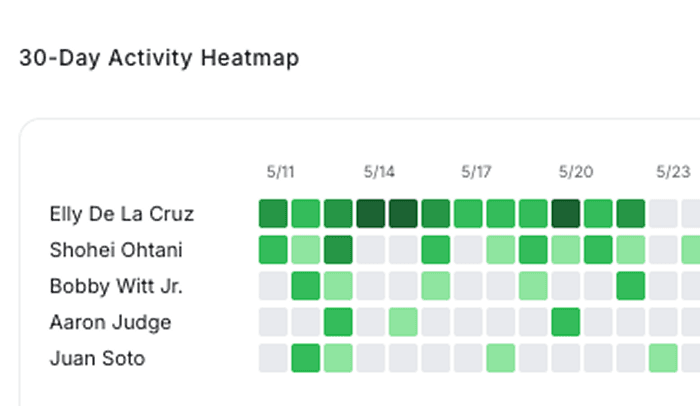
Score skills through the season, watch the trend lines move, and send parents a progress report they actually open.
Drill 4: Closing the Double Block
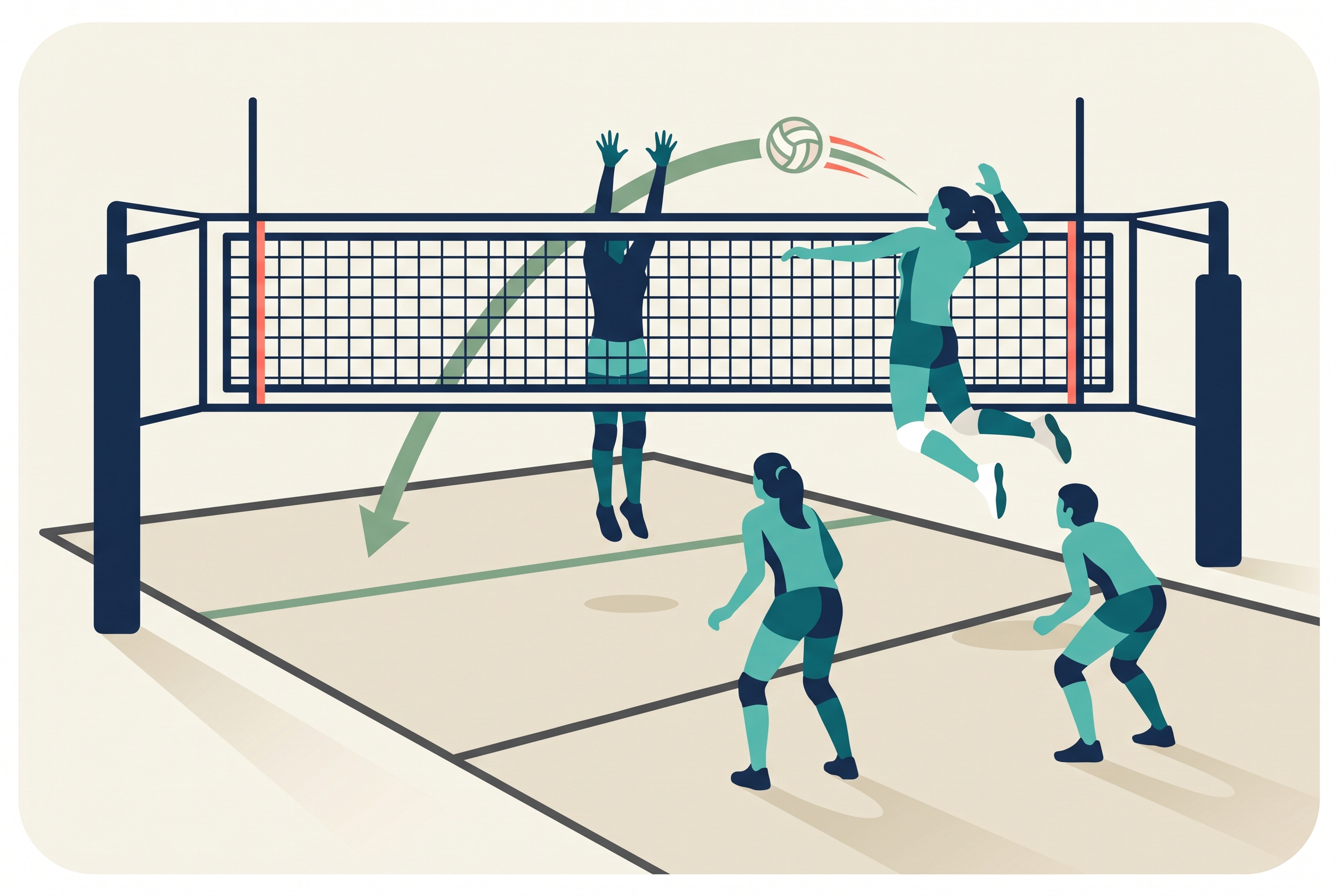
Purpose. Turn two blockers into one wall: the middle travels, the pin sets the line, and the seam between them disappears.
Setup. Pin blocker at the antenna, middle blocker at center net, coach on box at the opposite pin with hitters or targets.
Closing the Double Block
Steps. On the coach's turn, the pin blocker plants and takes the line; the middle crossovers in and closes hip to hip. Freeze at the top of the first three jumps for a spacing check, then run live at speed. Eight closes each side, then swap roles. Chart seams: any ball through the gap between blockers scores against the pair.
Coaching cues. For the pin: "set the line early, be a wall to close to." For the middle: "close to a touch," meaning her lead hip should brush the pin blocker's. The seam call belongs to the pin blocker, out loud.
Common mistakes. Both blockers jumping their own jumps: unsynced timing leaves a moving gap that looks closed from the bench. Freeze-checks expose it immediately.
Age fit. 13U and up; younger teams block solo and should spend the time on Drills 1 to 3.
Drill 5: Block Transition
Purpose. Train the sequence that separates varsity front rows from JV ones: block, land, open, push to the attack line, and be available to attack.
Setup. Blockers at the net, coach on the same side with a cart, a setter at target.
Volleyball · Blocking
Block Transition
Blocker jumps at the net, lands, pushes off to the attack line, then approaches and hits a live set from the setter and rejoins the line.
0:00 / 1:20
Steps. Blocker jumps against a simulated attack (or the box), lands, turns and pushes off the net to the attack line, and immediately approaches for a live set from the setter. Six full cycles per player. This is honest conditioning with a skill inside it, and it doubles as the middle's offensive rep block.
Coaching cues. "Land, look, leave": eyes find the ball during the turn, not after arriving at the attack line. Full approaches, not drifting steps; tired approaches are the ones that need the practice.
Common mistakes. Letting the transition shrink to two lazy steps as fatigue builds; the drill's value lives in the last two reps being full speed.
Age fit. 13U and up.
Drills 6 and 7: Make Blocking Compete
Blocker vs. hitter ladder. One blocker against a rotation of hitters attacking coach-tossed sets; the blocker scores for touches that help (chart them honestly) and holds the net until beaten three times clean. Blockers learn more from ten live reads than fifty patterned ones.
Wash with a scored block. Run your normal 6-on-6 wash game, but a block touch that a teammate converts scores double. For one scrimmage, blocking becomes the most valuable act in the gym, and the behavior follows the scoreboard: middles start traveling early and pins start setting the line without being reminded.
Tracking Blockers, Not Just Blocks
Blocking improvement hides from match stats, so measure it in practice: seam-chart results from Drill 4, helped-touch counts from the ladder, and the timing and hand-position scores in Rizzler's volleyball player evaluation template, whose Blocking category exists precisely because stuff counts undervalue young blockers. The optional block-touch metric (inches) gives your middles a number to chase season over season. Assign the at-home portion (footwork lanes and jump work need a wall, not a net) through Rizzler Reps, and staff the front row from measured reads in the Game Manager's Depth Chart rather than from height alone; the tryout guide shows where a blocking station fits in a full evaluation day.
Frequently Asked Questions
What are the best volleyball blocking drills?
Footwork lanes and mirror blocking to build movement patterns, read-and-press from a box to train eyes and hands, double-block closing for seam control, and block transition for the land-and-attack sequence. Feet first, then reads, then hands is the order that works.
How do you teach blocking to beginners?
Start with footwork patterns and squaring to the net, no ball, then add the press over a lowered net, then reads against a slow, visible attacker. Delay double-block work until solo footwork is stable, and grade effort on travel and timing rather than stuffs, which are rare at youth level.
Why does my team never block anything?
Usually feet, not height: blockers who arrive late reach sideways, and reaching blockers deflect balls out of bounds or not at all. Chart travel timing in practice, and redefine success as touches that channel or slow the attack; stuff blocks are the bonus, not the standard.
When should blockers jump?
After the hitter, almost always: the blocker's hands need to be over the net when the ball arrives, which for most youth attackers means loading as the hitter's arm starts forward. Jumping with the hitter's jump is the most common youth timing error and gives up every off-speed shot.
What blocking work can players do at home?
Footwork lanes along any wall, block-jump repeats with a press onto a high wall target, and shoulder-square landings. Ten minutes of patterns twice a week between practices keeps travel mechanics sharp, and coaches on Rizzler assign exactly this through Rizzler Reps.
Talk to our team
Want to see how to develop players all season long? Let's talk.
Tell us about your team and we'll show you how season-long skill tracking becomes the progress report a parent opens, while players keep building between practices with Rizzler Reps.
Track skills all season, not just on tryout day
Turn evaluations into reports parents actually open
Players build habits between practices with Rizzler Reps
Tell us about your program
4 fields · takes 30 seconds
Lands in the same inbox as the Help button · human response only