Volleyball Defense Drills That Turn Attacks Into Rallies
Defense drills work when they train the whole sequence a real dig requires: read the attacker, arrive in base, adjust to the set, and play the ball with intent to a target, not merely off the floor. The eight drills below build that chain in order, from stance and reads through live chaos, each with its setup, coaching cues, the mistake that ruins it, and age scaling. Digging is the visible outcome; the reads and the pre-contact stop are the skills. Blocking, defense's front-row partner, has its own blocking drills guide, and the serve-receive side of first contact lives with the serve receive drills.
The Standard That Makes Every Defense Drill Count
Hold one line in every drill on this page: a dig only counts if a teammate could play the next ball. Chart digs 3-2-1 like passes, where a 3 is a settable ball near the target, a 2 keeps the rally alive playably, and a 1 is floor-avoidance. Teams that count only "touches" build defenders who get admirable pieces of balls that die anyway. Teams that chart dig quality build defenders who end opposing runs, and the chart doubles as your defensive specialist selection data.
Drill 1: Base-and-Adjust Reads (No Ball)
Purpose. Teach the two-position rhythm of team defense: base position while the setter decides, adjusted position once the set direction shows.
Setup. Six defenders on court in base. Coach across the net simulating a setter, no ball to start.
Base-and-Adjust Reads (No Ball)
Steps. Coach calls out or gestures a set direction (outside, middle, right, tip). Defenders move base-to-adjust and freeze; coach corrects spacing, then resets. After ten silent reps, add a slow toss so movements attach to a real flight. Two minutes per group, several groups per practice.
Coaching cues. "Stopped before contact": every defender is still, low, weight forward, when the (imaginary) attacker swings. "See the hitter, not the ball" starts here.
Common mistakes. Defenders drifting toward where the last ball went, and coaches skipping this drill as too basic. Ten reps a week keeps a team's shape honest for a season.
Age fit. Every age. This is the free drill: zero equipment, ninety seconds, and it fixes half of what looks like bad digging.
Drill 2: Coach-on-Box Digging
Purpose. High-rep digging against a downward attack angle, the staple that builds platform control under fire.
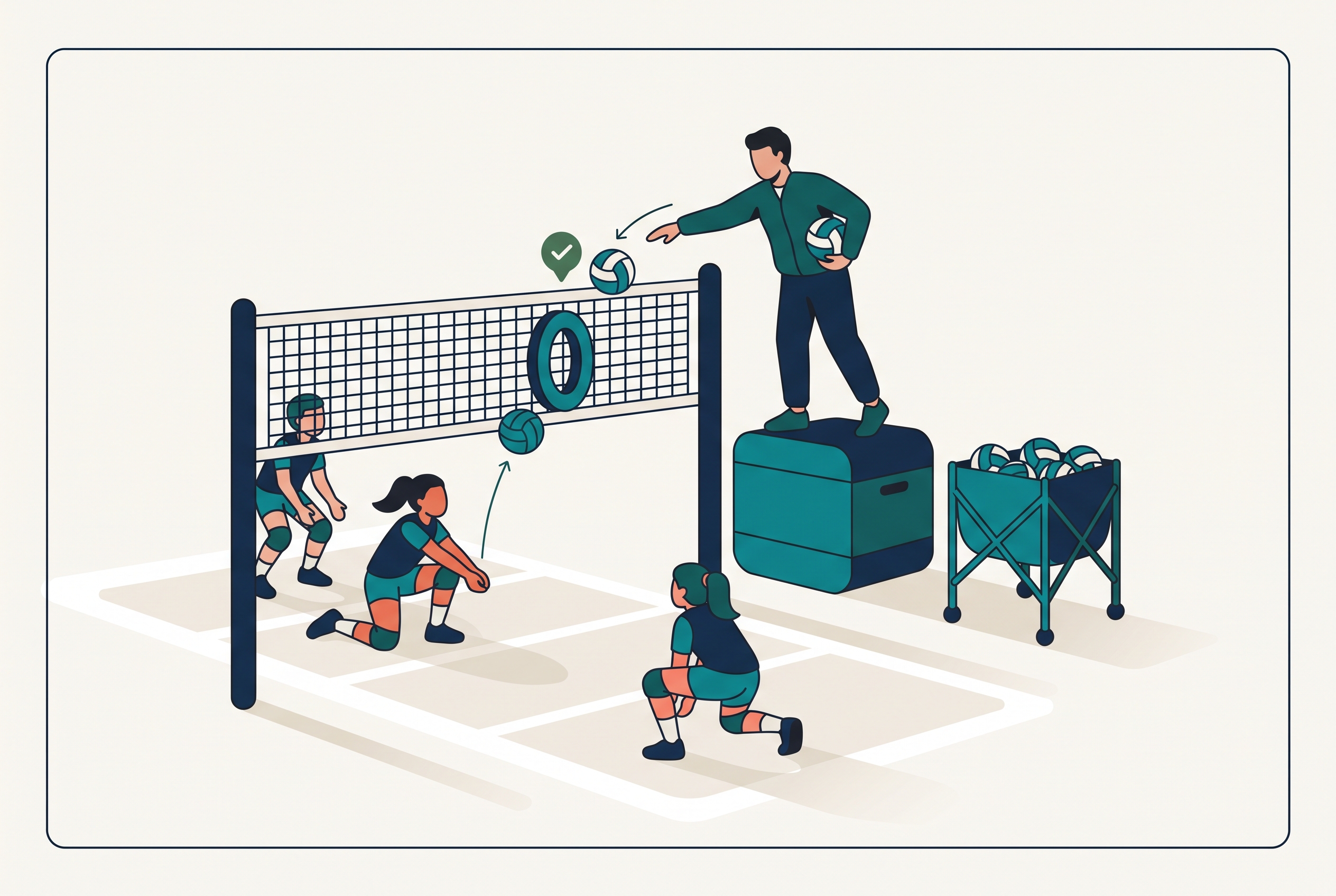
Setup. Coach standing on a sturdy box at the net, ball cart beside, three defenders in left-back, middle-back, right-back. Target (player or hoop) at the setter spot.
Volleyball · Defense
Coach-on-Box Digging
Coach on a box swings at left, middle and right back in turn; each dig goes to the target, balls return to the cart, then the trio rotates.
0:00 / 2:00
Steps. Coach attacks at the defenders in an unpredictable pattern, mixing hard swings, off-speed roll shots, and tips. Each defender plays her ball to the target; a scorer charts 3-2-1. Fifteen balls per trio, rotate. Post the averages.
Coaching cues. "Platform to target, body behind ball." On hard-driven balls, "quiet arms": the swing supplies the power, the digger supplies the angle.
Common mistakes. Coaches hitting every ball hard (real attackers mix speeds, so must the box) and defenders standing tall between reps. The reset to low base after every contact is the conditioning hiding inside the drill.
Progressions. Add a blocker in front of the box so diggers read around a screen; call the target dig zone before contact.
Age fit. 12U with the coach on the floor rather than a box; box angles from 13U up.
Drill 3: Dig and Replace
Purpose. Keep dig reps flowing while training the recover-and-refill habit that team defense depends on.
Setup. Coach on box, line of defenders behind the middle-back spot, target at setter position.
Volleyball · Defense
Dig and Replace
Coach on a box swings every two seconds; the digger plays to the target, sprints off through the sideline, and the next in line fills low.
0:00 / 0:40
Steps. First defender digs, then sprints off to the sideline; the next defender fills the spot before the coach's next swing, which comes within two seconds. A shanked ball must be chased by its digger before she exits, keeping every player accountable for her own miss. Two minutes continuous, then rest and repeat.
Coaching cues. "Fill low": the replacing defender arrives already in stance, not standing then sinking. "Chase your miss" builds the pursuit reflex this page returns to in Drill 5.
Common mistakes. Letting the line stack deep so players stand cold; cap groups at four so the rest interval stays under twenty seconds.
Age fit. 12U and up; younger groups use tossed balls.
Drill 4: Sprawl and Emergency Technique
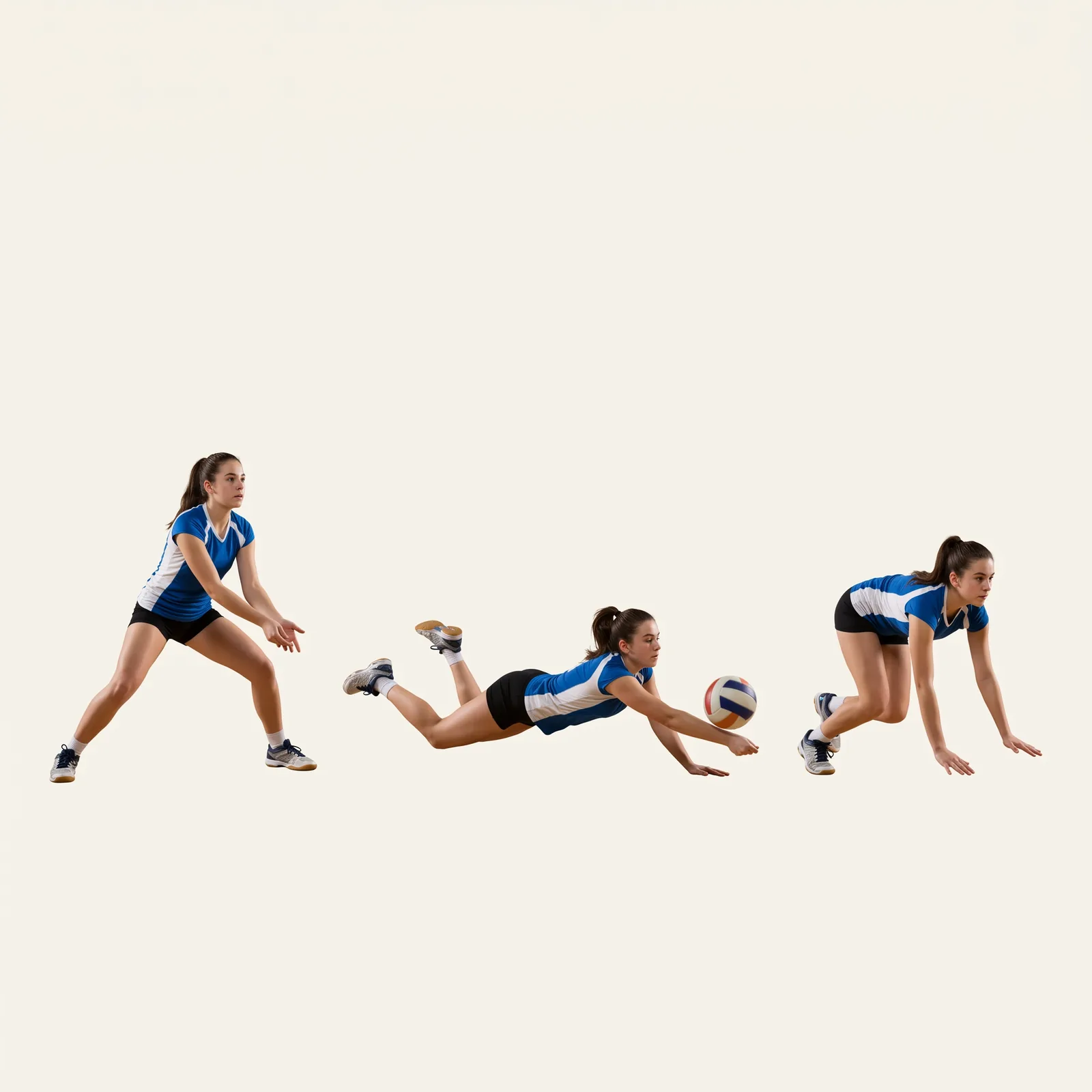
Purpose. Teach going to the floor safely and productively: the sprawl for balls dying in front, the extension for balls beyond reach.
Setup. Pairs, one ball each, on any open floor. No net needed.
Volleyball · Defense
Sprawl and Emergency Technique
Solo emergency defense: sprawl forward, one-arm dig, get back up.
Steps. Partner drops or tosses a short ball two meters in front of the defender, who sprawls: platform slides under the ball, hips down, chest through. Five each side, then extension reps on balls tossed wide. Finish with a mixed set where the tosser chooses. Keep total floor contacts modest; quality beats bruised volume.
Coaching cues. "Ball first, floor second": the play happens before the landing. Teach the landing shape (chest and thighs, hands free) explicitly, once, and inspect it every rep.
Common mistakes. Diving as a performance after the ball is unplayable; kill this early by only counting balls that a teammate could reach. Also skipping the technique block entirely and letting kids learn floor work by accident, which is how floor burns and jammed fingers happen.
Age fit. Teach the shapes from 11-12; full-speed emergency work belongs to 13U and up.
Player development
Track development all season, not just on tryout day
Score skills through the season, watch the trend lines move, and send parents a progress report they actually open.
Drill 5: Pursuit
Purpose. Build the no-quit standard: any ball touched is a ball chased, including over the bench.
Setup. Six players on court playing defense; coach with a cart anywhere behind them.
Volleyball · Defense
Pursuit
Coach tosses to the deep corner; left back chases it, middle back sprints under the dig, front left sends it over, then rotate one spot.
0:00 / 1:20
Steps. Coach tosses or hits a ball to an absurd spot: deep corner, off the block skyward, into open floor. Nearest player pursues; the team keeps it alive for three contacts and sends it over, no matter how ugly. Score a team point for every ball returned over the net; play to seven. Cap the block at six minutes because quality collapses with fatigue.
Coaching cues. "Go until it bounces." The second player's job is to sprint to where the pursuit dig will come down, which is the real teaching point: pursuit is a two-player skill.
Common mistakes. Running it so long that chasing becomes jogging. Short, loud, and competitive preserves what the drill exists to build.
Age fit. Every age, with toss difficulty scaled. This is the culture drill; teams that pursue in practice pursue at 24-23.
Drill 6: Tip and Roll Coverage
Purpose. Beat the off-speed game that wins youth matches: tips behind the block and roll shots to the middle of the court.
Setup. Coach on box with a blocker in front, three defenders behind, target at setter spot.
Tip and Roll Coverage
Steps. Coach shows a full swing every rep but randomly mixes hard attacks with tips just over the blocker and rolls to the donut (the dead space at mid-court). Defenders must hold their adjusted spots until contact, then release. Chart 3-2-1; tips that die score against the group as a whole.
Coaching cues. "Feet still at contact, then sprint": the defender who creeps early gets frozen by the hard swing; the one who waits and releases gets everything. Read the hand, not the approach; a slowing arm telegraphs the tip.
Common mistakes. Assigning tip coverage to nobody, so every tip becomes a group apology. Name the tip-coverage responsibility per set direction before the drill and the argument disappears.
Age fit. 13U and up, once opponents actually tip; younger levels fold soft-ball reads into Drill 2.
Drills 7 and 8: Make Defense Compete
Team defense wash. Six defenders against a coach-run offense (coach on box plus two live hitters). The defending side must earn three clean digs-to-target ("washes") before the offense earns five kills. Losers run the next round as the offense. This is the drill where individual skills become a system, and where your rotation shape either survives contact with live attacking or gets rebuilt.
Digging king of the court. Two trios alternate defending against the box; the trio with the better 3-2-1 chart after ten balls holds the court. Same format as the passing version in the passing drills guide, so teams can run the two back to back and compare charts.
Between Practices, and Into the Lineup
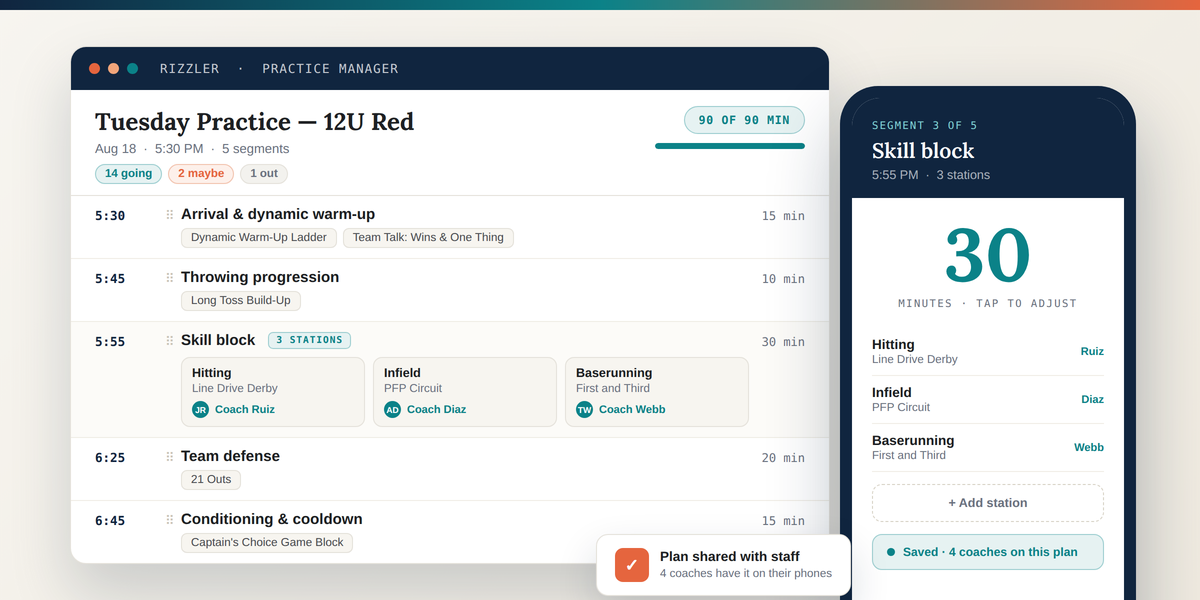
Defense travels home better than most skills: sprawl shape reps, wall digging (partner or rebound wall, low platform, thirty-ball streaks), and reaction-ball work all fit a garage. Coaches on Rizzler assign these through Rizzler Reps so home reps get logged, and the player evaluation template's Floor Defense category (digging, hustle and pursuit) turns the drill charts into a 1 to 5 score you can track across a season. When the numbers surface a defender your depth chart missed, the defensive specialist role is where she starts.
Frequently Asked Questions
What are the best volleyball defense drills?
Base-and-adjust reads for positioning, coach-on-box digging for platform control under fire, dig-and-replace for volume, sprawl work for floor technique, pursuit for effort culture, and tip coverage for the off-speed game. Together they train reads, technique, and intent to target, which is what "good defense" actually is.
How do you teach volleyball defense to beginners?
Start with base positions and the stopped-before-contact habit, then tossed-ball digging from the floor before any box work, then the sprawl shape taught deliberately. Beginners should chart dig quality early: intent to a target, not floor-avoidance, is the habit worth building first.
What is the 3-2-1 system for digs?
The same chart used for passing: 3 is a dig a setter could run offense from, 2 keeps the rally alive playably, 1 merely prevents the point. Charting digs per player across two weeks identifies your defensive specialists more reliably than scrimmage impressions.
How often should a team practice defense?
Some defense belongs in every practice: five minutes of base-and-adjust plus one digging block keeps the shape honest. Dedicated defensive practices earn their time in the weeks before tournaments, when the wash and king-of-the-court formats sharpen a team fast.
What defense drills can players do at home?
Sprawl shape reps, low-platform wall digging streaks, and lateral quickness footwork all need a ball, a wall, and ten minutes. Coaches on Rizzler assign exactly these through Rizzler Reps, so the offseason floor work gets logged instead of promised.
Talk to our team
Want to see how to develop players all season long? Let's talk.
Tell us about your team and we'll show you how season-long skill tracking becomes the progress report a parent opens, while players keep building between practices with Rizzler Reps.
Track skills all season, not just on tryout day
Turn evaluations into reports parents actually open
Players build habits between practices with Rizzler Reps
Tell us about your program
4 fields · takes 30 seconds
Lands in the same inbox as the Help button · human response only