
Volleyball
Volleyball Rotation Rules: Every Rule, Explained From Zero
The rotation rules in volleyball come down to five sentences. You rotate one position clockwise only when your team wins back the serve. Your service order is fixed for the whole set. At the moment of serve, everyone must stand in a legal alignment. Front-row players may attack at the net; back-row players may not. The libero swaps in and out of the back row without counting as a substitution. Everything a referee can whistle about rotation is a violation of one of those five, and this guide walks each of them, in the order a beginner should learn them.
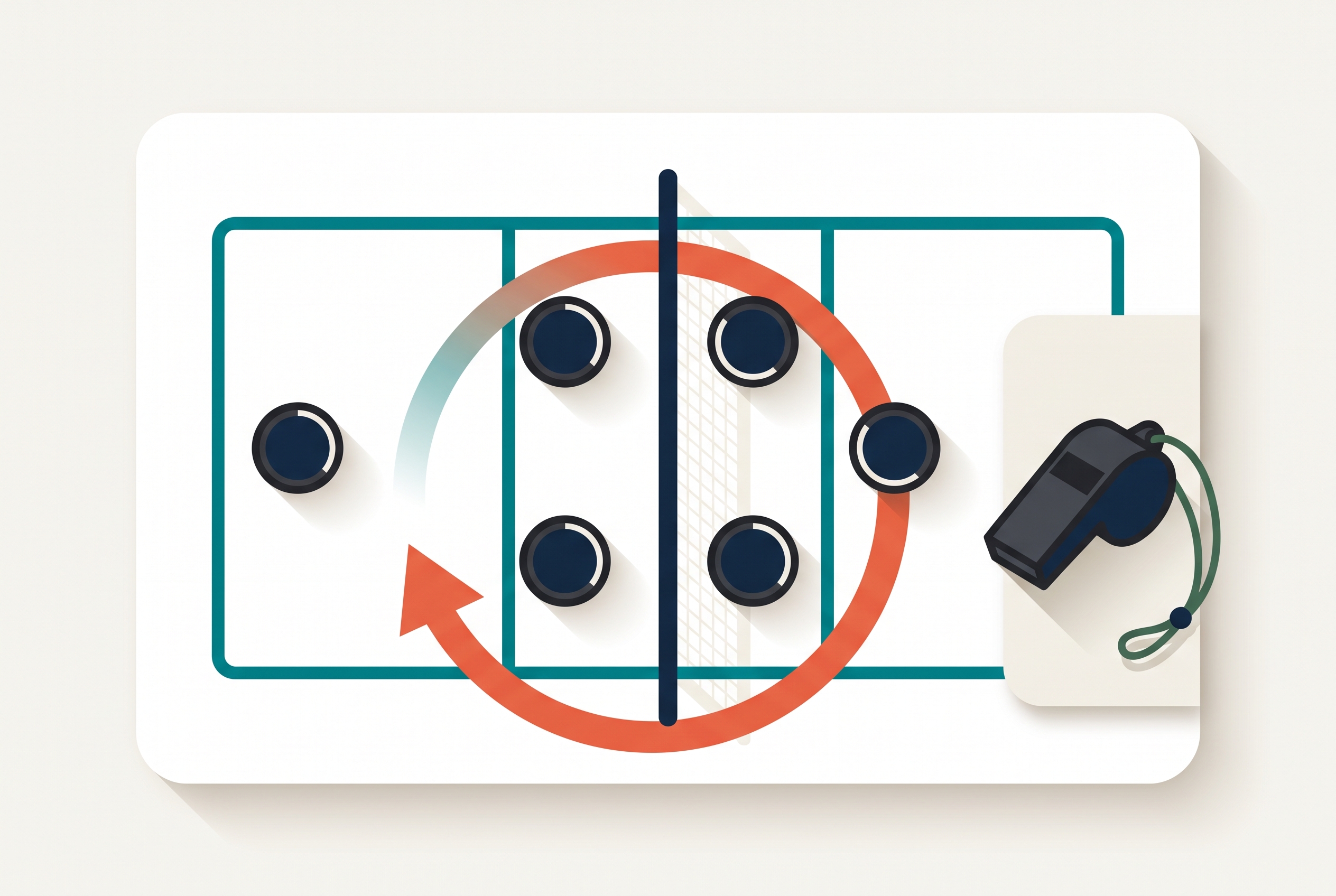
4-2 rotations — Two setters on opposite rotations; the front-row setter sets.
Rotation 1
Rotation 2
Rotation 3
Rotation 4
Rotation 5
Rotation 6
Build this with your roster — free →
No login required
Rule 1: You Rotate Only on a Side-Out Win
Your team rotates at exactly one moment: when the opponent was serving and your team wins the rally. All six players shift one position clockwise, and the player who moves into the back-right corner (zone 1) becomes your new server. That is the entire trigger.
Two situations confuse new players, and both are "nobody moves" situations. If your team is serving and keeps winning points, the same server keeps serving and nobody rotates. If you are receiving and lose the rally, the opponent keeps serving and nobody rotates on either side. Watch any youth match and you will see a player drift toward the next zone after a lost rally; the rules say stay put.
The zones are numbered counterclockwise starting from the server's corner: zone 1 is right back, zone 2 right front, zone 3 middle front, zone 4 left front, zone 5 left back, zone 6 middle back. "Rotating clockwise" means the zone 2 player drops back into zone 1 to serve, everyone else slides one spot the same direction, and the old server walks across the back line from zone 1 into zone 6.
Rule 2: Service Order Is Locked for the Set
Before each set, your coach hands the referee a lineup sheet listing six jersey numbers in serving order, slots I through VI. That order is the law of the set. Slot I serves first for your team, slot II second, and the wheel repeats until the set ends. Substitutes inherit the slot of the player they replace, so the order survives every substitution.
Serving out of order is the wrong-server fault, and it costs the rally plus any points scored while the wrong player served, once the officials sort out when the error began. Scorekeepers catch it eventually; benches that track the order on a printed rotation sheet catch it before it happens. If you take one habit from this page, track your next three servers from the bench out loud.
Rule 3: Positions Are Checked Only at the Moment of Serve
At the instant the server contacts the ball, all six players (minus the server) must be in a lawful alignment: each front-row player needs part of a foot closer to the net than the player directly behind them, and each side player needs part of a foot closer to their sideline than the middle player of their own row. One second after contact, everyone may run anywhere, which is why you see college setters sprint to the net from the back row the moment the serve is struck.
There are exactly seven of these neighbor relationships, they are judged by feet, and there is no diagonal rule at all. The referee's checks, the classic traps, and the fixes are diagrammed in our overlap rule guide, which is the page to read once your team starts stacking and hiding players. The penalty for getting it wrong, called illegal alignment in high school and a positional fault in club, is the rally and a point.
Rule 4: The Front Row Attacks, the Back Row Doesn't
Rotation decides attack rights. The three players currently in zones 2, 3, and 4 are front-row players: they may block, and they may attack the ball at any height from anywhere. The three players in zones 1, 5, and 6 are back-row players: they may not block, and they may not attack a ball that is entirely above net height while in front of the attack line (the line three meters back from the center line).
A back-row player who jumps from behind the attack line may hit as hard as she likes; that is the legal back-row attack you see from professional and college players. A back-row player who attacks above net height with a foot on or in front of the line commits an illegal attack, which ends the rally. This rule is the reason rotation "systems" exist at all: coaches arrange the service order so their best attackers spend the most useful rotations in the front row, which is exactly the problem the rotations hub and its system guides solve.
Rule 5: The Libero Moves Outside the Substitution Count
The libero, the player in the off-color jersey, replaces back-row players (usually the middle blocker) without using a substitution, which is also what makes her the quiet engine of fair playing time: she upgrades the back row without spending the sub count. She never rotates into the front row; when the player she replaced is due to rotate to the net, that player returns and the libero waits for the next back-row target. Her replacements happen between rallies, through the area between the attack line and the endline.
Libero details vary by rule set more than any other rotation rule: high school (NFHS) allows the libero to serve in one rotation slot, club (USAV) and college (NCAA) handle serving and the number of liberos differently. The full mechanics, including how the libero inherits overlap obligations, live in our libero rotation guide. Beginners need just the summary: the libero is a back-row specialist who slides in and out freely, and her presence never changes the rotation order of the other five.
Learning the Wheel: A Beginner's Walkthrough
Rotation clicks fastest when you learn it as service order first and court zones second. Stand your six players in a circle in lineup order and have them walk one position clockwise every time you call "side out." The order never changes; that is the insight. Zones are just where the order happens to be standing at any moment.
Then put the circle on a court and add the two questions every beginner asks. "Where do I stand?" is answered by the zone the wheel puts you in, adjusted by whatever serve-receive shape your coach runs (the five-person W for most new teams; see the serve-receive guide). "When can I hit?" is answered by rule 4: front row at the net, back row from behind the line.
The last beginner milestone is understanding that where you stand at serve and where you play the rally are different things. Players switch to their favorite positions the moment the serve is contacted, then return to the rotation order before the next serve. Which position each player switches to is a role question, not a rotation question, and it is covered player by player in our volleyball positions guide.
The Rotation Faults, Summarized
| Fault | What happened | Cost |
|---|---|---|
| Wrong server | Someone served out of the fixed service order | Rally, plus points scored during the error |
| Illegal alignment / positional fault | Players out of lawful alignment at serve contact | Rally and a point |
| Illegal back-row attack | Back-row player attacked above net height in front of the attack line | Rally and a point |
| Illegal block | Back-row player (or libero) participated in a completed block | Rally and a point |
| Illegal libero replacement | Libero entered for a front-row player, or replaced illegally mid-rally | Delay sanction, then rally on repeat |
Every fault on the list is preventable with paperwork and a walkthrough: a legal lineup, a printed rotation chart, and ten minutes of walking the wheel at practice. The free rotation generator checks alignment for all six rotations while you build the lineup, so the plan you print is legal before anyone steps on the court.
Frequently Asked Questions
What are the basic rotation rules in volleyball?
Rotate one position clockwise when your team wins the serve back from the opponent, keep the fixed service order all set, stand in legal alignment at the moment of each serve, and respect attack rights: front-row players attack at the net, back-row players only from behind the attack line.
When do you rotate in volleyball?
Only when the opponent was serving and your team wins the rally. The player rotating from zone 2 into zone 1 becomes the new server. Nobody rotates while your own server keeps scoring, and nobody rotates after your team loses a rally.
Can you switch positions after the serve in volleyball?
Yes. Alignment is judged only at the instant of serve contact. After contact, players may move anywhere: setters release to the target, hitters swing to their sides, and defenders drop into base. They must return to rotation order before the next serve.
What happens if you rotate wrong in volleyball?
Serving out of order is a wrong-server fault: the rally is lost and points scored during the error are removed. Standing out of alignment at serve contact is an illegal alignment (positional) fault, costing the rally and a point.
Does the libero count in the rotation?
The libero holds the rotation spot of the player she replaced, but only in the back row, and her replacements do not count as substitutions. When that spot is due to rotate to the front row, the original player returns. The rotation order of the other five never changes.
What is the easiest rotation for beginners?
The 4-2 system with a five-person W serve receive: the setter is always front row, nobody has to stack or hide, and alignment risk nearly disappears. Our 4-2 guide walks it rotation by rotation.
Are high school volleyball rotation rules different from club rules?
The rotation itself is identical: clockwise on a side-out, service order locked for the set, positions checked at the moment of serve. The differences sit around it. NFHS high school allows 18 substitutions per set and USAV club allows 12; both let the libero serve in one rotation slot; and NFHS moves to two designated liberos per set (one on the court at a time) beginning in 2026-27.
Talk to our team
Want to spend more time coaching and less time with paperwork? Let's talk.
Tell us about your team and we'll show you how to plan games, set lineups, run the schedule, and develop players in one place, so you spend the season coaching instead of chasing admin.
Less admin, more coaching
Plan games, set lineups, and track the season in one place
Keep every family in the loop automatically
Tell us about your program
4 fields · takes 30 seconds
Lands in the same inbox as the Help button · human response only
Read Next
Printable Softball Lineup Card with DP/FLEX (Free PDF + Excel)
ResourcesWhat Baseball Stats Should You Track at 12U?
StatsBaseball Practice Plan Template: Free Printable PDF and Excel
LearnHow to Organize a Youth Sports Team
LearnLeague-Wide Rule Compliance for Little League
For LeaguesHow to Build and Manage a Volleyball Roster
Volleyball