
Volleyball
How to Build and Manage a Volleyball Roster
Volleyball roster management means one place for everything you know about your team: names, jersey numbers, positions, parent contacts, availability, and notes. It matters more in volleyball than in most sports, because everything downstream reads from the roster. Your rotation plan pulls positions from it, your lineup sheet pulls jersey numbers from it, and your playing-time tracking attaches to profiles you set up once. Get the roster right in August and every match night from September on gets easier.

This guide covers how to build and run the roster itself. For what Rizzler's roster tools do (player records, contacts and invites, notes, goals, drills, assessments, and RSVP), see player roster management.
What a Volleyball Roster Needs to Capture
A volleyball roster is more than a name list; it is the data your rotation decisions run on. For each player, capture the jersey number, the primary and secondary position (setter, outside hitter, middle blocker, opposite, libero, defensive specialist), the grad year or age group for club play, and the parent contacts that every schedule change and skill report will route to.
Positions deserve the most care, because volleyball positions are jobs, not spots on a field. A roster that records "Maya: setter, secondary DS" is a roster that can answer real questions: who runs the 6-2 if your starting setter is out, who can absorb serve receive when you shuffle sets, who backs up the libero. If you are still settling what each job means, our volleyball positions guide breaks down all six roles and what to look for in each.
Roster Size: How Many Players You Actually Want
Most school varsity and JV volleyball rosters carry 10 to 15 players; club teams usually run tighter at 9 to 12 so everyone gets meaningful sets. The practical constraint is the rotation: with paired swaps and a libero, a roster of 12 keeps everyone in real roles, while a roster of 16 guarantees someone watches from the bench in street shoes. If you are choosing between keeping two extra players or cutting to a workable number, decide with your playing-time standard in mind, not the tryout-day guilt.
Jersey numbers come with a volleyball-specific wrinkle: the libero wears a contrasting jersey, and the libero designation is set per match on the lineup sheet. Track both the number and the libero-eligible players on the roster so the pre-match paperwork is a lookup, not a scramble.
From Tryout List to Final Roster
The roster starts at tryouts. When you run volleyball tryouts in Rizzler, every athlete who checks in already has a profile with their scores attached, so building the final roster is selection, not data entry: pick the team and the players carry their evaluation history with them into the season. That history becomes the baseline for mid-season skill assessments and the progress reports parents open in November.
If you are not starting from a tryout, import is the fallback: add players from a spreadsheet or enter them manually with positions and contacts, and you are match-ready in an evening.
The Roster Feeds Everything Else
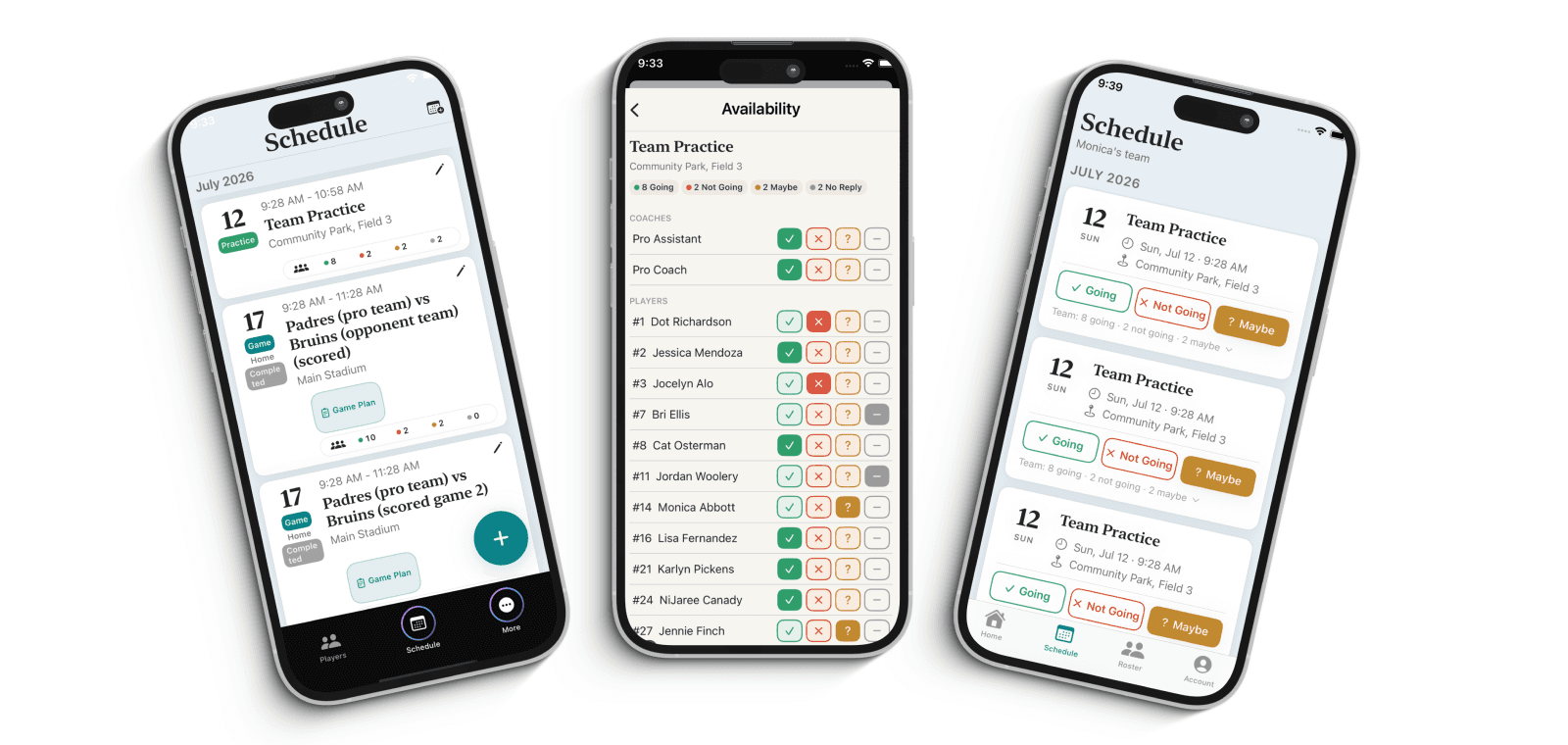
This is the payoff of doing roster management in one system instead of a spreadsheet and a group chat. In Rizzler, the roster is the source that every other volleyball tool reads:
Rotations and lineups. The rotation planner builds your 5-1 or 6-2 from rostered positions, with overlap checking against the actual players you assign. The printable lineup sheet pulls names and numbers straight from the roster.
Availability and RSVP. Parents and players mark availability for every match and practice through the parent and player apps, so you know Tuesday will be nine players before you plan Tuesday. Included free on every plan.
Playing time. Sets and rotations tracked in the Game Manager accumulate on each player's profile, so the season-long fairness picture is always current.
Development. Evaluations, goals from surveys, and drills assigned in Rizzler Reps (volleyball library live) all attach to the same profile, from the first tryout score to the end-of-season report.
Keep It Current, Not Perfect
A roster is a living document. Players get injured, a libero moves to outside, a family changes phone numbers mid-season. Two habits keep it useful: make the roster the only place you record changes (never announce a position change in a text thread and update the roster later), and review it at the season's midpoint alongside your mid-season evaluations, when role changes are decisions rather than drift.
Frequently Asked Questions
How many players should be on a volleyball roster?
Most school rosters carry 10 to 15 players and club rosters 9 to 12. The rotation is the real constraint: rosters of about 12 keep every player in a meaningful role, while larger rosters need a deliberate playing-time plan to avoid bench-only seasons.
What positions should a volleyball roster track?
Setter, outside hitter, middle blocker, opposite, libero, and defensive specialist, plus a secondary position for each player. Secondary positions are what let you cover an absent setter or shuffle serve receive without rebuilding the lineup from scratch.
Is there a volleyball roster template?
A printable roster works for the clipboard, but the roster earns its keep when it feeds your rotations, lineup sheet, and playing-time tracking automatically. Rizzler's roster does that on the Free plan for one team; the printable lineup sheet covers the paper half.
Does Rizzler track the libero designation?
Rizzler tracks each player's position, including libero and libero-eligible players, and the lineup tools account for the libero when planning rotations and playing time.
Set up your volleyball roster once, and your rotations, lineup sheets, and playing-time tracking inherit it all season.
Talk to our team
Want to spend more time coaching and less time with paperwork? Let's talk.
Tell us about your team and we'll show you how to plan games, set lineups, run the schedule, and develop players in one place, so you spend the season coaching instead of chasing admin.
Less admin, more coaching
Plan games, set lineups, and track the season in one place
Keep every family in the loop automatically
Tell us about your program
4 fields · takes 30 seconds
Lands in the same inbox as the Help button · human response only
Read Next
How to Run a Rugby Tryout: A Coach's Step-by-Step Guide
LearnHow to Run a Softball Tryout: A Coach's Step-by-Step Guide
LearnRizzler Plans & Pricing: Free vs Coach vs Club
ComparisonHow to Use Stats Without Overcoaching Youth Players
StatsWhat Is a DS in Volleyball? The Defensive Specialist, Explained
Volleyball14U Softball Practice Plan: 14U, 16U, 18U, and High School Practices
Learn