
Volleyball
The Setter: Volleyball's Quarterback, Explained
The setter is the player who takes the second contact of nearly every possession and decides which hitter attacks, from where, and at what tempo. She is volleyball's quarterback: the offense literally runs through her hands, the rotation systems are named for how many of her the team carries, and no other position touches the ball as often or makes as many decisions per set. Here is what the job actually involves, what separates a setter from a player who sets, and how coaches develop and evaluate one.
What the Setter Does, Rally by Rally
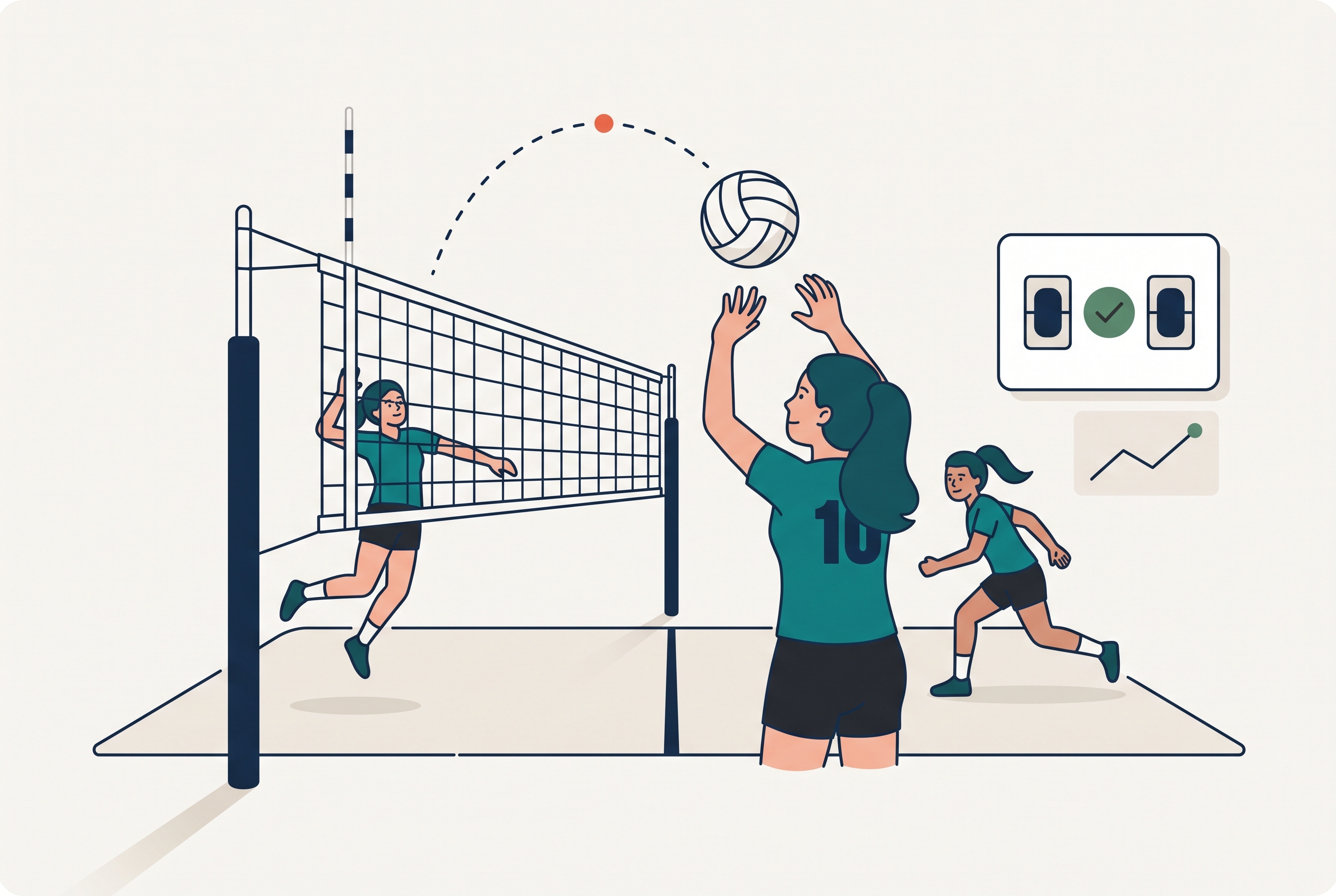
Every in-system rally follows the same script: a teammate passes the first ball toward the net, the setter arrives before it does, and she delivers the second contact to one of three or four attackers. That last sentence hides the job's real difficulty. "Arrives before it does" means the setter sprints to the target spot from wherever the rotation put her, on every single rally, including the ones where the pass is ten feet off the net and sinking. A setter in a typical two-set match makes that trip well over a hundred times.
The decision layer sits on top of the movement layer. In the second it takes the pass to reach her, the setter reads which of her hitters is available, where the opposing blockers are leaning, what the score situation can tolerate, and what she promised the middle in the huddle. Good setters distribute; great ones manipulate, feeding the hot hand until the block commits, then setting the middle behind it. That decision quality is trainable, and it is scored separately from hands in a serious player evaluation: Rizzler's volleyball template splits Setting into clean hands, location, and decision making for exactly this reason.
The Skills, in Priority Order
Hands come first because everything else depends on them being silent. A legal, consistent, spin-free ball delivered from the forehead is the entry fee for the position; referees at every level call doubles and lifts on setters who learned to push the ball from their chest. Second is footwork: the right-foot-to-target pattern, squaring the shoulders to the left antenna, and the discipline to beat the ball rather than reach for it. Third is location, the ability to put a hittable ball on the antenna from a perfect pass and from a terrible one. Fourth is tempo and deception, the layer that turns a functional setter into an offensive weapon.
Train them in that order. The setting drills library is organized around this progression, from wall triangles and footwork squares through target setting and live decision drills, and it is the standing assignment for any player who wants the job.
One Setter or Two: How Systems Change the Role
How many setters a team carries is the single biggest strategic decision in volleyball, and it defines the rotation system. In a 5-1 system one setter runs all six rotations: she attacks or blocks in her three front-row rotations and the offense gets three-hitter rotations only half the time, but the hitters hear one voice and one rhythm all match. In a 6-2, two setters split the job from the back row, buying three front-row attackers in every rotation at the cost of rhythm and setter reps. The 4-2 puts a front-row setter in the simplest possible offense and remains the right teaching system for young teams.
The practical consequence for players: a setter in a 6-2 also needs a hitting arm and a block, because she plays front row as an attacker. If you want to see how each system moves the setter through the six rotations, the free rotation generator animates all three side by side, overlap rules included.

What Coaches Should Look For
The setter decision at tryouts is too important for a highlight-reel impression, and the traits that matter are visible in stations if you look for the right ones. Hands you can hear are a fault waiting to happen; hands you cannot hear project calm. Feet that move early tell you more than a pretty ball delivered flat-footed. And watch what a candidate does after a bad pass: the player who chases it down and delivers something attackable is showing you match temperament that no perfect-toss drill reveals.
Score it rather than gut-feel it. Run setter candidates through a dedicated station at tryouts, grade hands, location, and decisions on a 1 to 5 scale, and record it in the evaluation template rather than on a legal pad. Then staff the position two deep on the Depth Chart in Rizzler's volleyball Game Manager, because the day your setter rolls an ankle in warm-ups, "who sets now?" is a question you want answered before the match, not during it. The Game Manager's Rotation Plan tab will re-generate your rotations around the backup in about a minute.
Developing a Young Setter
A setter's development curve is longer than a hitter's, which is why the position needs deliberate investment early. Three habits pay off disproportionately. Daily hands: ten minutes of wall setting or partner setting every day beats one long weekly session, and it is the classic at-home assignment coaches push through Rizzler Reps so the reps get logged instead of promised. Film the feet, not the ball: most youth setting errors start two steps before contact, and a phone clip from behind the setter shows what a courtside view hides. And give her the offense in pieces: one connection at a time (outside first, then middle, then the right side), each mastered before the next is added, so decision load grows with skill rather than ahead of it.
Expect the investment to compound slowly and then suddenly. Most setters are ordinary for a season, competent for another, and then, around the third year, start winning matches with choices nobody else on the court noticed.
Frequently Asked Questions
What does a setter do in volleyball?
The setter takes the team's second contact on nearly every rally and delivers it to an attacker, choosing who attacks and at what tempo. She runs the offense the way a quarterback runs plays, and she makes more decisions per set than any other player on the court.
What makes a good setter in volleyball?
In priority order: silent, legal hands; footwork that beats the ball to the target; location on the antenna from good and bad passes; and decision-making that feeds the right hitter against the right block. Height helps but is optional; hands and judgment are not.
Is setter a hard position in volleyball?
By consensus the hardest: the setter must reach the target from anywhere on the court on every rally, touch the ball under pressure more than anyone else, and be accountable for every hitter's success. It is also the position where a smart, steady player adds the most value.
How tall should a setter be?
There is no requirement, and shorter athletes with elite hands run offenses at every level through college. Height helps a front-row setter block and attack in a 5-1, which is why taller setters have an edge at the top of the sport, but youth coaches should choose hands and judgment over inches every time.
Should a setter be your best athlete?
Your smartest competitor with the best hands, not necessarily your best jumper. Athleticism shows up in range and defense, but a merely average athlete who delivers a consistent, well-chosen ball makes four hitters better, which is a bigger multiplier than any single athletic gift.
How do you evaluate a setter at tryouts?
Isolate the position in its own station: repeated reps from real passes, graded 1 to 5 on hands, location, and decision-making as separate skills. Rizzler's volleyball evaluation template scores exactly those sub-skills, so the setter decision comes from recorded numbers rather than a strong final scrimmage.
How many setters are on a volleyball team?
One on the court in a 5-1, the most common system above 14U; two in a 6-2 or 4-2, where the setters split the six rotations between them. Rosters usually carry two or three setters in total so a backup is always dressed.
Where does the setter stand in volleyball?
When the setter is front row, her base spot is right front (zone 2), next to the net. When she is back row, she holds her rotation-order spot until the serve is struck, then releases to the same target area at the net, right of center, to take the second ball. The 5-1 serve receive guide diagrams where she stands in each rotation.
Talk to our team
Want to spend more time coaching and less time with paperwork? Let's talk.
Tell us about your team and we'll show you how to plan games, set lineups, run the schedule, and develop players in one place, so you spend the season coaching instead of chasing admin.
Less admin, more coaching
Plan games, set lineups, and track the season in one place
Keep every family in the loop automatically
Tell us about your program
4 fields · takes 30 seconds
Lands in the same inbox as the Help button · human response only