
Volleyball
Volleyball Tryout Drills That Produce Numbers, Not Impressions
Tryout drills have a different job than practice drills: they must produce a comparable score for every player in limited time, under enough pressure to reveal temperament, without burying newer athletes so deep that you cannot tell talent from experience. That means stations, standard reps, and a written scale, not a long scrimmage and a gut feeling. Below is a complete station plan (the drills, the setups, and the 1 to 5 anchors), plus the competitive finisher that shows you what the numbers cannot. The logistics around it (waves, check-in, timelines, and communicating cuts) live in the full how to run a volleyball tryout guide.
The Station Map: Four Courts of Data
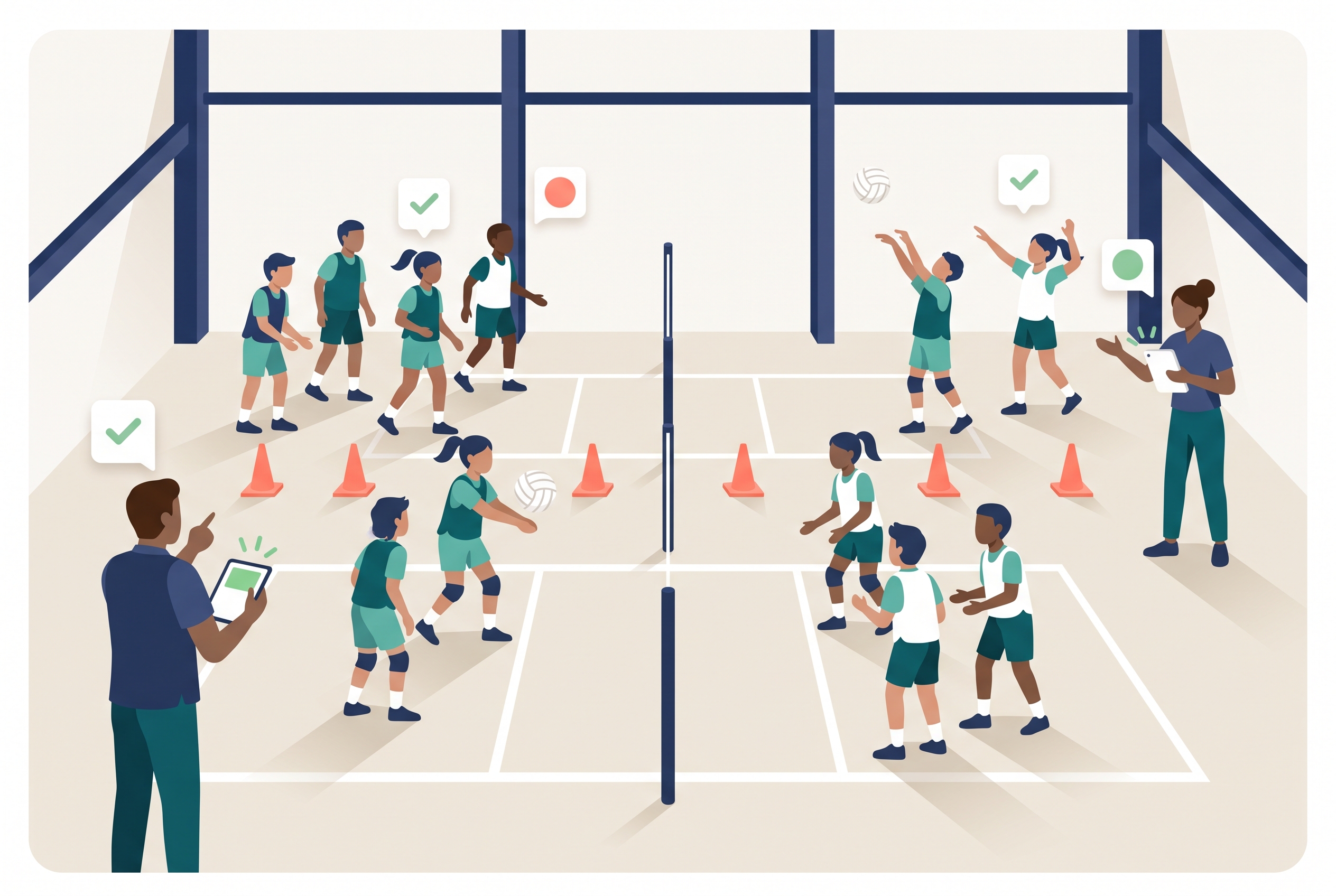
Split the gym into four stations and rotate groups of eight to ten players every twelve minutes; forty players clear all four stations in under an hour, and every player leaves with scores in serving, passing, setting or attacking, and movement.
Volleyball · Tryouts
Tryout Station Map
One court split into serving, serve-receive, setting/attacking and movement/defense stations; four numbered groups rotate every 12 min.
0:00 / 48:00
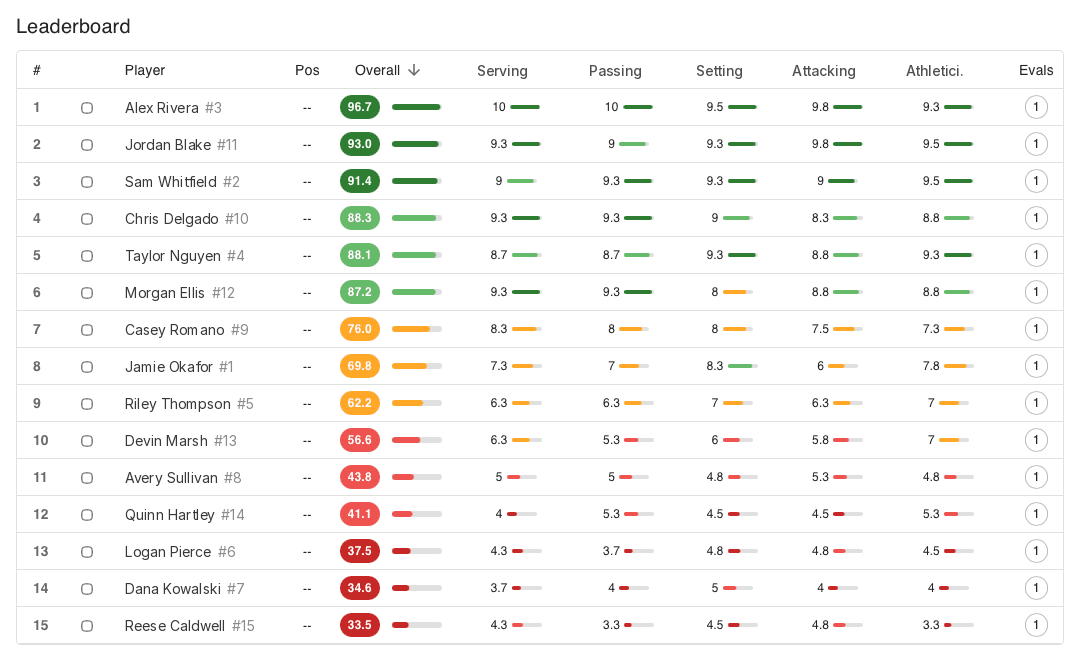
Staff each station with one evaluator who only scores (never coaches and scores at once), give each a copy of the scale below, and identify players by numbered pinnies. Scores go straight into the evaluation app rather than onto paper; Rizzler's team tryouts flow scores each station on a phone or tablet and totals as you go, so rosters can be drafted the same evening.
Station 1: Serving Gauntlet
The drill. Ten serves per player: two to each called half (left, right), then six at will. Chart in-or-out and zone accuracy separately, because "can serve in" and "can serve where told" are different skills at every age.
Scoring anchors. 5: nine-plus in with at least four called zones hit. 4: eight in, some placement. 3: seven in, placement scattered. 2: five to six in. 1: serving is not yet a weapon.
What to watch beyond the chart. The routine between serves. A repeatable pre-serve routine at a tryout predicts a server you can trust at 23-23; its absence at 13U is normal, its presence is a flag worth a note.
Station 2: Serve-Receive Passing
The drill. Trios rotate through receive spots against a consistent server (use your steadiest coach or a serving machine if you have one). Ten charted balls per player on the 3-2-1 scale; average them. The serve receive drills wave format keeps the line moving and the reps uniform.
Scoring anchors. 5: averages 2.5+, moves feet early, calls every ball. 4: 2.2+, occasional footwork reach. 3: around 2.0, inconsistent under pace. 2: below 1.8. 1: platform not yet stable.
What to watch. Communication before contact. The passer who claims seams out loud at a tryout, surrounded by strangers, is showing you a starter's temperament.
Station 3: Setting and Attacking Split
The drill. Run the station as two half-courts. Setting side: each candidate takes eight reps from a coach toss (front sets to the antenna target, two back sets), then four from a live pass. Attacking side: four-step approaches with a coach toss, six swings, zones called on the last three. Players self-select a primary side but everyone takes at least three reps on the other, because tryouts are where you discover the hitter with setter hands.
Scoring anchors, setting. 5: silent hands, antenna-height location on six-plus reps, footwork beats the ball. 3: legal but inconsistent location. 1: contact faults under any pressure.
Scoring anchors, attacking. 5: on-time approach, controlled swing, hits called zones twice-plus. 3: makes contact from a full approach, timing drifts. 1: approach and contact not yet connected.
What to watch. On the setting side, feet: candidates who move to the ball before shaping hands are six months ahead of their peers. On attacking, watch the last two steps, not the arm.
Station 4: Movement and Defense
The drill. Two parts, six minutes each. Base-and-adjust reads with a coach pointing directions (score movement quality and stopped-before-contact discipline), then coach-on-floor digging, eight balls each, charted 3-2-1 like the defense drills standard. Add a timed lateral shuttle (sideline to sideline, three round trips) for an athleticism number that does not depend on volleyball experience.
Scoring anchors. 5: low base held between reps, digs to target, shuttle in the top band for the age group. 3: technique present, effort spiky. 1: stands tall, plays balls with one arm.
What to watch. Recovery after failure. Everyone shanks a ball at a tryout; the player whose next rep is her hardest is answering the only question the station really asks.
The Finisher: Small-Sided Queens
End every wave with fifteen minutes of 4-on-4 queens (winners stay on, losers off, three-contact rule enforced). Skills stations tell you what a player can do; small-sided play tells you what she chooses to do: who calls the ball at match point, who hides, who organizes teammates she met an hour ago. Evaluators put down clipboards and take three names each: best competitor, best communicator, biggest gap between station scores and game impact. Those notes decide the bubble spots that numbers cannot.
Scoring Notes: Comparable Beats Comprehensive
Resist the urge to score twenty skills. Five numbers per player (serve, pass, set or attack, defense, athleticism) plus finisher notes fill a roster reliably; twenty numbers collected badly fill a spreadsheet. Rizzler's volleyball evaluation template maps its eight categories onto exactly these stations, and the position-fit question (who projects as a setter, pin, middle, or back-row specialist) reads straight off the category profile: high setting plus decision scores point one way, high attacking with weak passing points to the right side. Score first, project second, and re-run the same template mid-season so tryout day stops being the only data point your roster ever gets.
Frequently Asked Questions
What drills should you run at a volleyball tryout?
Scored stations, not open scrimmage: a ten-serve gauntlet, charted serve-receive passing, a setting and attacking split station, and a movement-and-defense station, capped by small-sided queens to reveal competitiveness. Every drill produces a written 1 to 5 score per player.
How do you evaluate players at a volleyball tryout?
Standard reps, one evaluator per station who scores without coaching, numbered pinnies, and anchored scales agreed before the first whistle. Enter scores digitally as you go so totals and rankings exist the moment the last station ends, and use game-play notes to settle bubble decisions.
How many players can you evaluate in one session?
Forty players clear four twelve-minute stations in about an hour, plus fifteen minutes of small-sided play per wave. Larger tryouts run waves: while wave one plays queens, wave two starts stations, letting a two-hour gym slot handle eighty players with the same evaluator crew.
Should tryouts include scrimmaging?
Yes, after the stations, as a finisher rather than the main event. Scrimmage-only tryouts overrate experienced players and hide skill gaps behind team context. Stations produce comparable numbers; the scrimmage then shows temperament, communication, and who competes when tired.
What should younger or beginner players expect at volleyball tryouts?
Simpler versions of the same stations: tossed balls instead of live serves at 11-12U, shorter distances, and heavier weighting on movement and coachability. Coaches filling developmental rosters should score improvement across the session itself, since first-rep polish mostly measures prior access to the sport.
How long are volleyball tryouts?
Most school and club programs run two or three sessions of 90 minutes to two hours on consecutive days; small programs decide in a single two-hour session. The station plan above is built for one 90-minute block, so run it once per session and use the last day for the finisher and the players you are still undecided on. The full timeline, from sign-up to cut list, is in how to run a volleyball tryout.
Talk to our team
Running volleyball tryouts at scale? Let's talk.
Tell us about your club, league, or school and we'll come back within one business day with a walkthrough of registration, check-in, evaluations, invites, and offers in one place.
Cut tryout admin from days to minutes
Online registration and check-in for hundreds of players
Evaluate, rank, invite, and track offers in one place
Tell us about your program
4 fields · takes 30 seconds
Lands in the same inbox as the Help button · human response only
Read Next
How to Run a Football Tryout: A Coach's Step-by-Step Guide
LearnLearn: Youth Sports Coaching Guides
LearnHow to Run a Basketball Tryout: A Coach's Step-by-Step Guide
LearnHow to Run a Gymnastics Tryout: A Coach's Step-by-Step Guide
LearnRizzler for Little League Assistant Coaches
For CoachesEarned Run Average (ERA): Definition, Formula & Youth Context
Stats