
Tryout Evaluation Form (Printable Template)

What Is a Tryout Evaluation Form?
- Few criteria. Eight to ten rows at most. Evaluators watching live action cannot reliably score twenty things per player.
- A defined scale. Every coach must agree on what a 3 means before the first player steps on the field.
- Room for notes. Numbers pick the middle of your roster; notes settle the bubble players.
The Scoring Scale (Agree on This First)
| Score | What it means |
|---|---|
| 1 | Well below the level of this team; significant gaps in fundamentals |
| 2 | Below the level; contributes with heavy development |
| 3 | At the level; a solid, playable contributor right now |
| 4 | Above the level; an immediate-impact player |
| 5 | Rare for this age group; a difference maker |
The Tryout Evaluation Form Template
| Criterion | What you are watching for | 1 | 2 | 3 | 4 | 5 | Notes |
|---|---|---|---|---|---|---|---|
| Speed and quickness | First-step burst and top-end speed; record a time if you run a timed sprint | ||||||
| Agility and body control | Change of direction, balance through contact, footwork when tired | ||||||
| Primary skill: control (rename for your sport) | How cleanly the player executes your sport's core skill at game speed, not standing still | ||||||
| Primary skill: accuracy (rename for your sport) | Hits a target under pressure: passing, throwing, shooting, or serving | ||||||
| Receiving | First touch, catch, or fielding when the ball arrives badly, not just on clean feeds | ||||||
| Defensive play | Positioning, effort, and technique away from the ball | ||||||
| Game sense | Decision speed, spacing, and anticipation in live play | ||||||
| Compete level | Effort between reps, and the very next play after a mistake | ||||||
| Coachability | Applies a correction on the next rep; positive with teammates | ||||||
| Overall projection | Ceiling and versatility relative to this roster, not the whole age group |
The Compact Roster Format: Your Whole Group on One Sheet
| # | Player | Speed | Agility | Skill 1 | Skill 2 | Receiving | Defense | Game sense | Compete | Coach | Total | Rec |
|---|---|---|---|---|---|---|---|---|---|---|---|---|
| 1 | ||||||||||||
| 2 | ||||||||||||
| 3 | ||||||||||||
| 4 | ||||||||||||
| 5 | ||||||||||||
| 6 | ||||||||||||
| 7 | ||||||||||||
| 8 |
How to Use the Form on Tryout Day
Get the Template Pack by Email
Get the full template pack: player sheets, team sheet, draft board
The forms above are free to copy straight from this page. The pack adds the print-ready and editable versions of all of it: individual player sheets, a full team sheet that scores your whole roster on one page with totals that add themselves, and a draft board that ranks players from the scores. Use the form below, mention tryout evaluation pack in the message box, and we will email the whole pack to you.
Talk to our team
Running a tryout at scale? Let's talk.
Tell us about your club, league, or school and we'll come back within one business day with a walkthrough of registration, check-in, evaluations, invites, and offers in one place.
Cut tryout admin from days to minutes
Online registration and check-in for hundreds of players
Evaluate, rank, invite, and track offers in one place
Tell us about your program
4 fields · takes 30 seconds
Lands in the same inbox as the Help button · human response only
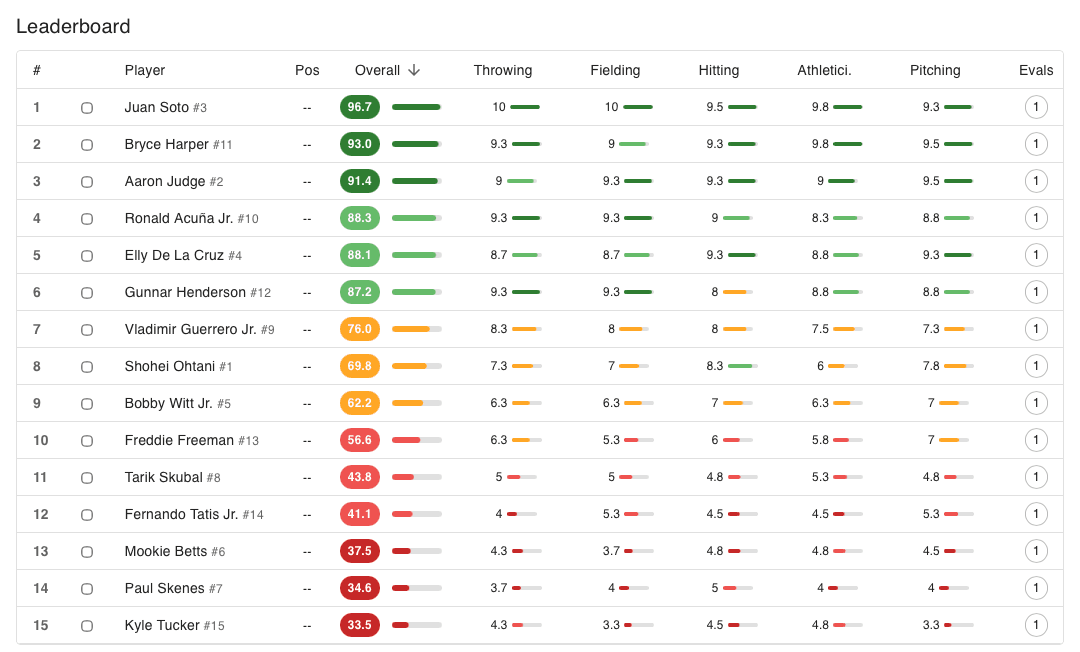
The Digital Version: Score Tryouts in Rizzler
Frequently Asked Questions
How many criteria should a tryout evaluation form have?
Should every coach score every player?
What scale should I use: 1 to 5, 1 to 10, or 20 to 80?
Can I use this form for any sport?
Should I use one sheet per player or one roster sheet for the group?
Read Next
Team Tryouts: Professional Tryout Management for Travel Clubs
FeaturesSoftball Pitching Chart: Free Printable PDF + Excel Tracker
ResourcesHow to Plan Pitching Across a Tournament Weekend
BlogBasketball Tryout Drills: 12 Drills That Actually Evaluate Players
Learn10U Baseball Practice Plan: A 75-Minute Kid-Pitch Practice
LearnLearn: Youth Sports Coaching Guides
Learn