A good volleyball drill does three things: it touches the ball more times per minute than a scrimmage would, it isolates one decision or movement so feedback lands, and it keeps score somehow, because players practice harder when something counts. This library is organized by the seven skill areas a volleyball practice actually plans around: serving, passing, setting, attacking, blocking, defense, and conditioning. Each section gives you the drills we would not cut, then hands off to the full per-skill guide with diagrams, progressions, and age fits. The age-specific versions live in the beginner drills, 10-12 year olds, and middle school drills guides, and the context-specific sets cover tryout drills and at-home solo work.
Serving Drills
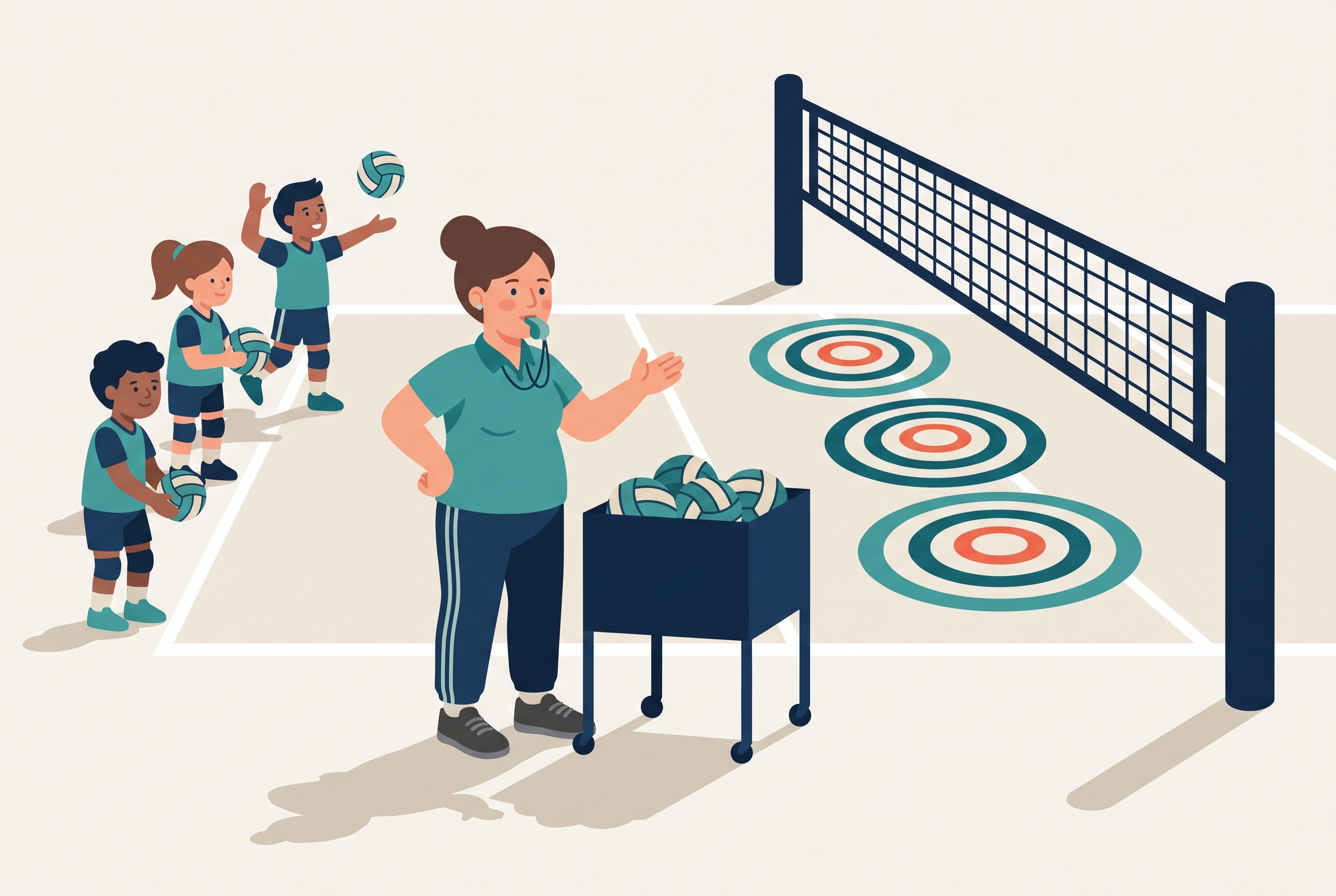
Open every serving block with a target, not a net. A serve that clears the net but lands where the opponent's best passer waits is a practiced mistake. The full progression, seven drills from aim to pressure with diagrams, is in the serving drills guide; the two staples below give the block its shape.
Zone battleship. Lay six towels across the far court, one per zone. Servers call their zone before contact; a hit sinks that towel. First group to sink four wins. The call-before-contact rule is the drill: it converts serving from a clearing exercise into an aiming one, and it tells you which servers can actually place a float serve versus merely deliver one.
Serve under pressure. Two teams line up at opposite endlines and alternate serves. A missed serve sends the server on a lap while play continues. The consequence is small, but it recreates the heart rate of serving at 23-24 far better than twenty relaxed reps ever will.
Passing Drills
Passing drills live or die on target quality. Give every drill a real target, a coach or a setter at the net, and count only passes that target could set. Individual platform work has its own passing drills guide; the team-formation side against live servers is in the serve receive drills guide.
Butterfly. The classic full-rotation drill: a server, a passer, a target, and lines that follow their ball, serve to pass to target, each player rotating to the role they just fed. Press play and watch a full rep — the server runs the outside of the court, around the pole, to the far pass queue:
Core · Passing & Serving
Butterfly Serve & Pass
Continuous serve-pass-target flow where players follow their ball through every role; nobody stands still.
15 min (10–20)
9-12 athletes (6–14)
1 coach
ages 9–18
intensity medium
full court
0:00 / 1:36
Setup
On each side place a server at the endline, a passer cross-court in serve-receive, and a target at the net; extra players stack one-deep behind server and passer with balls staged at each endline.
Execution
Serve cross-court, passer passes to target, target catches and jogs the ball to the serving line. Everyone follows their ball: server runs to passer spot, passer to target, target to server line. Both sides run mirrored flows simultaneously for constant reps.
Rotation
Built in; after 8 minutes reverse the direction so passers see the other angle.
Coaching points
Follow your ball to the next spot
Pass high enough to run under
Servers challenge, don't destroy, the passer
Equipment
volleyballs, ball cart, net
Progressions
Easier: Toss instead of serve; targets catch anything close.
Harder: Target becomes a setter who sets to a catching hitter; score 10 perfect passes to finish.
Safety
Runners cross under the net poles, never through the passing lane while serves are live.
Run it 12 minutes; every player touches every role. The middle school guide has the simplified half-court version for newer teams.
Pass and weave. Three passers, one tossing coach; the passer who plays the ball sprints behind the other two and re-enters on the far side. Seam confusion, not platform mechanics, causes most youth shanks, and this drill attacks the seam directly; the diagrammed version with progressions is in the passing guide.
Pepper with a purpose. Pepper is the warm-up everyone runs and few coach. Fix the standard: require the pass-set-hit sequence in order, call the score of controlled sequences out loud, and rotate partners every two minutes so your best passer is not warming up your other best passer all season.
Setting Drills
Setting splits into hands for everyone and a training plan for your setter, footwork, location, back sets, decisions, which is exactly how the setting drills guide is organized. The two below serve the whole gym.
Wall triangles. Setter faces a wall: set high to a spot, shuffle two steps, set from the new angle, shuffle back. Sixty seconds on, thirty off, four rounds. Hands stay above the forehead the whole minute, which is the habit that survives into matches.
Setter's choice, hitters live. Three hitters at the pins and middle, coach initiates a pass, setter chooses the target; hitters attack live. Score setter decisions, not kills: a good choice into a stuff block still counts. Decision-scoring is how you build a setter who runs an offense rather than a setter who takes turns.
Attacking Drills
Approach footwork lines. No ball, no net at first: four-step approaches (right-handers left, right, left-right close) in waves across the gym floor, then against the net, then with a toss. Ten focused minutes a week keeps a team's timing honest for a season. The full teaching progression for new hitters is in the beginner guide.
High-ball hitting. Coach tosses high outside sets; hitters swing from a full approach against no block, aiming for called zones. Youth hitters need hundreds of these before shot-selection drills mean anything. Chart makeable-versus-forced errors, and read our hitting percentage guide for what the numbers should look like by age.
Transition attack. Hitter starts at the net as a blocker, lands, pushes off to the attack line, then approaches against a live set. This is the footwork that separates JV from varsity outside hitters, and it doubles as conditioning.
Player development
Track development all season, not just on tryout day
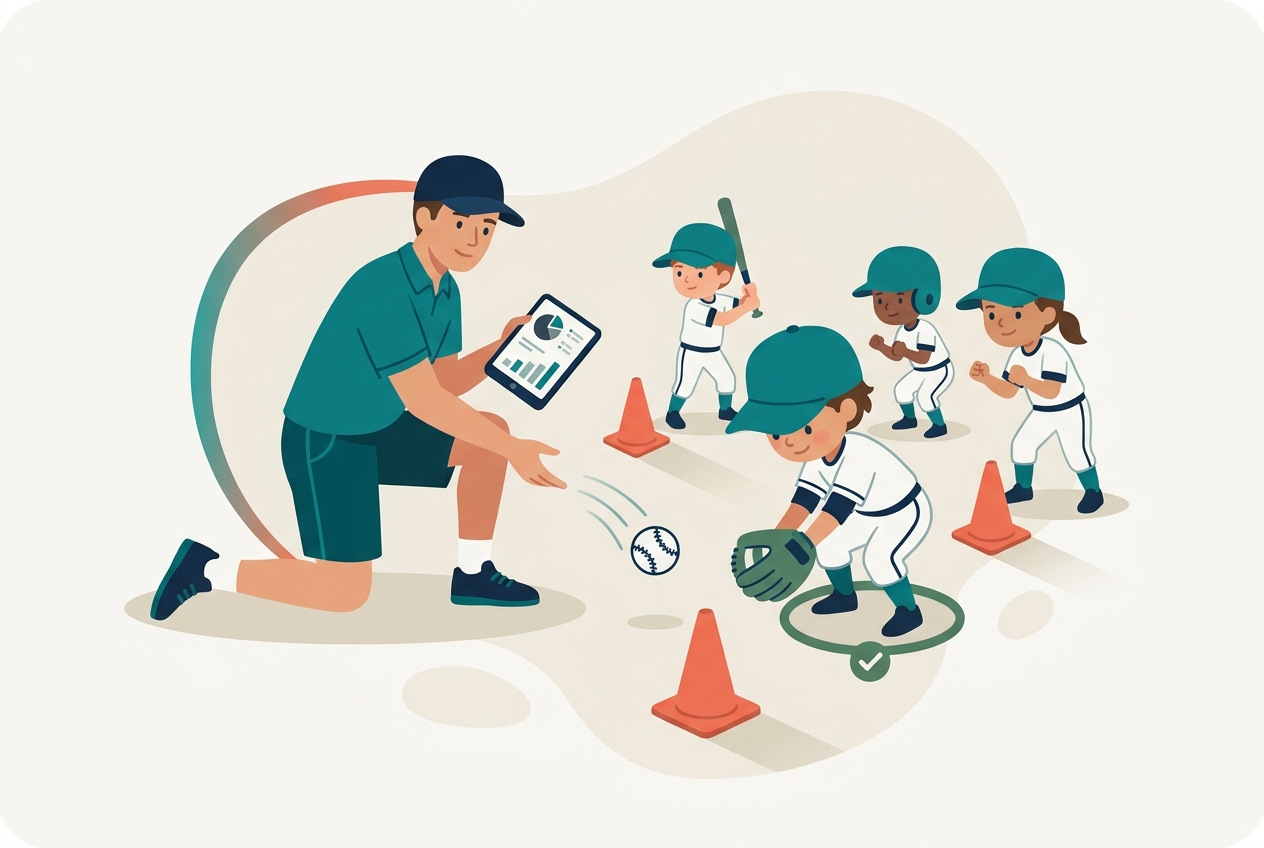
Score skills through the season, watch the trend lines move, and send parents a progress report they actually open.
Blocking Drills
Blocking is feet first; hands are just where the feet deliver you, which is why the blocking drills guide trains footwork patterns and reads before any pressing. The staple that serves every practice: footwork mirrors, pairs at the net with no ball, one leading shuffle and crossover patterns while the partner mirrors nose to nose, two thirty-second rounds each. The box-based read-and-press progression, double-block closing, and block transition live in the full guide with diagrams.
Defense Drills
Defense is reads and intent to target, not floor-avoidance, and the defense drills guide builds the whole chain from base positions through live chaos. The one to steal today: coach-on-box digging, coach attacking from a box at the net while defenders dig to a target, with the rule that a defender who digs sprints in to become the target, which turns a line into a team. Pursuit, chasing every touched ball for three contacts no matter how ugly, is the six-minute culture block; the full guide adds sprawl technique, tip coverage, and the wash games.
Conditioning Drills
Conditioning that uses volleyball movements steals less practice time than laps and transfers more: sideline shuffles, attack-line sprints, and block jumps in 40-second stations. The conditioning drills guide has the full court-lines circuit, wave sprints, jump complexes, and an age-gated plyometric progression; the load guidance for 11-14s is in the middle school guide.
Turning Drills Into a Practice Plan
A drill library is raw material; a practice is a sequence. The pattern that works at every level: a ball-touch warm-up (not laps), one skill block from this library with a scored finish, one team-system block such as walking your rotations or serve-receive shapes, and a game-like finish that keeps score. Four complete, ready-to-run sessions built exactly this way are in our volleyball practice plans, and the practice plan template gives you the printable frame with timings; drop drills from this page into its blocks and you have a session plan in ten minutes.
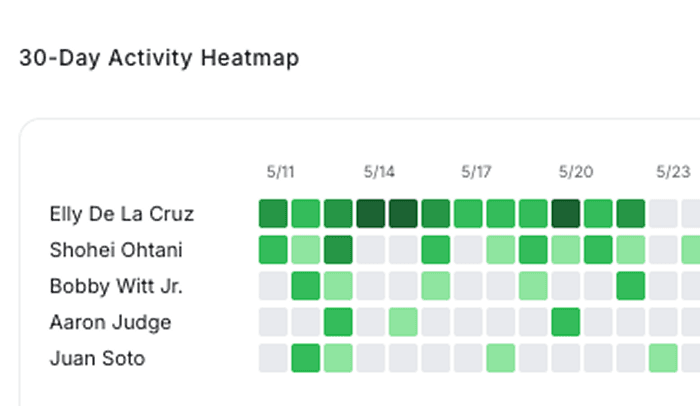
For the reps players do outside practice, this library pairs with Rizzler Reps: coaches assign drills from the volleyball library in the app, players log their work at home, and streaks and leaderboards keep the offseason from going quiet. Skill work you can see beats skill work you hope happened. The same skills these drills build are the ones you can score formally with Rizzler's volleyball player evaluations, whose eight categories (serving, passing, setting, attacking, blocking, floor defense, athleticism, volleyball IQ) match this library section for section.
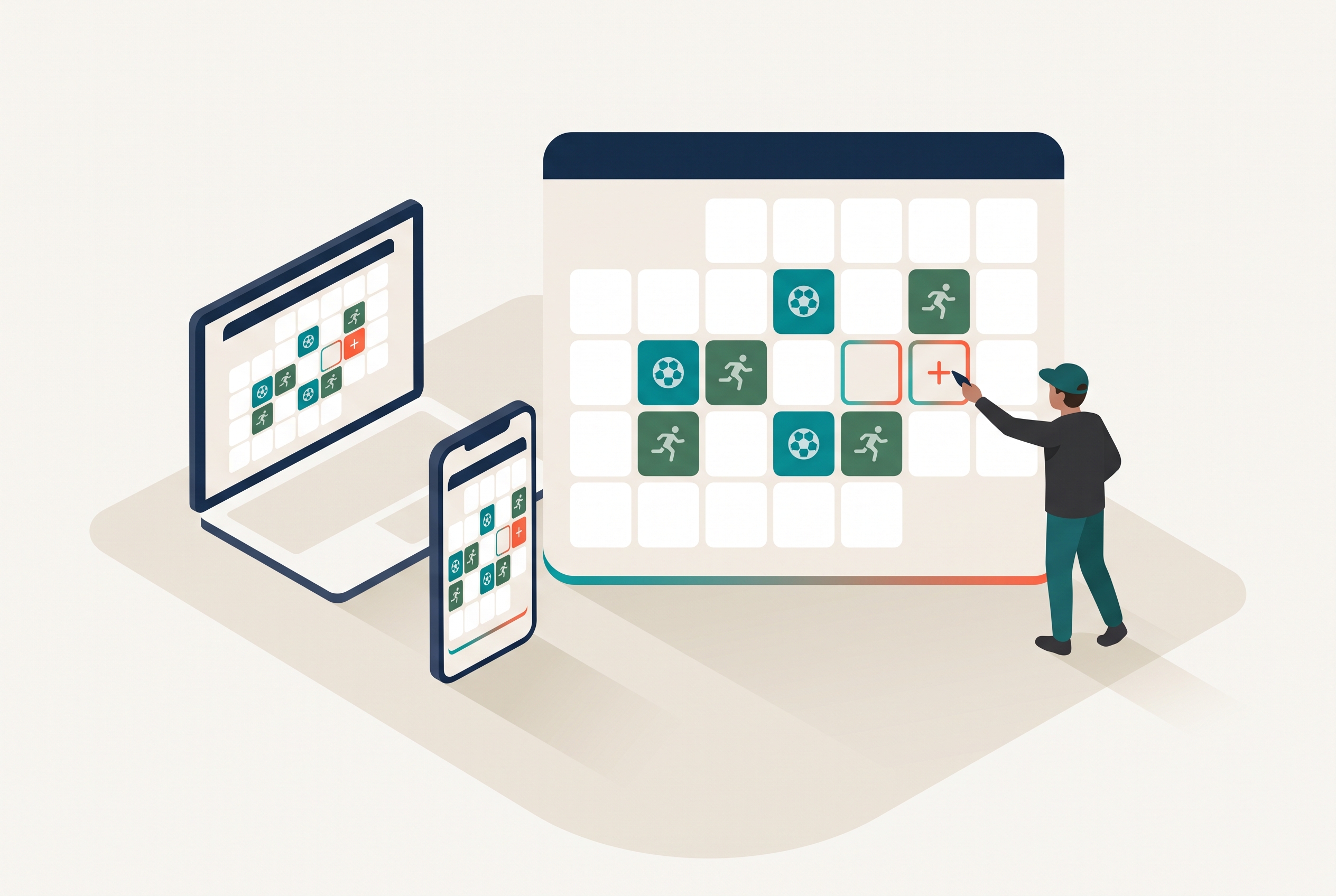
Every drill on this page is also a module in the free volleyball practice planner: drag the blocks onto a timed timeline for your gym slot, print the coach sheet, and share the plan by link, no login required. The volleyball practice plan template is the same session sheet as a blank PDF and Excel file.
Frequently Asked Questions
What are the best volleyball drills for practice?
The best drills maximize touches per minute, isolate one skill or decision, and keep score. Staples by category: zone battleship for serving, butterfly and pass-and-weave for passing, wall triangles for setting, high-ball hitting for attacking, footwork mirrors for blocking, and coach-on-box digging for defense. Each skill's full guide, with diagrams and progressions, is linked from its section above.
How do I structure a volleyball practice with these drills?
Four blocks: a ball-touch warm-up, one scored skill block from this library, one team-system block (rotations or serve receive), and a competitive finish. A 90-minute session fits roughly 20-25-25-20 minutes across those blocks. The printable frame is our practice schedule template.
What volleyball drills can players do at home?
Wall passing and wall setting, serving against a garage wall or into a marked target, approach footwork lines, and jump-touch work all need one ball and a wall; the full solo program with targets and daily plans is the at-home drills guide. Coaches on Rizzler assign at-home drills through Rizzler Reps so home reps get logged rather than guessed at.
How are these drills different for beginners?
Beginners need bigger targets, tosses instead of serves, and drills that guarantee early success so the ball stays in play. The beginner drills guide adapts each category, and the middle school guide covers the 11-14 age band where real serving and full rotations arrive.
Talk to our team
Want to see how to develop players all season long? Let's talk.
Tell us about your team and we'll show you how season-long skill tracking becomes the progress report a parent opens, while players keep building between practices with Rizzler Reps.
Track skills all season, not just on tryout day
Turn evaluations into reports parents actually open
Players build habits between practices with Rizzler Reps
Tell us about your program
4 fields · takes 30 seconds
Lands in the same inbox as the Help button · human response only