Volleyball Conditioning Drills That Don't Waste Court Time
Volleyball conditioning should look like volleyball: short maximal efforts (a jump, a sprint to a ball, a sprawl) separated by brief resets, repeated for ninety minutes. Laps train a fitness the sport never asks for and cost court time the sport desperately needs. The drills below build the three engines a volleyball player actually runs on: repeat-jump power, first-step quickness over three to five meters, and the ability to do both in the last set at the same quality as the first. Wherever possible they keep a ball in the drill, because conditioning that also touches a skill pays twice.
The Rule: Condition the Way the Game Moves
Match film of youth volleyball shows rallies averaging under ten seconds with fifteen to twenty seconds between them, and almost no player ever running more than five meters in a straight line. That is the template: work intervals of five to twenty seconds at full intent, short resets, movements from the sport's vocabulary (shuffle, crossover, sprint, jump, sprawl). Hold every drill on this page to it, and put conditioning blocks where fatigue teaches rather than erodes: last twenty minutes of practice, per the block structure in our practice plans.
Drill 1: Court-Lines Circuit
Purpose. Repeat-effort conditioning built from volleyball movements, in stations, with no lap in sight.
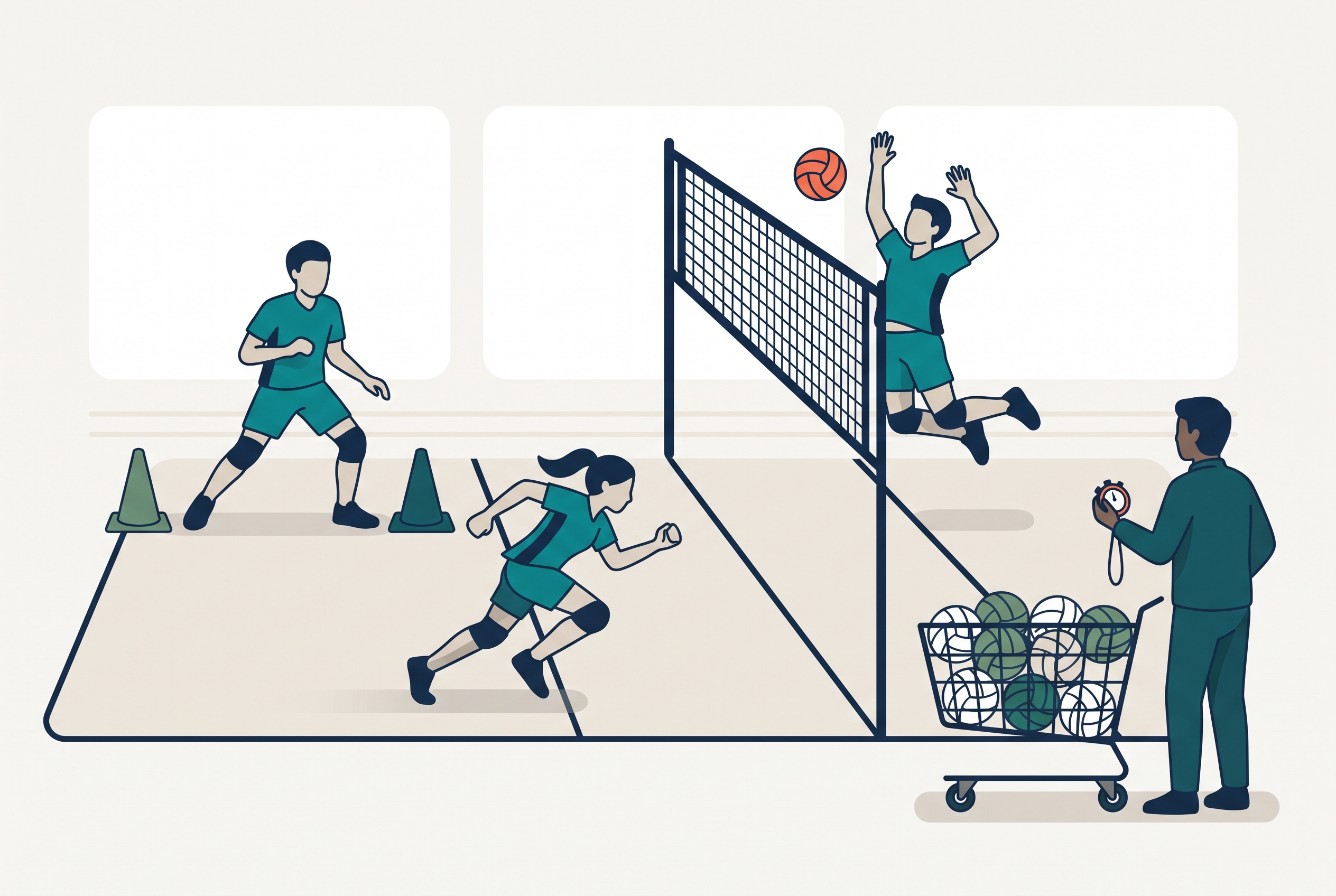
Setup. Three stations across one court: (1) sideline-to-sideline defensive shuffles, (2) attack-line-to-endline sprint-backpedal repeats, (3) block jumps at the net with a two-step shuffle between reps.
Volleyball · Conditioning
Court-Lines Circuit
Three groups rotate through sideline-to-sideline shuffles, attack-line-to-endline sprint-backpedals, and block jumps along the net.
0:00 / 3:00
Steps. 40 seconds of work, 20 seconds of transition, rotate through all three stations twice. Count reps per station and record them; the count is what makes the circuit a standard rather than a vibe.
Coaching cues. "Same quality, last round": posture low on shuffles, full jumps at the net, no rounding corners. The count exposes coasting without a word from the coach.
Common mistakes. Running stations too long. Past 45 seconds, movement quality collapses and the circuit starts training bad shuffles at high volume.
Age fit. 11U and up with round counts scaled down; two rounds for middle schoolers, three for varsity.
Drill 2: Wave Sprints With a Ball
Purpose. First-step speed to a dying ball, the sprint volleyball actually uses, trained with a save at the end.
Setup. Players in three lines on the endline; coach at mid-court with a cart.
Volleyball · Conditioning
Wave Sprints With a Ball
Three lines on the endline; the coach tosses to open floor, the front player sprints and saves it, then jogs the ball back to the cart.
0:00 / 1:04
Steps. Coach tosses a ball to open floor; the front player in the nearest line sprints and saves it (one clean up-ball counts, ugly is fine), then jogs the ball back to the cart. Waves run continuously for four minutes. Every save to a playable height scores a team point; set a target and a consequence.
Coaching cues. "First step wins": the game is decided in the first meter. Play the ball up, not back over the shoulder.
Common mistakes. Tossing every ball to the same depth; mix short dinks, deep corners, and sideline rollers so reads vary.
Age fit. Every age; this is also a sneaky pursuit-culture drill and pairs with the pursuit work in the defense drills guide.
Drill 3: Jump Complex at the Net
Purpose. Repeat-jump capacity, the middle blocker's tax, trained at the net where the jumps belong.
Setup. Players spaced along the net.
Volleyball · Conditioning
Jump Complex at the Net
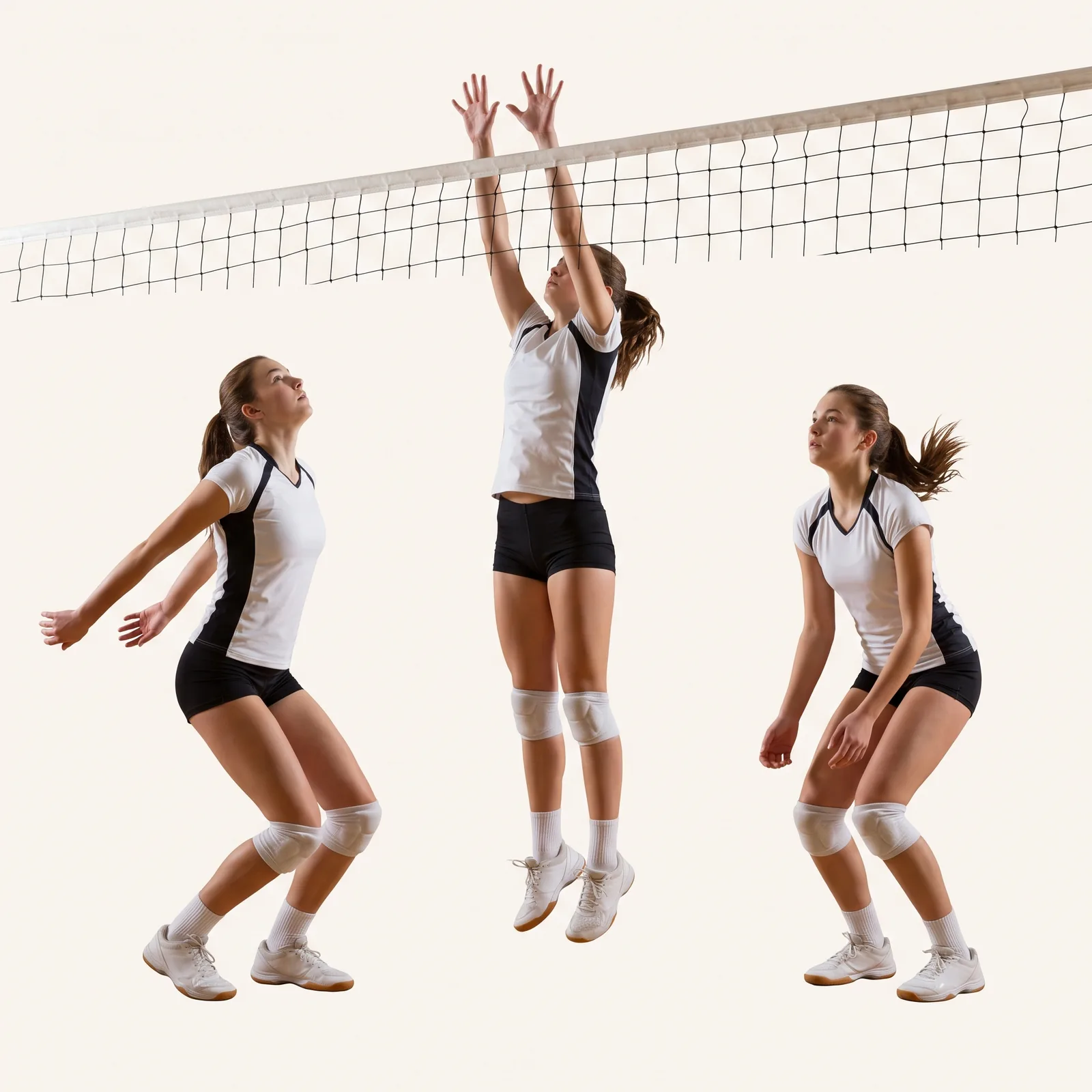
Repeated block and approach jumps at the net with soft landings.
Steps. One round is: three block jumps with a shuffle between, an approach jump from the attack line, five seconds rest, repeated four times. Two rounds per player per session, maximum. Count total jumps and hold the ceiling; jump volume is a budget, not a virtue.
Coaching cues. "Land soft, load fast": quiet landings with bent knees, immediate reload. Height matters less than the quality of the landing-to-jump cycle.
Common mistakes. Stacking this on top of a jump-heavy practice. Count all jumping in the session, including hitting lines; total volume is what knees experience.
Age fit. 13U and up. Younger players get their jump conditioning inside skill drills, which is plenty.
Player development
Track development all season, not just on tryout day
Score skills through the season, watch the trend lines move, and send parents a progress report they actually open.
Drill 4: Plyometric Progression (Earn Each Level)
Purpose. Build explosive power safely, with a progression that gates intensity behind landing quality.
Setup. Open floor; a low box or stair for level three.
Volleyball · Conditioning
Plyometric Progression
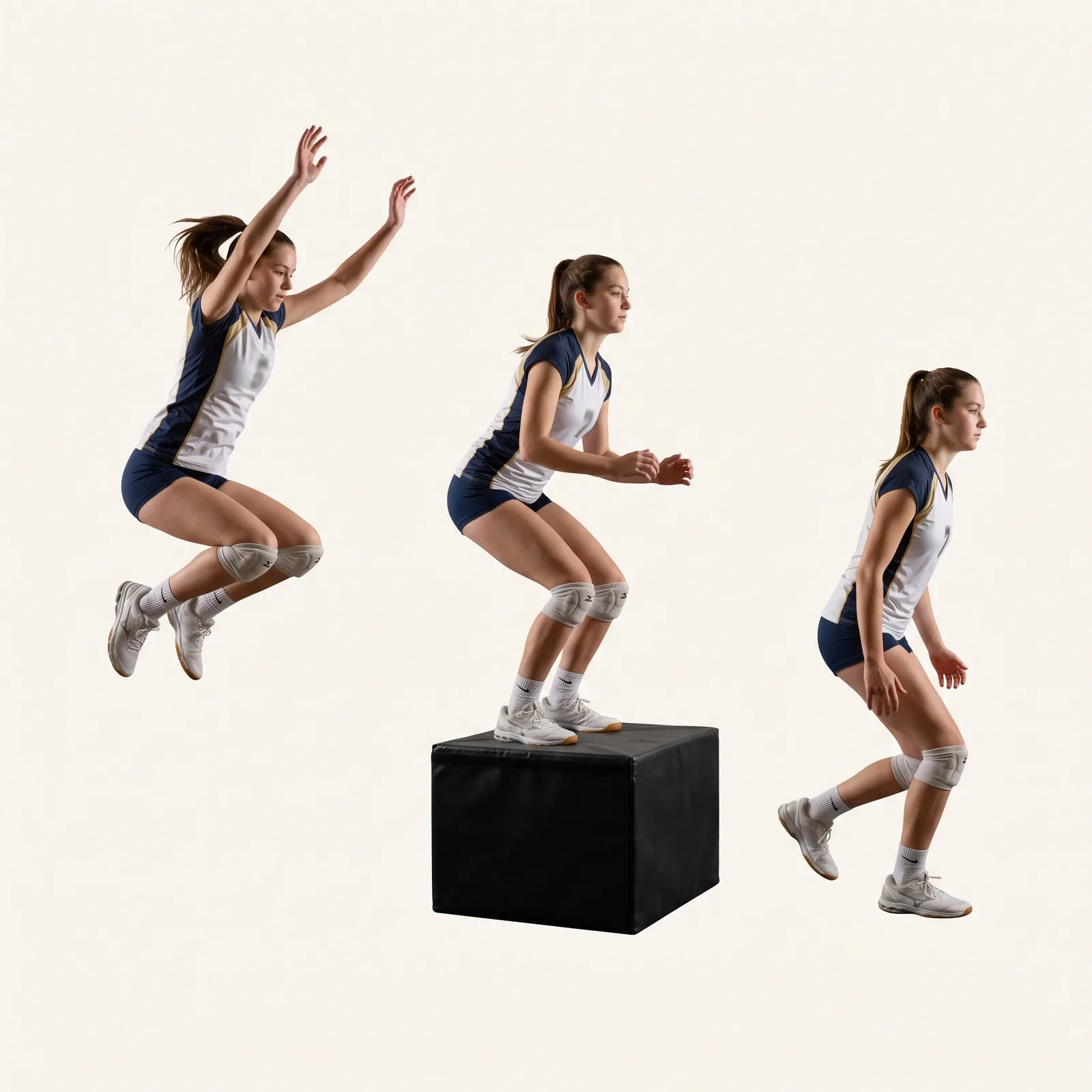
Earn each level: squat jumps, then box jumps, then depth jumps.
Steps. Level one: jump-and-stick, ten reps, two-second frozen landing each. Level two: repeated hurdle or line hops, low amplitude, quiet feet, three sets of eight. Level three: box step-off landings, then step-off into immediate vertical jump. A player earns the next level by showing ten silent, balanced landings at the current one. Two plyo sessions a week maximum, never on consecutive days.
Coaching cues. "Quiet is strong": landing noise is the audit. Knees track over toes; a caving knee ends the set, not the athlete's season.
Common mistakes. Treating plyos as conditioning volume. They are power work: low reps, full recovery, done before the team is tired, which usually means early in practice rather than in the final block.
Age fit. Levels one and two from 12U with strict form; level three for 14U and up. Growing athletes get the most from landing mechanics, not amplitude.
Drill 5: Serve-and-Sprint Ladder
Purpose. Conditioning that costs zero skill time: serving accuracy under a rising heart rate, which is exactly the match condition that breaks young servers.
Setup. Full team at one endline with balls; six zones marked on the far court.
Serve-and-Sprint Ladder
Steps. Player serves to a called zone, sprints to touch mid-court, and returns to serve again; three serves per turn. Hit zones count; a team total sets the target. The heart rate is the point: everyone discovers what their float serve does at 150 beats per minute, in October rather than in a fifth set.
Coaching cues. Same serving keys as ever, per the serving drills guide: consistent toss, firm contact, routine before every serve even when breathing hard. The routine under fatigue is the skill.
Common mistakes. Letting the sprint corrupt the serve into a heave. If accuracy collapses completely, shorten the sprint, not the standard.
Age fit. 12U and up.
Drill 6: The Five-Minute Finisher
Purpose. End practice with a team-wide repeat-effort standard that stays fun enough to survive the season.
Steps. Five one-minute rounds, ten seconds between: (1) lateral shuffles over the sideline, (2) sprawl-and-recover repeats, (3) block jumps, (4) attack-line suicides, (5) team choice, winner of the day's wash game picks. Count reps in round one and try to match them in round five; matching earns the team a lighter finisher next practice.
Age fit. Every age with scaled durations; middle schoolers run 40-second rounds, per the load guidance in the middle school drills guide.
Tracking the Engine, Not Just the Effort
Conditioning improves invisibly unless something is counted. Record circuit rep counts monthly, and for the power side, track the numbers that matter to volleyball: vertical jump and approach touch, both of which have a home in Rizzler's volleyball player evaluation template (Athleticism category, with approach touch in inches as an optional metric skill). Re-measure mid-season and the training argument settles itself. Between practices, the plyo progression and wall-based movement work travel home well; coaches on Rizzler assign them through Rizzler Reps so offseason conditioning gets logged rather than hoped for.
Frequently Asked Questions
What are good conditioning drills for volleyball?
Court-line circuits built from shuffles, sprints, and block jumps; wave sprints to a tossed ball; repeat-jump complexes at the net; and serve-and-sprint ladders that train accuracy under heart rate. Short maximal efforts with brief resets match how the game is actually played.
Should volleyball players run for conditioning?
Not distance. Volleyball is repeat short bursts: no rally asks for sustained running, and laps spend court time building the wrong engine while adding jump-free fatigue. Sprint waves, shuttle patterns, and circuit work deliver game-shaped conditioning in less time.
Are plyometrics safe for young volleyball players?
Yes, with gates: low-amplitude landings and hops from about age 12, box work from about 14, always form-first with full recovery and no more than two sessions a week. Landing quality (quiet, balanced, knees tracking) is the entry ticket to each next level.
How often should a volleyball team do conditioning?
A short block most practices beats a long block once a week: five to twenty minutes depending on the calendar, heavier in preseason, lighter in tournament weeks. Keep dedicated power work (plyos) separate from fatigue work (circuits) so each does its job.
How do you condition for volleyball at home?
The plyometric progression, court-line patterns in a driveway, sprawl-and-recover repeats, and jump-and-stick landings all need ten minutes and no net. Coaches on Rizzler assign home conditioning through Rizzler Reps, which logs the work so the offseason is visible.
What is conditioning in volleyball?
Conditioning is training the energy system the game actually uses: short bursts of explosive movement (approach, jump, land, shuffle, sprint to a ball) repeated hundreds of times across a match with brief rests between them. In practice that means court-based circuits, jump work, and change-of-direction sprints rather than distance running, which is the pattern every drill on this page follows.
Talk to our team
Want to see how to develop players all season long? Let's talk.
Tell us about your team and we'll show you how season-long skill tracking becomes the progress report a parent opens, while players keep building between practices with Rizzler Reps.
Track skills all season, not just on tryout day
Turn evaluations into reports parents actually open
Players build habits between practices with Rizzler Reps
Tell us about your program
4 fields · takes 30 seconds
Lands in the same inbox as the Help button · human response only