
Basketball
Printable Basketball Score Sheet (Free PDF + Excel)
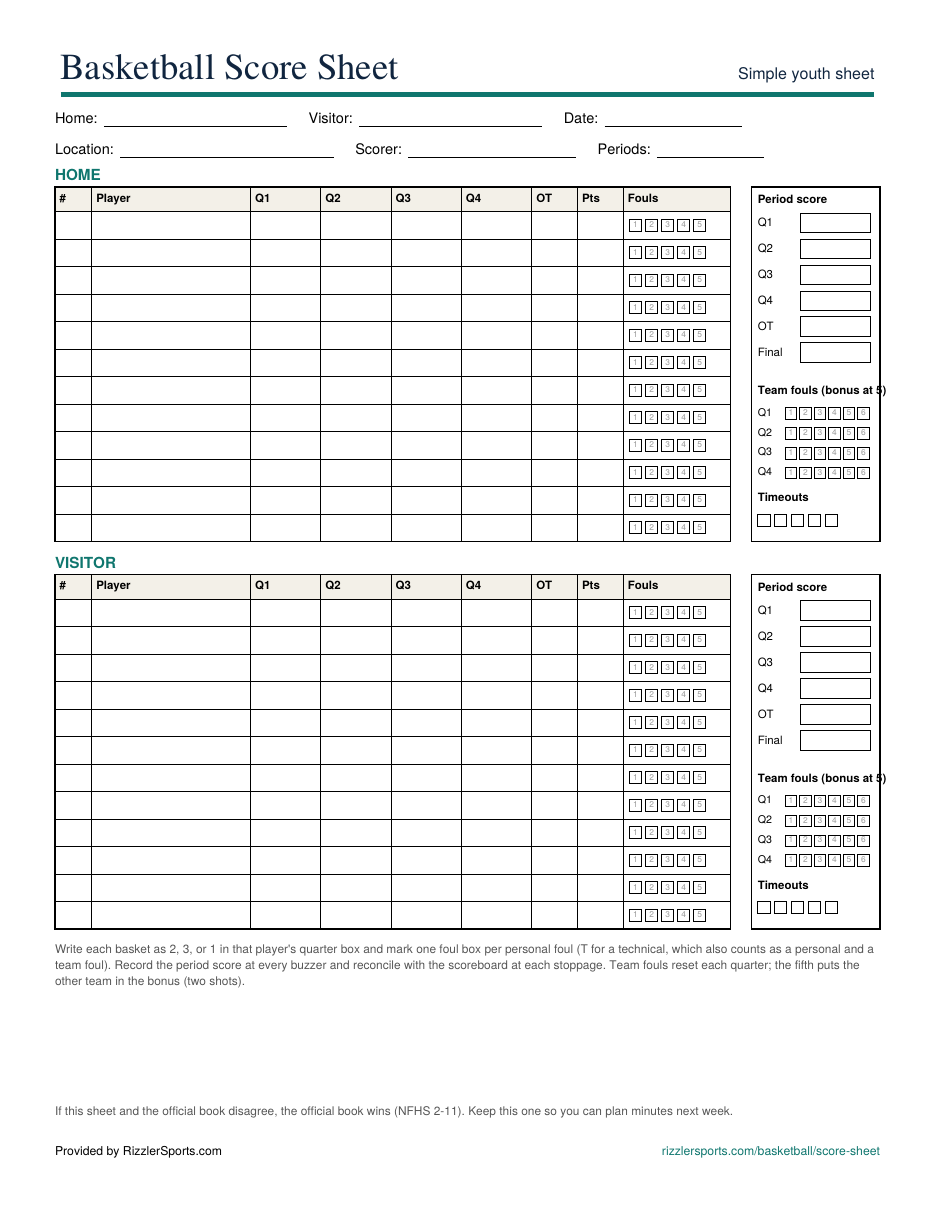
A basketball score sheet records the four things a game is officially made of: the running score, each player's points and personal fouls, team fouls by period, and timeouts. It is the game record, which makes it different from a stat sheet, the coach's player record of attempts, rebounds and turnovers that no referee will ever ask to see. The score sheet on this page prints in two layouts, a simple youth sheet for rec leagues and tournaments and an official-format sheet that mirrors the NFHS scorebook so a parent can keep a shadow book at a school game, plus a filled example of the official sheet through halftime and an Excel running-score log that totals by period.
Download the Basketball Score Sheet
PDFDownload the printable PDF
Three pages: the simple youth sheet (home and visitor, 12 players each, points by quarter, five foul boxes per player, period score, team fouls and timeouts), the official-format sheet (15 players per team, running score to 160, foul and technical boxes, team fouls by quarter with the bonus marked, timeouts, possession arrow, signatures), and the official sheet filled in through halftime.
ExcelDownload for Excel
A Running Score tab where you log each score (period, team, player number, points) and the home and visitor running totals and period scores calculate, plus a Players tab that pulls each player's points from the log and flags the fourth and fifth foul.
Both files are free, no email or account. For Google Sheets, upload the Excel file to Drive and open it; the running totals carry over.
Which Layout to Print
Print the simple sheet for rec league, 8U through 12U, and any tournament where you are keeping score for your own bench rather than for the table. It fits a whole game on one page with the three things a youth game needs tracked (points by quarter, fouls, period score) and nothing that slows a parent down. Print the official-format sheet for middle school and high school games, or whenever you want a shadow book that lines up row for row with the scorer's NFHS book so a dispute can be settled in thirty seconds. Tournament benches should print one sheet per game and two copies: one for the bench, one for the folder, because the tournament director will ask for the score of a game two days later and the bench copy will be in somebody's car.
| Layout | Best for | What it has | What it skips |
|---|---|---|---|
| Simple youth sheet | Rec, 8U to 12U, tournaments, a parent keeping score for the bench | 12 players per team, points by quarter, 5 foul boxes, period score, team fouls by quarter, timeouts | Running score strip, technical foul column, signatures |
| Official format | Middle school, high school, a shadow book beside the NFHS scorebook | 15 players per team, running score to 160, foul boxes plus T, team fouls with the bonus marked, timeouts split 60 and 30 seconds, possession arrow, scorer and referee signatures | Nothing; it is the full book page |
If you only print one, print the simple sheet. The running score strip on the official sheet is the part that takes practice, and a parent who has never kept it will drift from the scoreboard by the second quarter; the simple sheet asks for a period score instead, which is a number you can read off the wall.
How to Fill Out a Basketball Score Sheet
Here is the official-format sheet filled in through halftime of a 10U game, with the running score slashed, the period marks drawn, and both teams' fouls recorded. The six steps below follow it.
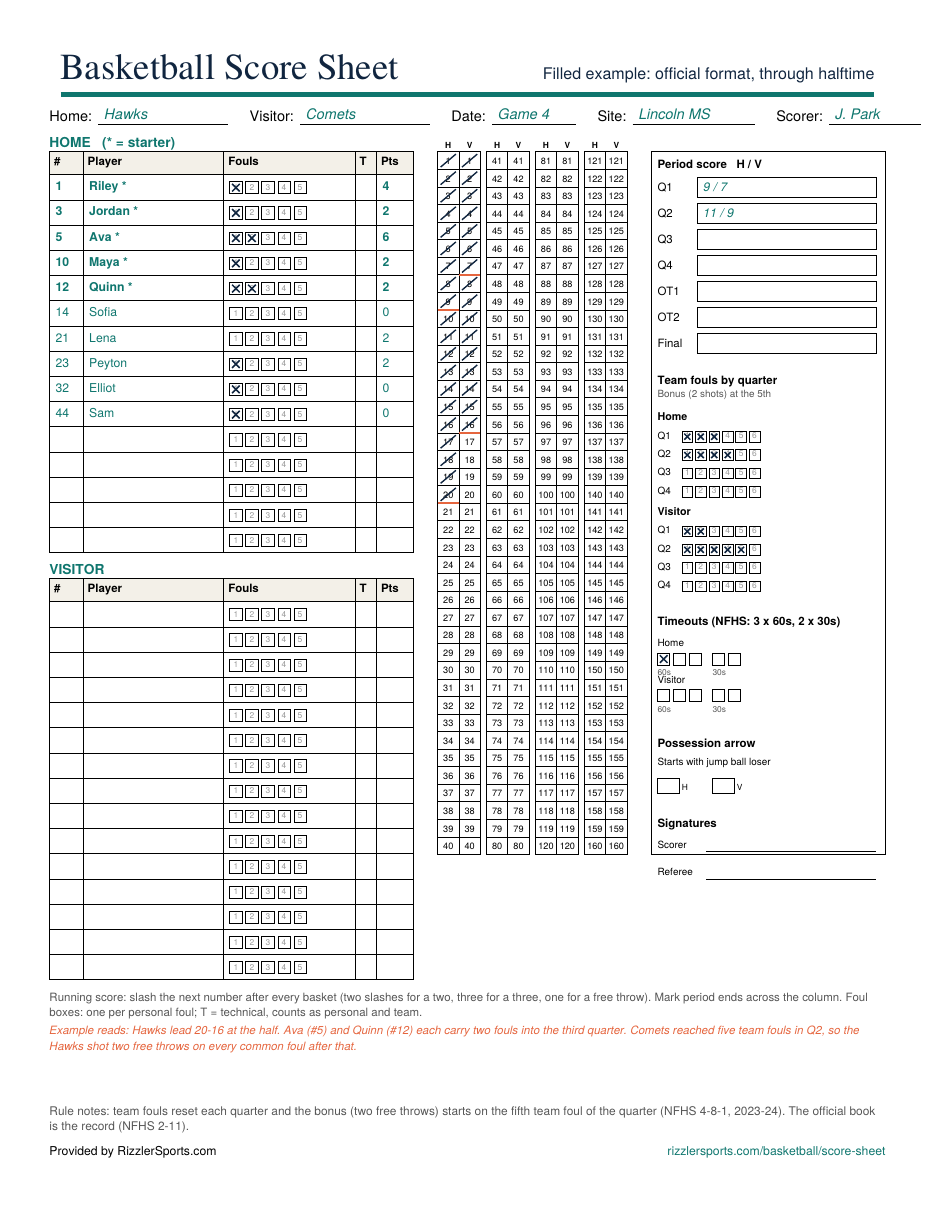
- Header and roster, ten minutes before tip. Fill in both teams, the date, the site and your name. List every player by number, starters first, and mark the five starters. At a school game this list is due to the official scorer at least 10 minutes before the start (NFHS 3-2-1 and 3-2-2); the lineup sheet is the form coaches hand over for that, and your sheet should match it.
- Running score: slash the next number. When a team scores, slash through the next unslashed number in that team's column: two slashes for a two, three for a three, one for a free throw. The last slashed number is always the score, which is why the strip works even when the scoreboard operator is a seventh grader.
- Player points. Write the points in the scorer's row as they happen, or tally and total at each quarter. The sum of the player column must equal the last slashed number in the strip; check it at every stoppage.
- Personal fouls. Cross one box for each personal foul. Write T in the technical column for a technical foul, which also counts as a personal foul and a team foul under NFHS rules, so cross a foul box too. A player's fifth cross means they are done; the scorer at the table will notify the official, and your sheet is how the coach knows it is coming.
- Team fouls by quarter. Cross a box for every foul charged to the team in that quarter, personal and technical. Under NFHS rules since the 2023-24 season, team fouls reset at the end of each quarter and the fifth team foul of a quarter puts the other team in the bonus, two free throws on every common foul for the rest of the quarter (NFHS 4-8-1). The old one-and-one no longer exists at the high school level. In the example, the visitors reached five in the second quarter, so the home team shot two on every common foul after that.
- Period score, timeouts, possession arrow. At every buzzer, draw a line across the running-score strip under the last slashed number and write the quarter score in the side panel. Cross a timeout box when one is charged (NFHS allows three 60-second and two 30-second timeouts per game, which is why the boxes are split), and mark the possession arrow after the opening jump ball so the alternating-possession calls can be checked.
Common Mistakes and How the Sheet Prevents Them
Running score drift is the big one: the scorer slashes two for a free throw, or forgets a make during a flurry, and by the third quarter the sheet and the scoreboard disagree by three. The fix is the period line. Reconcile at every stoppage, and when the strip and the scoreboard disagree, find the basket in the player column before you touch the strip; nine times out of ten a basket was credited to a player and never slashed, or slashed and never credited.
Forgetting the quarterly reset is the second. A parent who learned to keep score before the rule change will carry team fouls across the half and put the other team in the bonus two fouls early. The sheet puts a separate row of boxes under each quarter so there is nowhere to carry them.
Technical fouls get missed in two directions: not crossing the personal-foul box (a technical counts toward a player's five) and not counting it as a team foul (it does). The T column sits next to the foul boxes on the official sheet for exactly that reason.
And the one that costs teams games in tournaments: not writing the period score at the buzzer. A tournament tiebreaker that uses point differential needs the final, and the final is the last slashed number; a sheet without the period lines makes that number a guess.
Score Sheet, Scorebook, and Stat Sheet
The score sheet and the scorebook are the same document in different bindings: a scorebook is a bound book of score sheets with the official symbol set printed in. The how to keep a basketball scorebook page walks through the full symbol set, the scorer's duties under NFHS 2-11, and the rule differences between NFHS, NCAA and FIBA books. The stat sheet is the other document on the bench: shot attempts, rebounds, assists, steals, blocks, turnovers and minutes, the things the score sheet does not record. A bench that keeps both has the game and the players covered.
What Happens After the Buzzer
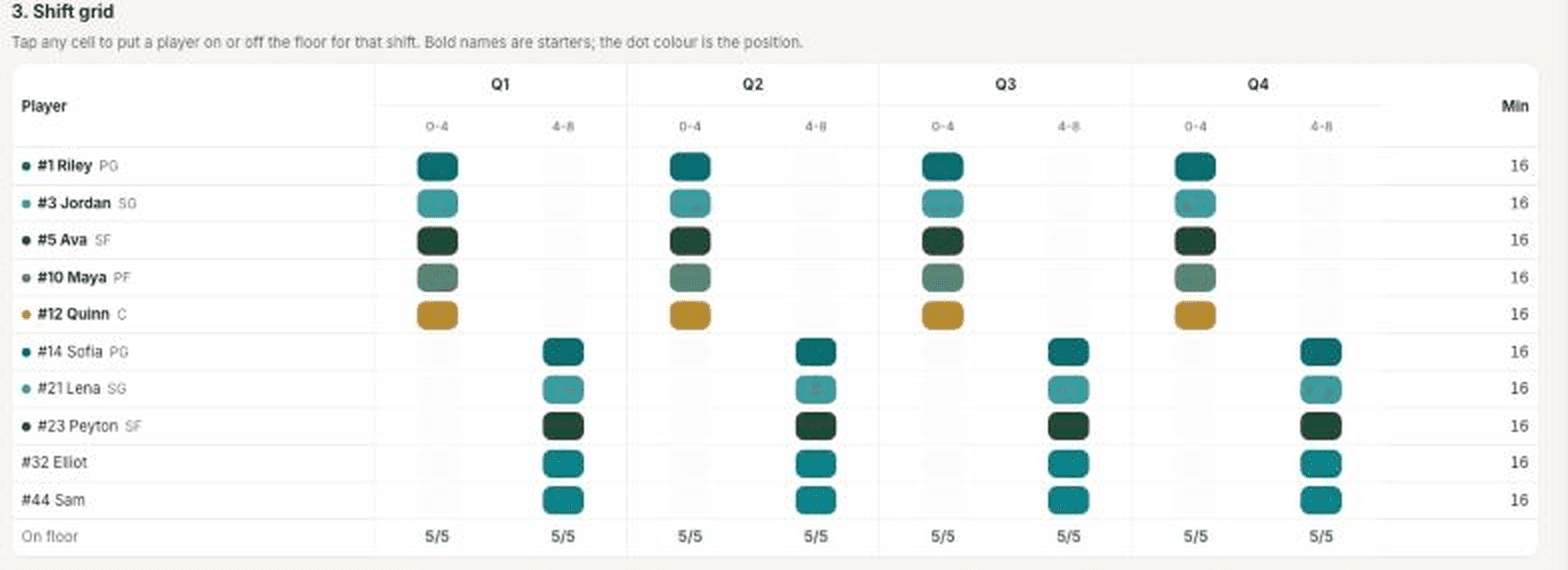
The score sheet tells you who scored and who fouled. It does not tell you who played how much, which is the number parents ask about and the number a coach has to defend. The free basketball rotation generator plans that before the game: enter the roster, pick the game format and equal or starters-weighted playing time, and it builds a shift-by-shift chart with planned minutes per player and a printable rotation card for the bench. Keep the rotation card next to the score sheet and the two documents answer every question a parent can ask. The basketball playing time page has the minutes math by roster size, and the rotation chart page has ready-made charts for 7 to 12 players.
Rizzler does not score basketball games yet, so the score sheet on this page is still the way to keep the game record. What Rizzler carries is the rotation plan: save one to a free account and it lands in Game Manager, with every game's planned minutes in one playing-time view for the season.
Frequently Asked Questions
Is the basketball score sheet free?
Yes. The PDF with both layouts and the filled example, and the Excel running-score log, download directly from this page with no email or account.
What is the difference between a simple score sheet and the official format?
The simple sheet tracks points by quarter, fouls, period score, team fouls and timeouts, which is everything a rec or youth bench needs. The official format adds the running-score strip to 160, a technical-foul column, split 60 and 30 second timeout boxes, the possession arrow and signature lines, so it lines up row for row with the NFHS scorebook at a school game.
How many score sheets do I need per game?
One per game, printed twice: one for the bench and one for the team folder. Tournament directors ask for scores days later, and tiebreakers use point differential, so the folder copy with the period scores written in is the one that matters.
What happens when the score sheet and the scoreboard disagree?
The official scorebook at the table is the record (NFHS 2-11); the scoreboard and your bench sheet are not. If your sheet disagrees with the scoreboard, reconcile at the next stoppage by finding the basket in the player column. If your sheet disagrees with the official book, the official book wins unless the referee has information that supports a correction.
How many team fouls before the bonus in high school basketball?
Five in a quarter. Under NFHS rule 4-8-1 as amended for the 2023-24 season, team fouls reset each quarter and the fifth team foul of a quarter puts the opponent in the bonus with two free throws on every common foul for the rest of that quarter. There is no one-and-one in high school basketball anymore; check your youth league's rules, since many do not use a bonus at all.
Can I keep a basketball score sheet on my phone with Rizzler?
Not yet. Rizzler does not score basketball games today; it plans basketball rotations and playing time in Game Manager and prints the rotation card. Keep the score sheet on paper or in the Excel log and plan the minutes in the rotation generator.
Read Next
The Coach's Guide to Quality At-Bats (QAB)
StatsBest Baseball Scorekeeping Apps for Coaches in 2026
LearnPitch Count Tracking Sheet: Printable + Auto-Calculating Excel
ResourcesBaseball Pitching Chart: Free Printable PDF + Excel Tracker
ResourcesCan I Use Rizzler with GameChanger?
FAQHow to Run a Lacrosse Tryout: A Coach's Step-by-Step Guide
Learn