Volleyball
The 5-2 Volleyball Rotation: One Setter Slot, Two Specialists
The 5-2 volleyball rotation looks exactly like a 5-1 on the lineup sheet: five attackers and one setter slot. The difference is that two setters share that slot, substituting for each other as it crosses between rows. One specialist sets the three front-row rotations, working at the net like a 4-2 setter; the other sets the three back-row rotations, penetrating like a 6-2 setter. It is the least common of the standard systems, but it fits one roster surprisingly well: two setters with genuinely different games.
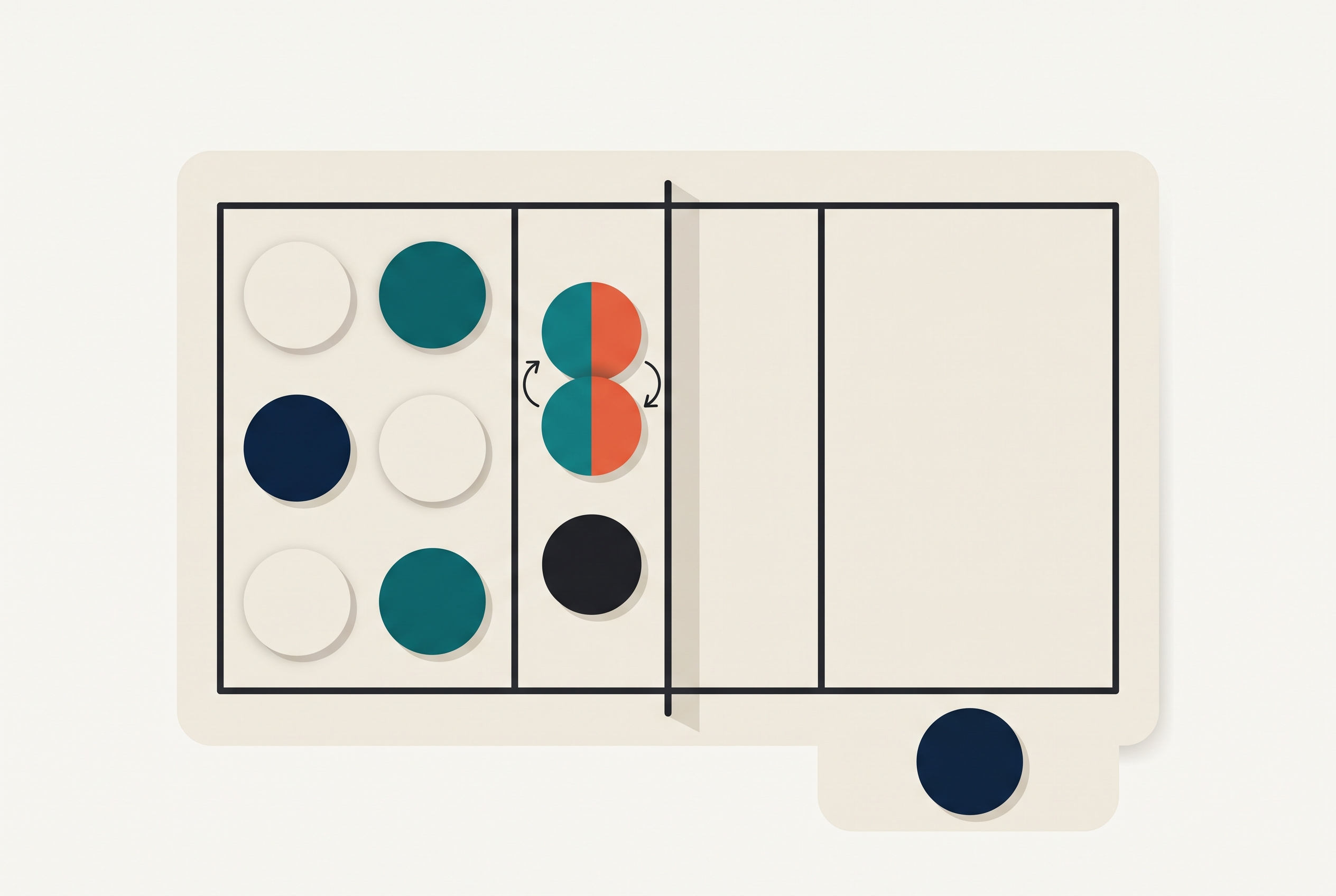
5-2 rotations — Two diagonal setters sharing duty: the front-row setter sets like a 4-2, the back-row like a 6-2.
Rotation 1
Rotation 2
Rotation 3
Rotation 4
Rotation 5
Rotation 6
Build this with your roster — free →
No login required
What Is a 5-2 Volleyball Rotation?
A 5-2 is a 5-1 lineup run by a setting platoon. The rotation wheel has a single setter position with the opposite hitter diagonal from it, same as any 5-1. But instead of one setter riding that slot through all six rotations, setter A plays it while it is in the front row and setter B substitutes in when it rotates to the back row.
Each setter therefore only ever does the half of the job that suits her. The front-row setter never has to penetrate from the back court; the back-row setter never has to block. The name counts what the team experiences: five attackers, plus a setting position staffed by two people.
A Worked 5-2 Lineup
Our Ridgeview Hawks have two very different setters: Maya, a strong blocker with clean hands who struggles defensively, and Sofia, the team's best digger who gives up too much at the net. The starting lineup, with the setter slot beginning in the front row:
| Slot | Player | # | Role |
|---|---|---|---|
| I | Dre | 15 | Middle |
| II | Jordan | 12 | Outside |
| III | Priya | 4 | Middle |
| IV | Maya | 7 | Setter slot (front-row half) |
| V | Kayla | 3 | Outside |
| VI | Tess | 9 | Opposite |
Maya sets from zones 4, 3, and 2 as the slot walks the net. When the slot rotates from zone 2 into zone 1, Sofia substitutes in for Maya and sets the three back-row rotations, hiding and releasing like any 6-2 setter. When the slot comes back around to zone 4, Maya re-enters. Two substitutions per full trip around the wheel, at the same two crossover points every time.
Serve Receive: Two Systems in One Match
The 5-2's quirk is that your serve receive changes personality every three rotations. During Maya's front-row half, receive looks like a 4-2: the setter is already at the net, out of the pattern, nobody penetrates, and overlap risk is minimal. During Sofia's back-row half, receive looks like a 6-2: the setter stacks and releases, with all the overlap traps that come with penetration.
That split is either the system's weakness or its teaching value, depending on your goals. Match-focused teams find the identity change disjointed. Development teams get both major serve receive styles real reps in every match, which no other system provides.
When a 5-2 Actually Fits
Three rosters justify it. First, the mismatched setter pair described above: each plays only her strong half, and the team gets a better blocker at the net and a better defender in the back court than either setter could provide alone. Second, injury management: a setter who cannot repeatedly jump-set or sprint the penetration run takes the front-row half with its shorter movements while she recovers. Third, the transition year: a team moving from a 4-2 toward a 6-2 can run a 5-2 as the bridge, letting the stronger penetrator learn back-row setting in live matches while the other setter keeps her familiar net job.
Outside those cases, most teams are better served by the standard ladder: 4-2 young, 6-2 as setters learn to penetrate, 5-1 when one setter separates from the pack. That is why you rarely see a 5-2 at varsity: its two halves each have a better specialist system waiting.
Bookkeeping: Substitutions and the Sheet
The setter platoon costs two substitutions per full rotation cycle, always at the same two crossovers. High school's 18 per set absorbs that easily; club's 15 usually does, though a long set with other substitutions in play can get tight, so decide in advance which half survives if you run low. On the official lineup sheet only the starting setter appears in the slot; her partner enters through normal substitution. Print the rotation sheet with both halves marked so the bench knows exactly which rotation triggers each swap. The rotation generator supports the 5-2 alongside the standard systems, which almost no printable resource does.
Frequently Asked Questions
What does 5-2 mean in volleyball?
Five attackers and one setter slot shared by two setters. One sets the slot's three front-row rotations from the net; the other substitutes in to set the three back-row rotations, penetrating after the serve. The wheel itself is identical to a 5-1.
What is the difference between a 5-2 and a 6-2?
A 6-2 keeps both setters on the court at once, diagonal from each other, with the back-row one setting and the front-row one hitting. A 5-2 has one setter on the court at a time, sharing a single slot by substitution, each working only her preferred half.
What is the difference between a 5-2 and a 5-1?
The lineup is the same; the staffing differs. A 5-1's setter plays all six rotations. A 5-2 splits those six rotations between two setters, front-row half and back-row half, at the cost of two substitutions per cycle.
Is the 5-2 good for youth teams?
As a bridge, yes: one young setter learns back-row penetration in live play while the other keeps the simpler net job, and the team practices both serve receive styles. As a destination system it is rare at every level.
How many substitutions does a 5-2 use?
Two per full rotation cycle, one at each point where the setter slot crosses between rows. Against high school's 18-per-set limit that is comfortable; against club's 15 it is workable but worth tracking late in a set.
Talk to our team
Want to spend more time coaching and less time with paperwork? Let's talk.
Tell us about your team and we'll show you how to plan games, set lineups, run the schedule, and develop players in one place, so you spend the season coaching instead of chasing admin.
Less admin, more coaching
Plan games, set lineups, and track the season in one place
Keep every family in the loop automatically
Tell us about your program
4 fields · takes 30 seconds
Lands in the same inbox as the Help button · human response only
Read Next
Best Baseball Player Evaluation Tools in 2026
LearnBaseball Position Chart: Printable Fielding Rotation (Free)
ResourcesLittle League Draft Preparation with Rizzler
For LeaguesSoftball Tryout Evaluation Form: What to Score (Free Template)
LearnVolleyball Serving Drills: 7 Drills for Accuracy Under Pressure
VolleyballBaseball Lineup Template for Excel & Google Sheets (Free)
Resources