
Learn
How to Start a Travel Baseball Team
Starting a travel baseball team comes down to six decisions made in the right order: who the team is for, how you will sanction and insure it, what it will cost, who plays, who coaches, and how you will run the season without living in your group text. Most first-time organizers get the baseball part right and the operation wrong. They can evaluate a swing and set a lineup, then drown in registration forms, insurance certificates, tournament deadlines, and forty parent texts a week. This guide walks the whole build in order, with a real first-year budget and a startup timeline you can work backward from.
The honest part first: travel baseball is a small business with a roster. If you want to do it well, treat the setup like one.

What do you decide before anything else?
Define the team before you recruit a single player. Three questions settle almost everything downstream:
| Decision | Options | What it drives |
|---|---|---|
| Age group | 8U through 18U, single age or "playing up" | Which tournaments, bat rules, and field size apply |
| Competitive level | Rec-plus / B / A / Major | Tryout bar, tournament tier, practice load, family cost |
| Commitment | Spring-only, summer, or year-round | Budget, roster size, how much you ask of families |
A 9U spring-and-summer B team is a completely different build than a 14U year-round Major program. Pick a lane and say it out loud in your first parent meeting, because the fastest way to lose a roster in July is to have sold families a different level than the one you are running. Write a one-paragraph mission: age, level, season length, region you will travel, and your development philosophy. Every later decision checks against it.
How do you sanction and insure the team?
You cannot enter sanctioned tournaments without a sanctioning body and proof of insurance, so this is not optional paperwork. The major youth sanctioning organizations are USSSA, Perfect Game, AAU, and regional bodies like Nations Baseball. Most teams register with whichever body runs the tournaments in their area, and many carry more than one because different events require different sanctioning.
Insurance is the piece new organizers skip and regret. Sanctioning bodies require general liability and accident-medical coverage before you can practice or play. USSSA, for example, requires $3,000,000 in general liability per occurrence and $100,000 in accident-medical coverage per accident, and team policies start around $178 per year depending on age and term. Field owners and tournament hosts will ask to be named as additional insureds on your policy, so get the coverage in place before you book a single practice.
If your program will run as a business or a nonprofit, this is also when you pick a legal structure, register the name, get an EIN, and open a dedicated bank account. Never run team money through a personal account. Parents are paying real fees and they deserve a clean, auditable set of books from day one.
What does a travel baseball team actually cost?
Build the budget before you set a player fee, not after. Here is a representative first-year budget for a 9U-12U B/A team playing eight to ten tournaments. Your numbers will vary by region, level, and how much gear families already own, but the line items are the same everywhere.
| Line item | Typical first-year range | Notes |
|---|---|---|
| Sanctioning + team insurance | $180 to $500 | Often more than one body; insurance required before you play |
| Tournament entry fees | $3,200 to $6,500 | 8 to 10 events at roughly $400 to $700 each |
| Practice facility / field rental | $1,000 to $4,000 | Cage and indoor time in winter drives this |
| Uniforms + gear | $1,800 to $3,600 | Two jerseys, pants, hats, bag per player at 12 players |
| Baseballs, Ls, field equipment | $300 to $700 | Practice balls, screens, tees replace themselves |
| Coaching stipend or background checks | $0 to $2,000 | Volunteer vs paid; background checks either way |
| Website / registration / software | $0 to $600 | Registration and payment platform, team app, email |
| Contingency (rainouts, extras) | $500 | Always budget for the tournament you enter and cannot play |
Add it up, divide by your roster, and you have a defensible per-player fee. A team like the one above usually lands somewhere between $900 and $1,800 per player for the year before travel and hotels, which families pay on their own. Show parents this table. Transparency about where the money goes is what keeps a program from imploding in year two.
How do you pick the roster?
Recruit through a real tryout, not a group chat of your buddies' kids. A structured tryout does two jobs at once: it gets you the players who fit your level, and it sets the tone that this is a serious program. Run stations for hitting, fielding, throwing (with a radar reading if you have one), catcher pop times, and a game-speed situation or scrimmage. Score every player on the same sheet so your decisions are defensible when a parent asks why their kid did or did not make it.
Our guide on how to run a baseball tryout covers the station layout, the evaluation criteria, and the timeline. If you want to score players consistently across your coaching staff instead of on paper, Rizzler's Team Tryouts workflow handles registration links, check-in, and scoring on one sheet; it is a Coach and Club plan feature, and Club is the tier built to run a full tryout at scale. The tryout roster then carries straight into your season roster, so you enter each family once.
A roster note most first-year coaches learn the hard way: carry eleven or twelve players, not fifteen. Playing time is why families leave, and a bloated roster guarantees unhappy parents at every tournament.
Who coaches, and how do you keep parents onside?
Line up your staff before the season, not the week of your first event. You want at least a head coach and two assistants so a base is always covered and practices split into stations. Every adult on the field needs a background check, full stop, and many sanctioning bodies require it. Decide early whether coaches are volunteers or paid a stipend, because that line lives in your budget above.
The relationship that makes or breaks a travel program is the one with parents. Hold a preseason meeting and put the hard things in writing: the fee and what it covers, the playing-time philosophy, the travel expectations, the refund policy, and how you will communicate. Then communicate through one channel, not five. When the schedule, the roster, availability, and your team messages all live in one team management app, you stop being the human relay for every date change, and parents stop missing them.
Set up the season so the admin runs itself
Once you have players and coaches, the season is an operations problem. The programs that last are the ones where the logistics mostly run themselves, so the coaches can coach. Here is the order to build it:
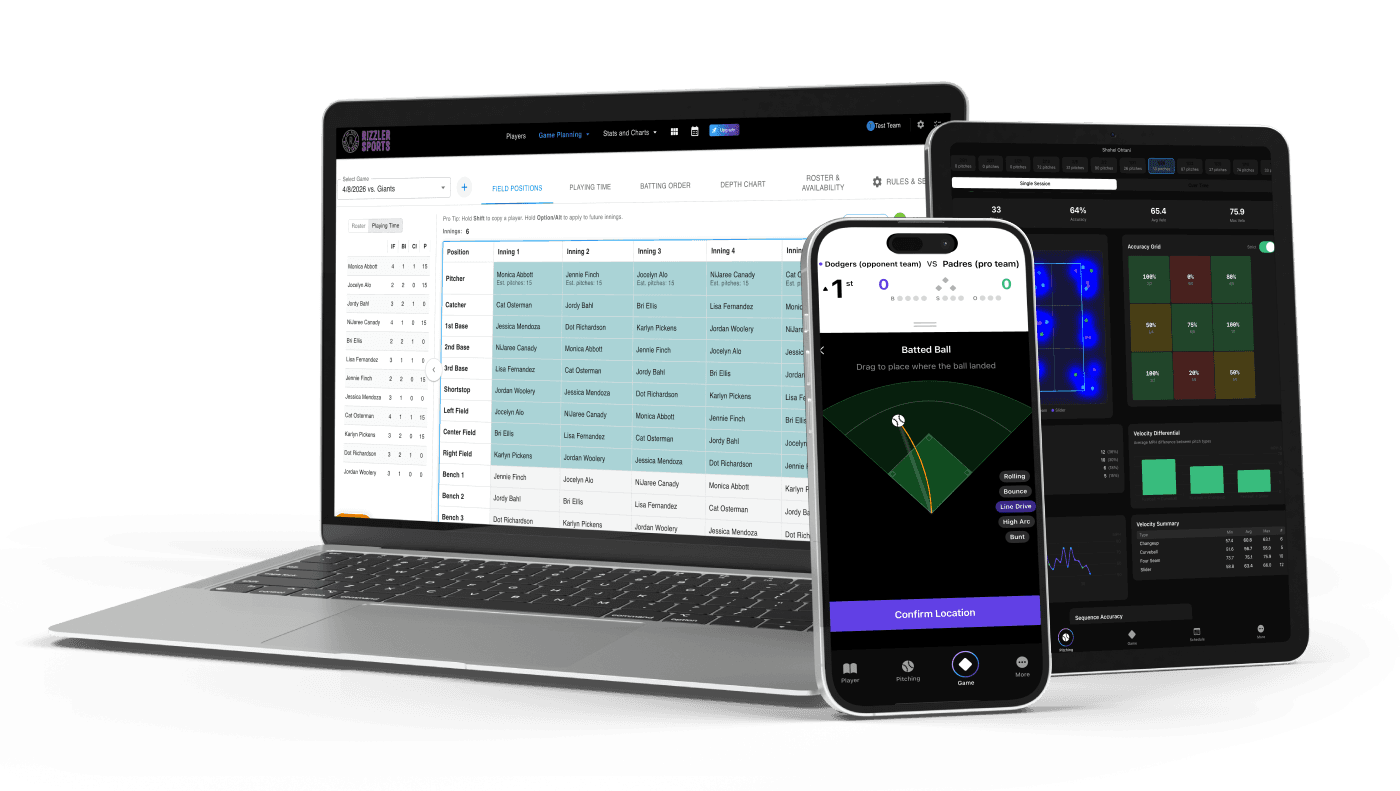
Put the whole schedule in one place: practices as a recurring series, tournaments as they get confirmed, each with a real location and arrival time. Sync it to the Google and Apple calendars families already use, so nobody can claim they did not know. In Rizzler, Schedule Sync and parent availability are free on every plan, and older players can RSVP for themselves. Turn on availability the day the schedule goes out so you always have a headcount three days ahead instead of discovering at the field that you have eight players for a tournament that needs nine.
For the baseball itself, Rizzler goes deep: lineup building, printable lineup cards, and pitch counting are on every plan including Free, and AI batting orders, multi-game and tournament planning, and pitch-count compliance across a weekend are Coach and Club features. As the team grows into a club with multiple age groups, the organization dashboard and multiple-league support on Club keep every team under one roof.
Be clear on one gap so you plan around it: Rizzler does not handle online registration, collecting payments, or building a public team website. Pair it with a registration-and-payment platform for the money side, and run the operation, evaluations, and communication in Rizzler. Honest tools beat surprised parents.
Your startup timeline, counting back from the first tournament
| Weeks out | What to do |
|---|---|
| 12+ weeks | Define age, level, and season; pick sanctioning body; register the name and open a team bank account |
| 10 weeks | Buy team insurance; draft the budget and per-player fee; book practice facility time |
| 8 weeks | Announce and schedule the tryout; open registration; line up coaches and background checks |
| 6 weeks | Run the tryout; finalize the roster; hold the parent meeting and collect first payments |
| 4 weeks | Order uniforms and gear; register for your first block of tournaments; build the schedule |
| 2 weeks | Start practices; publish the schedule to families; turn on availability and reminders |
| 1 week | Confirm tournament rosters and insurance certificates; set your opening lineup |
Dates will slide. The order will not: define the team, insure it, budget it, staff it, fill it, then run it.
Put it together
A travel baseball team that survives its first season is not the one with the best 10-year-old. It is the one built in order, with clean books, honest fees, a real tryout, and an operation that does not depend on the head coach answering forty texts a day. Do the setup like the small business it is, and the time you save goes back into the only part that made you want to do this: coaching baseball. Start this week by writing the one-paragraph mission and pricing the budget above; everything else hangs off those two.
Frequently Asked Questions
How much does it cost to start a travel baseball team?
Budget roughly $8,000 to $18,000 in first-year team costs for a 9U-12U squad playing eight to ten tournaments, covering sanctioning and insurance, tournament fees, facility rental, uniforms, and equipment. Divided across an eleven- or twelve-player roster, that usually means a per-player fee of about $900 to $1,800 for the year, before family travel and hotels. Build the budget first, then set the fee.
Do I need insurance to start a travel baseball team?
Yes. Sanctioning bodies require general liability and accident-medical coverage before you can practice or play, and field owners and tournament hosts will ask to be named as additional insureds. USSSA, for example, requires $3,000,000 in general liability and $100,000 in accident-medical coverage, with team policies starting around $178 per year. Get it in place before you book a practice.
What sanctioning body should a new travel team join?
Register with whichever body runs the tournaments in your area, most commonly USSSA, Perfect Game, AAU, or a regional organization like Nations Baseball. Many teams carry more than one because different events require different sanctioning. Check which tournaments you actually want to play before you pay for a membership.
How do I pick players for a new travel team?
Run a structured tryout with stations for hitting, fielding, throwing, and a game-speed look, and score every player on the same sheet so your choices are defensible. Carry eleven or twelve players, not fifteen, because playing time is the number one reason families leave. Rizzler's Team Tryouts workflow (a Coach and Club feature) handles registration, check-in, and consistent scoring, and the tryout roster carries into your season.
Can Rizzler run a travel baseball team?
Rizzler runs the operation and the baseball: roster, schedule sync, availability, team messaging, tryouts and evaluations, lineups, pitch counting, and tournament planning, with an organization dashboard on Club for multi-team clubs. It does not handle online registration, payment collection, or a public team website, so pair it with a registration-and-payment platform for the money side and run everything else in one place.
Ready to set up your new team in one place?
Building a club with multiple travel teams? Our team can help you set it up.
Talk to our team
Want to spend more time coaching and less time with paperwork? Let's talk.
Tell us about your team and we'll show you how to plan games, set lineups, run the schedule, and develop players in one place, so you spend the season coaching instead of chasing admin.
Less admin, more coaching
Plan games, set lineups, and track the season in one place
Keep every family in the loop automatically
Tell us about your program
4 fields · takes 30 seconds
Lands in the same inbox as the Help button · human response only
Read Next
Are My Team's Stats Private in Rizzler?
FAQ12U Softball Practice Plan: A Complete 90-Minute Practice
LearnSlugging Percentage (SLG): Definition, Formula & Youth Benchmarks
StatsHow to Build a Batting Order for 13U-14U Baseball
LearnHow to Use Stats Without Overcoaching Youth Players
StatsSoftball Tryout Evaluation Form: What to Score (Free Template)
Learn