Ice Hockey Practice Plan Template by Level (Free PDF + Excel)
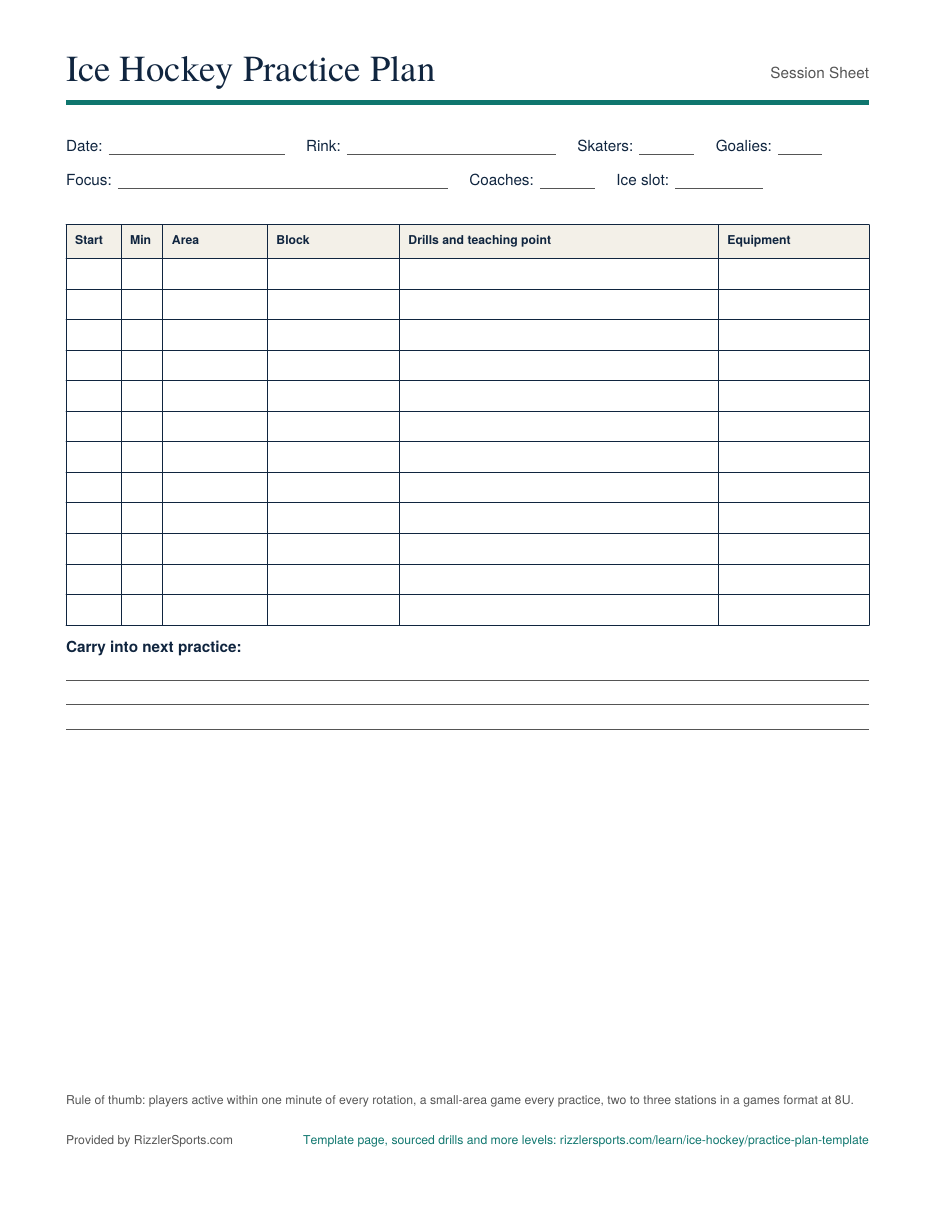
An ice hockey practice plan template is a one-page session sheet with a start-time column, a block for each station or game, the drill and its teaching point, and the equipment it needs, built for the one thing that makes hockey different from every other practice a coach plans: the ice is rented by the minute. The template on this page comes as a printable PDF and an Excel workbook with one filled tab per level, from 8U mites on cross-ice to a 90-minute high school session, and every drill in it is a named drill from the Hockey Canada Drill Hub or a USA Hockey American Development Model resource, with the setup and coaching cue as published. Below the downloads you will find what the sheet includes, the 60-minute station template that most 10U and 12U teams run, the per-level adjustments, the drills and small-area games that fill the blocks, and a short section on using the same stations when tryouts come around.
Download the Ice Hockey Practice Plan Template
ExcelDownload for Excel
Timed session sheet with a start-time column that calculates from the practice start, a live total against your ice slot, and five tabs: a blank template plus filled practices for 8U (50 min), 10U/12U (60 min), 14U (60 min) and high school (90 min), each with the drill sources listed.
PDFDownload the printable PDF
A blank session sheet for pencil planners, the filled 60-minute 10U/12U station practice on page two, and a one-page level guide from 8U to high school with the USA Hockey and Hockey Canada sources on page three.
PDFDownload the stat sheet and line chart
A bench card with four forward lines, three defence pairs, power play and penalty kill units and goalies, plus a game stat sheet with per-player goals, assists, plus-minus, shots, penalty minutes, faceoffs and shifts, goalie saves, and a period scoring grid.
For Google Sheets, upload the Excel file to Drive and open it; the start-time and total formulas carry over.
What the Template Includes
The sheet has six columns: start time, minutes, area, block, drills and teaching point, and equipment. Two of those are hockey-specific. The area column (cross-ice lanes, a faceoff circle, the neutral zone, an end zone with a net, full ice) is there because a hockey practice is a floor plan as much as a schedule; three stations that each need a net will not fit on one end, and the sheet should tell you that before the Zamboni leaves. The start-time column is the one most clipboard plans skip and the one that matters most on rented ice, because "stations, 30 minutes" tells you nothing when the clock on the scoreboard says 6:41 and you cannot remember whether the rotation started at 6:08 or 6:12.
Above the grid is a header for the date, the rink and ice format, skater and goalie counts, the coaches on the ice, the night's one focus, and the ice slot in minutes. Goalies get their own count because they change the plan: with two goalies you can run two scoring stations, with none you tip a net over for a target, which is the USA Hockey 8U guidance. Below the grid is a notes line for what to carry into the next practice. In the Excel version the total row compares the sum of your minutes to the ice slot and tells you whether the plan fits or by how much it runs over, which is the arithmetic that otherwise happens on the bench with a glove off. This sheet plans the session; the practice schedule template is the blank weekly grid for laying out which nights are ice, which are off-ice, and where the games fall.
Practice Length and Format by Level
Use the ice slot and format USA Hockey recommends for each age, then fill it with the block structure below. The ADM numbers are for structured ice touches, meaning practices plus games; the practice share is where this template lives.
Level
Ice slot
Format
Ice touches per week
Practice-to-game
Blocks on the sheet
8U mite
50 min, including the 10 min cut in a 60 min block
Cross-ice or half-ice, six stations
2 to 3
34 to 40 practices vs 16 to 20 games per season
Warm-up 6, six stations x 7, cool-down 2
10U squirt
60 min
Half-ice stations, full-ice games introduced
3 to 4
70/30
Warm-up 8, three stations x 10, small-area game 12, flow 7, cool-down 3
12U peewee
60 min
Half-ice stations plus one full-ice flow
4
70/30
Same shape as 10U with harder progressions
14U bantam
60 min typical slot
Half-ice stations plus full-ice team play
4 to 5 ice sessions
3-to-1 to 2-to-1
Warm-up 8, three stations x 9, small-area game 12, team play 10, cool-down 3
High school and 16U/18U
90 min typical slot
Full-ice warm-up, half-ice stations, full-ice systems
4 to 5 ice sessions
3-to-1 to 2-to-1
Warm-up 10, three stations x 10, small-area game 15, systems 20, special teams 10, cool-down 5
The 8U, 10U and 12U figures come from USA Hockey's recommended youth program structure and the 8U basic structure document; the 14U and high school ratios and session counts come from the ADM's 14U/16U practice-to-game guidance and its ice-touch targets (160 for 14U and 16U, 200 or more for 18U). The 14U and high school ice slots are not prescribed by the ADM; they are the blocks rinks commonly sell, and the sheet scales to whatever yours is. Where the season sits against other sports your families play is on the youth sports seasons calendar. Map the bands onto the age groups the site uses elsewhere (7-8, 9-12, 13-15, 16-18) and the level labels take care of themselves.
The 60-Minute Station Template
The 60-minute template is a warm-up, three ten-minute stations, a twelve-minute small-area game, a short full-ice flow and a cool-down, and it is the practice most 10U and 12U teams should run most weeks. Stations are the house style of youth hockey practice for a reason the USA Hockey 8U structure states plainly: the goal is to have players actively doing a drill within one minute of each rotation. Three stations on half ice means a group of 12 to 15 skaters is never standing in a line longer than four or five.
Start
Min
Area
Block
Drills (Hockey Canada Drill Hub unless noted)
0:00
8
Full-ice lanes
Warm-up
Skating Warm Up Forwards; Random Obstacles puck warm-up
0:08
10
Neutral zone
Station 1: skating
Transition Footwork Races; 5 Puck Agility
0:18
10
Faceoff circle
Station 2: puck skills
1 Touch Pass and Move; 4 Pylon Agility
0:28
10
End zone with net
Station 3: scoring
Corner Puck Protect; Quick Release (Shoot on Front Foot)
0:38
12
Cross-ice or corner
Small-area game
Corner 2 vs 2; Gretzky (Dave Starman)
0:50
7
Full ice
Flow or scrimmage
Short shifts, one rule that tests the night's focus
0:57
3
Any
Cool-down
Easy laps, one question per group about the focus
Each group visits every station, so the three ten-minute blocks are really one thirty-minute rotation with a whistle every ten. The small-area game is not optional padding; Hockey Canada's small-area games guidance lists what they train (lateral movement, puck protection, tight turns and quick first steps, stick on stick, angling, timing and support, reading pressure) and the honest answer is that no drill trains those things as fast as a game with a rule. The seven-minute flow at the end is where the stations either show up or get exposed, and it is the block to protect if the Zamboni driver waves you off early: cut a station, never the game.
8U: six stations on 50 minutes
The USA Hockey 8U basic structure is six stations on cross-ice or half-ice: two skating, one ABCs (agility, balance, coordination), one puck control, one passing and shooting, and one hockey competition station running 1v1 up to 4v4. At least two or three of the six should be in a games format. With 50 minutes of ice (the usual 60-minute block with the cut included), that is a six-minute warm-up, six seven-minute stations and two minutes to cool down. If you get a full 60, the same document says to add one minute to each station and four to the game activity. Repeat each session twice in a row so the second night is about doing it, not learning it, and rotate every player through goalie, because 8U has no full-time goalies.
14U: a defence station and a team-play block
At 14U the sheet keeps its three stations but one of them becomes position work, since Hockey Canada's guidance is no position-specific specialization until U13 and the first place it shows up is the defence station (Defence Quick Feet shot from the middle, Half Wall 1 on 1). The small-area game gets a tactical rule (USAH DZ, below) and a ten-minute team-play block replaces the flow: install one concept, breakout or forecheck or regroup, then play it live. The ADM's 14U/16U guidance is a 3-to-1 to 2-to-1 practice-to-game ratio across four to five ice sessions a week, which is why the stations never go away at this level; the sessions are where the ratio gets spent.
High school: 90 minutes with a systems period
The 90-minute high school template adds, rather than substitutes: the warm-up and three stations stay, the small-area game grows to 15 minutes with a tactical rule, and a 20-minute systems period plus a ten-minute special-teams block fill the rest. Hockey Canada's skill-mix guidance for high performance players is roughly 35 percent technical, 35 percent individual tactics and 30 percent team tactics, and the systems and special-teams blocks together are that 30 percent. Rotate the systems period through breakout, forecheck, D-zone coverage and regroup across the week, and split special teams by unit so the penalty kill gets the same reps as the power play.
Tryouts on Rizzler
Run your next hockey tryout on Rizzler
Registration, check-in, slider scoring, rankings, and offers in one place. Set up tonight, evaluate tomorrow.
Drills by Level
Every drill below is named and set up as it appears in Hockey Canada Drill Hub practice plans 01, 03 and 06, so you can pull the diagram from the source PDF and hand it to an assistant. The reps column is a station-sized number: ten minutes, 12 to 15 skaters, one coach.
8U mite
Drill
Setup
Reps
Coaching cue
Skating Warm Up Forwards
Two lines on the hash marks; down the ice and back along the boards
4 to 6 lengths
Technique on every skill; repetition is the point
Puck Dots
Pucks in one or two straight rows down the ice
4 to 6 lengths
Lots of pucks so the same move repeats many times
5 Puck Agility
Five pucks in a circle
3 to 4 laps each
Around an outside puck, back to the middle, toes forward, one crossover
4 Pylon Agility
Four pylons around a circle
30 to 40 seconds on, rotate
Stickhandle around them at random; add a challenger when ready
Land Mines
Pucks scattered in a faceoff circle
30 to 40 seconds on, rotate
Control through and around the pucks; quick feet, quick hands
Corner Puck Protect
Corner start, obstacle stick at the top of the circle
6 to 8 reps, switch corners
Heel-to-heel open up, puck on the back foot, finish on net
10U squirt
Drill
Setup
Reps
Coaching cue
Transition Races
Two lines, two pylons each
6 to 8 races
Race to the top pylon, pivot, backward to the bottom; pivot the other way next rep
1 Touch Pass and Move
Stationary passers at the top and bottom of a circle, one skater circling
2 laps each, then add a second skater
Face the passer, stick set, change direction
Quick Release (Shoot on Front Foot)
Right shots in one corner, left shots in the other, pass from the far corner
8 to 10 shots
Receive across the body, one motion to the forehand, shoot off the front foot
Random Obstacles warm-up
Pucks scattered down the centre lane
4 lengths
Creativity and quick hands
Corner Puck Protect
As above, now with an assistant coach as the obstacle
6 to 8 reps
Open up past the stick, protect, shoot
12U peewee
Drill
Setup
Reps
Coaching cue
End Wall Retrieval (Attack Net)
Pucks at the blue line, coach dumps one wide of the net
6 to 8 reps
Shoulder check and a fake before the pickup; quick feet out of the corner
Side Wall Retrieval (Attack Net)
Coach passes to the side wall
6 to 8 reps
Head turns toward the pivot first, then pivot fast and take it to the net
Transition Footwork Races
Two pylons in a line
6 races, then add a puck
Forward, pivot, backward, pivot, repeat on the other side
Quick Feet Pass off Wall
Pucks at the blue line, players toward the corner
6 to 8 reps
Pass off the boards to yourself; head fake, let the puck slide past the obstacle
Half Wall 1 on 1
Lines on the half wall at the hash marks
Every pair twice
Attacker touches the blue line and turns up; defender touches the goal line and closes the gap
14U bantam
Drill
Setup
Reps
Coaching cue
Skating Agility Warm Up
Middle lane
4 lengths
Crossovers into forward and backward slide stops, then a zig-zag; deep knee bend
Circle Skating Backwards
Start in a corner, skate the circle backward
4 to 6 circles each way
Crossunder, crossover reach, inside pivot; outside foot stays on the ice
Defence Quick Feet (Shot From Middle)
Start at the offensive dots, obstacle in the slot
8 shots each
Backpedal with the puck around the obstacle, shoot in stride once it clears
Shot Off Puck Protection
In from the blue line, cut around the boards first
6 to 8 reps
Body between puck and obstacle, hips open, puck to the shooting position fast
Hi-Lo Half Wall Retrieval
Pucks on the end-circle dots
6 reps
Pass off the wall, low-high figure 8, tight turns, attack the loose puck
High school, 16U and 18U
Drill
Setup
Reps
Coaching cue
Puck Control Agility Warm Up
Middle lane, 14 puck skills in sequence
2 full sequences
Side-middle-side, forehand side control, Mohawk backhand, one-hand series; head up at pace
Half Wall 1 on 1
As at 12U, now with a live gap and a finish
Every pair three times
Stick on stick, stick on puck; close the gap as fast as possible
Defence Quick Feet (Shot From Middle)
As at 14U with a screen in front
8 shots each
Possession on the forehand, into the lane, eyes on the target
Shot Off Puck Protection
As at 14U against a live defender
6 to 8 reps
Quick protective move back toward the defender, then shoot
Transition Footwork Races with a puck
Two pylons, puck carried throughout
6 races
Same footwork, head up, puck on the forehand through the pivot
Practice Games (Small-Area Games)
Small-area games are competitive drills in a smaller than normal area, which is Hockey Canada's definition, and they are the one block that belongs in every practice on this page. Six that come from published sources, with the level they fit:
Game
Setup and rule
Level fit
What it trains
2 vs 1 Keep Away
Four pylons mark the box; two keep the puck from one, coach sets the interval
8U and up
Possession, head up, support in a tight space
Corner 2 vs 2
Coach plays the puck into the corner; play to a goal, coach feeds pucks back in when one leaves
10U and up
Battles, puck protection, net-front finishing
Gretzky
3v3; each team has a "Gretzky" behind the far net who cannot score; pass to your Gretzky before you can attack
10U and up
Support behind the net, quick passing, attacking off a feed
Regroup
3v3 with a player behind each team's own net; regroup with your goal-line player before every attack and on every change of possession
12U and up
Transition, regroup habits, moving the puck back before forward
USAH DZ
2v2 with two stationary D on each half wall; forwards win the puck and pass to their D, and a D-to-D pass must happen before any point shot
14U and up
Defensive-zone retrieval, D-to-D movement, point shots and net-front play
2v2 Point Shot
USA Hockey ADM game built on a point shot with offensive and defensive net-front play
14U and up
Screens, box-outs, creative ways to score
The first five are from Dave Starman's small-area games set; the sixth is from USA Hockey's ADM tutorial series. The reason to prefer these over made-up games is that the rule in each one is the teaching point: Gretzky makes kids look behind the net without a coach yelling it, and USAH DZ makes a D-to-D pass a habit because the shot is not allowed otherwise.
Tryout Drills and Evaluation Days
The same three-station layout runs a tryout: a skating station, a puck-skills station and a scoring station give every evaluator a comparable look at every skater in the same ten-minute window, and the drills above are already in the Hockey Canada format most associations use. Three drills from this page translate straight to evaluation stations: 5 Puck Agility for edges and transitions, Half Wall 1 on 1 for compete level on both sides of the puck, and Corner Puck Protect for protection and finishing. The difference on a tryout day is the scoring, not the drill. Each coach scores the same drill against a shared 1 to 5 rubric, you average several independent scores per skater, and goalies get their own crease station with their own criteria. The ice hockey tryout guide covers the planning-to-offers timeline, and the tryout evaluation form is the paper version of that rubric.
Running hockey evaluations this season?
Rizzler's evaluation workflow is sport-agnostic, so it runs a hockey tryout today even though the free practice planner does not yet have a hockey module library. Skaters register online, every evaluator scores player evaluations from a phone or tablet at their station, scores average and rank automatically, and offers go out and get tracked without a spreadsheet. Start with the how to run an ice hockey tryout guide, print the tryout evaluation form for the clipboard version, and see how evaluation events run a whole association's tryout weekend from one roster. Structured Team Tryouts are part of the Club plan, built for associations moving up to 300 players through a weekend.
Frequently Asked Questions
How long should a 10U hockey practice be?
Sixty minutes of ice, three to four times a week, with a 70/30 practice-to-game ratio across the season, per USA Hockey's recommended youth program structure. For 8U the recommendation is 50 minutes of ice in a 60-minute block that includes the cut, two to three times a week.
How many stations should a youth hockey practice have?
Six at 8U on cross-ice or half-ice (two skating, one agility-balance-coordination, one puck control, one passing and shooting, one hockey competition), with at least two or three run as games. From 10U up, three stations of about ten minutes each on half ice, followed by a small-area game, keeps lines short and lets one coach run each station.
How often should we scrimmage?
Every practice, but briefly. The template ends with a seven-minute flow or scrimmage at 10U and 12U and a ten-minute team-play block at 14U, and the small-area game before it is already live play with a rule. Full-ice games are not part of 8U practice at all; USA Hockey keeps that level cross-ice or half-ice.
What is a small-area game in hockey?
A competitive drill played in a smaller than normal area such as cross-ice, the neutral zone or a corner, with fewer players and many puck touches. Hockey Canada lists what they develop: lateral movement, puck protection, tight turns and quick first steps, stick-on-stick and body-on-body play, angling, timing and support, and reading pressure. Gretzky, Regroup and Corner 2 vs 2 above are examples.
How do hockey tryouts differ from practice?
The stations are the same; the scoring is not. A tryout uses a shared rubric, several independent evaluators per station, and a fixed rotation so every skater gets the same reps in front of the same coaches. Practice optimizes for repetitions and learning; a tryout optimizes for a fair, defensible comparison, which is why the drills should be ones the skaters have seen before.
Is the ice hockey practice plan template free?
Yes. The PDF, the Excel workbook and the stat sheet and line chart download directly from this page with no email or account. The Excel sheet is editable; the PDFs are print-ready, and the drill sources are listed on the last page of the template.