
Learn
Wrestling Practice Plan by Age (Free Printable + Practice Games)
A wrestling practice plan is a timed session sheet that moves the room through six blocks in a fixed order: warm-up and tumbling, stance and motion, technique, drilling, live wrestling, and conditioning, with one position named at the top that every block serves. The plans on this page are written for four age groups, from the 8U room where practice is mostly games to the high school room where it runs two hours, and they download as a printable PDF and an Excel workbook with one tab per age group. Below the downloads are the 90-minute template, the adjustments for each age, eight practice games with the skill each one trains, and the drills coaches actually run, grouped by position and sourced from USA Wrestling's coach education materials.
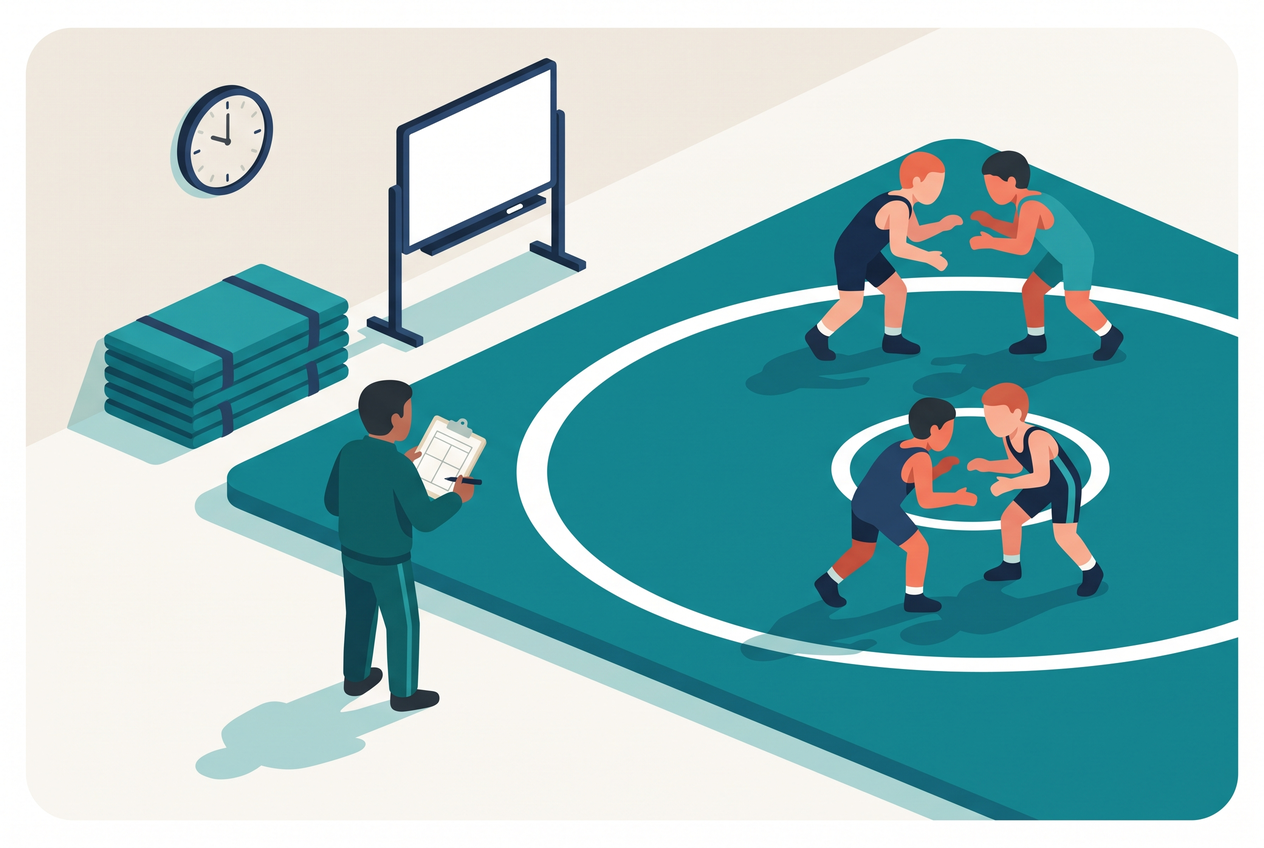
Download the Wrestling Practice Plans
ExcelDownload for Excel
One tab per age group (8U, 10U-12U, 14U, high school) with the session plan filled in, a start-time column that calculates from your practice start, a live total against your mat slot, and a blank tab to plan your own.
PDFDownload the printable PDF
A blank session sheet on page one, then the four filled age-group plans, for coaches who plan on a clipboard at the edge of the mat.
For Google Sheets, upload the Excel file to Drive and open it; the time formulas carry over. The plans are also stored as structured templates, so each block carries its source and the whole plan can be regenerated when a drill changes.
What a Wrestling Practice Is Made Of
Every wrestling practice, from the first-year 8U room to a varsity room in the week of a dual, is built from the same six blocks, and the plan's job is to keep them in the right proportion for the age on the mat.
The warm-up is tumbling and movement before it is anything else: forward and backward rolls, cartwheels, bear crawls, hip heists, and sprawls down the mat, which USA Wrestling's core curriculum lists under gymnastics, agility, and core lines rather than as a jog around the room. Stance and motion comes next while the room is fresh, because USA Wrestling's coach education identifies stance, motion, changing levels, and penetration as the first four of the basic skills every other technique is built on.
The technique block teaches one position with two or three details. Drilling hardwires it with reps on a cooperative partner, then with resistance. Live wrestling tests it, ideally from the position just taught rather than from neutral every time. Conditioning closes the practice, never opens it, because a room that is gassed before technique learned nothing tonight.
What changes by age is not the blocks but their share of the clock. In the youngest rooms, the stance, motion, and technique work is delivered through games: a tag game that only works if the wrestler stays in a good stance teaches the stance without a single whistle. By high school, the games shrink to a warm-up and the live and drilling blocks carry the practice.
Practice Plan at a Glance, by Age
Age groups use the USA Wrestling and school labels coaches actually use, from 8U through high school varsity. Practice lengths follow the common coaching guidance of about 90 minutes for a regular practice and shorter sessions for younger rooms, pre-match days, and the post-season.
| Age group | Practice length | Technique + drilling | Live wrestling | Games | Conditioning |
|---|---|---|---|---|---|
| 8U, folkstyle intro | 60 min | 20 min (taught through games) | 5 to 8 min, partner goes of 30 seconds | 25 min | Folded into games |
| 10U and 12U | 75 min | 30 min | 15 min, situational goes of 45 to 60 seconds | 15 min | 5 min |
| 14U, middle school | 90 min | 35 min | 25 min, situational and short open goes | 10 min, warm-up only | 10 min |
| High school varsity and JV | 120 min | 55 min | 35 min, situational, open goes, wrestle-offs | 5 min, warm-up only | 12 min |
The two numbers to protect at every age are the technique block and the live block. If practice runs short, cut conditioning first and games second; live wrestling already is conditioning, and technique is the reason the room exists.
The 90-Minute Wrestling Practice Plan Template
This is the 14U and middle school version written out, and it is the template the other three plans scale from. One position per practice: a single leg finish chain, or escapes from bottom, not both.
| Start | Min | Block | What happens | Coaching point |
|---|---|---|---|---|
| 0:00 | 12 | Warm-up and tumbling | Forward and backward rolls, cartwheels, bear crawls, hip heists, sprawls down the mat, then a short tag game | Full range and no jogging; the tag game ends in stance |
| 0:12 | 8 | Stance and motion | Stance and motion in lines, mirror drill with a partner, scramble to stance on the whistle | When your hands move, your feet move |
| 0:20 | 20 | Technique | One position, two or three details, whole room watches, then partners walk it through | Fewer details, more reps |
| 0:40 | 20 | Drilling | Reps of tonight's technique both ways, cooperative first, then the partner adds resistance in the last rounds | Finish every rep; no half shots |
| 1:00 | 20 | Live wrestling | Situational goes starting from tonight's position, 45 to 60 seconds, rotate partners, then two short open goes | Fresh wrestlers wrestle the position; tired wrestlers survive it |
| 1:20 | 7 | Conditioning | Buddy carries, sprints, or a mat circuit of sprawls, push-ups, and stand-ups | Effort, finish strong |
| 1:27 | 3 | Cooldown and huddle | One takeaway from tonight's position, weight check reminder, next practice or dual | One sentence per wrestler, not a speech |
This page is the session plan: what happens inside one practice. The wrestling practice schedule template is the blank timing grid and the in-season versus off-season weekly layout for deciding when practices happen; most coaches keep both in the same folder.
8U: the game-heavy room
A 60-minute practice for first-year and second-year wrestlers is roughly half games, and that is by design, not a concession. USA Wrestling's own curriculum for the youngest ages lists wrestling-specific games (toe tag, spinning bear, bone fight, sharks and minnows) alongside drills, and its live wrestling guidance keeps one-on-one goes minimal at the younger ages during practice. The plan runs 12 minutes of tumbling and animal walks, 10 minutes of stance and motion games, 15 minutes of one technique taught as a game (a tail-grab game to teach the level change and penetration step, say), 10 minutes of partner drilling with the coach calling the reps, 8 minutes of short partner goes of 30 seconds from the taught position, and a 5-minute closing game. No conditioning block; the games are the conditioning. Every wrestler needs a partner close to their size, and the coach-to-wrestler ratio matters more here than at any other age.
10U and 12U: technique arrives
At 75 minutes, the plan keeps 15 minutes of games but moves them to the warm-up and the finish, and the technique and drilling blocks become real: 15 minutes of technique on one position and 15 minutes of drilling it. Live wrestling grows to 15 minutes of situational goes of 45 to 60 seconds, always starting from the position taught, with partners rotated so a wrestler sees three or four different bodies. A short 5-minute conditioning block (buddy carries or a sprawl-and-sprint ladder) ends the practice before the closing game. This is the age to start the chain: the single leg should be taught with its finish and its re-attack in the same week, not as a standalone shot.
14U and middle school: the template as written
The 90-minute template above is the middle school plan. Games shrink to a warm-up (a tag game to end the tumbling line in stance), situational live wrestling becomes the center of the practice, and conditioning earns its own 7 to 10 minutes. Weight starts to matter at this age and the huddle is where it gets handled: a reminder, not a lecture, and a conversation with the parent when it is more than that. The tryout evaluation form is the rubric most middle school rooms use for the first scored session of the year.
High school: two hours, two technique blocks
The varsity room runs 120 minutes with two technique blocks (20 minutes on a neutral position, 15 on a top or bottom position), 20 minutes of drilling that ends in hard-drilling rounds at match pace, 35 minutes of live wrestling that includes open goes and the week's wrestle-offs, and a 12-minute conditioning block. The day before a dual, the plan drops to a 45 to 60 minute walkthrough with drilling and a weight check and no hard live, and the post-season room drops to an hour or less.
Eight Wrestling Practice Games and What Each One Trains
Games are not filler. Each one below is on the mat because it trains a basic skill while the wrestler thinks about winning the game instead of holding the position. Age fit is a starting point; most of them scale up as a warm-up for older rooms.
| Game | How it is played | Skill it trains | Best ages |
|---|---|---|---|
| Toe tag | Partners face off in stance and try to tap each other's toes with a hand while protecting their own; a tap scores | Moving the body in relation to a partner, level change, hands and feet moving together | 7-12, warm-up for all ages |
| Tail grab (fox tail) | Each wrestler tucks a shirt or rag into the back of the shorts; both stay in the circle in a takedown stance until one captures the other's tail. Played all-in, wrestlers who lose their tail stand on the boundary and can grab any tail that comes too close, so the circle shrinks | Stance (head up, back straight, hips in, knees off the mat), circling to find an attack angle, footwork | 7-15 |
| Sumo and knee sumo | Standard sumo in a circle: push the partner out or make a body part other than the feet touch the mat. On the knees, push the partner out of the circle. Variations: no arms, chest to chest; one leg, each wrestler holding an ankle | Base, balance, hip pressure, and the feel of pushing and pulling | 7-15 |
| Bone fight | Both wrestlers hold the same towel, shirt, or pool noodle and fight to pull it free | Sensing push and pull, footwork that keeps the partner in front, pulling an opponent out of position | 9-18 |
| Spider fight | Both wrestlers in a back arch (hands and feet on the mat, hips up) try to knock each other out of the arch or out of a circle | Balance, core strength, back-arching | 9-18 |
| Spinning bear | One wrestler on hands and knees as the bear, the partner circles from a modified snap-down position and tries to spin to the back while the bear turns to keep the partner in front | Circling from the front headlock position, offense and defense from the same game | 9-18 |
| Sharks and minnows | Two sharks start on their knees; everyone else crawls across the mat inside the boundary. Sharks capture a minnow by turning it to its back, and captured minnows become sharks. No standing | Turning an opponent, mobility on the knees | 7-12 |
| Pin the king | Each team names a king and soldiers. Soldiers attack the other king or defend their own; a soldier is out when pinned, and the game ends when a king is pinned | Takedowns, pinning, team defense of a position | 9-15 |
Two more worth knowing for the 8U room: mat-ball, where two teams move a dodgeball down the mat on their knees using drive steps only, and the skills relay, where a runner shoots through a partner's legs, leapfrogs over the partner's back, sprints to the far wall for five stand-ups, and sprints back to tag the next teammate. Both come from youth club coaching and both train the drive step and the stand-up without anyone noticing they are drilling.
Wrestling Drills by Position
These are organized the way coaches run them, by the position the room is working on, and the names match the USA Wrestling Core Curriculum drill list so that a coach can look up the video for any of them.
Stance and motion
Stance and motion in lines (the room moves on the coach's call: circle, step, level change, back to stance), the mirror drill (one partner leads, the other mirrors every motion from a good stance), and scramble to stance (wrestlers lie or sit in a scattered position and get to a proper stance on the whistle). The cue from USA Wrestling's basic skills material is the one that matters: when your hands move, your feet move. Three to five minutes every practice, every age, before technique.
Level change and penetration
Limbo level change first: the wrestler lowers under a held band or arm without bending at the waist. Then the penetration step in its three forms, the drop step, the outside step, and the knee spin, taught in that order. USA Wrestling's basic skills material describes a quick, deep level change as the thing that separates good shooters from the rest, and the double-knee drop as a deep level change made without a step.
Drill the penetration step down the length of the mat with the hands finishing on the partner's legs, then with a partner who sprawls so the wrestler learns to finish or recover. Two sets down and back, every practice from 10U up.
Hand fighting and tie-ups
USA Wrestling's basic skills list includes contact, meaning the standard tie-ups: head tie, underhook, double underhook, wrist tie, and forearm hook. It also lists the grips: the knuckle grip, handclasp, butterfly lock, and forearm hook.
Drill them as a pummeling round (both wrestlers fighting for the underhook, 45 seconds, no takedowns), then as a tie-up-to-shot drill where the coach calls the tie and the wrestler has to get to it and attack from it. The wrestlers' handshake game from the core curriculum is the 8U version. From 12U up this block is worth five minutes every practice, because every takedown starts here.
Chain wrestling and finishes
Chain wrestling means the second attack is already decided before the first one is stopped. Drill it as a sequence, not a move: setup, penetration step, lift or finish, and if the partner sprawls, a re-shot or a go-behind. USA Wrestling's basic skills frame the sequence as setups, penetration, and lifting (the flaring, L-shaped cut that sets up the finish), with the back step and back arch as the throws that follow. Drill the sequence cooperatively until it is smooth, then with the partner choosing to sprawl or not, so the wrestler reads the reaction instead of guessing. This is a 12U and up block.
Top and bottom
From the referee's position: stand-up returns (bottom wrestler stands, top wrestler returns to the mat, reset and repeat), the spin drill (top wrestler spins around a partner on hands and knees, changing direction on the whistle), and circle par terre (the room rotates partners through the referee's position on the coach's whistle). Situation wrestling from the core curriculum's live activities is where top and bottom work pays off: start every third live go from the referee's position instead of neutral. From 10U up; for 8U, sharks and minnows and turn-the-turtle games cover it.
Live wrestling formats
Shark bait (one wrestler stays in the middle and takes a fresh partner every 30 to 45 seconds), groups of three (two wrestle, one rests and watches for the coaching point, rotate), and situation wrestling from a named position are the three formats in USA Wrestling's core curriculum, and between them they cover every room. The rule that holds at every age: short, hard, situational goes beat long open matches for everyone except the varsity starters who need match conditioning.
Weight Classes and the Lineup
A practice plan does not set the lineup, but the lineup shapes the plan: the week of a dual, the wrestle-offs for contested weights belong in the live block, and the day before weigh-ins the plan goes light. How to run wrestle-offs fairly and how to group a room by weight for evaluation are covered in the wrestling tryout guide, which also explains why most youth rooms are no-cut and what evaluation means when nobody is going home.
Evaluating a wrestling room this season?
Wrestling is mostly a no-cut sport, so evaluation is not about who makes the team. It is about grouping the room by skill so partners match, building the varsity ladder from scored wrestle-offs instead of memory, and showing a parent why their wrestler is on JV this week. The wrestling tryout guide covers the stations and the wrestle-off format, the tryout evaluation form is the paper rubric, and evaluation events in Rizzler score every wrestler from every coach's phone and rank the room automatically.
When the Plan Needs to Live Somewhere Besides a Clipboard
The printable plan is enough for one coach and one room. It stops being enough the week a parent asks why their wrestler moved groups, or a varsity spot has to be defended with something better than "I remember the wrestle-off." That is the point where the evaluation side of Rizzler takes over: score the room on a shared rubric with player evaluations from every coach's phone, score wrestle-offs the same way so the result is a record, and run preseason evaluations for a whole club through team tryouts. The practice plan stays on the clipboard; the scores stop living in one coach's memory.
Sources
The drill and game names on this page follow USA Wrestling's coach education materials so a coach can look any of them up: the USA Wrestling Core Curriculum drills, activities, and games list, Ted Witulski's Reviewing the Basic Skills of Wrestling for USA Wrestling's National Coaches Education Program, and USA Wrestling's Folkstyle Level 1 practice plans. Game rules come from Matt Krumrie's 5 Great Games on TheMat.com, Kentucky Wrestling's beginner games, and Doug Tate's wrestling games collection presented by the University of Victoria. Practice-length guidance follows the common coaching rule of a 90-minute regular practice with shorter pre-match and post-season sessions, as described in Wrestling Vault's Coaches Corner on practice length. The youth sports seasons calendar shows where the wrestling season sits against the other sports your families play.
Frequently Asked Questions
How long should a youth wrestling practice be?
Sixty minutes for 8U, 75 minutes for 10U and 12U, 90 minutes for 14U and middle school, and up to two hours for high school. Below high school, the limit is attention, not fitness: a sharp hour with one position and plenty of games beats a two-hour grind that teaches nothing after the first forty minutes.
How much live wrestling should be in a practice?
Roughly a quarter of the practice from 12U up, and much less for 8U, where USA Wrestling's curriculum keeps one-on-one live wrestling minimal during practice. Make most of it situational: short goes of 45 to 60 seconds that start from the position taught that night, with partners rotated, and save open six-minute matches for varsity wrestlers who need match conditioning.
How do I keep 7 and 8 year olds engaged at wrestling practice?
Teach through games. Toe tag teaches stance and motion, tail grab teaches the level change and circling for an angle, sumo teaches base and hip pressure, and sharks and minnows teaches turning a partner, and none of them feel like drilling. Keep every block under 12 minutes, keep partners close in size, and end on a game rather than conditioning.
What is a wrestling practice plan supposed to include?
Six timed blocks with a start time and one coaching focus each: warm-up and tumbling, stance and motion, technique on one position, drilling that position, live wrestling that starts from it, and a short conditioning finish, plus a huddle. Name the position at the top of the sheet so every block serves it.
How do wrestle-offs fit into practice?
In the live block, the week of a dual, for contested weights only. Score them the same way you score an evaluation so the result is a record rather than a memory, and run them before the hard conditioning so both wrestlers are fresh. The wrestling tryout guide covers the format and how to handle the wrestler who loses one.
Are the wrestling practice plans free?
Yes. The PDF and Excel files download directly from this page with no email or account. The Excel workbook has one tab per age group plus a blank tab, and the start-time and total-minutes formulas work in Google Sheets after upload.
Read Next
How to Build a Batting Order for 13U-14U Baseball
LearnHow to Start a Travel Baseball Team
LearnOrganization Dashboard: Manage Your Entire League or Club
FeaturesBasketball Scorebook Lineup Sheet: Roster and Starting Five for the Official Book (Free PDF)
BasketballHow to Run a Rugby Tryout: A Coach's Step-by-Step Guide
LearnHow to Reduce No-Shows at Practice
Learn